Unknown's avatar

Peace, from Generation to Generation

“Peace, from Generation to Generation”
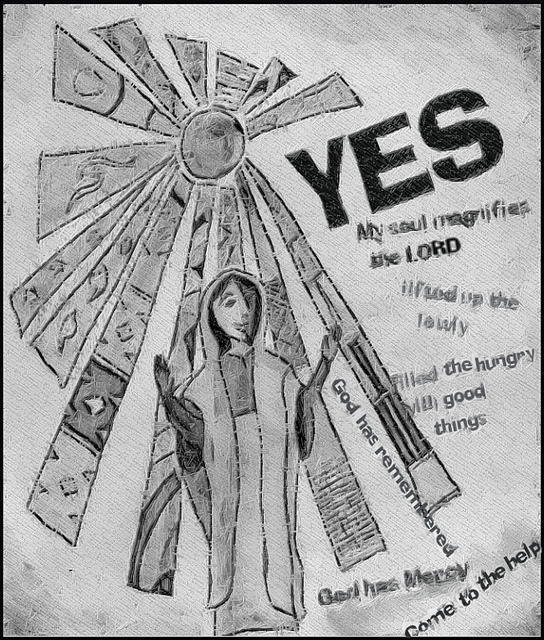
Luke 1:44-56 (1:50) – December 8, 2024

People have been writing songs about the Virgin Mary for centuries. Songs of praise, songs of worship, songs honoring God, and lifting up Mary for saying “yes” to God. Christmas carols might be the first thing that come to mind—but I am also thinking of music from centuries past. From the familiar first part of Handel’s Messiah, to the various settings of the Magnificat, with lyrics from the first chapter of Luke—our Gospel reading for this morning.

            Some Protestants might not be as familiar with the Virgin Mary as many Catholics and Orthodox Christians are. Mary is held in extremely high esteem in many denominations and faith traditions throughout the world, and for excellent reasons. I honor her greatly.

If we look at our modern world today, the situation here in our country, we have a great deal of uncertainty, and very little peace. Does our world today have some strong similarities to the world that Mary inhabited? I wonder, and I would say yes.

Mary sings about the mighty work of God. Yes, personally, in her life. But also in the lives of all the people in the world. “What will this work of God look like?  Something revolutionary is about to happen. God will turn the world upside down. The rich and the powerful will be brought low, and those living on the margins will be raised up. This isn’t a vision that fits very well with a Christian world that values success and power.[1]

For, that is definitely what a large portion of the so-called “Christian world” values today. At least, here in this country, and among a large number of people who claim to follow Christian values and practices religiously. Even if certain Christian denominations do not say it outright, the “Health, Wealth and Happiness Gospel” is a high priority in many people’s lives today.

Let us take a look at what Mary’s situation consisted of. Did you know that Mary—an unwed teenager from an oppressed people-group in an occupied country under crushing Roman rule—was also a radical? A subversive? Was plotting to overthrow the existing oppressive government and replace it with the rule of God?

            What surprising, even shocking things to say about the sweet, innocent Virgin Mary! Everyone associates her with travel to Bethlehem while nine months pregnant, and needing to deliver the infant Jesus in a stable, because there was no room for them in the inn.

That Mary? Radical? Subversive? Absolutely, yes.

Think about the modern Christmas season from another direction. Contrast Mary’s situation with today. Is there any place we can go where we are not bombarded with commercial messages shouting for us to “Buy, buy, buy!” and reminding us of big sales, and markdowns, and half-price! Not to mention all the pressure to be “merry and bright” all the time. Even when going to yet another event or concert or dinner or celebration is the last thing you want to do!

Let us reflect on the first chapter of Luke, on Mary’s song. The last thing on Mary’s mind was commercialism. “Mary’s song, often called the Magnificat, is a welcome contrast to the hyped-up speed of the commercialism that is too often the dominant theme in our culture during the Advent season. Her lyrics are an invitation to approach Christmas with a slower, more contemplative pace.” [2] Is it possible to slow down the frenetic pace of the holidays, to get off the commercial merry-go-round, and instead sit still and worship the coming Messiah?

Sure, the wonderful classical settings of the Magnificat were often sung in a foreign language, like Latin. Or, in text from the King James version of the Bible, full of “thee’s” and “thou’s” and all manner of archaic words. Listen to the first part of her Magnificat, as translated in the modern version by Eugene Peterson, “The Message.” 

“I’m bursting with God-news; I’m dancing the song of my Savior God. God took one good look at me, and look what happened—I’m the most fortunate woman on earth! What God has done for me will never be forgotten, the God whose very name is holy, set apart from all others. His mercy flows in wave after wave on those who are in awe before Him.”

 One well-known depiction of the Virgin Mary is one that is meek, docile, sweet, and not raising a fuss at all. But, wait a moment. Do we realize what Mary is going to sing next? How revolutionary were many of the statements in her song?

             “Even more importantly, Mary’s song is an overture to the Gospel of Luke as a whole. Mary’s lyrics set the tone for Jesus’s radical and controversial ministry that is to come:

You have shown strength with your arm;

You have scattered the proud in the thoughts of their hearts.

You have brought down the powerful from their thrones, and lifted up the lowly;

You have filled the hungry with good things, and sent the rich away empty.

“In contrast, the Christmas season leaves too many still hungry, and too many even further in debt.” [3]

            Do you hear what radical things Mary is saying? If these lyrics of her song were more well-known, would our understanding of Mary be changed? Here Mary is advocating social change, rescuing victims—neglected women, forgotten elders and children, abused strangers and refugees—from being trodden underfoot, even ground under the heel of bragging, bluffing tyrants and braggarts. Turning all society as it was in her day—and ours—upside down.

            What subversive idea is our revolutionary Mary advocating now? Feeding the starving? Giving the poor a banquet? Turning the unfeeling, callous rich people out into the cold? Yes, these radical words are the words found in Luke chapter 1, before we rush on to the narrative of the birth of the Baby in Bethlehem from Luke 2. 

Just looking at this Magnificat, we can see how subversive it was for the infant Messiah to be born to the Virgin Mary. And, we can begin to realize how radical it is for us to say, “O come, let us adore Him, Christ the Lord!” For Jesus truly will bring peace on earth, and He will truly turn the world upside down, just as Mary sang two thousand years ago.

But, this is still only the second Sunday of Advent. We still wait for the baby Jesus to be born in Bethlehem. We still hold our collective breath with all the rest of creation as we wait—and wait. And with Mary, we can rejoice in the promise of the coming Messiah.

Are we overwhelmed with the superficial, commercial glitz and bling of the holidays? Or, are we focused on what really matters – on the coming of our Messiah, our Lord, in God’s peace and wholeness? Let us focus on Jesus, today. Alleluia, amen.

@chaplaineliza

(Suggestion: visit me at my other blogs: matterofprayer: A Year of Everyday Prayers. #PursuePEACE – and  A Year of Being Kind . Thanks!


[1] http://www.bobcornwall.com/2015/12/blessed-are-you-among-women-lectionary.html

[2] http://www.patheos.com/blogs/carlgregg/2011/12/magnificat-learning-to-sing-mary%E2%80%99s-song-a-progressive-christian-lectionary-commentary-on-luke-146-55/

[3] http://www.patheos.com/blogs/carlgregg/2011/12/magnificat-learning-to-sing-mary%E2%80%99s-song-a-progressive-christian-lectionary-commentary-on-luke-146-55/

“Magnificat! Learning to Sing Mary’s Song,” Carl Gregg, Patheos, 2011.

Unknown's avatar

On Eagle’s Wings

“On Eagle’s Wings” – Memorial Meditation

Isaiah 40:28-31 – Sunday, October 20, 2024

            My husband Kevin is a homebody – most of the time. However, he does enjoy occasionally hitting the road. I suggested to him about two months ago that we take a road trip, so we planned to go to the Smokies National Park next week. That is, until Hurricane Helene blasted right through that region, causing devastation all the way from landfall in Florida to many points north. The official Smokies park service website now pleads with prospective visitors not to visit, at least for a while, because of the massive clean-up that needs to be done.

            So, since I have PTO time reserved away from work already, my husband and I made a quick switch to someplace closer to home. On Wednesday, we are heading to Cahokia Mounds near St. Louis, to Pere Marquette State Park, on the Mississippi River, and to Starved Rock State Park. I know this is not prime time to see eagles, but I hope that perhaps we will catch a glimpse of these magnificent birds on their migration south to open waters for the winter! 

One of Carol Metler’s favorite church hymns was “On Eagle’s Wings.” This lovely, newer gospel song was originally written as a verse and refrain for Psalm 91, which affirms that we find refuge under God’s wings. The refrain of this gospel song is most sung in Protestant congregations – “And God will raise you up on eagles’ wings, bear you on the breath of dawn, make you to shine like the sun and hold you in the palm of God’s hand.” 

            Whether we consider Psalm 91 or Isaiah chapter 40, both sections of the Bible talk about God’s protecting hand – and more! Listen to the words of the prophet again: those who hope in the Lord will renew their strength. They will soar on wings like eagles; they will run and not grow weary, they will walk and not be faint.”

This chapter in Isaiah especially mentions the followers of God soaring on wings like eagles. You know and I know the followers of God often do not have an easy time of it. Life is not a walk in the park. Life is a challenge, sometimes. Even, more often than that, sometimes.

            I suspect our dear Carol knew that life was a challenge, many times in her life. She was stubborn, and persistent, and she made it through – with God’s help!

            However, I would like to step back and consider the historical context of this biblical passage. Isaiah chapter 40 was written while the Jewish people were in exile in Babylon, and it is  in the section of the book that deals with comfort. This reading comes from the very middle of Exile.  The Jewish people had been stuck in the foreign country long enough to feel like everything was going wrong and God wasn’t doing anything to help them. [1]

Commentator Dr. Steed Davidson stresses God’s power at work. The prophet does a compare/contrast thing here. Human people are inadequate to change the long distances of history and the circumstances of life. But – but – God is the Creator of heaven and earth! God has strength and power that transcends faulty human striving. Plus, verse 31 calls on “listeners to participate in God’s processes in order to experience transformation.” [2]

            God gives strength to the weary to continue. God comes alongside those who are bone tired, so weak and dispirited that, of themselves, they could not take even one more step. But, God! But – God! Have you ever been so tired, or worn out, or anxious, fearful, discouraged – or one of a dozen other downhearted emotions? And then – but, God!

            Imagine trying your hardest on a challenging project, and feeling like you got to the end of yourself. You can’t give any more. And then, but, God! Or, imagine you are sitting by the bed of a loved one recovering from serious surgery or in the middle of chemotherapy, and you feel so helpless to help your dear loved one. And then, but, God! God transforms everything.

            “But” is usually a negative, a placeholder, a frowny face kind of a word, in so many situations. “But” so often has negative connotations – except for this one, here – but, God!

            God transcends the negative language that we use. God transforms any downhearted stammering of “but, but, but…” into a positive, blooming, blessing of “but – God!” Showing the renewing, revitalizing possibilities of our Lord. Like the Refuge we run to, like a sturdy, safe Rock in the wilderness, God is so much more than we can possibly ask or think.

            The pastoral musician Father Michael Joncas wrote this song in the 1970’s, and it has been sung countless times, and in some very harrowing situations. Imagine the ultimate shock, horror and heart-rending grief of the September 11th attacks; this song was performed at many of the funerals of the victims of that attack. This song is often performed during or at the end of a Catholic funeral mass. And, we will have this song played later on in this worship service, too.

Countless people have been touched by the words and music of this hymn, and many of those same grieving, hurting people would testify that God did indeed come close to them through their difficult times, just as this song tells us.

            This is just what the authors of our two sections of Scripture wanted us to remember. Time and again, stories and narratives from the Bible remind us that the saints of old had challenges – difficulties – they had to deal with – walk through – even, soar above, on eagle’s wings. Can you relate? Hoping in the Lord is expecting that God’s promise of strength is a reality. God can come alongside. God can comfort and strengthen. Just as it was when our prophet wrote these words, just as it is now, today. God can assist us when we are alone as well as when we are together in one group, one congregation, one family.

“Do you not know? Have you not heard?” Praise the Lord, we know God’s protection and care is always with us, always holding us in the palm of God’s hand.

And to that, we all may say, alleluia, amen.

@chaplaineliza

(Suggestion: visit me at my other blogs: matterofprayer: A Year of Everyday Prayers. #PursuePEACE – and  A Year of Being Kind . Thanks!


[1] http://worshipingwithchildren.blogspot.com/2015/01/year-b-5th-sunday-after-epiphany-5th.html

[2] https://www.workingpreacher.org/commentaries/revised-common-lectionary/fifth-sunday-after-epiphany-2/commentary-on-isaiah-4021-31

Unknown's avatar

Trust in the LORD!

“Trust in the LORD!”

Psalm 20 (20:7) – June 16, 2024

            I seldom mention politics in my sermons, but today will be an exception. I am uncomfortable, even alarmed at the general political conversation in the United States right now, in June 2024. Many people across our country are polarized, in terms of political discussion. All kinds of issues – from schooling, bussing, immigrants, guns, diversity, human rights, ecology, taxes, unemployment, science – you name it. Just about any and every issue can be a battleground today. It seems like any two people, or two groups, or two countries have got to be fighting with each other all the time.

            This makes me want to come before God, and bring my concerns before the Lord about the political conversation – or downright fighting! – that is so regularly going on today! I read in one of my commentaries on Psalm 20, written more than ten years ago, that our commentator at that time saw “so many people willing to tear people’s reputations and actions to shreds; regardless of however right or wrong are their opinions, and their understanding!”

In her commentary, Joan Stott goes on to say “We are going through a particularly ‘sticky’ situation … people seem to be delighting in other people’s potential mistakes and/or problems, and ridiculing their deliberately made decisions.” [1] Wow. Double wow! If that argumentative attitude was pervasive in this country twelve years ago, imagine today, with fist fights breaking out in rooms and chambers where our elected representatives meet.   
            Here in our worship service, this space is set apart to be directed to God. We have the luxury of having this special place for worship, prayer, praise and thanksgiving. And, petition, too, when we need God’s help. That is what Psalm 20 begins with: petition to our God. “May the Lord answer you when you are in distress; may the name of the God of Jacob protect you.
May God send you help from the sanctuary and grant you support from Zion.”

From current news stories from across our country, I do not think many people step back and consider wisely before they angrily express opinions or enter into arguments. They yell and shout and sometimes even get into fist fights over political disagreements.

But, wait. This psalm also mentions war, and fighting. Except, coupled with prayer. Our psalmist is lifting up the concept of praying to God before making any decision, especially one as serious as a battle. Leaders from across the world this past Thursday gathered on the beaches in Normandy to remember the 80th anniversary of D-Day, June 6th, 1944. In one of the many articles commemorating this huge wartime operation, I read one about General Dwight Eisenhower, who supervised the invasions of France and Germany for the American forces.

General Eisenhower wrote a draft of a memo that was never released, just in case the invasion failed. Included among his remarks is: “My decision to attack at this time and place was based upon the best information available. The troops, the air and the Navy did all that Bravery and devotion to duty could do. If any blame or fault attaches to the attempt it is mine alone.” [2]  And, contemporary accounts tell us Eisenhower definitely prayed earnestly about the attack.

            Is there any solution to our anxiety about contentious or brawling arguments in politics today? Something that is definitely rare in today’s political discussion is active listening, and considerate hearing of different points of view. Commentator Joan Stott is grateful for “wise and considered decisions that in the past, have been made following earnest prayer, and hours of listening to … people’s viewpoints and needs.” [3] Oh, that we might be blessed with more leaders locally and nationally who are wise, and act in measured and rational ways.

            Which brings us back to Psalm 20. Not only does this psalm lift up the people of the nation: “May he give you the desire of your heart and make all your plans succeed. May we shout for joy over your victory and lift up our banners in the name of our God.” Moreover, this psalm points us toward the ultimate source of our strength, in verse 7! “Some trust in chariots and some in horses, but we trust in the name of the Lord our God.”

            I know that many prayers went up to God before the Normandy invasion in June of 1944. I am so grateful that meticulous planning and considered, measured judgment came into play in the whole operation. Would that a small amount of that measured thinking and considered judgment be used today, as friends, and acquaintances, and our political leaders engage in political infighting and mean-spirited arguments.

            What can you and I do about all this argumentation? I know it seems like a huge problem! Insurmountable, sometimes. Especially when you and I come up against angry words or harsh opinions, or even fist fights! However, we can take this psalm into our lives and hearts today, and ask God to be with each of us as we go about our daily activities.

            Plus, as a congregation before God, we know that God is with each of us, in power and in strength. This psalm really lifts up this image of God! The Lord is saving us for a life in heaven, yes! And, the Lord is saving us here and now, from the ways sin impacts our lives! [4]  Sin? Yes – not following God, not acting and speaking in ways that lift up our God. And, arguing and infighting about politics are certainly not pointing people to our loving and powerful God!  

            We – you and I are the sign that God is at work in the world. And, we can show people day by day that we are living lives that show forth God’s purposes. Not arguing, not bickering, and certainly no fist fights! Instead, we can all strive to apply God’s love, understanding and reconciliation to our speech and our actions, each and every day.

            The writer of this psalm knew from personal experience “that to call on God when in need was to place our lives, our thinking and planning within God’s overview, and to trust always in God’s leading and guidance.” [5] That was true thousands of years ago, and it is just as true today. Whether fighting with swords, shields, arrows and armor, or with the weapons of argument, animosity and downright hatred of one group against another. We need to go to God and have God lead us and guide us each day. May it be so! Alleluia, amen. 

@chaplaineliza

(Suggestion: visit me at my other blogs: matterofprayer: A Year of Everyday Prayers. and  A Year of Being Kind . Thanks!


[1] http://www.thetimelesspsalms.net/w_resources/pentecost3[11]b_2012.htm

[2] https://www.businessinsider.com/d-day-in-case-of-failure-letter-by-general-eisenhower-2012-6

[3] http://www.thetimelesspsalms.net/w_resources/pentecost3[11]b_2012.htm

[4] https://www.umcdiscipleship.org/worship-planning/ascribe-to-god/fourth-sunday-after-pentecost-year-b-lectionary-planning-notes

[5] http://www.thetimelesspsalms.net/w_resources/pentecost3[11]b_2012.htm

Unknown's avatar

Through God’s Strength!

“Through God’s Strength!” – September 19, 2020

Philippians 4:12-20 (4:12-14)

When people have food, shelter, employment, and money, it’s easy to be content and happy. Isn’t it? Or, is it easy to be poor, hungry, unemployed and homeless? What would the apostle Paul’s answer to that question be?

This is our last sermon from Philippians. We are looking again at the apostle Paul, in prison, in a really awful situation. Shackled to a Roman soldier, 24 hours a day, with no privacy, in a cold, dank, drafty stone cell.

For the past eight weeks, we have considered Paul and his words to his friends from Philippi. He wrote this thank-you letter to the Philippians congregation, and it was one of the most joy-filled letters we have, included in the New Testament.

Do you know how much it means for a friend to send a message, an email, a card or letter, especially when you are downhearted and close to giving up hope? That is what Paul’s former congregation in Philippi did. They showed “a love and concern that led them to help Paul. The most significant gifts often cost us very little—sometimes nothing, except a few moments to say a friendly word or the make a telephone call or send an email, the stamp to post a letter or a card. What matters is that someone has been remembered with affection and concern.” [1]

Paul says he knows what it’s like to be poor, and he knows what it’s like to have abundance, in verse 12. I know there are many in the United States who may consider themselves to be poor, but I wonder whether you realize quite what Paul was talking about here.

We could drill down to find out more about economic, educational and societal poverty worldwide. For example, according to the United Nations latest report on poverty in 2019, 23 percent of the world population – that’s 1.3 billion people – lived in abject poverty worldwide. Just to give you an idea of how little money we are talking about, that is living on approximately $1 a day, or less.

Paul did not mean just economic poverty. He also was talking about poverty of spirit, poverty of emotional wherewithal, poverty of humility and ability to persevere.

We all know something about that. Who has not felt the pinch of poverty of spirit in the past six months? In the past six months, who has not had their emotions shredded raw, like raw vegetables on a kitchen grater? Never mind about humility, who has felt their ability to persevere stretched very, very thin? I know I have. And, I suspect I am not the only one, by far.

 Paul could have been in despair, being in prison, charged with a capital crime. He was facing possible death. Yet, he wrote one of the most joy-filled letters in the New Testament. What was his secret? How did Paul keep his chin up?

He tells us, right here. In today’s Scripture reading, Paul says, “I have learned the secret of being content in any and every situation, whether well fed or hungry, whether living in plenty or in want. 13 I can do all this through him who gives me strength.”

Yeah, right, Paul! Easy for you to say!

As one of my favorite commentators J. Vernon McGee says, “Many of us think that if things are going right and if we are in the right place, then we will be contented. That means that we depend on the circumstances of life for our contentment….But Paul had learned to be content regardless of his state. There were times when he had nothing, and he was content. There were times when God had given him an abundance, and he had learned how to abound.” [2]

Paul “is able to meet the circumstances of life head-on in the strength of Christ. Paul does not depend on his own strength or ability, rather he relies on the sustaining help of Jesus.” [3] Our Lord Jesus will sustain us with his strength. Alleluia!

Paul does not share his dire circumstances in order to twist the arms of his friends to send him more money. No! He thanks his Philippian friends for both their financial gift as well as their messenger, Epaphroditus, and this letter is so, so much more than just a simple thank-you card. Paul also communicates the fact that – over his years of serving the Lord – he has learned to be content, no matter what. Either contentment with hunger, as Jesus did in the wilderness, or “contentment with abundance, without being caught up with the desire for more. He has learned to rejoice in the lean times and does not feel compelled to change his circumstances. He leaves that to God.” [4]

This sounds like it flies in the face of everything we might hear from those television evangelists who preach the health, wealth and prosperity Gospel. But, isn’t it consistent with what many people in the Bible – both the Hebrew Scriptures and the New Testament – experience on a daily basis? Paul tells us right here that it is not the outer trappings of wealth and plenty, or the circumstances of life that count to God. No, it is the internal attitude, the Godly mindset, the inside job that truly counts.

Praise God that our internal attitude is what God finds truly valuable. May we all, like Paul, be filled to overflowing, well-supplied with the strength of Christ Jesus our Lord.   


[1] Hooker, Morna D., “The Letter to the Philippians,” The New Interpreters Bible Commentary, Vol. XI (Abingdon, Nashville, TN: 2000), 548.

[2] McGee, J. Vernon, Thru the Bible, Vol. V (Thomas Nelson Publishers: Nashville, 1983), 326.

[3]  “The Power that Christ Gives,” Rev. Bryan Findlayson, Lectionary Bible Studies and Sermons, Pumpkin Cottage Ministry Resources   http://www.lectionarystudies.com/sunday28aee.html

[4] From the series: To Live Is Christ: A Study of the Book of Philippians

https://bible.org/seriespage/13-give-and-take-phil-410-20

@chaplaineliza

(Suggestion: visit me at my regular blog for 2020: matterofprayer: A Year of Everyday Prayers. #PursuePEACE – and my other blog,  A Year of Being Kind . Thanks!

Unknown's avatar

Not Grow Tired or Weary

“Not Grow Tired or Weary”

Isa 40-28 the Lord, mountain

Isaiah 40:21-31 (40:28) – February 4, 2018

Today, February 4, 2018, marks a great extravaganza of sport, of enjoyment, of food and drink and parties and advertising and lots of other things that encompass entertainment. Today is the evening of the Super Bowl, that year-end blow-out, where American football celebrates the best it has to offer. And then some.  This game has become a worldwide phenomenon, and millions of people will tune in and watch the festivities, worldwide.

The elite athletes who play in this game are among the small percentage of people in the United States who are in really peak physical condition. It does not matter about when or where such professional athletes are playing professional sports, vast audiences worldwide watch in admiration as these strong athletes compete. Huge crowds watch to see who will be victorious, which team will be the most mighty and powerful.

This was a similar occurrence in the days of the first century, too. The Apostle Paul talks about elite athletes involved in professional sports in his time–except, more blood-thirsty, where people received public accolades and their equivalent of Super Bowl and other championship rings.

This was definitely not the situation in the time of our Scripture passage from Isaiah 40, I am sorry to say. The nation of Israel is in exile. The last thing they are thinking of is competing in sports. In fact, the conquering nation of Babylon has demonstrated its might and its power over the defeated nation of Israel, since they transported a large portion of the people of Israel into exile, into towns of Babylon and into labor camps, too.

If we were to look at this war between Israel and Babylon as one huge competition, Team Israel would be really smacked down. Sure, it was a bloody competition, but the Babylon team ended up on top. They were the winners, and they took lots and lots of treasure and precious things from Israel for their “championship” prizes. Along with lots and lots of the best and brightest people in Israel as their captives.

The direct analogy breaks down at this point, but let’s take a closer look at the predicament of Team Israel. In exile. Discouraged, dismayed, away from “home” for decades. Away so long that the next generation of Israelites have grown up in Babylon and only have long-distance memories to fall back on. In the cosmic order of things, defeated Team Israel must really feel like grasshoppers, like verse 22 tells us.

Today, with this fierce American culture of competition, one-up-man-ship, dog-eat-dog and better-than, many people feel like grasshoppers, too. Few of us can claim to be professional athletes or elite soldiers, either. So many are made to feel less-than or inferior. Not good enough, not fast enough, not skilled enough, not popular enough.

As one of the commentators, Doug Bratt, says of our modern-day predicament, “Maybe it’s the other students at school who mock them.  Or perhaps loneliness or even advancing age makes people feel like grasshoppers.  We may feel like grasshoppers when we trudge into our workplace or try to raise a difficult child.  Or perhaps reports from their investment or pension funds make people feel like grasshoppers.” [1]

 We can feel defeated even before we begin to try, before we make the attempt to put ourselves forward and compete. Lord, what gives? How come? Why me? What’s the use? I may as well pull the covers over my head and stay in bed.

However, most everyone would agree with the statements from Isaiah chapter 40 about the Lord, the everlasting God, the creator of the heavens and the earth. The Lord is greater than all of us, here on the earth. The Lord is even greater than the kingdom of Babylon or the Roman Empire. The Lord is greater and more powerful than all the armies of all the empires of all time, put together.

Just as a comparison, a few verses earlier in this chapter, in verse 12, the prophet says “Who has measured the waters in the hollow of God’s hand, or with the breadth of God’s hand marked off the heavens? Who has held the dust of the earth in a basket, or weighed the mountains on the scales and the hills in a balance?” Just to let you all know, according to Isaiah 40, the universe can be measured in the span of God’s hand.

It’s figurative and poetic language, but this language gives us some idea of how huge and mighty and powerful our God really is.

Even the most elite Olympic athlete and the most powerful professional soldier has their down times. Even the best of the best grows weary and gets tired. It happens to the best of us, as well as to the rest of us.

Eric Liddell, the 1924 Olympic medal winning runner who was made famous again by the movie Chariots of Fire, was one of these elite Olympic athletes. Yes, athletes from all over the world, through the ages, have been at the top of their game and the best of the best.

I suspect Eric Liddell and the other men on the British running team grew tired and weary, from time to time. And, those who hear and proclaim Isaiah 40 today also know what it means to be weak.  Even children and young adults, as the prophet reminds us, sometimes “grow tired and weary.”  Even Olympic athletes and elite soldiers pccasionally stumble and fall.  So, at no matter what point of life in which we find ourselves, whether or not we always realize it, all of us very much need God’s help. [2] No matter what, no matter who, we all need God’s helping hand. Maybe more often than sometimes.

In Isaiah 40, we find that Israel is told that they can exchange their weakness for God’s strength. Commentator Ralph West tells us in Hebrew, it actually says they can “exchange their strength.”  “God can give strength without His strength being diminished at all. God can give power without His power being lessened, if you wait on God.  If you wait on the Lord, God will give replace your weakness with God’s strength, your emptiness with His wholeness, your burnout with His new beginning, all because of God’s mercy.” [3]

Do you hear? Do you understand? God’s provision is not just for the best and the brightest. God’s power and strength is not just for the one percent at the top of the heap. God’s mercy is for everyone, young and old. We all can exchange our weakness and weariness for God’s strength, for God’s mighty power.

“God doesn’t always take away our problems.  Yet God gives us the strength to deal with them.  God helps vulnerable people like us so that we can run and not tire out.” [4] Having a mighty, powerful God like this on our side is worth a whole lot more than any Super Bowl ring, any day of the week. Amen, and amen!


[1] http://cep.calvinseminary.edu/sermon-starters/epiphany-5b-2/?type=old_testament_lectionary

Commentary and illustration idea, Isaiah 40:21-31, Doug Bratt, Center for Excellence in Preaching, 2015.

[2] http://cep.calvinseminary.edu/sermon-starters/epiphany-5b-2/?type=old_testament_lectionary

Commentary and illustration idea, Isaiah 40:21-31, Doug Bratt, Center for Excellence in Preaching, 2015.

[3] http://www.theafricanamericanlectionary.org/PopupLectionaryReading.asp?LRID=100

Commentary, Isaiah 40:27-31, Ralph D. West, The African American Lectionary, 2009.

[4] http://cep.calvinseminary.edu/sermon-starters/epiphany-5b-2/?type=old_testament_lectionary

Commentary and illustration idea, Isaiah 40:21-31, Doug Bratt, Center for Excellence in Preaching, 2015

@chaplaineliza

(Suggestion: visit me at my regular blog for 2018: matterofprayer: A Year of Everyday Prayers. #PursuePEACE – and my other blog,  A Year of Being Kind . Thanks!)