Unknown's avatar

Go to Work for God!

“Go to Work for God!”
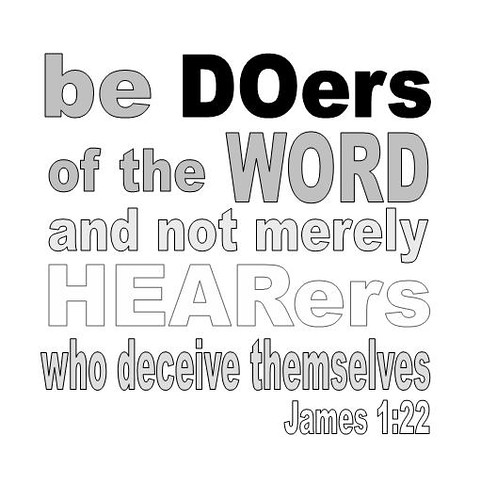
James 1:17-25 (1:19-20) – September 1, 2024

This is Labor Day weekend, all across the nation, a weekend to picnic, to barbeque, to go to the beach or pool one last time, or a weekend to get out into nature. This is the unofficial end of summer, and the beginning of our fall schedule. Even the college football season started this weekend! You know it’s got to be fall when football begins and baseball winds down.

But, it’s also Labor Day weekend – commemorating “when labor activists pushed for a federal holiday to recognize the many contributions workers have made to America’s strength, prosperity, and well-being. The first Labor Day holiday was celebrated on Tuesday, September 5, 1882, in New York City. By 1894, 23 more states had adopted the holiday, and on June 28, 1894, President Grover Cleveland signed a law making the first Monday in September of each year a national holiday.” [1]

            What does the history of our holiday of Labor Day have to do with this Bible reading from the first chapter of the letter of James? Just this: “God is at work for the health of this world God loves so much.” [2]     

            We know this letter is from the apostle James, but who on earth is he writing to? He says who, several verses back, and in fact throughout the letter. He is writing to his fellow believers in Christ, those who are dispersed, who are scattered far and wide. James refers to these fellow believers as “beloved” and “brothers,” so you can tell that he has a relationship with them. In other words, James is not just writing to some stranger in another city.

            I don’t know about you, but when I’m communicating with someone I know, it’s a lot easier for me to be open and to come straight out with important stuff I need to say.  I think it’s the same with the apostle James, especially since I’m familiar with this letter and its contents. He must have known some of these people pretty well, because he talks straight. He doesn’t pull his punches. And, what he’s communicating here in chapter 1 is pretty significant.

Remember how James began this passage? “Every generous act of giving…comes from above.” That means every generous act of giving. Not some generous acts, not only Christian acts of giving (whatever those might be). But ALL generous acts of giving. Period. No matter WHO does them. They all come from above – that is, from God, or Godly impulses. All that we do that is good comes from God, which is an amazing statement. [3]

            We all can do God’s work, all the time. Not just on Sunday.

            A natural follow-up to Godly giving and Godly working is Godly listening. James says, “19 Remember this, my dear friends! Everyone must be quick to listen, but slow to speak and slow to become angry. 20 Human anger does not achieve God’s righteous purpose.” Not only are we to listen well, what does James say next? Don’t get angry!

            James has the following advice in the following verses: “So get rid of every filthy habit and all wicked conduct. Submit to God and accept the word that he plants in your hearts, which is able to save you.” My goodness! What is James doing here, writing a heavenly advice column? It certainly sounds like it. And, heavenly advice it is, too.  

            James even gets down to specifics. Avoid these behaviors! Don’t be slow to listen! Don’t be quick to anger! Plus, promote these behaviors! Instead, be quick to listen! Be slow to speak! And most important, be “eager to care for those most vulnerable. All of these things are within our reach.” As commentator Dr. David Lose says, “What parent doesn’t want to be slower to anger with his or her children? What friend doesn’t want to be a better listener? Aren’t all of us in a position to offer help and support to those in need?” [4] James here is encouraging all of us not just to think the faith, but to do it.

            Here, James is dealing with the Law. God’s rule book. James is a faithful Jewish follower of God, and as such is thoroughly steeped in the Mosaic Law code, or God’s rule book. Moreover, he has a pragmatic way of looking at the new way of living that comes from following his Messiah Jesus. Again, don’t just think the faith or hear the faith. Instead, do it!

            I return time and again to Carolyn Brown, retired Director of Children’s Ministry and commentator on the nuts and bolts of the Bible. She breaks things down to simple, straight forward truths. She says of this reading, “At the beginning of the school year children are learning the rules for their new classes, teams and clubs.  The rules tell them who they are and how they act in each situation.  Knowing that is important to them.” [5] 

            Just so with James. God’s rule book is important to him, too! Plus, following the way of God, following these acts of giving, acts of mercy, or advocacy, or support, or friendship are available to any of us. All of us, all the time. This manual for Christian living is NOT just something we do on Sundays, not just when we are in church or thinking heavenly thoughts. We can go to work for God anytime. All the time. Anywhere. Everywhere.  

            Dr. David Lose suggests that we try something for this coming week. Each of us consider this challenge. “write down one place [you] will be in the coming week where God could use [you] to listen, to be patient, or to care for those in need.” [6]  We are hereby all commissioned as God’s co-workers and partners. We all can continue to help make this world a more trustworthy, safe and healthy place, to work for God on this Labor Day, and every day. Alleluia, amen!

@chaplaineliza

(Suggestion: visit me at my other blogs: matterofprayer: A Year of Everyday Prayers. and  A Year of Being Kind . Thanks!


[1] https://www.dol.gov/general/laborday/history

[2] https://www.workingpreacher.org/dear-working-preacher/ordinary-saints

[3] Ibid.

[4] Ibid.

[5] http://worshipingwithchildren.blogspot.com/2015/08/year-b-proper-17-22nd-sunday-in.html

[6] https://www.workingpreacher.org/dear-working-preacher/ordinary-saints

Unknown's avatar

Love Your Enemies

Matthew 5:43-48 – February 19, 2017

matt-5-44-love-enemies-pray

“Love Your Enemies”

Rules are good things. Rules help us to know what are good things to do, or prudent actions to avoid. Rules—or laws—or commands give us guidelines for how to behave, and what is or is not acceptable. You all know the rules of the road, and traffic laws we need to follow. We have codes of conduct and ethical guidelines for different professions. All of these are rules, laws, codes. Commands.

Moses talked about commands, too. The Ten Commandments, and an elaboration of the big ten, too. That’s what we have for our Old Testament reading today. We used a modern translation, Eugene Peterson’s The Message, to give us a fresh understanding of this important part of God’s rule book, or God’s guidelines for living.

There are 613 laws—or rules—or commands—in the Law of Moses, in the Hebrew Scriptures. In the last few weeks, our Gospel readings have Jesus starting with a big law from Moses’s Law Code, and then elaborating on it. Not reciting the law by rote, like some child at school, but much more than that. Jesus transcends the Law of Moses, every time.

Like last week. Remember what Jesus said in Matthew 5:21? “You have heard that it was said to those of ancient times, ‘You shall not murder’; and ‘whoever murders shall be liable to judgment.’” He quickly followed with Matthew 5:22—”But I say to you that if you are angry with a brother or sister, you will be liable to judgment; and if you insult a brother or sister, you will be liable to the council; and if you say, ‘You fool,’ you will be liable to the hell of fire.”

Transcending the Law of Moses, with additional information. Jesus was talking about the inside job, about how people’s feelings translated to their outward actions. Today’s reading from Matthew 5 goes even further. How does Jesus begin? In verse 43: “You’re familiar with the old written law, ‘Love your friend,’ and its unwritten companion, ‘Hate your enemy.’ I’m challenging that.”

We all know how children scuffle and argue together. Imagine a playground or the park in your mind, with a group of kids. Two of them start arguing. The argument escalates. Soon they are name-calling, first one, then the other. Then, they start pushing one another. They push harder, and more vigorously. Before you know it, punches start flying. Maybe the friends on both sides get involved, and we have an outright brawl on our hands.

What did Jesus say, again? “You’re familiar with the old written law, ‘Love your friend,’ and its unwritten companion, ‘Hate your enemy.’ I’m challenging that.” And then, Jesus goes a step—or three—further. He adds: “I’m telling you to love your enemies. Let them bring out the best in you, not the worst. When someone gives you a hard time, respond with the energies of prayer.” This may well be the hardest thing that Jesus ever told us to do.

We can tell, from specific examples in the surrounding verses, that Jesus was thinking about the occupying Roman forces. He gave several examples of how His listeners ought to act when confronted by Roman soldiers, and made some recommendations on how to respond. Positively, courteously, and not in a retaliatory way! Turn the other cheek; don’t hit back. Give the soldier your cloak, and the shirt off your back, too.

Jesus said—in extremely plain language—we are not to retaliate. Not to escalate things, or make things bigger, or worse, or to blow things out of proportion. Jesus said “Love your enemies.”

Here is the parallel passage from Luke 6:32-33, where Jesus is also preaching. “27 “But to you who are listening I say: Love your enemies, do good to those who hate you, 28 bless those who curse you, pray for those who mistreat you.32 “If you love those who love you, what credit is that to you? Even sinners love those who love them. 33 And if you do good to those who are good to you, what credit is that to you? Even sinners do that.”

I know this may be difficult for us. But—what part of this rule do we not understand? Or, is it just really, really challenging for us to live up to this particular command of Jesus? This is part of God’s rule book. This is the ultimate. The pinnacle. This is the last of the laws from the Law Book of Moses that Jesus quotes here, and then goes even further in His interpretation.

We sit, in our safe, warm church, looking back at the first century. We consider Jesus, talking about the occupying Roman forces. They had the whole nation of Israel under their collective thumb. But, we aren’t under occupation, being crushed by enemy forces or living under martial law. However, the nation of Israel was. What’s more, Jesus knew it, very well. Even more than that—Jesus gave these commands, or rules, for believers to follow, with full knowledge of the land of Israel being under occupation.

One of the commentators I consult regularly had this example listed for the Gospel reading today. Carolyn Brown describes a children’s book called The Christmas Menorahs: How A Town Fought Hate, by Janice Cohn. She tells us, “A hate group threw a rock through the bedroom window of a Jewish boy in Billings, Montana.  There was a menorah lit in the window.  In response, the children of the town drew menorahs to put in their own windows.  The local newspaper printed a full page menorah for other families to color in.  It was the community’s way of standing up to a bunch of bullies.” [1]

Thus, a loving, non-violent, empowering way of standing up for someone being bullied. Of loving one’s enemies, just like Jesus said.

“The book includes the legend about the King of Denmark wearing a yellow star when the occupying Nazis decreed that all Jews must wear a yellow star.” [2]

I remember what a dear senior friend of mine told me, who grew up in the hilly region of France not far from Switzerland. She was a child during World War Two. A number of unaccompanied Jewish refugee children were being housed in their small town. A very devout, Christian town, let me add. The occupying Nazi forces demanded that the Jewish children wear the yellow stars of David, indicating they were Jewish. My friend’s mother sewed yellow stars for every child and young person in that town. They all wore the yellow stars, every day, whether Jewish or Christian. That is how they combatted the Nazi occupying forces, using peaceful, non-violent means. (And, they saved the lives of every Jewish child in that small town.)

Remember what Jesus said in response to the question: “But, who is my neighbor?” Jesus told the parable of the Good Samaritan, and the Jewish people could not stand the Samaritans! Jesus knew that! Yet, that was just His point.

Is it difficult to show love to our enemies? To those who hate us? Yet, this is exactly what Jesus calls us to do. This is right up at the top of God’s rule book, right next to “Love God with all your heart, mind, and strength, and love your neighbor as yourself.”  Including our enemies. Including whomever is a Samaritan to each of us.

Yes, loving our enemies is difficult, and challenging. It’s difficult for me, and I suspect it’s a challenge to a number of others here, too. But, God will help us. All we need to do is ask God for help with loving others who are difficult for us to love.

Listen to the words of Jesus, finishing this Gospel passage: “48 “In a word, what I’m saying is, Grow up. You’re kingdom subjects. Now live like it. Live out your God-created identity.” We already know what to do and how to live. Let’s go out, and live like it.

Alleluia! Amen!

[1] http://worshipingwithchildren.blogspot.com/2014/01/year-seventh-sunday-after-epiphany.html Worshiping with Children, Epiphany 7, Including children in the congregation’s worship, using the Revised Common Lectionary, Carolyn C. Brown, 2014. 2011.

[2] http://worshipingwithchildren.blogspot.com/2014/01/year-seventh-sunday-after-epiphany.html Worshiping with Children, Epiphany 7, Including children in the congregation’s worship, using the Revised Common Lectionary, Carolyn C. Brown, 2014. 2011.

@chaplaineliza

(Suggestion: visit me at my regular blog for 2017: matterofprayer: A Year of Everyday Prayers. #PursuePEACE – and my other blog,  A Year of Being Kind . Thanks!)