Unknown's avatar

Everything We Need?

“Everything We Need?”

Psalm 23 KJV

Psalm 23:1 – May 12, 2019

Advertising lets us know how much stuff we really “need.” Madison Avenue certainly knows how to plant the thoughts of desire and dissatisfaction in our hearts, prompting us to go out and buy, buy, buy! Consume, consume, consume!

Aren’t we supposed to be dissatisfied with what we have? I thought I was supposed to buy lots of things at shoe stores, department stores, sporting goods stores, computer stores, car dealerships, even garden supply stores at this green and growing time of the year.

What does King David tell us, in the very first verse of our psalm reading today? From the Good News Translation, “The Lord is my shepherd; I have everything I need.”

The first verse of Psalm 23 many people are familiar with? “the Lord is my Shepherd; I shall not want.” The other translation has a bit different words for the second phrase; ‘I have everything I want.” But, doesn’t this fly in the face of advertising and popular culture today?

One pastor expanded on this thought in his comments on this psalm: “We live in a consumerist society that thrives on teaching us to want. Wanting more and more and more: I want a new car. I want a flat screen TV and a Blue Ray player. I want more apps for my iPhone. I want to win Lotto. I want a bigger house. I want it all… “ [1]

Anyone who knows more than one language knows what a challenge it is to exactly translate certain words and phrases from one language to another. Sometimes there are no exact translations. The Good News Translation is one of those versions of the Bible that instead of words, it translates thoughts and phrases from the original Hebrew and Greek into English. Like, right here, where we have the phrase “I have everything I want.”

If I look at life from a sheep’s perspective—which is one perspective of Psalm 23—we do have everything we want. Fields of green grass to eat, quiet pools of fresh water to drink, and a quiet place to rest, all provided for us by this Good Shepherd.

The problem is, we are not sheep. We are human beings, with the complexities and challenges of living in the real world. Life continues to happen. Friends get sick, relatives lose their jobs, loved ones die. Wildfires burn many acres of land, hurricanes devastate towns, floods wash away livelihoods.

We come back to the opening words of this psalm: “The Lord is my shepherd; I have everything I need.”

Another word for a psalm is a poem. King David begins with a simple metaphor. This first line is concise, simple, and expresses the message of the entire psalm. The Lord supplies—or satisfies—every need. [2] This idea of King David’s definitely goes against everything that Madison Avenue and popular American culture tells us today. But, most of us want to have our emotional and spiritual needs met, too.

Rev. Lockhart lists these needs: “I want a happy life. I want to live in safety and security. I want to be left alone. I want someone to show that they care about me. I want someone to visit me. I want the best for my children and my grandchildren. I want my husband to be more considerate. I want my wife to understand me. I want worship to be more fun. I want to know God loves me. And I want to die peacefully in my bed. I want and I want and I want.” [3]

What’s the use? Life is just not fair. I want so much. I’m never going to get what I want. I may as well quit trying to get what I need.

Except—that attitude of defeat is not what God wants for us.

I can tell us all right now that God never promised us a huge flat-screen television, or a fifteen-room mansion, or the latest iPhone, or winning numbers in next week’s Lotto drawing. However, God did promise us the Good Shepherd’s presence at our sides, all along our journey.

This psalm is so familiar, and well-loved. The pastoral images leap right off the page, they are so vivid. We sheep do have a Good Shepherd. We sheep are led into green pastures full of grass. We even have nice, quiet pools of water to drink from, and can lie down to rest, free from all danger.

Except—we are not supposed to flop down and stay in those green, verdant pastures forever. King David describes a journey. We—that is, all of us—are on a journey. A journey through life that the Lord oversees and guides. Sure, sometimes we do get to rest in those green pastures, but it’s just temporary. Our psalmist is on the go, walking beside the water, along paths, and through valleys. Some of those valleys are really deep and dark, too! [4]

What does verse 4 say? “Even if I go through the deepest darkness, I will not be afraid, Lord, for You are with me.” It does not matter what the darkness is—devastating disaster, mental illness, shattering disease, emotional trauma, sexual abuse, grinding poverty, constant warfare. God has promised to be with us all the way, and all the time, too.

Verse 6 says “Surely goodness and love will follow me all the days of my life.” The Hebrew word “follow” can also be translated “pursue.” You know, the same word used when enemies pursue us when we are trying to run away. Except, it’s not enemies pursuing us. Instead, goodness and love will be pursuing us and chasing us down! [5]

We can thank God for such a wonderful image.

The last line of our psalm finishes up our journey. We are to dwell in the house of the Lord all our lives long. Except—the Hebrew word is not exactly “dwell.” Instead, our verb means “to return.” Again, we were—we are—on a journey with God. Our lives are sometimes peaceful, and sometimes difficult. Sometimes quiet, and sometimes traumatic. This psalm enables us to shoulder difficult burdens, and aids us as we sometimes walk sad paths, as well as those times when we rest in beautiful green pastures—or comfortable, joyful places.

No matter where we are on this journey with the Good Shepherd, Jesus has promised to be right by our sides. Yes, we will end up with God when we finish our journey! I do not know exactly what that will be like. I can’t give you a blow-by-blow description. However, as King David tells us, we can continually return to God’s presence all the days of our lives. And, no matter what, if God is there, for sure we will have no more worries or concerns.

What a Good Shepherd. What a wonderful promise. Amen, alleluia.

[1] http://revplockhart.blogspot.com/2012/04/psalm-23.html

Psalm 23, Peter Lockhart, A Different Heresy, 2012.

[2] http://www.workingpreacher.org/preaching.aspx?commentary_id=2372

Commentary, Psalm 23, Joel LeMon, Preaching This Week, WorkingPreacher, 2015.

[3] http://revplockhart.blogspot.com/2012/04/psalm-23.html

Psalm 23, Peter Lockhart, A Different Heresy, 2012.

[4] http://www.workingpreacher.org/preaching.aspx?commentary_id=2372

Commentary, Psalm 23, Joel LeMon, Preaching This Week, WorkingPreacher, 2015.

[5] Ibid.

@chaplaineliza

(Suggestion: visit me at my regular blog for 2019: matterofprayer: A Year of Everyday Prayers. #PursuePEACE – and my other blog,  A Year of Being Kind . Thanks!
Unknown's avatar

God Delivers Us from Evil

“God Delivers Us from Evil”

Psa 27 1-3 afraid, fear

Psalm 27:1-3 – March 17, 2019

I often stay up late at night. My light is often burning way past midnight. (If you don’t believe me, ask Sunny. She can attest to the time stamp on many of my emails being past midnight, and some 1:00, even 2:00 am.) Imagine my huge shock and horror in the wee hours of Friday morning when I saw coming across the computer news feed that there had been a mass shooting in Christchurch, New Zealand. I was absolutely devastated. Talk about shocking me out of my security and complacency!

That is the portion of the Lord’s Prayer we are focusing on this week: deliver us from evil. Please, Lord! Right now!

So many faced such evil, such horror, and such sorrow in the town of Christchurch, and all New Zealand just two days ago. Imagine, if you will, two peaceful congregations, coming together for their midday time of prayer, abruptly torn apart by semi-automatic weapon fire. Is it any wonder many people around the world cannot even visualize such an attack? What on earth? Dear Lord! Deliver us from evil!

As soon as news of this horrific shooting started to come across my computer screen, you’d better believe I checked out my various favorite go-to news sites, including the BBC News. Yes, the news was even worse than I had heard or feared. And, the death toll was rising. So were my shock, dismay and horror at the rapidly developing story.

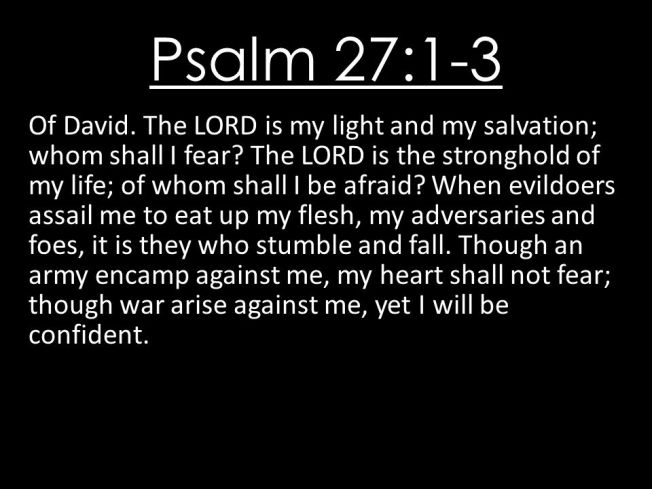
As we consider our Scripture reading from the Psalms this morning, we can flee to the assurance and strength of the first verse of Psalm 27: “The Lord is my light and my salvation; I will fear no one. The Lord protects me from all danger; I will never be afraid.”  I read these words and take heart. God is the source of my—our strength. God is our light, and we need no other light source. God is our protection and our protector. I—we—all of us need no one else.

But, wait, Lord! You didn’t mean that You would protect me from a domestic terrorist with a semi-automatic rifle!  Did You?

Even though the conception of a semi-automatic rifle was not even thought of at the time the psalm writer put pen to paper and wrote this psalm, that is the gist of verses 2 and 3: When evil people attack me and try to kill me, they stumble and fall. Even if a whole army surrounds me, I will not be afraid; even if enemies attack me, I will still trust God.”

King David is said to be the author of this Psalm, and I can believe it. David certainly knew quite a bit about having evil people try to attack him. Not only when he was young, before he even met Goliath on the field of battle, he was shepherd for his family’s flocks. He knew the many dangers a sheep or goat could face in the rocky, semi-arid pastures in the country of Israel. He was their shepherd, and he would need to rescue them when they got into trouble.

Then, when David was secretly anointed king and needed to run from the previous-but-still-on-the-throne King Saul, his fear and anxiety had the opportunity to shift into high gear. King Saul wanted to kill David. Literally. Seriously. Saul sent regular armed parties into the wilderness of Israel specifically to kill David. I am amazed that David could even write these words: “even if enemies attack me, I will still trust God.”

Dr. Beth Tanner, commentator on Psalm 27, writes “With all of the violence in our world, Christians are faced almost daily with a decision to live in fear, or despite their fear, to trust in God and God’s promises. To choose to remain true to God’s principles of hospitality feels frightening as well. Terrorists and Refugees come from the same places.” [1]

Gangs of fierce, armed men hunting you down, repeatedly? Frightening, indeed.

If we consider our problems today, whatever the specific problem is, we can draw some insight from this psalm. It’s clear that the person composing this prayer—King David—is afraid. “And yet, right in the middle of his expressions of fear, the Psalmist also declares his confident faith that God’s presence is like a light that keeps him safe.  So, he seeks God’s presence in the place where the people of Israel of his day believed God could be found: in the Temple.” [2] In the same way, we can seek the Lord where we know God is to be found: in the sanctuary, with other believers, and in meditation and prayer.

A number of these peaceful people at prayer on Friday were refugees from war-torn countries. They had fled their home countries of Somalia, Syria and Iraq—just to name a few—and had finally found sanctuary in the peaceful, beautiful town of Christchurch. New Zealand has truly gorgeous scenery, and a wonderful, equitable society of friendly people.

Not the kind of place one would expect for a domestic terror attack, certainly.

Yet, to run away, to leave almost everything you found dear and loved with all your heart, to come to a foreign land, no matter how pretty, Such heartache, and such desperation. And finally, to be getting back on your feet and finding a new home, just to have your place of worship abruptly, shockingly invaded. Get all shot up.

Dear God, deliver us from Evil, personified.

Dr. Tanner goes on to say: “Gun violence comes out of nowhere and even those places we considered safe are safe no longer. Fear threatens to defeat the gifts of trust and hospitality. The feeling of the psalm is the same.” [3]  It does not matter whether we ask to be delivered from evil things or evil people, from evil personified or evil within our own hearts. This psalm gives the message that we can depend on God as our light, our safety, our security, our salvation. And, if we depend on God, what more sure defender and protector do we need?

Jesus speaks to the city of Jerusalem rhetorically in the Gospel reading from Luke today: “Jerusalem, Jerusalem! You kill the prophets, you stone the messengers God has sent you! How many times I wanted to put my arms around all your people, just as a hen gathers her chicks under her wings, but you would not let me!” Jesus speaks of the image of a mother hen fluffing up her feathers and gathering her chicks to safety, under her wings. Such a wonderful maternal image! And, such an encouragement and comfort in times of trouble.

It doesn’t matter what evil approaches, what danger comes quickly. If we are gathered under the wings of Jesus as our mother hen, we will be safe and cared for—now, and wherever we go with our Lord.

May it be so, Lord. Amen.

[1] http://www.workingpreacher.org/preaching.aspx?commentary_id=2777

Commentary, Psalm 27 (Lent 2C), Beth L. Tanner, Preaching This Week, WorkingPreacher.org, 2016

[2] http://thewakingdreamer.blogspot.com/2014/01/what-do-we-have-to-fear.html

“What Do We Have To Fear?” Alan Brehm, The Waking Dreamer, 2016.

[3] http://www.workingpreacher.org/preaching.aspx?commentary_id=2777

Commentary, Psalm 27 (Lent 2C), Beth L. Tanner, Preaching This Week, WorkingPreacher.org, 2016

@chaplaineliza

(Suggestion: visit me at my regular blog for 2019: matterofprayer: A Year of Everyday Prayers. #PursuePEACE – and my other blog,  A Year of Being Kind . Thanks!