Unknown's avatar

Terrified? Astounded!

“Terrified? Astounded!”
Jesus Transfiguration_Russian icon


Luke 9:28-36 (9:34-35) – March 3, 2019

Have you ever been truly terrified? Not of a horror movie on the movie screen, or of a horrific news story on television, in the newspaper or on the computer, but something terrifying that happened in real life? A first-hand experience, when you were an eye-witness to something truly terrifying?

Both Scripture readings today feature people who were eye-witnesses, who were also absolutely terrified. Both situations are so extraordinary, so far out of the observers’ common, every-day experience that they are frightened almost to death.

Let’s take the three disciples, first. Peter, James, and John, his brother. Jesus asks them to climb with Him to the top of a mountain to pray. This was a regular thing that Jesus did—not the mountain part, but going away by Himself—or with a couple of other people—to pray and meditate in depth. (May I say that this practice of regular prayer is a wonderful practice! And, one we will talk more about as we journey with Jesus throughout Lent in the coming weeks.)

So, Jesus and the three disciples retreat up the mountain to pray, and Peter, James and John were pleased and proud to be singled out in this way by Jesus. I am sure Jesus had a regular practice of prayer and communion with God. He probably led the disciples in regular prayer, and His habit of prayer times were a normal, every-day activity to the disciples.

Let us look at the Scripture reading from Exodus, where the people of Israel are at the foot of the mountain while Moses is up on top, meeting with God and receiving the tablets with the Ten Commandments on them. I am sure the people of Israel were living their common, ordinary, every-day lives while Moses communicated with God for days at a time. Other than some thunder and lightning from the top of the mountain, nothing had really changed for the people of Israel.

Except—in both situations—something suddenly crashed into their every-day lives and ordinary experiences and made all of these people terrified. What was it? They were all eye-witnesses, but what could possibly make them so terror-stricken?

Has anything suddenly crashed into your lives, and upended everything normal and ordinary? Something fearsome and terrifying?

C.S. Lewis wrote the Chronicles of Narnia, a series of books for children that featured a mysterious lion, Aslan. Aslan is the Great King of Narnia, who we later see as a Christ-figure. There are talking beasts—animals, in the Narnia books. When the children from this world speak with some talking beavers in Narnia, Mr. Beaver mentions Aslan: “He’ll be coming and going. One day you’ll see him and another you won’t. He doesn’t like being tied down – and of course he has other countries to attend to. It’s quite all right. He’ll often drop in. Only you mustn’t press him. He’s wild, you know. Not like a tame lion.” [1] The character of Aslan shows himself in Narnia as a large and terrifying, but also magnificent and wise, lion with warm, kind eyes.

Aslan is dangerous! His roar is both fearsome and magnificent. People in Narnia say “He’s not a tame lion.” Aslan embodies all that is good, and yet is terrifying at the same time. Can you see how something awfully good and magnificent can also be fearsome and terrifying? Both, at the same time?

I suspect that was what the disciples experienced, on top of the mount of Transfiguration as well as the people of Israel, when Moses came down the mountain with the tablets of the Ten Commandments. Good and magnificent, but fearsome and terrifying at the same time.

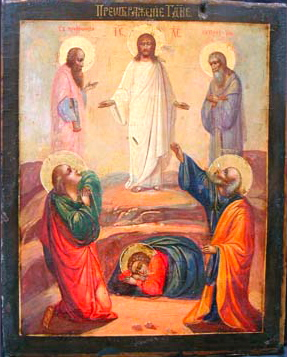
The disciples were familiar with the figure of their Rabbi Jesus in prayer. They knew that common sight; it was comforting, even. But, listen to what Luke says: “29 As Jesus was praying, the appearance of his face changed, and his clothes became as bright as a flash of lightning. 30 Two men, Moses and Elijah, appeared in glorious splendor, talking with Jesus. 31 They spoke about his departure, which he was about to bring to fulfillment at Jerusalem. 32 Peter and his companions were very sleepy, but when they became fully awake, they saw his glory and the two men standing with him.”

In other words, Peter, James and John were astounded and terrified. Jesus was manifesting the presence of God, the divine glory, so His face shone and His clothes became brighter than bright. Fearsome, indeed!

In the case of the people of Israel, when Moses came close to them after being in the presence of God for days and days, his face shone brighter than bright. All of the people of Israel were terrified! What’s more, they begged Moses to cover his face, so that they did not have to see the divine glory reflected in the face of Moses.

Have we ever been eye-witnesses to the presence of God? To the divine glory? In all honesty, I have heard God’s voice on two occasions, but I have not seen the divine glory. Yet, in both readings today, all the people seeing the divine glory were terrified. By all accounts, what a fearsome sight, to be sure!

The three disciples saw the transformed Jesus talking with Moses and Elijah, discussing His departure, His crucifixion and what would come next. Except, they did not understand all that, yet. The point that fascinates me is that God manifested divine glory in Jesus—made His face all shiny and magnificent—not for Jesus’s benefit. No! God did this for the disciples! They were the ones who needed to see the glory of the transfigured Christ! Not their Rabbi Jesus, who they had been living with for the past few years. They sort of knew He was special, but they did not realize how special! “By wrapping Jesus in a shiny cloud and incredible clothes, God was telling the disciples, ‘Jesus is more than a special person. Jesus is God-with-you.’” [2]

Praise God! Jesus, Emmanuel, God-with-us! Jesus has great power, magnificence and divine glory. Yet, Jesus is kind and gentle, loving and caring. Astounding, terrifying, and God-with-us in His majesty and power.

Moses and Elijah came to talk with Jesus while He was transfigured with the divine glory. In Communion today, we can imagine ourselves coming to the Lord’s table with Moses and Elijah and a host of others. A traditional phrase from the Communion liturgy is “with the angels and archangels and all the heavenly host.” That is exactly who we are joining as we come to the Communion table today.

Who are you joining at the Communion table today? We are connected to God, our heavenly Parent, to our Lord Jesus, as well as to a whole host of others, both those living today as well as those with the Lord. Yes, a terrifying thought! But, also welcoming. Not either/or, but both/and.

The divine glory surrounding Jesus is terrifying! Yet, also magnificent, and welcoming, with God’s glorious transformative power. Can we be drawn closer to God today? God willing, we can.

Alleluia, Amen.

[1] Lewis, C.S., The Lion, the Witch and the Wardrobe (New York: Macmillan Publishing, 1950), 180.

[2] http://worshipingwithchildren.blogspot.com/2016/01/year-c-transfiguration-of-lord-february.html

Worshiping with Children, Transfiguration, Including children in the congregation’s worship, using the Revised Common Lectionary, Carolyn C. Brown, 2016.

@chaplaineliza

(Suggestion: visit me at my regular blog for 2019: matterofprayer: A Year of Everyday Prayers. #PursuePEACE – and my other blog,  A Year of Being Kind . Thanks!

Unknown's avatar

In A Manger

“In A Manger”

international Nativity

Luke 2:1-7 (2:6) – December 16, 2018

Nativity scenes are so sweet. You see them frequently at this time of year. Either lit up, like the one outside of our church, or carved in olive wood, similar to the figure I am holding up right now. They can be ceramic, plaster, or painted. Little, small enough to fit under a Christmas tree, or almost life-sized, like the one I saw outside of a big Catholic church in the suburbs.

I suspect we all could mention the cast of characters we might find in a nativity scene. Besides Mary, Joseph, and the baby Jesus, we find shepherds, animals, kings, and sometimes an angel. The nativity pictures look so gentle and perfect, just like a Christmas card.

Mary and Joseph did not have a picture-perfect time of it. As an adult male living under Roman occupation, Joseph was ordered to go to his ancestral town of Bethlehem and register, just as the Roman rulers said. Dr. Luke records it: “In those days Caesar Augustus issued a decree that a census should be taken of the entire Roman world. (This was the first census that took place while[a] Quirinius was governor of Syria.) And everyone went to their own town to register.”

There must have been a great deal of coming and going throughout Israel, as every adult went to their ancestral town. Complicating matters was Mary, Joseph’s betrothed, who was greatly pregnant. “So Joseph also went up from the town of Nazareth in Galilee to Judea, to Bethlehem the town of David, because he belonged to the house and line of David. He went there to register with Mary, who was pledged to be married to him and was expecting a child.”

I wonder how Joseph and Mary felt about being uprooted from their small town of Nazareth and forced to travel—that is, walk—dozens of miles through semi-arid, sometimes hilly country. I wonder what Mary and Joseph thought about coming to the very crowded town of Bethlehem, a near suburb of Jerusalem, chock full of extended relatives of King David. And, I have only an inkling of an idea of what Mary thought, being great with child, having to make the long, difficult journey. The forced timing of this whole trip must have been simply awful.

I want us to step back from Mary and Joseph for a moment. Let us leave them in Bethlehem. As one commentator mentioned, “We all see the Bible through an interpretive lens, and many Western Christians tend to read it through a European/American one. We often bypass the culture and customs that were prevalent during biblical times. We even interject our own bias and prejudice. This is a common error that causes misinterpretation to ensue.” [1]

But, isn’t that human nature? Each of us, all of us, relate to biblical narrative through the lenses of our own personal experiences, through our own separate upbringings. How else do we begin to understand some other person’s story, if not through familiar ideas, surroundings, characters, and narratives?

I was privileged to have the opportunity to get to know the Rev. Dr. Kenneth Bailey. I have attended the New Wilmington Mission Conference in western Pennsylvania the last week of July for almost twenty years, where Ken and his wife Mickey also attended. Except, they went to New Wilmington for some decades. The Baileys served as Presbyterian missionaries in the Middle East for decades, too, coming back to the United States each summer before returning to their work as teachers. Ken as a seminary professor, and his wife as a high school teacher.

Ken Bailey knew a vast amount about Middle Eastern culture and customs, both modern and ancient. He also knew a whole bunch of languages fluently, both modern and ancient. He was a man of great knowledge, stature, and influence, and yet also a humble and unassuming person. He wrote a number of biblical commentaries and scholarly discussions which included first-century Palestinian culture, and how it informs our reading of the Bible today.

I hesitate to break this to everyone, but according to current understandings of Palestinian customs and culture of the first century, Jesus was most probably not born in a stable. Where did this idea of a stable come from? It is difficult to tell. People elaborate, of course. You’ve all played “telephone” as young people, sitting in a big circle around a room, one person whispering in the ear of the next, each whispering what they heard in turn, and everyone laughing when the initial message ends up being all garbled at the end of the “telephone” chain.

We know the biblical text of the Gospel of Luke has remained constant, even through many translations over the centuries. However, as generations of people verbally relate the Nativity story, people tend to elaborate. It gets even more complicated when the message of the Gospel crosses the boundaries of different cultures, and crosses lines into different continents.

For example, considering the manger in a stable: “The mention of a ‘manger’ in Luke’s nativity story, suggesting animals, led mediaeval illustrators to depict the ox and the ass recognising the baby Jesus, so the natural setting was a stable—after all, isn’t that where animals are kept?” [2]  That stable is from a European point of view. But not necessarily, although Luke certainly mentions a manger.

Let’s go back to Mary and Joseph. We left this poor, exhausted couple on the outskirts of Bethlehem. The common modern understanding of an “inn” was another elaboration, since the Greek word kataluma is exactly the same word used to describe the upper room of the Passion Week. Its definition: “‘the spare or upper room in a private house or in a village […] where travelers received hospitality and where no payment was expected’ (ISBE 2004). A private lodging which is distinct from that in a public inn, i.e. caravanserai, or khan.” [3]

Mary and Joseph were probably bedded down in an upper room, dormitory-style, with a number of other extended relatives of the great King David. No private room, like they might have at an inn. As Luke said “she gave birth to her firstborn, a son. She wrapped him in cloths and placed him in a manger, because there was no guest room available for them.”

Not wonderful accommodations, but at least they were not freezing outside with no place to sleep. There was a communal area where the family’s animals were kept, at one end of the large open room, on the ground floor. I suspect there were animals, too—all watching the Holy Family, Mary, Joseph and the newborn baby Jesus. “Once Jesus was born, I envision the two of them tiredly improvising with a manger and some spare cloth, seeking the chance to rest before their newborn inevitably begins his new routine of squalling every 3 or 4 hours to be fed.” [4]

Where does that leave us, with our pretty nativity scenes under our Christmas trees, in front of our houses, and on our Christmas cards? What is the message we receive each Christmas? The holy God of all the universe became a human baby, born to an unmarried teenager, in uncomfortable, awkward circumstances. Not the best of beginnings from a human point of view, but certainly God-ordained beginnings.

What does all that mean for us? It means that we do not have to have neat, tidy lives, that our situations can be uncomfortable, awkward, sad, lonely, anxious, fearful, traumatic, with a whole host of other “negative” circumstances. None of that matters. What does matter is God is with us. Emmanuel, the God-become-human, God with us, is here in the middle of all those awkward, unfamiliar, even ugly situations. Have you lost a job? Jesus is with us. Have you lost a loved one? Jesus is with us. Have you lost a home, or changed neighborhoods, or are feeling lonely, depressed, or especially anxious? Jesus is still with us.

For to us a child is born, to us a son is given. Alleluia, amen.

[1] http://www.ashleyeaster.com/blog/yes-mary-knew

Guest post by: Pastor Gricel Medina, Leadership/Community Developer

[2] https://www.psephizo.com/biblical-studies/once-more-jesus-was-not-born-in-a-stable/

[3] Ibid.

[4] https://modernmetanoia.org/2016/12/09/756/

“Twas the Night Before Birthing”, Emily S. Kahm, Modern Metanoia, 2016.

@chaplaineliza

(Suggestion: visit me at my regular blog for 2018: matterofprayer: A Year of Everyday Prayers. #PursuePEACE – and my other blog,  A Year of Being Kind . Thanks!

Unknown's avatar

Mary and Joseph, Unafraid

“Mary and Joseph, Unafraid”

angel with trumpet

Luke 1:26-31, Matthew 1:19-21 – August 5, 2018 – from Dave Ivaska’s book Be Not Afraid

When a woman is pregnant and expecting a baby, it can be a marvelous experience. However, an unexpected pregnancy can be surprising, even worrisome. I know I have heard of several unplanned pregnancies over the years, and I suspect many of you have, too. An added complication can occur when the parents of the unexpected baby are not married.

That was exactly Mary and Joseph’s situation. Both were unmarried, only engaged. Both were very much involved with the birth of this unexpected baby. And, both had angels appear to them, telling them “Be not afraid!”

Just imagine: Mary and Joseph, considering the exact same unexpected situation, with two very different reactions and quite separate expectations. We are not told, but I cannot help but wonder whether Mary’s fear and Joseph’s fear of the unknown was compounded by fear for the other. How were their fears for the other encountered, and addressed? [1]

Both Mary and Joseph have angels suddenly come upon them. Both angels immediately say, “Be not afraid!” This occurrence is starting to become familiar to us by now, after two months of this summer sermon series. The sight of angels must be terrifying, since the first words out of their mouths is almost always, “Be not afraid!”

Mary must have been completely flabbergasted at the appearance of the angel. Even though she had heard about miraculous and angelic appearances in synagogue on the Sabbath for years, it’s a quite different thing to have it actually happen to her. Mary probably was interrupted while she went about her usual routine at home.

In Luke’s account, the angel Gabriel—God’s special messenger angel—comes to Mary and reassures her with the words “Be not afraid!” In this longer narrative of the birth of Jesus, the angels come to several people (and one group of people). What is more, according to commentator Shively Smith, “the simple phrase, “do not be afraid,” offers comfort and hope to those without hope, as in the case of Zechariah and Elizabeth (Luke 1:7, 24-25); miracles to those not looking for miracles, as in the case of Mary (Luke 1:26-27); and even disruption to those going about their daily routines, as in the case of the shepherds (Luke 2:8).” [2]

Matthew tells us that Joseph was interrupted by the angel of the Lord in a dream. From the short, spare account of Matthew—only a verse and a half!—we do find out that Joseph was called a righteous man. Joseph certainly was considering the unexpected news that Mary had brought to him. Both Joseph and Mary considering the same situation, but in different circumstances.

We all realize that today’s cultural references are different from those of first-century Palestine. The cultural marriage practices of the Jews of that time were patriarchal and highlighted the joining together of two families, not of two individuals, as marriage is seen today here in the United States. Nevertheless, we can see how God breaks apart first-century cultural practices and societal expectations through this miraculous birth narrative.

Joseph was, indeed, a righteous man. When his fiancée Mary first came to him with this unexpected news, he first thought she had been unfaithful. Wouldn’t you? Isn’t that the first thing anyone would think of? Either that, or that Mary had been raped, which is even more unpleasant and shocking. (But, the Gospel doesn’t go there.) Joseph does not want to expose Mary to public disgrace. So, how to deal with this unexpected situation?  

I suspect the situation was looking pretty desperate to Joseph. That is where the angel of the Lord steps in—or, flies in—to the situation.  The angel reassures Joseph that the baby within Mary’s uterus is indeed holy, conceived of the Holy Spirit. What is more, that the baby will be the Messiah! The words of the angel: “you are to give him the name Jesus, because he will save his people from their sins.”

This is quite similar to other appearances of supernatural wonder in the Gospel of Luke. Commentator Shively Smith tells us “each instance is accompanied by an awe-inspiring, even unusual moment that reasonably sparks wonder and even fear. Indeed, the practice of offering a word of assurance at moments of supernatural wonder and disruption to the norms of daily life is something Jesus takes up in his ministry later in the gospel (Luke 5:10; 8:50; 12:32).” [3]

Let us come back to Mary and Joseph, two individuals going through a difficult, even traumatic time, in terms of society’s expectations as well as cultural norms. This is a different way of thinking about the birth of Jesus than that we are used to, every Christmas. Commentator David Lose tells us “let’s not forget the distress, sense of betrayal, disappointment, and a host of other emotions that Joseph must have experienced, or the fear and hurt that Mary would likely have also felt as they sorted out their divinely complex relationship.” [4]

On one hand, Mary has this assurance of supernatural power and presence within her from the angel. On the other, Joseph gets a reassurance of supernatural power and presence concerning Mary from the angel. We might presume from all this that there is some far greater plan that neither Mary nor Joseph has any clear idea about. The injunction “Be not afraid!” is a part of this greater plan.

A supernatural plan, a plan that overarches all time and space, whereby the Savior of the world is going to enter in to our everyday lives, and blow apart every cultural norm and societal expectation. It blows our minds, just thinking about the birth of Jesus, two thousand years later. The encouragement “Be not afraid?” Don’t be afraid to step forward with TRUST, as part of a larger plan that comes from above.

You think the situations we find ourselves in today are complex? God understands the complexity and the ins and outs of every situation, every predicament, every sadness and trauma and difficulty each of us might find ourselves in. As we take a closer look at Mary and Joseph, we see that they are not just figures from some stained glass window, but instead flesh and blood people with the same emotions and fears and family difficulties we might have today.

“And the more we can imagine them as people like us — with ups and downs to their relationships, for instance — the more we might imagine ourselves to be people like them — that is, people who go through all kinds of things, some quite damaging, and yet whom God uses nevertheless to accomplish God’s purposes.” [5]

The angel’s words, “Be not afraid!” We can take them to heart, too, and be encouraged, reassured, that God is with us, today, just as much as God was with people in bible times, just as much as God was with Mary and Joseph, all the way through their wonderful and frightening and even shocking experiences. Even though we may go through all kinds of things, God will never leave us, nor forsake us. Be not afraid!

Alleluia, amen.

[1] Ivaska, David, Be Not Afraid (Downers Grove, Illinois: InterVarsity Press, 2000), 97.

[2] http://www.workingpreacher.org/preaching.aspx?commentary_id=3531

Luke 1:26-38 Shively Smith, Preaching This Week, WorkingPreacher.org, 2017.

[3] http://www.workingpreacher.org/preaching.aspx?commentary_id=3531

Luke 1:26-38 Shively Smith, Preaching This Week, WorkingPreacher.org, 2017.

[4] http://www.workingpreacher.org/craft.aspx?post=2961

“Matthew’s Version of the Incarnation,” David Lose, Dear Working Preacher, 2013.

[5] http://www.workingpreacher.org/craft.aspx?post=2961

“Matthew’s Version of the Incarnation,” David Lose, Dear Working Preacher, 2013.

@chaplaineliza

(Suggestion: visit me at my regular blog for 2018: matterofprayer: A Year of Everyday Prayers. #PursuePEACE – and my other blog,  A Year of Being Kind . Thanks!)

Unknown's avatar

“The Lord Our God Helps Us”

“The Lord Our God Helps Us”

2 Chron 32 be strong, fight battles

2 Chronicles 32:14-18 (32:1-3, 6-8, 10-14, 17-22) – July 29, 2018 – from Dave Ivaska’s book Be Not Afraid

Making comparisons can be devastating. It’s so human, isn’t it, for me to compare me and my stuff with someone else’s. In the magazine Psychology Today, I saw an online article on comparisons many people make. I know, from this article, that many of these comparisons are not about life-or-death matters. However, especially in the case of young people, mental comparisons can be extremely damaging, both psychologically and emotionally.

“You know those people who have more than you—money, acclaim, looks, whatever? The spike of envy they trigger is natural, and social media is primed to amp it up. But in a world where followers and likes can seem like rock-solid proof of a person’s worth, you don’t have to take the bait.” [1] How true, isn’t it, for us to make mental comparisons between us and them, whoever “they” are?

This isn’t just a 21st century type of problem. Comparisons have been going on for centuries, even millenia. Take our scripture reading today, where the army and people of Judah were comparing themselves with the army of Assyria. One really big problem: the Assyrian army had conquered many of the surrounding tribes and countries around Israel. The Assyrians not only said they were the biggest, baddest military power in the Middle East in this time period, but they had the battles and victories to prove it.

The country and army of Assyria felt confident they were on top. Listen again to 2 Chronicles 32:1 – “Sennacherib king of Assyria came and invaded Judah. He laid siege to the fortified cities, thinking to conquer them for himself.” The Chronicler is not telling us the complete story here. He does not include what we learn from 2 Kings 18:13-16. King Hezekiah unwisely and unsuccessfully tried to satisfy the Assyrian king Sennacherib with gold and treasures from the temple. That blatant bribery didn’t work. [2]

From what it sounds like, the Assyrian king was strutting his stuff, surrounding and besieging the fortified cities of Judah, and even Jerusalem itself. The Assyrian army had been successful and victorious in many battles over the past one hundred years. King Sennacherib had every reason to believe they would continue to be victorious. So much so that he began to get too big for his britches. He started to boast, and even trash talk to the nation of Judah.

Let’s sample some of that ridicule and boasting, from the modern translation The Message. “You poor people—do you think you’re safe in that so-called fortress of Jerusalem? You’re sitting ducks. Do you think Hezekiah will save you? Don’t be stupid—Hezekiah has fed you a pack of lies. When he says, ‘God will save us from the power of the king of Assyria,’ he’s lying—you’re all going to end up dead.”

As if that wasn’t bad enough, the Assyrian king trash talks some more: “Do you have any idea what I and my ancestors have done to all the countries around here? Has there been a single god anywhere strong enough to stand up against me? Can you name one god among all the nations that either I or my ancestors have ravaged that so much as lifted a finger against me? So what makes you think you’ll make out any better with your god? Don’t let Hezekiah fool you; don’t let him get by with his barefaced lies; don’t trust him.”

Any confidence the officers and the army of Judah had had would have been completely undermined. They must have been feeling really small and dispirited after all of this. I mean, the Assyrian army was the biggest, baddest army in the whole known world, and they were besieging Jerusalem! So much so that the Assyrians were playing tremendous psychological mind games with the people of Judah

This unhealthy practice might be similar to comparing so much we feel a constant sense of inadequacy and helplessness. The author of this magazine article from Psychology Today has a sense of inadequacy that “flares especially when she compares herself to friends, colleagues, and people from her past—many of whom linger in her awareness because of social media. There’s the college buddy who achieved her dream of becoming a performer and lives in a gorgeous home in a tony suburb. There’s the junior high rival, now a globetrotting public health specialist. “He’ll post, ‘Leaving today for Liberia to help with the Ebola crisis,’ and get dozens of comments like ‘You’re the most amazing person I’ve ever met!'” [3]

Sure, the king of Judah had been previously unwise in trying to bribe the Assyrians, and he hoped they would just pack up and go home if the nation of Judah gave them a big enough payment or tribute. King Hezekiah’s army and officers are down in the dumps and really anxious and fearful about the Assyrian army outside the fortified walls of Jerusalem. What would you do in a similar situation, with intense anxiety and fear freezing your heart and mind?

The people and army of Judah fell into this trap so easily. And, frankly, I would agree with them. According to all reports, the Assyrian armies sure looked like the biggest, baddest army around. Listen: “18 Then they called out in Hebrew to the people of Jerusalem who were on the wall, to terrify them and make them afraid in order to capture the city. 19 They spoke about the God of Jerusalem as they did about the gods of the other peoples of the world—the work of human hands.” I really would half-expect to hear the Assyrians at a rally chanting “We’re number one! We’re number one!”

But, God says, “NO!” Here in this example of Hezekiah saying “Be Not Afraid!” in 2 Chronicles 32, we can surely find a prescription for the comparison trap. Here’s what King Hezekiah did. He held a rally of his own with all the army officers and government officials. He said, “Be strong and courageous. Do not be afraid or discouraged because of the king of Assyria and the vast army with him, for there is a greater power with us than with him. With him is only the arm of flesh, but with us is the Lord our God to help us and to fight our battles.” And the people gained confidence from what Hezekiah the king of Judah said.”

But, that is not all. God steps in, and sovereignly takes over. After Hezekiah and the prophet Isaiah cry out to heaven on behalf of Jerusalem and the people of Judah, “21 the Lord sent an angel, who annihilated all the fighting men and the commanders and officers in the camp of the Assyrian king.” God’s angel kills everyone in the enemy camp! The Assyrian king is so cowed and dispirited himself that he slinks off to Assyria, his tail between his legs. Listen to our bible reading: “the king withdrew to his own land in disgrace. And when he went into the temple of his god, some of his sons, his own flesh and blood, cut him down with the sword. 22 So the Lord saved Hezekiah and the people of Jerusalem from the hand of Sennacherib king of Assyria and from the hand of all others. God took care of them on every side.”

This special kind of situation doesn’t happen a lot, where God’s angel kills all the enemy army, but it’s recorded here to show that God took care of the people! God will always be with us, even when we are walking through the bad guys, or in the middle of the dark valley, or during a raging storm. We are told to Be Not Afraid! God will be with us, even to the end of the age. Alleluia, amen!

[1] https://www.psychologytoday.com/us/articles/201711/the-comparison-trap  By Rebecca Webber, published November 7, 2017

[2] https://www.blueletterbible.org/comm/guzik_david/studyguide2017-2ch/2ch-32.cfm David Guzik :: Study Guide for 2 Chronicles 32

[3] https://www.psychologytoday.com/us/articles/201711/the-comparison-trap  By Rebecca Webber, published November 7, 2017

@chaplaineliza

(Suggestion: visit me at my regular blog for 2018: matterofprayer: A Year of Everyday Prayers. #PursuePEACE – and my other blog,  A Year of Being Kind . Thanks!)

Unknown's avatar

In the Middle of Fear

“In the Middle of Fear”

Isa 43-2 redeemed

Isaiah 43:1-3, 10-13 (43:2) – July 15, 2018 – from Dave Ivaska’s book Be Not Afraid

If you were ever in the middle of a fearsome, hair-raising experience, you might be able to relate to my sermon today. Even if you have not been personally involved in a terrifying experience like being trapped in a dangerous house fire or caught in the middle of a raging storm in deep water while on a small boat, you probably know someone who has. Or, at least heard first-person accounts of those terrifying experiences.

What does the prophet say in this morning’s scripture reading? It is really difficult to hear what anyone is saying when you or I are in the middle of a fearful predicament. Even if the words are really important, or even if they come from a particularly significant person.

We might have the words coming at us, but we are still in the horrible situation of being in the middle of a devastating fire, or a terrifying flood, or other traumatic experience. We still have situations as if we are lost in deep water, or caught up in the middle of fear-inducing flames. What will we do? How will we cope? Will the wild flames overwhelm us? Will the raging waters close over our heads? Dear Lord, answer me! Gracious God, help!

Take the nation of Judah, who the prophet of God is talking to. The nation has been conquered. The best and brightest of the people of Judah have been captured and taken captive, far away in Babylon. “By outward circumstances, the people of Judah had [good] reason to be afraid of Babylon’s army and exile. God points them past the present circumstances to both this command and promise.” [1]

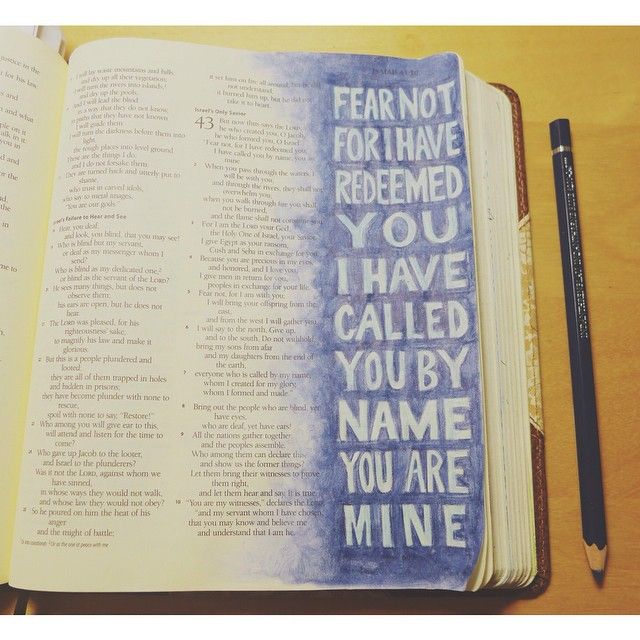
Did you hear? These verses have good news! They have within them both a command and a promise. These words are a proclamation, from the Lord, no less! “But now, this is what the Lord says—God who created you, Jacob, He who formed you, Israel: “Do not fear, for I have redeemed you.”
In the paragraphs just before our reading today, in Isaiah 42, God is called not only the creator of the heavens and the earth, but also creator of all the people on the earth. God is the “source of breath and life for humankind (42:5). Now God reveals the divine self strictly in relationship to God’s chosen ones. The God who speaks the new word of freedom, life, return, and redemption is “the creator-of-you, Jacob,” “the shaper-of-you, Israel” (verse 1). This is the transcendent God whose word created all that is good (Genesis 1).” [2]

So, God not only created the heavens and the earth, and is the creator of all that is vast and unending in this universe, but God is also the Lord of the small and the personal. The prophet proclaims God as the Lord of all, of that which is large and small, the creatures and people of this world, too.

Israel was—and is a country with desert regions and vast wilderness places. Israel was—and is also a country where sudden storms come up, and flash floods suddenly happen. That can be extremely scary, to be caught in a sudden flash flood where the water starts to rise all around you without any warning. We hear on the news today about flash floods that overwhelm people and stall out their vehicles. And sometimes, those individuals even die.

What fear! What anxiety! And, what threatening troubles!

What can we do, in the face of all of this difficulty and challenge? The prophet gives us the answer. God has redeemed us.

But—what does “redeemed” mean, anyway? Isn’t that a religious word? We certainly hear it in religious contexts. According to the dictionary, “redeem” means to buy back, to recover, as by a mortgage or pledge.

So, we are kept captive by our fear and anxiety. The nation of Israel is similarly kept captive by their fear and anxiety, too. Here in the United States, in the 21st century, we do not have debtors’ prisons any longer. However, centuries ago, when people became bankrupt and could not pay their debts, they were often either were thrown into prison or made slaves until the debt was paid.

God does not magically erase all difficulty. “God does not manipulate the created order and introduce entirely new categories: fireless existence. Rather, God redeems what God has made, and redemption involves an exchange within the created realm. A price is paid in order to set things back the way they were.” [3]
This act of redemption is not the end of things. No, the Lord does not stop there. As the prophet says in today’s reading, “I have summoned you by name; you are mine.” God speaks our name. That is what the prophet says!

In this act of speaking their name, God takes ownership. The Lord God claims Israel as God’s own and sets them free. “In these verses God speaks to God’s people not like a king on a throne pronouncing an edict, but like a lover whose heart is bursting, who has waited an eternity just to say their name. In this act of speaking their name, You are mine” means also “I have ransomed you” (43:1) [or, redeemed you]. Maker, lover, and redeemer, God will pay any price and overcome every obstacle to be reunited with God’s own. [4]

We can take heart. We can claim these precious verses as our own, as we go through fiery trials. God has called us by name, too. The Lord says “You are mine.”

Bible study teacher David Guzik states plainly “God twice owns His people. God has right of ownership both as Creator and Redeemer. God’s ownership is personal, because He says I have called you by your name. His ownership is certain, because He seals it by saying You are mine.” [5]

We have the Lord’s assurance that we are God’s creation, we are redeemed, and we have been called by God’s name. What is more, we have been bought with a price, with the precious blood of our Savior.

Knowing we belong to God is a wonderful response to fear and anxiety. So, “Be Not Afraid!” No matter the trial or difficulty, God will be with us. The Lord is right by our side. We have God’s word on it, from right here in Isaiah 43.

Alleluia, amen.

[1] https://www.blueletterbible.org/comm/guzik_david/studyguide2017-isa/isa-43.cfm

Study Guide for Isaiah 43 by David Guzik – Blue Letter Bible

[2] http://www.workingpreacher.org/preaching.aspx?commentary_id=494

Commentary, Isaiah 43:1-7  Anathea Portier-Young, Preaching This Week, WorkingPreacher.org, 2010.

[3] Seitz, Christopher R., The Book of Isaiah 40-66, New Interpreters Bible Commentary, Vol. 6 (Nashville, TN: Abingdon Press, 2001), 381.

[4] http://www.workingpreacher.org/preaching.aspx?commentary_id=494

Commentary, Isaiah 43:1-7  Anathea Portier-Young, Preaching This Week, WorkingPreacher.org, 2010.

[5] https://www.blueletterbible.org/comm/guzik_david/studyguide2017-isa/isa-43.cfm

Study Guide for Isaiah 43 by David Guzik – Blue Letter Bible

@chaplaineliza

(Suggestion: visit me at my regular blog for 2018: matterofprayer: A Year of Everyday Prayers. #PursuePEACE – and my other blog,  A Year of Being Kind . Thanks!)

Unknown's avatar

Be Strong, Courageous, Unafraid, My Son

“Be Strong, Courageous, Unafraid, My Son”

1 Chronicles 28:14-18 (28:20) – July 8, 2018 – from Dave Ivaska’s book Be Not Afraid

King Solomon's Temple at Jerusalem

An older father, giving the gift of encouragement and advice to his younger son. We have seen this sort of touching scene play out, over and over again. In books, on television, in movies. This is like a pep talk from a wonderful motivational speaker, only even better.

King David is aging, and he knows his time is short. God has already chosen David’s favorite son Solomon to be the next king, among all of his sons. (And, he did have a number of sons, from a number of different wives.) What is more, David calls together a large crowd of the leaders, nobles, and executives of Israel for an important royal address.

What is the backstory here? How did this grand scene with a cast of hundreds of the leaders and administrators of Israel come about?

For that, we’ll need to step back and consider King David. He was considered a man after God’s own heart. He wrote a good portion of the book of Psalms, the song book of the Bible. He truly had a relationship with the Lord. But—God did not want David to be the one to build a special Temple for the Lord in Jerusalem. Can you imagine? Why? Why was that?

King David had also been a warrior for years, and had either killed or ordered the killing of a large number of people. The Lord God communicated in no uncertain terms to David that he was not supposed to be the one to build the special Temple. It would be up to David’s son Solomon to build the special house of the Lord. That was by order from God most high.

Can you imagine the scene? All the people, gathered for this grand motivational speech at the end of David’s life. He had been collecting the best of everything for use in the construction of such a fine structure, for years. All for Solomon’s use, and all for the glory of God. Remember, this was a dearly beloved wish of David’s, to see God’s Temple built in Jerusalem.  

David had it all. In his prime, he was a skilled warrior. David also was a fine musician—he played the harp and wrote songs; he was incredibly attractive, and he was a natural leader of men. What was not to like about King David? Or, to look at him from another point of view, King David must have been really intimidating, certainly for young Solomon. And probably for most of all the leaders and administrators of Israel.

Why do coaches, teachers and other motivational speakers give those rousing speeches? To encourage and hearten their listeners, of course. King David must have known that Solomon needed encouragement, and even reassurance.

As an important note, King David also wanted to let everyone know for sure that Solomon was his chosen successor. Just in case, even after the death of David, he wanted everyone in the kingdom of Israel to understand that fact—even though there were a number of sons of David, including several with eyes on the throne and the king’s succession.

Let’s focus on Solomon, specifically. Sure, he had already been anointed as king, and David his father had already made his views on the succession crystal clear. Can you picture Solomon, standing there next to his father?

He must have been young and inexperienced. Plus, his father David was putting the extensive plans and provisions for the Temple into his hands.  What a remarkable position to be in.  His father David is at the end of his life, and the young, inexperienced Solomon is offered both detailed plans for the Temple plus letting everyone know—for sure—that Solomon is the one God wants to follow the aged David,

Let’s take a closer look at the provisions for the Temple. David made it absolutely clear to everyone listening that everything Solomon would need would be given to him. Reading from our scripture passage today again, “10 Consider now, for the Lord has chosen you to build a house as the sanctuary. Be strong and do the work.”

11 Then David gave his son Solomon the plans for the portico of the temple, its buildings, its storerooms, its upper parts, its inner rooms and the place of atonement. 12 He gave him the plans of all that the Spirit had put in his mind for the courts of the temple of the Lord and all the surrounding rooms, for the treasuries of the temple of God and for the treasuries for the dedicated things.”

Imagine how meticulous the Temple plans of King David were. The brief excerpt I just read was only scratching the surface. I get the feeling that this kind of explanation and planning might have been right up the young man Solomon’s alley. From several situations that are mentioned about the heir apparent, after he has succeeded to the throne, I suspect Solomon might have particularly relished the level and amount of detail in the plans.

There is another important focus in this passage. I could preach a whole sermon on this aspect of David’s instruction and command to his son. However, let us just mention the charge that David gave: “in the sight of all Israel and of the assembly of the Lord, and in the hearing of our God: Be careful to follow all the commands of the Lord your God, that you may possess this good land and pass it on as an inheritance to your descendants forever.” In other words, be faithful to God! Follow the Lord all the days of your life! This is a solemn command, just as much as the rest.

We come, finally, to the assurance God has given to Solomon, and by extension, to all of us. “20 David also said to Solomon his son, “Be strong and courageous, and do the work. Do not be afraid or discouraged, for the Lord God, my God, is with you. God will not fail you or forsake you until all the work for the service of the temple of the Lord is finished.”

Just like a skilled motivational speaker, David hits on facing and overcoming natural fears and anxieties. Plus, he also focuses on assuring his son of God’s caring, enabling presence. As commentator Leslie Allen says, “The Lord is David’s own God. David is testifying that God had seen him through every problem and would be there to help Solomon to the end.” [1]

“Be not afraid or discouraged!” This is on top of “Be strong and courageous!” After the clear unequivocal statement of God’s presence being with David his whole life long? What a tremendous encouragement and reassurance this must have been to Solomon, especially since David his father said those things in front of all the important people in Israel.

What is this summer sermon series all about? We are taking a look at different aspects of the “Be Not Afraid” passages. Yes, the aging David was giving his son a much-needed boost of encouragement, as well as reducing fear and anxiety. When anyone has a huge task looming over their heads, fear and anxiety naturally enters the picture. Solomon had two huge tasks ahead of him: that of taking over as king, and of building the Temple.

As we can see from the example of Solomon, fear of huge tasks can be disabling. Fear and anxiety can cause us to trip up, even to freeze. David has a remedy for this kind of paralyzing fear: do the work! This matter-of-fact strategy helps many people conquer their fears and overcome anxiety. This apparently was just the ticket for Solomon. And, this is a great suggestion for anyone facing a really big task.

Hear the words of David: be strong! Be courageous! Be not afraid! And then, we can celebrate. For, our God will be with us, even to the end of the age. Amen, alleluia.

[1] Allen, Leslie C., The First and Second Books of Chronicles, New Interpreters Bible Commentary, Vol. 3 (Nashville, TN: Abingdon Press, 1999), 463.

@chaplaineliza

(Suggestion: visit me at my regular blog for 2018: matterofprayer: A Year of Everyday Prayers. #PursuePEACE – and my other blog,  A Year of Being Kind . Thanks!)

Unknown's avatar

His Name: Emmanuel

“His Name: Emmanuel”

emmanuel-plainsong

Isaiah 7:10-14  – December 18, 2016

So many people love babies. Look at just about any gathering of people. Church congregation, senior center, exercise group, book club. When anyone mentions that someone has just had a baby, what happens? Lots of comments like, “What did she have? Boy or girl?” How big is the baby?” And, especially, “Oh, I hope mom and baby are happy and healthy!”

Common, everyday occurrences, like young women getting pregnant and babies being born. That is exactly what the prophet spoke of in our passage today. The prophet gave a lot of background, but he finished this passage by talking about the clear promise from God. Let’s go back to the beginning of the passage from the prophet: “Again the Lord spoke to King Ahaz, saying, Ask a sign of the Lord your God; let it be deep as Sheol or high as heaven.” It sounds like the Lord God wants to give King Ahaz a really big message. But, wait. Why is this stuff happening?

A little backstory. The kings of Syria and Israel (Northern Kingdom) join together to go to war with the Assyrians. They ask King Ahaz of Judah (Southern Kingdom) to join with them, but Ahaz refuses. Both countries send armies to march on Jerusalem to dethrone Ahaz and put a puppet king on the throne.

We have big political intrigue going on in Jerusalem at this time! Remember, it’s about seven centuries before the birth of Jesus in Bethlehem. The Lord sends Isaiah to Ahaz a second time, this time offering to give Ahaz a sign so that he will believe God. From Isaiah 7: “12 But Ahaz said, I will not ask, and I will not put the Lord to the test,” and once again Ahaz refuses.

One of the commentators I consulted said, “King Ahaz received an oracle from Yahweh, directing him to ask for a sign as deep as Sheol or as high as heaven. This may refer to a sign announced by an earthquake or in lightning. With seeming piety, Ahaz refuses to ask for a sign lest it put Yahweh to a test. Isaiah, however, treats his answer as a refusal to trust God and announces that God will give him a sign anyway.” [1]

What is this sign? A common, everyday sign. There may have likely been just a young woman who was at Ahaz’s court, to whom Isaiah could literally point a finger and say, “Look, she’s pregnant. She’s going to have a son. That birth is the sign that God is with us.” We can see this as a sign that God is in the common, everyday things, the simple, ordinary passages of life.

Do the simple, small things that come into our lives change our course? These verses give us an interesting image. God would save the people of Israel through the sign of something so common and ordinary as a pregnant woman. Isaiah began by offering the opportunity for a great big, splashy sign, but instead gave the king a common image of everyday, ordinary happenings.

The sign was certainly not for the mighty and powerful. Rejected by those in power, God would work wonders among the humble and lowly. In other words, the simple common folk. The original reference for Isaiah was to a child born in his time, and in the near future. For the prophet, the message is that in a few years, both the kingdoms threatening Judah will be no longer a problem. This indeed is historically what happened.

Some centuries pass. The Book of Isaiah was originally written in Hebrew, which was the common language of Israel during the 700’s BCE. By the time we arrive at 300 BCE, there has been a huge turnover in the world. Now, the Greeks under Alexander the Great have conquered most of the known world, and they have spread the Greek language far and wide. Plus, the Jewish people had been scattered all over the Middle East and into Asia Minor.

Many of the scattered Jewish people could hardly read and understand their own Scriptures any more! So, a large group of Jewish scholars translated the whole of the Hebrew Scriptures into Greek. It is that translation that Matthew uses when he says, “22 All this took place to fulfill what had been spoken by the Lord through the prophet: 23 “Look, the virgin shall conceive and bear a son, and they shall name him Emmanuel,” which means, “God is with us.”

Believers from the time of Matthew’s gospel have pointed to these verses as Messianic prophecies. Yes, there is a technical difference between “young woman” and “virgin.” This tension is evident if we closely examine the difference between the Hebrew words and the Greek translation. Yet—what is the same? It is a message of God’s caring and love that sees pregnancy and birth—simple, everyday happenings—as signs of God’s care and concern for God’s people.

Emmanuel. God with us. Was that true in Isaiah’s day, with the Assyrian armies breathing down the necks of the people of Israel? Of course! Isaiah gave the king a special oracle to let him know so. Emmanuel. God with us. Was that true in the time of Jesus’s birth, with the occupying Roman armies breathing down the necks of the people of Israel? Of course it was!

God has always had concern and love for God’s people, no matter where and no matter when. No matter if the persecuted Christians were running from the Romans, or being chased and persecuted by any one of the occupying forces in the centuries in between.

Jesus came from humble origins. Yet, He changed the world. Likewise, the birth of this child, was a sign that even in the midst of the chaos and destruction surrounding Jerusalem in the uncertain time of Isaiah and the uncertain time of the baby Jesus, God was still with them. Life still did go on. In a very real sense, that was (and is!) a miracle.

What is the simple message we receive from these words of the prophet? God will be with us, no matter what. That is the message to King Ahaz and the people of Israel, that is the message to occupied Israel in the newborn Jesus’s day. And, it’s the message we can take home with us this day.

“Look, she’s pregnant. She’s going to have a son. That birth is the sign that God is with us.” We can see this as a joyful sign that God is in the common, everyday things, like the simple, ordinary passages of life. Like a baby being born, displayed to all of us as a wonderful sign from the Lord God. Praise God! God is concerned about the smallest and every day and ordinary, like babies and new moms and children, like you and like me.

Alleluia, amen!

[1] http://fontes.lstc.edu/~rklein/Documents/adventa.htm#Advent4, Studies on Old Testament texts from Series A, Ralph W. Klein, Lutheran School of Theology at Chicago.

@chaplaineliza

(Suggestion: visit me at my regular blog for 2016: matterofprayer: A Year of Everyday Prayers. #PursuePEACE – and my other blog,  A Year of Being Kind . Thanks!)