Unknown's avatar

In These Last Days

“In These Last Days”

Hebrews 1:1-4 (1:2) – October 5, 2025

            Can you think of an excellent host or hostess you know? Perhaps one or your friends or family? Celebrating or hosting is a big part of coming together as friends, as family, for all kinds of festive occasions. Some people are especially blessed with the skills, gifts and graces that are part and parcel of being a wonderful host or hostess. Today is World Communion Sunday, and our Lord Jesus is our heavenly Host today at this service.

But first, we need to take a closer look at our Scripture reading for today. The letter to the scattered Hebrews (Jews who believe in Jesus as their Messiah) was a circulating letter, traveling from place to place, copied and sent from one small group of believers, one congregation to the next. In order to understand this letter more deeply, we need to look at it as directed to people with a Jewish understanding, and a Jewish viewpoint.

“God spoke to our ancestors in many times/ways through the prophets, but now God speaks through the Son” – in the same way, we can view the older Hebrew Scriptures as God speaking through the prophets (and writers of narrative and poetry), but now (as in the New Testament), God speaks through the Son, our Lord Jesus Christ – especially in the Gospels.

Jesus – before He came to the earth and emptied Himself of all God-hood to become a little baby born in Bethlehem – created the universe at the beginning of time, and Jesus is the one who will possess all things at the end of time. So, before the beginning and after the end – there was the Son long before His incarnation, the second person of the Trinity. Before the universe, before the Big Bang and all things were created, there was the pre-incarnate Son.

 Plus – Jesus sustains/continues/upholds the universe with His powerful Word. The Word that had the creative force in the beginning of time!

Let’s think about that creative force for a moment. In chapters 8 and 9 in The Magician’s Nephew, one of the Chronicles of Narnia, C.S. Lewis has the Great Lion Aslan walking around on a brand new world. The Lion is singing, and the sheer creative force is magnificent, as shown by the reaction of all creation, land, water and sky to the sounds and the notes of Aslan’s powerful, creative voice. [1]

Yet, that is not all! We can see the writer of the letter to the Hebrews goes on to tell us more about what Jesus did. After Jesus finished His work on earth and achieved forgiveness for all sins for all human beings (for all time), the resurrected, ascended Jesus SAT DOWN in heaven. This goes along with what Paul says in the first chapter of the letter to the Ephesians, 1:20-22, which sounds quite a lot like Hebrews 1:3 from our reading today.

In the worship in the Temple before the first century CE, even at the time that the Rabbi Jesus was walking around Palestine for three years before His death, resurrection and ascension into heaven, Jewish priests continually stood up when they did their work in the Temple. That was the way of it. That was how priests went about their priestly duties, continually standing before the Lord, continuing to offer sacrifices for sins, making atonement for the sins of everyone who came to them.

Except – our Lord Jesus was not like the earthly priests. The apostle Paul said Jesus sat down in heaven, and no longer had to continually stand and continue to offer sacrifices to the Lord. Here in our reading today, the writer of the letter to the scattered Hebrews (or, Jews) tells them that Jesus “sat down in heaven at the right side/hand of God, the Supreme Power.”

As our commentator Carolyn Brown retells these three verses from Hebrews chapter 1, she says “Jesus was one with God at the beginning of everything and will be one with God after everything ends. Jesus worked with God on creating the whole world and keeps taking care of it. In Jesus of Nazareth God lived among us as a person and allowed himself to be crucified. Jesus is God in human skin.  Everything we know about Jesus tells us what God is like.  Jesus Christ forgives us.” [2]

Do you understand how powerful that declaration is? As one of what I consider one of the most meaningful gospel songs says, “Jesus paid it all! All to Him I owe, Sin had left a crimson stain, He washed it white as snow.” This is one of the reasons we celebrate Communion, or the Lord’s Supper, because we are so grateful to Jesus for being the Lamb of God, who as our reading today tells us, “achieved the forgiveness of sins for all human beings.”

The first Sunday of October is World Communion Sunday in most congregations.  Not only set apart for children and young people, but for everyone. “That means raising awareness that Christians all around the world are one big family.  We may have skin of different colors, wear different clothes, speak different languages, and do all sorts of different things, but we are all baptized and we all share communion.” [3] 

Do you hear? All believers, worldwide, are all one big family. That means that we all come together around the communion table, from north and south, from east and west, from every tribe and people-group and nationality. Across national borders, regardless of languages spoken, paying no attention to differences of politics, or of allegiances, of national dress, or of regional separations.

All of these earthly differences do not matter to eternity. Jesus tells us so. All are welcome at the Lord’s table. And, it is His table. As I have said many times before, on many Communion Sundays in the past 11 and a half years, this is not St. Luke’s table. It is not the United Church of Christ’s table. It is not the Protestant Church’s table. Instead, this is the Lord’s table, and our Lord Jesus says all are welcome.

We can see how great God’s love is for humanity through the incarnation. Yes, God sent God’s son to earth to become human, live among us, and die for us. And, on this World Communion Sunday, we remember how our Lord Jesus provided communion for us, as a sacrament, a means of grace, and to remember Him.

Through the centuries, all believing Christians have celebrated this meal, this Lord’s Supper, in remembrance of Him. “Today, through World Communion, we also celebrate that though each church does things differently, we each and all of us need God and God’s grace. By participating together around the world in Holy Communion, we celebrate our common need for God, and together we celebrate receiving His love and grace.” [4]

This weekend is a jam-packed weekend, indeed. Not only is today World Communion Sunday, but yesterday was the feast day of St. Francis of Assisi. Many faith traditions celebrate with a Blessing of the Animals this weekend. St. Francis is not only a patron saint of animals, he is also the patron of all creation, or the natural world.

As we reflect on our Lord Jesus, God’s Son before the beginning of time and after the end of time, I want to end our sermon today with a benediction; the final verse from the hymn that is attributed to Francis, “All Creatures of Our God and King.”

Let all things their Creator bless, and worship Him in humbleness,
O praise Him! Alleluia!
Praise, praise the Father, praise the Son, and praise the Spirit, Three in One! O, let us praise God, indeed! Alleluia, amen.

@chaplaineliza

(Suggestion: visit me at my other blogs: matterofprayer: A Year of Everyday Prayers. #PursuePEACE – and  A Year of Being Kind . Thanks!


[1] Lewis, C.S., The Magician’s Nephew (Macmillan Publishing Co., New York NY, Collier Books edition: 1970), 101, 104-07.

[2] https://worshipingwithchildren.blogspot.com/2012/09/year-b-proper-22-27th-sunday-in.html

[3] Ibid.

[4] https://onthechancelsteps.wordpress.com/2013/09/22/same/

Unknown's avatar

Have the Same Mindset

“Have the Same Mindset”

Philippians 2:1-11 – October 1, 2023

            How many here have seen a Christmas pageant? How many here have ever participated in a Christmas pageant? It can be sweet, even awe-inspiring, seeing the story of the Nativity played out, sometimes with a large choir or even real animals. We can watch a Christmas pageant and be so proud of our children or grandchildren as they participate. Or, we could possibly be totally swept away as we consider what a grand, eternal narrative we are watching, as it was played out on a huge cosmic stage!            

            Today’s Scripture reading comes from the apostle Paul’s letter to the Philippian believers. I want us all to pay close attention as we connect this passage from Philippians theologically with the Incarnation, as God in Jesus came down on our level.” [1]

            We all know the story of Christmas Eve, and the cast of characters. The shepherds, the angels, the animals. Even the wise men (even though they really arrived some months later, according to the Gospel of Matthew). We see the Holy Family at the center of the Christmas pageant. Young Mary, exhausted shortly after the birth. Joseph, trying to protect his family. Then, we have the baby Jesus. A beautiful baby.

            But, what if we walk around backstage, behind the manger? That is what Paul is doing right here in Philippians 2! Paul is showing us what went on behind the scenes, before time began. Paul reminds his friends – his readers in Philippi – about the mind, the motivation and the character of God, in Jesus Christ. Then, Paul starts to relate the behind-the-scenes story of the Incarnation. Imagine only being vaguely aware of how Jesus came into the world. Paul lets us know how God the eternal Son humbled Himself! Became human – a tiny baby!

            Jesus fully joined the human race. He became one of us, and willingly left all of His Godhood behind. Far, far away in heaven. Just think of what a huge cosmic event that was, for the eternal God the Son to become a tiny, helpless human baby. And yet, becoming human was (and is) the best way to communicate with us humans, on our level. In our language, and in a way we could possibly begin to understand.

            When Paul wrote this letter to his Philippian friends, he was worried about their little church. He had heard about some church fights some of the believers were having. Paul calls these fights divisions in the body. (Remember, Paul refers to the church as the body of Christ in several places, in several places in the New Testament.)

            Paul had just finished talking about these divisions in the church when he says “make my joy complete by being like-minded, having the same love, being one in spirit and of one mind. Do nothing out of selfish ambition or vain conceit. Rather, in humility value others above yourselves, not looking to your own interests but each of you to the interests of the others.”

            Think back on your own history, and the history of this church, or other churches where you have been a member. Do you remember church fights? Where one or two members were bickering with each other? Perhaps others in the church started to join in? Even, maybe, it got to the point of a church split? Perhaps it was an argument between different members of the church board. Or a difference in worship styles. Or a showdown between the pastor and one or two elders in the church. Or even a disagreement about the style of the new church drapes.

            Let’s concentrate on what Paul said in our reading today, from Philippians. “Have this mind in you that was in Christ Jesus.” Our Lord Jesus is all about unity. His humility and love for everyone transcends division and fighting, squabbling and bickering. Even over serious, consequential things like worship bands and the color of the new church carpet.

            The Church Universal today is fractured and splintered into so many different pieces! We know that the quarrels, disagreements and selfish attitudes among church members are nothing new. Paul wrote to his friends about those same things, and it hasn’t changed one bit, all these centuries later. Whether it is conflicts between faith traditions (Catholics vs Protestants), between denominations (Baptists vs Methodists) or groups within denominations (conservative vs liberal), things have certainly not changed. [2]  

            Yet, the apostle Paul knows very well how the Gospel of Christ can change hearts and minds! Just look at how the various Philippian believers, from all strata of society, welcomed the stranger Paul into their midst. They welcomed him and the Gospel he preached into their hearts and homes! And, they continued to financially support Paul long-distance long afterwards, when he was in prison in Rome.

            As Paul says, we need to pattern our lives upon Jesus Christ and His humility. However, I caution us all because of powerful things, divisive things that are just waiting to pounce and to separate us as believers in Christ. We need to keep our eyes on Jesus, and not allow conflicts, quarrels and divisions to confuse and separate us as believers.

That is why World Communion Sunday exists. We all believe in our Lord Jesus Christ. We all – across faith traditions, across language differences and cultural divides, across earthly conflicts and reasons to fight – can agree on this important thing. We come together in our faith in Christ; we come together in our reverence for God and our celebration of the Lord’s Supper.

And one day, the world wide group of believers will acknowledge together that “God exalted Jesus to the highest place and gave him the name that is above every name, 10 that at the name of Jesus every knee should bow, in heaven and on earth and under the earth, 11 and every tongue acknowledge that Jesus Christ is Lord, to the glory of God the Father.”

So, come. The Lord has prepared THIS table. To that, we can all say “Maranatha! Come, Lord Jesus!” And we can also say, “Alleluia, amen!”

@chaplaineliza

(Suggestion: visit me at my other blogs: matterofprayer: A Year of Everyday Prayers. #PursuePEACE – and  A Year of Being Kind . Thanks!

(I would like to express my great appreciation for the observations and commentary from Alyce McKenzie, https://www.patheos.com/progressive-christian/level-with-me-alyce-mckenzie-09-19-2014.  And also, many thanks to Dennis Bratcher and his superb article at http://www.crivoice.org/kenosis.html.)


[1] https://www.patheos.com/progressive-christian/level-with-me-alyce-mckenzie-09-19-2014

[2] http://www.crivoice.org/kenosis.html – Dennis Bratcher

Unknown's avatar

Keep Awake!

“Keep Awake!”

mark 13-26-artistic-christian-clouds-

Mark 13:24-27 (13:27) – December 3, 2017

How difficult it is to keep watch! Imagine how hard it is when you know the estimated time of arrival. There is even an acronym for this—ETA. We know about the estimated time of arrival of planes and trains and buses. People give relatives and friends their estimated time of arrival if they are traveling a long way. It is the polite thing to do, even courteous and helpful thing to do. Just so that the people on the receiving end know when visitors or relatives will be arriving.

We know when the Baby in Bethlehem arrived. Two thousand years ago, that’s when! God the Son, the baby Jesus, God made flesh, was born into this world as a helpless Baby a little more than two thousand years ago, as foretold in Bethlehem. He was born into an oppressed people group, in a land that was under occupation, under a conquering power; born to a young woman and her fiancé with very little money, power, or other prestige.

This is the first Sunday of Advent, the weeks the Church sets aside to wait quietly, expectantly, for the Baby in Bethlehem to be born. Yet, these first two weeks of Advent also give us a look at the future: predictions and promises for the second coming of Jesus Christ.

Here in our Gospel reading from Mark this morning, Jesus is asked about the timing of the second coming. When will this mysterious time come about?

Jesus—as is so often the case—does not give a direct answer. Instead, listen to His first example: “24 “In the days after that time of trouble the sun will grow dark, the moon will no longer shine, 25 the stars will fall from heaven, and the powers in space will be driven from their courses. 28 “Let the fig tree teach you a lesson. When its branches become green and tender and it starts putting out leaves, you know that summer is near. 29 In the same way, when you see these things happening, you will know that the time is near, ready to begin.”

Sure, the people of Jesus’s time were wondering when Messiah would return. When, Jesus? Please, just tell us when! How similar is that to our own time. Many, many people are dissecting both the Hebrew Scriptures and the New Testament writings. They, too, ask when Messiah is going to return the second time? When, Jesus? Please, just tell us when!

Next, Jesus gives His listeners a parable about a householder and his servants. As the Rabbi Jesus says in our Gospel reading today, “34 It will be like a man who goes away from home on a trip and leaves his servants in charge, after giving to each one his own work to do and after telling the doorkeeper to keep watch.”

We know that Jesus often tells His listeners stories about everyday things, with a twist. Somehow, Jesus uses these common, ordinary things to communicate powerful truths. In this parable, we see a bunch of servants working for a boss with a large household, a large piece of property. The boss goes away on a long journey, and his employees do not know when he will be back.

What would people at your workplace do in a situation like that, with the big boss gone for a really long time? Would your fellow employees continue working hard? Or, would some of them start fooling around? Maybe stop working altogether? How might you react, if this happened to you, or to someone you knew? Again, what would you do?

 Jesus totally skips over that part about exactly when the Messiah is coming back.

Instead, Jesus commands His listeners to “Keep watch!” Let’s look more closely at this story. We are not only supposed to wait expectantly, but we need to be alert. Not just to stand around and twiddle our thumbs like a bunch of do-nothings and know-nothings. Each servant—or employee has their own job to do. Each servant—or employee has an assigned task. The door-keeper has just about the most important job of all of them, which is to stay alert and to keep watch, no matter what. Keep an eye on things, and when the big boss unexpectedly returns, we are warned not to cut back or sleep or lie down on the job.

Let us consider today, in modern-day United States. When we think of Advent, what comes to our minds? Advent wreaths? Advent get-togethers after work or on the weekends? Maybe school holiday productions incorporating Advent?

Dr. David Lose, one of my favorite commentators, said “Each and all of it can be wonderful, and each and all of it can become rather overwhelming. So perhaps we might invite folks to make a short list – whether in their heads or on paper – of a few of the things that will occupy their Advent.[1]

What are you going to do for Advent? How are you going to get ready? How are you going to watch and keep awake?

I am not sure about anyone else here, but my December activities are threatening to become overwhelming. Can anyone else relate? Does anyone else have any idea about vulnerability and connecting with others?

The Church around the world is told to keep watch diligently. And then, “to think about how in each of those events and activities they might be more attentive to the vulnerability and need of those around them and more honest and open about their own need that they might receive the care of others.” [2]

Now, wait a minute, Jesus! I thought Advent was a time for us to wait and watch? A time for Advent calendars and Advent wreaths? I wanted to sit quietly in my corner and watch from the comfort of my easy chair. I did not want to step out of my comfort zone!

Guess what? The landlord—the big boss—has given all of us our jobs to do. In last week’s Gospel reading from Matthew, we are to welcome the stranger, feed the hungry, clothe the poor, and visit the people in hospitals and in prison. Yes, this may be a lot for us to take in. However, the commands of Jesus are pretty important! Don’t you think we ought to sit up and pay attention to His commands?

Jesus and His commands can lead us in new directions. Pastor Janet Hunt makes the following suggestion: “knowing that it will all one day end can also set us free, can’t it?

  • Free to speak words of truth and hope and love.
  • Free to reach out in generosity and kindness.
  • Free to forgive what before seemed unforgivable.
  • Free to let go of what we thought we would always need.” [3]

What an exciting opportunity to truly be what Jesus—the householder—the big boss—is calling each of us to be. “How do we “keep awake” in this kingdom time of already-not-yet? Simply by being faithful to the tasks God has given us to do – the tasks of kindness, mercy, justice, faithfulness, and love.” [4] When we are faithful in these things, we will become more and more like our Lord and Savior Jesus Christ.

Maranatha! Come, Lord Jesus!


[1] http://www.davidlose.net/2014/11/advent-1-b/  “Preaching a Participatory Advent,” David Lose, …in the meantime, 2014.

[2] Ibid.

[3] http://dancingwiththeword.com/raking-in-the-dark/  “Raking in the Dark,” Janet H. Hunt, Dancing with the Word, 2017.

[4] From An Advent Journey: Devotional Guide, Week One. This curriculum comes from Illustrated Children’s Ministry.

(A heartfelt thank you to An Advent Journey: Devotional Guide. Some of these sermon ideas and thoughts came directly from this guide.  I appreciate this intergenerational curriculum, which is the basis for my Advent sermon series. This curriculum comes from Illustrated Children’s Ministry. Thanks so much for such great ideas!)

@chaplaineliza

(Suggestion: visit me at my regular blog for 2017: matterofprayer: A Year of Everyday Prayers. #PursuePEACE – and my other blog,  A Year of Being Kind . Thanks!)

Unknown's avatar

Love, Humble and Obedient

“Love, Humble and Obedient”


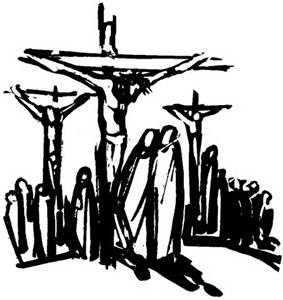
crucifixion sketch

Luke 19:37-40 – Phil 2:8 – March 16, 2016

Have you ever watched a television show or a movie where there are two different stories going on at the same time? A few scenes of the first story, and it gets to an exciting or a suspenseful part; then the show switches to the other story. The second story goes on for a bit and just gets interesting, and suddenly the show changes back to the first story.

This sermon is going to do just that.

Like many stories, the first story we look at today does not start at the beginning. Instead, it interrupts in the middle of the action. Rabbi, or Teacher Jesus, wanted to enter Jerusalem on a Sunday morning. This was a special week. Observing, believing Jews from not only all over Israel, but from all over the world had come to Jerusalem to celebrate the Passover feast.

People were really starting to talk about this Teacher Jesus! Some people said He was the prophet Elijah who had returned. Others said He was John the Baptist raised from the dead. Even some in Israel said this Jesus might be the Messiah, the Anointed One of God.

So, when Jesus planned His entrance into Jerusalem that day, He knew what people were saying. He wanted to show everyone—the friendly people in the crowds as well as those who doubted or actively disliked Him—that He was the Messiah. Jesus entered Jerusalem on the back of a donkey. He did NOT come in like a conquering king, on a white horse. No, He came in as the Anointed One of God. Humble, and riding on a donkey.

Let’s consider what the Teacher Jesus had been doing for a number of months. Jesus’ words and teaching had authority. He preached with power, which was different from the way the scribes and teachers of the day preached. He healed people, restored sight to the blind and made lame people walk—all of which showed God’s mighty power. And if this wasn’t enough, the Teacher Jesus even forgave sins! He certainly appeared to be from God.

We’re going to shift scenes now. Cut!! Now—instead of looking at a situation two thousand years ago, we are going back before the universe was created. Before God spoke and called anything at all into being. Before the beginning of all things, there was GOD. God the Father, God the Son, and God the Holy Spirit. There was community and fellowship within the Godhead even before anything else was created in the whole universe.

I’ll focus on God the Son. Fully God. He was always in existence. There never was a time when He was NOT. When God the Son took on humanity, when He became Jesus at Christmas two thousand years ago, the human Jesus had an actual, physical birthday. But God the Son always was, always is and always will be. It’s a mystery! I can’t understand it, much less explain it. This is a part of the God we worship and celebrate.

Let’s compare the two stories now. Take God the Son before the foundation of the world, all-powerful, all-knowing. Take Jesus the Teacher in Jerusalem, teaching, preaching, healing, even forgiving sins! Compare them side by side. These are all ways that we can describe God.

Jesus, as He comes into Jerusalem, is greeted by crowds of people waving palms and shouting ‘Hosanna!’ They quoted Psalm 118, ‘Blessed is He who comes in the name of the Lord!’ This is a clear sign of what the crowds who greeted Jesus on that day were thinking. This was the way the people of Jerusalem had greeted the conquering king Jehu several centuries before. They greeted Him as Messiah, the Anointed One, who comes in the name of the Lord.

Consider God the Son, before the foundation of the world. The Apostle Paul tells the believers in the city of Philippi that He set aside His God-ness. He laid it aside. Jesus emptied Himself, willingly, of all things related to being God, to become Man. After being in on the creation of the heavens and the earth, after speaking the world into existence, after being all-knowing and all-powerful, God the Son became a baby. Think of a baby you know, a cute, cuddly, helpless little baby. God the Son willingly became like that.

We all know the Christmas story. Jesus was born in Bethlehem in a barn to a young, homeless couple. Jesus was Jewish, from Israel, an oppressed people-group, in an occupied country. Jesus was marginalized and shunted aside from the very start.

Think about Israel in the first century—occupied territory! People oppressed, terrorized by not only the Roman soldiers, but also by Herod’s soldiers. Looking through history, we can read the fear of occupation and domination from first-person, historical accounts. It doesn’t matter whether it’s a letter written during the time of the Underground Railroad, a diary from Nazi-occupied Holland or a personal account from a victim of human rights abuse from Guatemala today. Horror. Violence. Oppression.

God the Son breaks into this mess of a world. God over all the universe, the Word made flesh, became a baby named Jesus. He became powerless, most vulnerable, least of all. In this fallen world, where power and influence are everything, Jesus came to be with us as a helpless baby.

But I’m not done with the story—yet. Or should I say, the stories? Plural.

Jesus the Teacher could have hidden Himself. He could have just laid low for years, taught quietly, stayed on the outskirts, far away from large towns. But, NO. Jesus did just the opposite. Jesus decided to come to Jerusalem, where there were large crowds, many Jewish leaders, and also many Roman soldiers. He walked into this situation with his eyes wide open.

Some people—I’m thinking of the Pharisees, the Sadducees, the scribes and other temple leaders—were awfully uneasy. For them, Jesus was their worst nightmare. Dr. Luke tells us in chapter 9 of his gospel that Jesus set his face to go to Jerusalem. Our Lord Jesus made up His mind to travel that path. Certain death awaited Him. But He determined to go, nevertheless.

Let’s see what the Apostle Paul says in Philippians 2. Jesus is described as humbling Himself. Humble? The people in Jerusalem that Palm Sunday morning certainly didn’t expect a humble, quiet guy. No! They expected someone who would take charge, rally the people, and mount a rebellion! They wanted someone who would turn things upside down!

Think about the world the Jews were living in. They were subjects of the Romans, the most powerful nation in the world. So the Jews did not like this oppression much at all. People would pop up, claiming to be the Messiah, the Anointed One, and attempt to rally an army to himself. These attempts never went anywhere. The Romans quickly put an end to any rebellion.

When the Apostle Paul wrote about the person and work of our Lord Jesus, he uses terms familiar to his audience. Paul communicates it in simple, matter-of-fact words. Listen to just a part: Jesus “made Himself nothing, taking the form of a servant, and coming in human likeness.” Even at that Passover dinner on Thursday night, Jesus did not lord it over the disciples. He washed their feet. He did not seek to dominate others, like the Romans did. So many people want power over others. Instead, Jesus wanted to serve. Just like the Apostle Paul describes here in Philippians, Jesus took the form of a servant. He humbly, willingly and lovingly decided to serve others.

Wow. I repeat, WOW.

Let’s get back to the story. Back to Jerusalem. While Jesus went through the turbulent events of Passion Week, with all of the confrontations and discussions, and especially Passover dinner on Thursday night, we see only a portion of the events of this week. Almost the highlights of the week, what you might see if you were watching a video or a television show in two parts, and at the beginning of the second part they showed you the story so far, up to this point.

Why did Jesus come to earth, empty and humble Himself? He did it for us. We can’t understand it. It is pure love from Jesus. And, we can praise God that Jesus did this, for us.

Remember the people on that Palm Sunday morning, the ones who said ‘Blessed is He who comes in the name of the Lord!’ They were looking for a savior, a conqueror. Jesus was a savior, He was a conqueror, all right. Just not in the way everyone else expected.

Paul tells us that Jesus became obedient, obedient to death, even the death of the cross. Jesus could have turned away. Jesus could have stepped aside. But He didn’t. We even hear it in what Jesus prayed in the Garden. He said to His Father, “Not My will, but Thine be done.” He became obedient unto death, even death on a cross.

Jesus knew that some of that crowd who cried “Hosanna!” on Palm Sunday morning would be screaming “Crucify Him!” on Good Friday morning. On Palm Sunday morning, He entered Jerusalem. Jesus was preparing Himself to be obedient to the point of death, even death on a cross, one of the most horrible kinds of execution ever thought of by anyone, anywhere.

We can ask . . . WHY? Why did the God over all the universe, the Creator of the heavens and the earth come down from heaven and die a criminal’s death on a cross? It was LOVE.

Jesus shows us a love we could not resist, that melts our hearts. This is what causes us to fall at His feet in worship and praise. As the final step, the culmination of His amazing love for us, Jesus has been raised from the dead and exalted to the right hand of God the Father! Jesus receives the name which is above every name. Jesus Christ is Lord. Did you hear? Do you know? At the name of Jesus every knee should bow! Every knee of those in heaven, and those on earth, and those under the earth. Every tongue shall confess that Jesus Christ is Lord, to the glory of God the Father.

Praise God. Amen, and amen!

@chaplaineliza

Suggestion: visit me at my daily blog: matterofprayer: A Year of Everyday Prayers– where I am doing a Lenten journey.  #PursuePEACE – And my other blog,  A Year of Being Kind -Thanks!

Unknown's avatar

Looking for Jesus

“Looking for Jesus”

William Holman Hunt, “Finding of the Saviour in the Temple,” 1854-60

William Holman Hunt, “Finding of the Saviour in the Temple,” 1854-60

Luke 2:48-49 – December 27, 2015

Christmas time is here! Called by some the most wonderful time of the year. Certainly, one of the busiest times, what with parties, social gatherings, visiting at relatives’ homes, and so many extra things on people’s to-do lists. Yes, Christmas is now over, but we are still right smack in the middle of the winter holidays.

Our Gospel reading from Luke today is right smack in the middle of the holidays, too. Except—right in the middle of the Passover holiday, in the spring. An extra special holiday, to be sure! This is one of the rare glimpses we receive of the young Jesus, before the beginning of His ministry. When we do get a glimpse of Jesus as a growing boy, Dr. Luke doesn’t say much more than Jesus was “increasing in wisdom and in years, and in favor with God and people.”

Most people know the Christmas story from Luke chapters 1 and 2 so well. You remember. Angel visitations, miraculous statements, heavenly choruses. And, capped by the birth of the Messiah, the Lord, who will save His people from their sins. And then—we have this sort of addendum. This conclusion of Luke chapter 2.

As Scott Hoezee says in his commentary, “we have a story as mundane, as utterly earthly and simple as they come: lost child. Panicked parents. A frantic search. The whole thing started with angels and it ends . . . paging for a lost child on the P.A. system at Walmart?” [1]

Let’s take a closer look at our passage from Luke chapter 2. This reading is from “The Message,” the excellent version translated by Eugene Peterson, starting at verse 41.

41-45 Every year Jesus’ parents traveled to Jerusalem for the Feast of Passover. When He was twelve years old, they went up as they always did for the Feast. When it was over and they left for home, the child Jesus stayed behind in Jerusalem, but His parents didn’t know it. Thinking He was somewhere in the company of pilgrims, they journeyed for a whole day and then began looking for Jesus among relatives and neighbors. When they didn’t find Him, they went back to Jerusalem looking for Him.”

Now, from Jesus’s point of view, His decision to stay behind in Jerusalem for several days made sense to Him. He may have wanted to get to know God a little better. And, Nazareth was only a small town away up north, far away from the capital city of Jerusalem. I suspect Jesus wanted to talk further with the knowledgeable rabbis and teachers in the Temple, too.

But, from His parents’ point of view? How many of us have served as parents or adults, responsible for young children in our care? Did any of us have a child turn up lost? What must Mary and Joseph have been feeling, during that time when they did not know where Jesus was?

This reminds me of my oldest daughter, when she was just a preschooler. I was at a department store in Chicago with my two children (at that time), my older daughter just turned three, and my second daughter a baby strapped in a stroller. I was looking at clothing on the round metal racks that are common to many department stores. As I looked at clothing and tried to keep track of my young daughter at the same time, she got lost. I could not find her, and she was much too small to see me over the clothing racks.

It only took me about five minutes of searching to discover where she had gone, but that time was desperately anxious for me and traumatic for my daughter—I suspect those five minutes seemed to go on forever. She was lost. She did not know where she was, or where I was. She was all alone, far from her home and familiar things, until I found her and reassured her that everything was all right.

Back to our Gospel text, from Luke 2.

46-48 The next day they found Jesus in the Temple seated among the teachers, listening to them and asking questions. The teachers were all quite taken with Him, impressed with the sharpness of His answers. But His parents were not impressed; they were upset and hurt. His mother said, ‘Young man, why have you done this to us? Your father and I have been half out of our minds looking for you.’”

As one commentary notes, “Mary and Joseph spend 48 hours before finally tumbling to the idea that just maybe they should check the Temple. ‘I can’t imagine he’d be there’ they must have said to each other, ‘but we we’re running out of likely places, so let’s check.’ For his part Jesus is merely confused. The Temple was the first place they should have looked, as it turns out. Jesus was ‘home’ at the Temple. His parents don’t understand, however. They are too flush with a combination of intense relief and a little abiding post-traumatic stress to be able to suss it all out just then.” [2]

Let’s take a closer look at Jesus’s response: “49-50 He said, ‘Why were you looking for me? Didn’t you know that I had to be here, dealing with the things of my Father?’ But they had no idea what he was talking about.”

Many learned biblical scholars have tried to puzzle out this divine mystery. The mystery of Jesus being at once human and divine, at the same time. Here, we have just a glimpse of what this may have been like for Jesus.

The twelve year old boy Jesus probably knew Himself as human. Just as His parents and other family were, and the other children in his town. I wonder whether Jesus was starting to understand by this time that He was fully divine, as well? Yes, some verses in the Gospels tell us He did have an awareness of being divine. Of having Godly attributes. However, I wonder whether He was starting to realize the special call on His life, even now?

We don’t know for sure; we aren’t told. But, do you think this could be why Jesus wanted to stay in the Temple? To talk with those knowledgeable about the Scriptures?

To finish the reading: “51-52 So Jesus went back to Nazareth with them, and lived obediently with them. His mother held these things dearly, deep within herself. And Jesus matured, growing up in both body and spirit, blessed by both God and people.”

Dr. Luke is a faithful reporter. He tells us the facts, as they were related to him. But we don’t know the back story, Jesus’s feelings, His reasoning. Did the Temple have a draw on His life, even at the age of twelve? Did it feel more like home than his family home in Nazareth? Luke doesn’t say.

We know that Mary was a reflective woman. She treasured up these many wonderful things, and also the things that perplexed and troubled her. And, we can ponder these things in our hearts, hold these thoughts dearly, deep within ourselves, just like Mary did.

We know today, from the testimony of all the Scriptures, that Jesus is at the same time fully God and fully man. Yes, that is why He came down from heaven to be born of Mary. This is the good news brought to us by the angel chorus. The Eternal Second Person of the Trinity, Creator of the whole universe, God the Son, emptied Himself of all God-ness. Took on humanity, and was born as a helpless Baby. Good news of great joy for all the people.

Jesus. Messiah. He will save His people from their sins. Fully God, fully human, at the same time. Yes, it’s a mystery. It’s a miracle. For a closing hymn, we will sing “Once in Royal David’s City,” one of my favorite Christmas carols. Please notice the words of verses 2 and 3. Talking about Jesus being human. And then, verse 4 tells us of the future, when we will be with Jesus forever, in heaven.

We can all say alleluia, amen, to that!

(The congregational response to this sermon will be the Nicene Creed.)

@chaplaineliza

Suggestion: visit me at my daily blog for 2015: matterofprayer: A Year of Everyday Prayers. and my other blog,  A Year of Being Kind .  Thanks!

[1] Sermon Starters for the Week, Scott Hoezee, textual notes, illustrations, commentary, Center for Excellence in Preaching, 2015.

[2] Ibid.

My thanks and deep appreciation for Eugene Peterson’s translation of selected verses from Luke 2;  “Scripture taken from The Message. Copyright © 1993, 1994, 1995, 1996, 2000, 2001, 2002. Used by permission of NavPress Publishing Group.”

Unknown's avatar

Generous With Our Purpose

“Generous With Our Purpose”

John 2:10 – February 22, 2015

Big events can be a big headache. Taking care of the venue, and preparing where the big party is going to be celebrated is one big concern. The entertainment, the decorations are more challenges. So is keeping track of all of the food and drink. How much is too much? And what if I don’t have enough? What happens if I run out?

This is exactly what happened at a wedding at the beginning of Jesus’s ministry, in Cana of Galilee. Let’s zoom in, and take a closer look. Jesus was invited to the wedding as a guest. His disciples were invited, and probably many other people He knew. And His mother, too.

In the first century, Jewish custom held that most any wedding would be an event of celebration for several days. Our Scripture passage today shows an affluent Jewish family—with some servants and a household steward. We read that the family provided extravagant feasting for days. In the case of today’s Scripture, if there were any miscalculation or lack in provisions in food or drink, not only the bride and groom but also their families would most likely suffer great humiliation.

What about today? What are some challenges or needs that we might have right now? People all over the world have lack of funds, logistical problems, or miscalculations and find themselves lacking provisions every day. What about lacks or needs due to physical situations? Unemployment, illness, or suffering of other kinds? These things are nothing new, sadly. They can be overwhelming. I’m just one, puny person on this whole planet. Billions of people live today! Who am I to expect that Jesus even knows about my needs for food and drink?

Let’s go back to Cana, in Galilee. A couple of days of partying had already passed. It was the third day of the big wedding celebration, and a few people found out they had run out of wine. They ran to tell the chief steward. Oh, no! What was to be done? With a big crowd like he had in the house, I suspect he couldn’t just send out to the local liquor store for more supplies.

It was then that Mary, the mother of Jesus, got involved. Somehow, Mary heard about the lack of wine, too. She hurried to her son Jesus and told Him about it.

What about us, today? When we have needs or lacks, what do we do? Do we try to be tough, and go it on our own? Are we self-sufficient, not needing or asking for any help? Are we frozen by the need, unwilling or unable to budge? Or are we open and willing, like Mary, ready to trust Jesus, to go to Him for assistance?

Mary asked her son Jesus to help out. “They have no wine,” is what she said. There was some back and forth between mother and son. Jesus says, clearly, “What does this have to do with Me? My hour has not yet come.”     (Just wait, I’ll get to that comment, in a minute.)

Here we have Jesus, the Second Person of the Trinity, God in human form. God the Son, the Logos, the one who spoke at the beginning, and created the universe. Who formed our world and placed the stars in space. Mary, Jesus’ earthly mother, is asking Him to change His mind, to change His plans, to change His timetable.

Mary eventually told the servants, “Do whatever He tells you.” Mary trusts in Jesus. His mother trusts that whatever He will say or do is going to work.

Nearby were some large containers, for ceremonial washing. That’s stone containers, holding about twenty to thirty gallons apiece. With such a crowd of people, a lot of water was needed for everyone to wash before eating. Jesus told the servants to fill the large containers with water. After doing so, Jesus said, “Now draw some out, and take it to the chief steward.”

What the servants brought to the steward was no longer water. It had miraculously changed to wine. And not any garden-variety wine, no! The good stuff. The best wine to be had!

Here we have Jesus—willing to change His plans, change His timetable. Willing to change His mind—because generosity puts people first!

Our Lord Jesus offers compassion and generosity to the people at the wedding celebration in Cana. And not only to them, Jesus offers a practical, tangible demonstration of compassion, generosity and kindness to all of us, today, as well! Here in this passage from the Gospel of John, Jesus shows Himself to be all this—so that anyone who reads these paragraphs will be able to see that this kind, generous, miracle-working God is the kind of God who is available to them, too!

Jesus caused this superior wine to be made available. I find it interesting that Jesus is sometimes portrayed as the True Bridegroom for the Church, after His resurrection. The True Bridegroom provides the best wine for all the people at the wedding, showing them His rich abundance and generosity.

What about us? When we finally come to Jesus with our need, with our problem, what then? Do we trust in Jesus with all our hearts? True, some are held back by many things. Fear is a big hesitation. Insecurity and doubt are two others. Will we offer what common things we have (the containers of water, in this case)? Jesus miraculously can change them to wine. Jesus can help us wherever or whenever we need it, providing for us out of His abundance!

The assistance can come directly from God, but this help may come from another source, too. Wherever or whomever the kind, generous help comes from, praise God! Jesus is generous to us, comes alongside of us and provides miraculously for our needs, too.

The six large containers held a whole lot of water. So Jesus changed it into a whole lot of wine. The good wine, at that! Jesus provided generously! He provided out of His abundance, His extravagance. Wonderful job, Jesus!

What is going on in your life today? Where do you need a touch from God? Jesus and His abundance, His extravagance, His generosity can come into your life today. Jesus wants to give you and me joy and blessing. Even good times and laughter, in abundance. We can see from the good wine He miraculously provided at the wedding at Cana that He can and will.

What a generous God we serve!

Praise God! Amen.

@chaplaineliza

Thanks to the kind friends at http://www.40acts.org.uk – I am using their sermon suggestions for Lent 2015. Do Lent generously!

(Suggestion: visit me at my daily blog for 2015: matterofprayer: A Year of Everyday Prayers. Thanks!)