

“Bigger Than We Can Imagine!”

Exodus 20:1-4 (20:3) – March 3, 2024
Who likes following the rules? How about the rules for games or contests, or the rules of the road? Knowing the rules means you know how to act, how to play the game, what is expected. As people try to figure out the world around them, rules are very helpful. [1]
For the past number of weeks, we have been following the Gospel readings each Sunday for our Scripture lessons and to highlight for our sermons. I am sad we have not been focusing on the Lectionary Hebrew Scripture readings, though. For the past weeks, our Lectionary for the Hebrew Scriptures has followed the Exodus narrative, following Moses and the people of Israel as they left Egypt, left slavery, and became a free people under God.
And now, they are wandering in the wilderness. This Exodus narrative is powerful, indeed! We talked about wandering in the wilderness several weeks ago, when we considered our Lord Jesus in the wilderness, being tempted by Satan. I mentioned that you and I are not often in the actual wilderness, miles from the nearest town, from the nearest person, even! However, you and I can feel very much lost in the wilderness, sometimes. We can be lost and wandering emotionally, psychologically, and especially, spiritually.
It’s at times like these that we need our friends, our families, a familiar group of people we can travel with. Because, that is exactly what the people of Israel were doing, out there in the wilderness. They were surrounded by their beloved community, every step of the way.
Or, was their community really so beloved? As the hungry, tired and footsore people of Israel have been wandering in the wilderness, they haven’t stopped arguing with their leader Moses and testing God! That’s the powerful God who led them out of Egypt with a mighty hand, and made miracle after miracle happen, supplying the people’s basic needs for food and water. Can you see why Moses might have had it with being the leader of this stiff-necked people? This stubborn group of constant complainers? [2]
I don’t know about you, but when I get a bunch of rules, I like to know why. I am not very likely to follow a bunch of rules just because the leader is twisting my arm. Or, even worse, because God said – imagine folding God’s arms – “Because I said so!” If that were the case, I think I might be a little stubborn and stiff-necked, too.
If we look at the larger narrative from Exodus, when God gives the commandments to the people of Israel, this provides “the people with a sense of purpose and identity and even a bit of security. Although God has brought them out of Egypt and performed a number of miracles, it is not until this point in the story that God tells the people about God’s intentions for them.” [3]
Think back to your childhood, or perhaps the childhoods of your cousins or your friends. When you had rules in your house growing up, how often were those rules set to give you boundaries, and to make you feel secure? Rules from a loving parent or a caring coach are meant to give us boundaries, to help us feel safe, secure, and even loved!
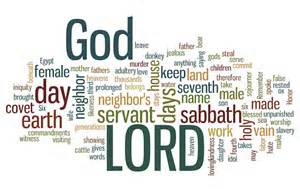
One of my favorite Bible commentators is Carolyn Brown. She is now retired, but she was a longtime Children’s Ministry Director in the Presbyterian church. She paraphrased the Ten Commandments for our Scripture reading today. Many if not all of these Ten Commandments are there to help us be in community with each other. Listen to several selected ones:
I am God. I am the one and only God. Don’t worship or pray to anything or anyone else.
I am bigger than anyone or anything you can imagine. So don’t make pictures or statues that you think look like me and worship them. You’ll get them wrong.
Say my name with respect. Work six days of the week, but keep one for rest and for remembering that you are my people.
Treat your father and mother with respect. Don’t kill anyone. Be loyal to your family.
Don’t take what is not yours. Don’t tell lies about other people.
Don’t wish that you had things that belong to other people. [4]
These rules sound like common sense, and to help all of us to live in community! These rules help all of us to form ourselves into an alternative community. Not a community under a king or a dictator, but “rather by loyalty to a god who has chosen to redeem a group of slaves from a life of bondage. The commandments mean to sketch out a space where human beings can live fruitful, productive, and meaningful lives before God and with one another.” [5]
We do not have a mean, distant God, giving us a rule-book that is difficult to follow. We do not have God as an annoying supervisor, looking to be a harassing tyrant over us. No! Instead, these commands are “a piece of the whole life of faith, enlightening us as to our relationship with God and our dependency on that relationship.” [6]
When we are wandering in the dark, in the wilderness, far away from the light of God’s presence, it may seem like God’s loving presence and caring counsel are far away, too. Our loving, caring God is always waiting, arms wide open, for us stubborn people to turn around, to come back home.
Remember, God will not say, “Jump through these hoops, and only then will I love you!” No! Instead, God says, “My love for you will shape you into these kinds of people, this kind of loving, beloved community.” Let us strive to live together as a people of faith, as a community loved by God. Amen!
(Suggestion: visit me at my other blogs: matterofprayer: A Year of Everyday Prayers. and A Year of Being Kind . Thanks!
[1] http://worshipingwithchildren.blogspot.com/2011/09/year-proper-22-27th-sunday-in-ordinary.html
[2] https://www.workingpreacher.org/commentaries/revised-common-lectionary/ordinary-27/commentary-on-exodus-201-4-7-9-12-20-2
[3] Ibid.
[4] http://worshipingwithchildren.blogspot.com/2011/09/year-proper-22-27th-sunday-in-ordinary.html
[5] https://www.workingpreacher.org/commentaries/revised-common-lectionary/ordinary-27/commentary-on-exodus-201-4-7-9-12-20-2
[6] https://revgalblogpals.org/2014/06/10/narrative-lectionary-the-rules-of-engagement-edition/
 Pastor, Preacher, Pray-er