Unknown's avatar

God Baking Bread!

“God Baking Bread!”

Matthew 13:33 – August 6, 2023

            Has anyone here baked bread, from scratch? I have, although it’s been a number of years since I baked white bread and wheat bread. Now, I more often bake sweet breads – banana, zucchini, apple, and other types. Homemade bread is such good bread!

            In our short Scripture passage today, we have our Lord Jesus, telling another one of His parables. This one is in chapter 13, which has a number of parables or short stories, all about the kingdom of God. These metaphors and word-pictures are meant to help Jesus’s listeners get a little bit better understanding of this huge concept Jesus taught about!

            The topics Jesus used for His parables are down to earth, from real life. For example, Jesus talks about a farmer and his field, and the weeds that grow. Typical of so many in that time, and relatable to so many of His listeners! Remember, we are looking at Bible readings that help us Re-Image God, in a nurturing, feminine way. The parable we highlight today features a woman. Yes, and something typically known as women’s work, in the home.

An unusual topic for a Rabbi to talk about! I am sure there were (and are) men who traditionally and habitually bake bread, but in Palestine as in many other rural-based cultures, but women often did many of the tasks involved with housework and home-making. Including the regular baking of bread. And, in a typical Palestinian house, a lot of bread needed to be baked each week. In the first century of the Common Era, you couldn’t run out to the local grocery store and get a loaf of bread, a dozen eggs and a gallon of milk, after all.

This parable of the yeast is one where our Lord Jesus focuses on work done by a woman. Sometimes, when the Bible mentions yeast in connection with spiritual things, yeast has a negative connotation. Not here! Jesus did something unexpected! He turned the tables on a typical understanding of yeast, or leaven. This parable is unusual and unexpected! In a matter-of-fact way, Jesus lifts up this work of baking, and the work of women, too. And without specifically naming it, Jesus compares God’s work to women’s work.

One of my favorite commentators is the Rev. Janet Hunt, a Lutheran pastor in De Kalb, a couple of dozen miles to the west of us, near Northern Illinois University. She loves to bake bread, and talks about her baking at length in her article about this particular parable. Pastor Janet’s mother used to bake bread, too. According to Pastor Janet, she was told “that our mother’s mother also baked as her mother did before her in a time and place where doing so was not an occasional practice or a hobby as it is with me, but was a necessary part of one’s weekly tasks, for bread was an everyday staple and it was not yet sold in stores.” [1]

Even today, in some rural areas and small towns, baking bread at home is much more common than it is in urban areas. The woman in this parable took a lot of flour – over a bushel of flour! She probably ground that flour with a hand-cranked little mill, too. And then, baked some bread. Jesus said that she mixed the yeast into the flour until it had leavened the whole big batch of flour! In case you are not familiar with the process of leavening, the introduction of the yeast causes a transformation of the dough.  

Before the adding of the yeast, before its mixing and incorporating into the whole batch of dough, what do we have? A big pile of flour, and some water to moisten it. Perhaps a bit of sweetener like honey, perhaps not. But, imagine the working and mixing of the flour, water and yeast! As this unnamed woman mixes and kneads the dough, the yeast gets incorporated throughout the whole. As the dough rises, the yeast does its work unseen, quietly.

The woman of Jesus’ parable “would not have had a finely tuned gas or electric oven in which to bake her bread. It would likely have been done in a clay oven over hot coals. And while she certainly could have turned her attention to other things while the bread rose or the coals came to the right temperature, baking the bread would have required her to stay nearby all day long so as to be ready for the next step. For in fact, it is possible to let bread rise too long, making the final product less appealing. And coals need to be at a certain temperature to make the baking optimal.” [2]

I hope I am making the baking of bread sound like a challenging activity, because it was, and is! Let us take a step back, and consider again this short parable of Jesus. He compares the kingdom of heaven to yeast. Could it be that our Lord is saying that “Kingdom work” takes time, energy and attention, just as the work of yeast and baking takes time, energy and attention? That it sometimes requires patience as we wait for ‘yeast’ to rise?    

Time after time, I have heard stories and read accounts of the slow or hidden or pain-staking work of the kingdom of heaven finally showing fruitfulness. Finally, good dough baking and bringing forth good, homemade bread, as we recognize the kingdom of heaven at work in our lives or in the lives of those near and dear to us! We can take common things, everyday materials, and have them transformed by God.

God loves to take things as simple as bottles of water given out for free at a farmer’s market, or boxes of cereal or feminine hygiene products brought to a local food pantry to be a part of God’s kingdom. Because, they are! Something as simple and as straight-forward as common, everyday activities or items can be used and transformed into God’s purposes – God’s work – God’s kingdom.

Remembering this parable of the yeast, we can see how God works quietly, confidently, sometimes over a long time. Today, we come before God to celebrate the Lord’s Supper, that meal of common things that our Lord Jesus transformed into a sacrament. We come to meet God in a special way at God’s table, doing what Jesus commanded us to do. As often as we eat this bread and drink this cup, we celebrate our Lord until He comes again in glory.

Doing Kingdom work as Jesus told us to do from this parable, we can bring glory to our God in common ways, using everyday things. We don’t have to be extraordinary ministers or missionaries, or God’s adventurers. As Jesus told us? We can use ordinary things, everyday items, common ways. And, this will indeed bring glory to God. Let us take these words to heart, and go and do them. Amen, alleluia!

@chaplaineliza

(Suggestion: visit me at my other blogs: matterofprayer: A Year of Everyday Prayers. #PursuePEACE – and  A Year of Being Kind . Thanks!


[1] https://dancingwiththeword.com/a-one-sentence-parable-which-opens-up-the-world/

[2] Ibid.
Unknown's avatar

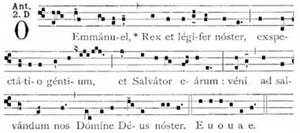
His Name: Emmanuel

“His Name: Emmanuel”

emmanuel-plainsong

Isaiah 7:10-14  – December 18, 2016

So many people love babies. Look at just about any gathering of people. Church congregation, senior center, exercise group, book club. When anyone mentions that someone has just had a baby, what happens? Lots of comments like, “What did she have? Boy or girl?” How big is the baby?” And, especially, “Oh, I hope mom and baby are happy and healthy!”

Common, everyday occurrences, like young women getting pregnant and babies being born. That is exactly what the prophet spoke of in our passage today. The prophet gave a lot of background, but he finished this passage by talking about the clear promise from God. Let’s go back to the beginning of the passage from the prophet: “Again the Lord spoke to King Ahaz, saying, Ask a sign of the Lord your God; let it be deep as Sheol or high as heaven.” It sounds like the Lord God wants to give King Ahaz a really big message. But, wait. Why is this stuff happening?

A little backstory. The kings of Syria and Israel (Northern Kingdom) join together to go to war with the Assyrians. They ask King Ahaz of Judah (Southern Kingdom) to join with them, but Ahaz refuses. Both countries send armies to march on Jerusalem to dethrone Ahaz and put a puppet king on the throne.

We have big political intrigue going on in Jerusalem at this time! Remember, it’s about seven centuries before the birth of Jesus in Bethlehem. The Lord sends Isaiah to Ahaz a second time, this time offering to give Ahaz a sign so that he will believe God. From Isaiah 7: “12 But Ahaz said, I will not ask, and I will not put the Lord to the test,” and once again Ahaz refuses.

One of the commentators I consulted said, “King Ahaz received an oracle from Yahweh, directing him to ask for a sign as deep as Sheol or as high as heaven. This may refer to a sign announced by an earthquake or in lightning. With seeming piety, Ahaz refuses to ask for a sign lest it put Yahweh to a test. Isaiah, however, treats his answer as a refusal to trust God and announces that God will give him a sign anyway.” [1]

What is this sign? A common, everyday sign. There may have likely been just a young woman who was at Ahaz’s court, to whom Isaiah could literally point a finger and say, “Look, she’s pregnant. She’s going to have a son. That birth is the sign that God is with us.” We can see this as a sign that God is in the common, everyday things, the simple, ordinary passages of life.

Do the simple, small things that come into our lives change our course? These verses give us an interesting image. God would save the people of Israel through the sign of something so common and ordinary as a pregnant woman. Isaiah began by offering the opportunity for a great big, splashy sign, but instead gave the king a common image of everyday, ordinary happenings.

The sign was certainly not for the mighty and powerful. Rejected by those in power, God would work wonders among the humble and lowly. In other words, the simple common folk. The original reference for Isaiah was to a child born in his time, and in the near future. For the prophet, the message is that in a few years, both the kingdoms threatening Judah will be no longer a problem. This indeed is historically what happened.

Some centuries pass. The Book of Isaiah was originally written in Hebrew, which was the common language of Israel during the 700’s BCE. By the time we arrive at 300 BCE, there has been a huge turnover in the world. Now, the Greeks under Alexander the Great have conquered most of the known world, and they have spread the Greek language far and wide. Plus, the Jewish people had been scattered all over the Middle East and into Asia Minor.

Many of the scattered Jewish people could hardly read and understand their own Scriptures any more! So, a large group of Jewish scholars translated the whole of the Hebrew Scriptures into Greek. It is that translation that Matthew uses when he says, “22 All this took place to fulfill what had been spoken by the Lord through the prophet: 23 “Look, the virgin shall conceive and bear a son, and they shall name him Emmanuel,” which means, “God is with us.”

Believers from the time of Matthew’s gospel have pointed to these verses as Messianic prophecies. Yes, there is a technical difference between “young woman” and “virgin.” This tension is evident if we closely examine the difference between the Hebrew words and the Greek translation. Yet—what is the same? It is a message of God’s caring and love that sees pregnancy and birth—simple, everyday happenings—as signs of God’s care and concern for God’s people.

Emmanuel. God with us. Was that true in Isaiah’s day, with the Assyrian armies breathing down the necks of the people of Israel? Of course! Isaiah gave the king a special oracle to let him know so. Emmanuel. God with us. Was that true in the time of Jesus’s birth, with the occupying Roman armies breathing down the necks of the people of Israel? Of course it was!

God has always had concern and love for God’s people, no matter where and no matter when. No matter if the persecuted Christians were running from the Romans, or being chased and persecuted by any one of the occupying forces in the centuries in between.

Jesus came from humble origins. Yet, He changed the world. Likewise, the birth of this child, was a sign that even in the midst of the chaos and destruction surrounding Jerusalem in the uncertain time of Isaiah and the uncertain time of the baby Jesus, God was still with them. Life still did go on. In a very real sense, that was (and is!) a miracle.

What is the simple message we receive from these words of the prophet? God will be with us, no matter what. That is the message to King Ahaz and the people of Israel, that is the message to occupied Israel in the newborn Jesus’s day. And, it’s the message we can take home with us this day.

“Look, she’s pregnant. She’s going to have a son. That birth is the sign that God is with us.” We can see this as a joyful sign that God is in the common, everyday things, like the simple, ordinary passages of life. Like a baby being born, displayed to all of us as a wonderful sign from the Lord God. Praise God! God is concerned about the smallest and every day and ordinary, like babies and new moms and children, like you and like me.

Alleluia, amen!

[1] http://fontes.lstc.edu/~rklein/Documents/adventa.htm#Advent4, Studies on Old Testament texts from Series A, Ralph W. Klein, Lutheran School of Theology at Chicago.

@chaplaineliza

(Suggestion: visit me at my regular blog for 2016: matterofprayer: A Year of Everyday Prayers. #PursuePEACE – and my other blog,  A Year of Being Kind . Thanks!)