Unknown's avatar

Stand Firm in Benediction!

“Stand Firm in Benediction!”

2 Thessalonians 2:13-17 (2:16-17) – November 9, 2025

            It’s sometimes difficult to be persistent! To hold on, and continue working, continue trying, despite delays and disappointments and detours. Isn’t it? Continuing to work all alone, standing by and standing up when others fall away. Even just being faithful, and doing what you promised to do can be a real trudge up a long, winding road, up a steep and lonely hill.

            It’s a good thing that as we live the Christian life, so often we are in community with each other! Isn’t it easier and more companionable to be traveling together, or working on a project together, or carrying a load together, with a group of friends?

            That’s what the Apostle Paul was writing about, here in this second letter to the young church in Thessalonica. When Paul and his friends were on their second missionary journey, they had only spent a short time in that city before they needed to leave. This was a young church that Paul planted, and Paul had already sent one letter to the believers there. He sent this second one to correct some misunderstandings and to renew the Thessalonian believers’ hope in Christ.

            We are focusing on this small section right in the middle of Paul’s letter. He breaks away from giving further instruction on the confusing timing of our Lord Jesus Christ’s return to giving encouragement to his fellow believers. “But we ought always to thank God for you, brothers and sisters loved by the Lord, because God chose you as firstfruits to be saved through the sanctifying work of the Spirit and through belief in the truth. 14 He called you to this through our gospel, that you might share in the glory of our Lord Jesus Christ.”

            When I hear about churches and pastors today who really focus on the “end times,” and about the prophecies in both the Hebrew Scriptures as well as the few times in the New Testament that refer to the Second Coming, I often roll my eyes. If you have ever read or heard of the books on the End Times, the books are so much dominated by fear and anxiety, by persecution of Christians by cartoonish bad guys. Those same churches and pastors so often advise their congregations of strict rule-following, and black-and-white do’s and don’ts.

            Yes, I did read that first portion of the assigned reading from 2 Thessalonians 2 this past week, and I did not feel led to write a sermon on it. However, I continued reading in chapter 2, and found Paul encouraging his Thessalonian friends, and thanking God for them!

As commentator Mariam Kamell says, “Christians can be confident, encouraged people because we know that we are held as first fruits by God’s choice, preserved through the Spirit. In Paul’s paradigm there is neither room for pride in our efforts to improve the world, nor despair at the state of the world around us. For Paul, all of this talk about the end is to encourage us in our security in Christ and draw us ever further in the Spirit’s sanctifying work.” [1]

            So, we are not to despair over the End Times! We are not to be fearful and cower in the shadows, dominated by fear and anxiety! Instead, we are to rejoice, and be hopeful in our security and salvation in our Lord Jesus Christ.

            Paul then says, “so then,” which is very similar to his connecting word “therefore.” As one of my Bible instructors used to say when I was attending a Christian college for undergrad, “See what “therefore” is there, for! Why is Paul using this particular connecting word?  “15 So then, brothers and sisters, stand firm and hold fast to the teachingswe passed on to you, whether by word of mouth or by letter.”

            I know things and people and situations in this world today can be really scary, and even make us want to hide under the covers! Especially when we consider persecution and lawlessness – however, God has the final word. “Don’t worry about what will happen when you (or people you love) die and don’t worry about what will happen when you grow up or get to be a teenager or [grown-up].   Instead, think about today.  Live as God’s person today.  Do the best you can and know that God is with you.” [2]  

            Isn’t that wonderful encouragement for all of us? Instead of cowering in fear, or being a strict rule-follower or else! We are to know we are God’s people, followers of Jesus Christ, and led by the Spirit of God. Paul prays that the Thessalonian believers are to be encouraged – in their inner being.

“This is clearly a ministry of the indwelling Spirit of Christ. Against the wiles of this age, may we look in faith to the one who constantly surprises us with his love and inspires us with courage and confidence, enabling us to stand firm and not be overwhelmed by the vagaries of life. Our God will buttress us in our faith; this we can rightly ask in prayer, believing.” [3]

            The apostle Paul is truly being encouraging to his friends. Yes, they had some misunderstandings about what Paul preached to them, which Paul clarified. Yes, some of these believers were acting in ways displeasing or disappointing to our God, but at the end of the day and the end of this letter, Paul wanted to give encouragement and hope, not fear and dismay! We are to be cautious around churches and ministers who want to fix, manage and control every aspect of life! Paul leads with the grace of Christ, and the love of God. Period.

            And then, what should burst out of Paul but a benediction! Just as in the middle of the letter to the Ephesians, here at the end of the second chapter to the Thessalonians is a marvelous benediction. We will close with Carolyn Brown’s wonderful paraphrase of Paul’s words:

            “Remember that God loves you.  God chose you to hear about that love and to know the stories of Jesus.  Do not forget them.  Live by them every day.  And may God who created the whole universe, Jesus who showed us how much God loves us, and the Holy Spirit who guides us be with you giving you courage and strength to be God’s people every day.” [4]

@chaplaineliza

(Suggestion: visit me at my other blogs: matterofprayer: A Year of Everyday Prayers. #PursuePEACE – and  A Year of Being Kind . Thanks!


[1] https://www.workingpreacher.org/commentaries/revised-common-lectionary/ordinary-32-3/commentary-on-2-thessalonians-21-5-13-17-3

[2] https://worshipingwithchildren.blogspot.com/2016/09/year-c-proper-27-32nd-sunday-in.html

[3]  https://www.lectionarystudies.com/sunday32caiie.html

[4] https://worshipingwithchildren.blogspot.com/2016/09/year-c-proper-27-32nd-sunday-in.html

Unknown's avatar

In Prayer Before God

“In Prayer Before God”

2 Samuel 18: 5-17, 29-33 (18:33) – August 11, 2024

            The summary of a popular novel or a made-for-TV movie might be “An aging father grieves over the sudden death of his beloved son.” How often do we see this sort of sad headline broadcast by the media, or plastered on the covers of magazines in grocery stores? We can all feel for the affected family, or the grieving friends and relatives.    

            We all know grief. We all have experienced it, too. Some people are not even sure whether they ought to be grieving, but their insides say they very much ought to! “Grief is tremendous suffering and deep sadness. Grief could come after the death of a loved one. It could begin after the death of a pet. Grief could happen when our best friend moves to another city, and we have to say goodbye. We can’t get over grief – deep sadness- the way we get over a cold.” [1]

            This is what our Bible reading from 2 Samuel is all about today. The aging King David is grieving for his son – his most favorite son, Absalom. But, let’s back up a little, in this very sad tale. Absalom must have been a good-looking, charismatic guy, and a compelling leader, too. He thought very well of himself, and was itching to take over the kingdom from his father, King David. He certainly convinced a lot of people in Israel to get on his side, enough to mount a rebellion – an army to overthrow his father’s kingdom!

            This narrative is lengthy, and I don’t want to read it all to you. Let me give you the short-short version. Absalom was one of many children of King David. David had many wives, and they all were fruitful. David ended up with several dozen children from wives and concubines. Absalom was David’s favorite son. Sadly, and shocking to think – considering David was his father, Absalom was not a kind and virtuous person. By Biblical report, he was narcissistic, stuck up, and thought way too much of himself.

            David’s many children had a great deal of drama going on between them. You can read all about this unsavory drama yourselves, in 2 Samuel. Still, King David loved Absalom very much, even though Absalom raised an army to overthrow his father and become king of Israel himself. Sadly, things did not work out well for Absalom. “In this reading we see David issuing orders, trying to ensure that whatever happens in the upcoming battle between his supporters and the rebellion led by Absalom, that Absalom is to be spared. Ultimately, today’s passage ends with David learning that Absalom had been killed and the King is heartbroken.” [2]

            What do we do when we face such heartache over a loss that is not really a loss? What do we do when we have what is called ambiguous loss and grief? Certain kinds of loss and grief are frequently not even recognized as grief. Instead, it’s marked by uncertainty – the absence of closure, the murkiness surrounding what has been lost, or whether it’s truly gone.

Look at the awful situation with Absalom, who was treating his father King David so poorly. The young man was even leading a rebellion against his father! And, King David still loved his son very much, even when Absalom died. David loved and grieved so much!

            Some of these complicated and ambiguous situations are so difficult for the people and families to respond to. And, how should you and I respond to such pain, hurt and suffering? Our worship service each week gives us a road map on a caring way to respond even to ambiguous and puzzling situations. We can pray. We can come before God.

Our commentator reflects that “Few simple solutions exist to the complex problems that plague our lives, whether we’re talking about war among nations, conflicts within families, or battles being waged in individual hearts. And yet, no matter the enormity of the challenges we face, grace abounds again and again.” [3]

It is part of a loving and grace-filled response to lift our neighbors, our loved ones and their complicated situations to the Lord. A good place to begin is to acknowledge and validate the emotions surrounding the situation. There is real grieving going on! Even though the grief inside might not be acknowledged, or might be hidden or difficult to see, there are several responses possible. Let us choose the loving and caring response by praying for these friends without judgement. Let us cover the difficult or painful situation in prayer.

We realize that God knew David’s difficult situation, with Absalom and his total disrespect and rebellion of his father. We feel so deeply for King David, still loving his favorite son despite everything crashing down around his ears.

Even though our friends and loved ones may be in distress or even in despair, “The prayers of the people remind us that when we don’t know what to do or we are afraid to acknowledge the suffering around us, we begin with prayer; and not just individual prayer—corporate prayer. We don’t have to know the details of our neighbors’ struggles [and pain] to gather together and offer one another grace through prayer.” [4]

We can do that alone, in prayer before God, certainly! What is more, we can gather together as a congregation, as friends in Christ. Let us take the opportunity to lift up each other as we grieve, as we go through all kinds of losses. What a loving way to extend comfort and encouragement! And, we can bring all of these prayers before our loving, caring, compassionate God. What a balm for the heart and soul, as we know God cares for each one of us.

@chaplaineliza

(Suggestion: visit me at my other blogs: matterofprayer: A Year of Everyday Prayers. and  A Year of Being Kind . Thanks!


[1] https://www.umcdiscipleship.org/worship-planning/worship-with-rejoicing/twelfth-sunday-after-pentecost-year-b-lectionary-planning-notes/twelfth-sunday-after-pentecost-year-b-childrens-message

[2] https://www.churchofscotland.org.uk/worship/weekly-worship/monthly/2024-august/sunday-11-august-2024-twelfth-sunday-after-pentecost-year-b

[3] https://www.umcdiscipleship.org/worship-planning/worship-with-rejoicing/twelfth-sunday-after-pentecost-year-b-lectionary-planning-notes

[4] https://www.umcdiscipleship.org/worship-planning/worship-with-rejoicing/twelfth-sunday-after-pentecost-year-b-lectionary-planning-notes

Unknown's avatar

Gratitude Is—!

“Gratitude Is—!”

Philippians 4:4-7 (4:6) – November 19, 2023

            It’s that thankful time of the year, and this service is one way we all gather to say “thank You” to God. We say thanks for all sorts of good things. Wonderful gifts. Exciting opportunities. We gladly come before God and mention how thankful each of us is—to God.

One of my favorite biblical websites (and, I fully consider her a bible commentator) is “Worshipping with Children,” written by Carolyn Brown. This is what she had to say about Thanksgiving: “One of my favourite times with the children was the year we learned how to say “Thank you” in many languages from our congregation, and ended by using those words for our prayer together.” [1]

I know I taught my children how to say “thank you” when they received gifts, and compliments, and lots of other things. It’s a common thing, for grown-ups, parents, and grandparents to instruct children in these considerate, valuable, and grateful words.

            But, gratitude? Yes, almost everyone knows they are supposed to be thankful at Thanksgiving-time. But, grateful? That is not quite thankful – or is it?  

            Our New Testament Scripture reading for this Sunday is directed toward a group of people – of believers in God. Similarly, the Psalm reading is meant for a group of people, as are our hymns today, too. Isn’t it easier for us to be thankful – jointly? And, to be grateful – together?

            Sometimes being a part of a special group of people is helpful for joining together and agreeing to be in one accord with one another. Especially in terms of encouragement and hope, any group of people makes it easier to show signs of gratitude and thankfulness. Like, in the example of the group of people the apostle Paul addresses through this thank-you note. 

            We all know that being grateful and thankful is not just a head thing, not just something we decide to do one fine day. No, being grateful and thankful is not just an intellectual belief we endorse to be true. Instead, our gratitude and thankfulness ought to be a well-worn habit, a way of living. Most important, our gratitude and thankfulness should be visible, shown in what we do and say, shown in the choices we make and the priorities we set.

            Who remembers thank-you notes? I know I just mentioned thank-you notes written for gifts received (especially written by our children), but this is on a much larger scale. If you like to think so, each of us can be saying “thank you” to God, each and every day. In the same way, each of us has many reasons to be grateful to God each and every day, too.

            We are in a worship service right now. Worship is supposed to be a grateful and thankful time, for sure! What kinds of prayers are grateful and thankful? What about the group that is us, our congregation? “What prayers can we offer that might tap into the sense of interconnectedness and belonging? How can we celebrate the community that we are and the community that we are becoming? Let there be space for saying thank you to one another and to God.” [2]

When Paul wrote this particular letter, he wrote it from prison in Rome. He had been sent to the emperor’s court on a capital charge. He was on trial for his life. And yet—the apostle Paul writes this joyful, thankful, gratitude-filled letter.

Let us count off difficulties and challenges that Paul faced: not only the upcoming trial—for his life, but on top of that, Paul considered himself to be responsible for the churches he had planted on his missionary trips in Asia Minor and throughout Greece. Such heavy burdens on Paul. Yet, here in chapter 4 we see him writing almost blithely to the Philippian believers. He not only writes a thank-you note for a financial gift the Philippian believers sent to him, but Paul also is full of praise, thanksgiving and gratitude to God!

When we look at the people who were on the receiving end of this correspondence, few of them were living comfortable lives. One of the commentaries I consulted said, “Many were poor, many were slaves and few of them would have known the meaning of security. In marked contrast, those of us who live in comparative wealth and luxury today are frequently those who are most worried and anxious.” [3] Isn’t that a true description of us, today?

Sometimes there IS stuff to worry about! A lot of times, people (yes, even Christians) worry about all kinds of stuff! Aren’t we tempted to be worried and anxious when finances are a challenge or the car is giving big problems? Or, how about when we or one of our loved ones is unemployed? Or, in the hospital or dealing with a chronic illness? What about in an accident, or even in jail? Some would say it is natural, even part of the human condition to be worried.

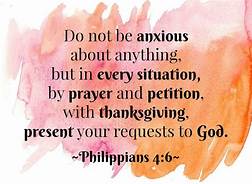
Here is camaraderie, teamwork, and togetherness at work. And, the togetherness, the sense of interconnectedness and belonging of the Christian life is what Paul recommends to us in verses 2 and 3. All of Paul’s commands dovetail into his urging to pray—with gratitude and thanksgiving. “Do not be anxious about anything, but in every situation, by prayer and petition, with thanksgiving, present your requests to God.”   

All too often, our prayers are just a ‘shopping list’ we bring to God, without thanksgiving and seasoned with anxiety and fear. We are urged to be grateful, to count our blessings.

            I encourage all of us – and I am preaching to myself as much as to anyone else – to strive to make it a habit. A way of living, to be thankful and grateful. Not just for this week, for Thanksgiving, but for the rest of the year, too. For always. Let us encourage each other to tap into this praiseworthy sense of interconnectedness and belonging! And celebrate the community that we are and the community that we are becoming!

Be like Paul. Don’t be filled with worry, but instead, be filled with gratitude and thanksgiving! Not just on Thanksgiving, but every day!

@chaplaineliza

(Suggestion: visit me at my other blogs: matterofprayer: A Year of Everyday Prayers. #PursuePEACE – and  A Year of Being Kind . Thanks!

(I would like to express my great appreciation for the observations and commentary from the web page www,umcdiscipleship.org for their brief series on gratitude. I used several quotes and ideas from their useful resources. Thanks so much!)


[1] http://worshipingwithchildren.blogspot.com/2013/09/year-c-thanksgiving-day-october-14-2013.html

[2] https://www.umcdiscipleship.org/worship-planning/our-hymn-of-grateful-praise/twenty-fifth-sunday-after-pentecost-year-a-lectionary-planning-notes

[3] Hooker, Morna D., The New Interpreter’s Bible Commentary (Vol. 12,The Letter to the Philippians), (Nashville, TN: Abingdon Press, 2000), 547-48.

Unknown's avatar

Casting Our Cares!

“Casting Our Cares!”

1 Peter 5:6-11 – May 21, 2023

            I have a friend – really, several friends – who all have a major challenge in life. Imagine, feeling off kilter much of the time. They haven’t been to a doctor, and a few haven’t even gone to the emergency room when they have a flare up. Several of my friends don’t have health insurance and cannot even afford medical care. This is the situation for many, many people across the United States.

            Except – the situation with several of my friends is not physical illness, like a broken bone or having gallstones or needing a knee replacement. Those are all conditions that are straightforward, and can be readily fixed. No, the situation with several of my friends – and several relatives in my extended family – is mental illness. Invisible illnesses like major anxiety disorder, or one of many forms of autism, not to mention schizophrenia or bipolar disorder. This kind of affliction is a very real illness, just as real as diabetes, or spinal stenosis, or heart disease.

            The apostle Peter did not have the kind of understanding that the medical workers of today have. At least, not about the medical intricacies and interrelations of the human body and the human mind. He did not have medical understanding concerning diseases and health histories. However, Peter had significant spiritual and relational understanding, especially concerning his risen and ascended Lord Jesus Christ and Christ’s relationship with us.

            As I have reminded us all during the past weeks, Peter concentrates on suffering a number of times in this short letter. He raises it again in today’s matter-of-fact reading.

Everyone will suffer at one point or other in our lives, frankly. It just depends when and how much we suffer, whether we suffer physically, mentally, emotionally or spiritually. Sure, we can be afraid! Who wouldn’t be afraid? It only makes sense for us to fear and have concerns!

If we step back and take a look at the beginning of chapter 5, I know that Peter was thinking more about suffering in a physical sense.  But, I want us all to consider people with mental illness, especially untreated mental diseases. Peter’s words about suffering surely can apply to people like these, people like several of my friends and several in my extended family.

Perhaps, you are thinking of someone you know, someone in your circle of friends or your family. Thank goodness here in the Chicago area we have a large number of therapists, social workers, psychologists, and psychiatrists. Even though we have all of these professionals here in this area, all of these people who can diagnose and assist those with mental illness and cognitive impairment, many, many people still suffer. Just like there are many people who suffer with heart disease, or diabetes, or many other physical illnesses.  

The apostle goes into more detail here in chapter 5, when he talks about suffering. “Peter does such an amazing job of describing the human condition in such terrorizing detail. From fiery ordeals to facing a lion prowling around looking for someone to devour, yikes! Sure, it feels like that on a regular basis, but seeing [the fears] there in print makes me want to cling to those fears even more tightly. They are real; they are overwhelming; and they are mine.” [1] I think those fears might be yours, too. Except, the apostle gives us a welcome relief! A welcome refuge from all of these anxieties and fears, too!

            Let us look at verse 7. “Cast all your anxiety on him because he cares for you.” Another translation of this verse says “Cast all your cares upon him.”

            Yes, we are beset on all sides by suffering and strife, sometimes! Yet, we have this Godly solution to our problem. If you will, we have a medicine for our spiritual diagnosis. “But here’s the real question – “How do you do it?” Or even – “Can we do it?” Is such a thing humanly possible? Well, of course it is. We wouldn’t be presented with a task that is beyond human capabilities. God isn’t in the frustration business.” [2]

            Our opening hymn today, the gospel song “I Must Tell Jesus” gives us some direction. “In my distress He kindly will help me, He ever loves and cares for His own.” And the chorus gives us reassurance, too: “I must tell Jesus! I cannot bear my burdens alone.” That is just the point! We cannot bear these burdens all alone, ashamed and in silence. We need each other to assist. We need each other to come alongside, to encourage, to comfort. And, often we need the additional helps of therapists, counselors, social workers, psychologists or psychiatrists.

            I remember praying with a dear senior, some years ago. This senior had a heavy burden of the spirit that she had carried around inside of her for decades. I was finally able to have her talk about it, a little. I hope that she was helped when we prayed together. I pray she was able to let this psychological burden go. Just a little bit, at least.

            We can confide in a good friend, too, or ask for prayer. We can write in a journal and set down our fears, frustrations, and anxieties. However you and I hold these cares about mental illness, there is help! This is just one of many resources, and it’s available locally in many places throughout the United States. NAMI, the National Alliance on Mental Illness is supportive and welcoming to individuals and families living with mental illness. (www.nami.org)

I don’t know how it’s been described to you: depression, anxiety, compulsion, addiction, autism, Asperger’s, disorder, syndrome. I invite anyone who would like to have Jesus come alongside of them, to help them bear their burden to come forward and light a candle. For your loved ones, or friends, or yourself. And, we can all help bear each other’s burdens, too.

At this tender moment, this moment of release and encouragement, we can indeed cast all our cares upon the one who truly understands. Hand over our anxieties so they burden us no longer. We can cast all our cares upon Him who cares for us immeasurably more than we can ask or think or possibly understand. And, that is a sure promise from God.

Alleluia, amen.

@chaplaineliza

(Suggestion: visit me at my other blogs: matterofprayer: A Year of Everyday Prayers. #PursuePEACE – and  A Year of Being Kind . Thanks!


[1] https://www.umcdiscipleship.org/worship-planning/a-living-hope/seventh-sunday-of-easter-year-a-lectionary-planning-notes/seventh-sunday-of-easter-year-a-preaching-notes

[2] https://www.umcdiscipleship.org/worship-planning/a-living-hope/seventh-sunday-of-easter-year-a-lectionary-planning-notes/seventh-sunday-of-easter-year-a-preaching-notes

Unknown's avatar

Surely Goodness and Mercy

“Surely Goodness and Mercy”

Psalm 23 (23:6) – May 8, 2022

            Words matter. The words you and I choose to use really do matter. How do you speak about God? Do you – do I – speak of God as being a strict, even punitive taskmaster? Perhaps we speak of God as distant, and really far away, not to be bothered with our petty little affairs here on earth. Do the words you and I use about God show others God’s marvelous love and care? Or do those words show how scary and intimidating God is, instead?

            Our Scripture reading today comes from the book of Psalms, and is one of the most familiar and beloved readings in the whole Bible, in either the Hebrew Scriptures or the New Testament. Countless people have turned to Psalm 23 for peace, for reassurance, in times of anxiety or struggle, and even in times of great joy. This psalm is a psalm for the ages, and has been read for centuries by believers, skeptics and atheists alike.

            What words does King David have to say about the Lord? We can see those words of trust and encouragement throughout this psalm. For, this is indeed a song of praise to God and comfort to one another!

            Except, what if David’s trusting expressions for the Lord are not what you and I might say to God? Or, about God? What if we think of the Lord as something other than a loving Shepherd? What other words do you and I have to describe our Shepherd? Strict? Angry? Distant? What about disapproving? Even, unforgiving? This is not the way that I came to know the Lord Jesus, as a child in Sunday school. I came to know Him as a loving Shepherd!

            One of my favorite commentators Carolyn Brown reminds us that “it is important to recognize that the Good Shepherd is a metaphor and children have a hard time with metaphors.  Studies show that most children do not develop the brain skill of transference that is necessary to understand metaphors until they are into adolescence.  But, the Bible and our worship is filled with metaphors.  I suspect that we help the children claim them when we carefully explore the details of a few key ones, expecting them to become familiar with the concrete part of the metaphor and some of the spiritual realities it embodies, but not fully making the connection until later.  The Good Shepherd is definitely one of those key metaphors. 

“Dr. Maria Montessori reports that while working in a children’s hospital she found that when she told sick children stories about the Good Shepherd using small wooden figures, they almost all grabbed the [shepherd] figure and held onto it “for keeps.”  So the Good Shepherd made sense to them in some way.” [1]

That is all very well, to talk about the Shepherd psalm as literature and as a metaphor. But, can I personalize this scripture reading, and get some meaning out of it for me? Where am I in this psalm? Where are you? Can we see ourselves in this scripture passage?

            Yes, I certainly can, and I hope you can, too. I can recognize myself throughout. David compares himself to a sheep, here, and the Lord God is the Good Shepherd. So, when I look at this psalm, I find I have no problem seeing myself as a sheep, too. If you imagine with me here, we can all identify as sheep in the flock that Jesus our Good Shepherd herds.

I want us to focus on one particular idea from verse 4 of this very personal psalm. “Even though I walk through the darkest valley . . . “  King David had some scary experiences, and downright dangerous ones, as well. Even though he had already been anointed as king by the prophet Samuel, there was a problem . . . in the person of King Saul. King Saul was still claiming to be king, and he sent his soldiers after David for a whole bunch of years. So, David was seriously on the run for his life, for a long time. He got into some really tight situations after being acknowledged as king by the people of Israel, too. He lost friends and family to illness and death. And I am sure he was scared over the years, much more than once or twice.

In the same way, it does not matter how strong of a believer you or I happen to be, it can be terrifying to walk in the darkest valley, whatever that dark valley of our life may be. Believers, whatever their personal or inner strength may be, cannot help but be frightened.

It is scary to walk through the dark valleys of life. I see people who are walking through some of life’s darkest valleys on a weekly basis, even on a daily basis. In my chaplain’s work at Unity Hospice, I meet with patients and their loved ones who at times are in denial, fearful, or angry. Sometimes, they even may be serene and accepting of that valley of shadow.

            Phillip Keller, a pastor who had also been a sheep farmer, or shepherd, for about eight years, wrote a book called A Shepherd Looks at Psalm 23. Rev. Keller was brought up in East Africa, surrounded by native herders. Their manner of herding sheep was very similar to the way their counterparts in the Middle East herded sheep.

            In talking about this verse from the psalm, Rev. Keller mentions that a good shepherd knows every step of the rough terrain his sheep are likely to tread upon. The good shepherd knows the difficulties and the dangers of the land, as well as the easy places, the pleasant, sheltered places. That’s true, in our case, too. God knows where each of us has been, and where each of us is going. God knows our every step, and our every misstep, too. God goes ahead of us, to look over the terrain, and check out any adverse conditions. There are no surprises to God.

            So, is it any wonder that this psalm ends with the marvelous words “Surely goodness and mercy shall follow me all the days of my life, and I will dwell in the house of the Lord forever.” God knows where we have been, and God knows where each of us is going. And, God is right by our sides all the way. God will lead us home, no matter what. That is good news for all of us! Alleluia, amen.


[1] http://worshipingwithchildren.blogspot.com/2015/03/year-b-fourth-sunday-of-easter-april-26.html

@chaplaineliza

(Suggestion: visit me at my other blogs: matterofprayer: A Year of Everyday Prayers. #PursuePEACE – and  A Year of Being Kind . Thanks!

Unknown's avatar

Be a Do-er!

“Be a Do-er!”

James 1:16-25 (1:22) – August 29, 2021

            When my children were small, they sometimes used to bicker and argue. And not only with each other, but with me and my husband, too. We would correct them about certain common-sense things, and a typical response would be, “I know that!” It didn’t matter whether it was “Don’t touch that hot stove!” or “Don’t run out into the middle of the street!” Their response would often be, “I know that!” Complete with an eye roll and an ornery attitude.

            So often, parents, grandparents, teachers and other adults are put in an awkward situation. We may question if our children really know what they just did! Time after time, we adults agree with this chapter from James that our actions need to match what we know and say. And, face it. This is not only true of children. It can be true of adults, as well. I suspect we are all familiar with the phrase “Don’t just talk the talk – walk the walk!”

            James wrote this letter to a bunch of believers scattered all over a large area of what is now the Middle East. They were living in small groups, and the letter was copied and passed around from group to group, sent or mailed for encouragement and instruction. In other words, James sent out a manual for Christian living! A how-to book: how to LIVE the Word.

            The great theologian Martin Luther did not like the letter James wrote. “Martin Luther thought James was dangerous stuff. He thought that James was an “epistle of straw” because of all this hearing and doing stuff. See, Luther was afraid that we would read the Letter of James and come away with the feeling that it was all about doing.”[1] I understand where Luther was coming from, because he came out of a Christian tradition where people had to earn their salvation. People in his time and place had little certainty of their salvation, and constantly needed to be doing more and more just to placate some mean, vengeful God in heaven, as well as some judgmental, nasty-spirited church leadership here on earth.

            Thank God, we know the grace and mercy of God! And, so did Martin Luther! Yet, we are faced with this challenging letter from the apostle James! What ARE we going to do with these hard-hitting verses of his? How are we to respond to that talk about doing the Word? Walking the walk? Living a life of Christian action?

            Some people love to get into discussions about the Bible. About what exactly the words “salvation” or “justification” or “sanctification” mean. We love to dive deep into the Bible, “but find it a lot more difficult to do what it says. Of course, our problem is even more complex than that. Theological knowledge can easily become a good work in itself. We can easily make theology our religion.”[2]

Such philosophical, esoteric discussions can go on and on and on. I love theological discussion, don’t get me wrong! However, several hundred years ago, some Christian writers put their finger on these endless, almost frivolous discussions: they called those involved in them theologians arguing about how many angels could dance on the head of a pin.

            Again, I greatly enjoy discussing theology! Yet, something within me wants to be up and doing, too. What about the Bible, anyway? Is there any application here? Anything for me to do? Any way for us to honor God through action, through doing what these verses say?

             James does give us some excellent examples in his how-to manual of Christian living. “Everyone should be quick to listen, slow to speak and slow to become angry, 20 because human anger does not produce the righteousness that God desires. 21 Therefore, get rid of all moral filth and the evil that is so prevalent and humbly accept the word planted in you, which can save you.” Plain-speaking from James, and hard-hitting, too! He does not sugarcoat his words. And sometimes, these words are hard for us to hear, and even harder to put into practice, like James is telling us to.

            And yet, as our commentator David Lose says, “All of these things are within our reach. What parent doesn’t want to be slower to anger with his or her children? What friend doesn’t want to be a better listener? Aren’t all of us in a position to offer help and support to those in need? James encourages us not just to think the faith, but to do it.” [3]

            Now, is James only talking to pastors? To church leaders? No, he is not. James is addressing the whole congregation. That means all of us – all of you. Everyone in the pew, no matter what, no matter who. James considers each one of us as believers. Each one of us is important, with our daily lives and activities and responsibilities. It does not matter if we serve in a large arena or a small circle: we all have the opportunity to serve, to be doers of the Word.  

As David Lose suggests, I invite you all to write down one place you will be in the coming week where God could use you to listen, to be patient, or to care for those in need. Or maybe we could have folks stand and actually commission them as God’s co-workers and partners in making this world a more trustworthy, safe, and healthy place.[4]

Remember, James gives us a how-to manual. How to live the Christian life! Listen to James: “Do not merely listen to the word, and so deceive yourselves. Do what it says!” However we are gifted or moved by the Spirit to carry them out, we all have our marching orders. Do what the Word of God says! Love, care, encourage, help, serve. And love some more. Amen, alleluia!   

@chaplaineliza

(Suggestion: visit me at my other blogs: matterofprayer: A Year of Everyday Prayers. #PursuePEACE – and  A Year of Being Kind . Thanks!


[1] https://www.umcdiscipleship.org/worship-planning/doers-of-the-word/fourteenth-sunday-after-pentecost-year-b-lectionary-planning-notes/fourteenth-sunday-after-pentecost-year-b-preaching-notes

[2] http://www.lectionarystudies.com/sunday22be.html   “Be Doers of the Word,” Rev. Bryan Findlayson, Lectionary Bible Studies and Sermons, Pumpkin Cottage Ministry Resources.  

[3] https://www.workingpreacher.org/dear-working-preacher/ordinary-saints David Lose

[4] Ibid.

Unknown's avatar

Give Thanks to the Lord!

“Give Thanks to the Lord!”

Psalm 107:1-3, 17-22 (107:7) – March 17, 2021 (Midweek Lenten Service, Week 4)

            One thing that I’ve heard many people miss in this time of the pandemic is congregational singing. Sure, there is piano and organ music in worship services, sometimes guitar, violin or cello, even wind instruments on taped services, when no church members are present in the congregation. But, many people really miss singing hymns together in worship services, and can’t wait until it’s safe to sing in a group once more.  

            That’s exactly what we have here today. A congregational hymn, in Psalm 107, one many people would sing together in worship as they marched up the hill to the great Temple in Jerusalem. Or, they also could possibly sing this psalm in praise to God as the worship in the Temple started to get under way.

            Just as modern worship services often begin with praise music, this psalm opens with instructions to the congregation to give thanks to God. We can think of many hymns and praise songs that do this exact thing. In this particular psalm, God, in goodness and steadfast love – or chesed – has redeemed the people from the hand of the oppressor. What is more, God’s people have been gathered “from the east and from the west, from the north and from the south” (verse 3), or from all points of the compass. [1]

            This is a longer psalm, speaking to travelers lost in the desert, prisoners, the sick, and sailors on the sea. God reaches out to all of these groups, to all of these travelers through life. I don’t know about you, but I sure feel lost and alone sometimes – especially after the year of the pandemic. We are now at the one-year point, thinking about all kinds of loss so many have gone through this past 12-month period of time. How have you navigated through these difficult times? What has been your anchor in this time of storm and distress?

            This psalm was written after the exile to Babylon, so I am certain that many of the people who had returned to the land of Palestine had difficult memories of the 50-year period of time just passed. However, this psalm urges us to remember the wonderful things God has done and continues to do for each of us, every day. The Lord is good, and displays steadfast love, or chesed, to all. God’s wonderful words to all the children of humanity completely overwhelm me – looking at the world, the beauty of each day, and the marvels of creation that God freely gives.

Commentator Nancy deClaissé-Walford does remind us, “What about those who in the wilderness and are sick to the point of death through no fault of their own? What about those who are battered by the storms of life? Yes, we can cry out to God; yes, we can hope in God’s good provisions.”

I know this is a difficult thing for some, especially when going through serious illness, extended challenges, or the loss of a close loved one. Yet, God’s mercies are faithful. They are sure every morning. “Great Is Thy Faithfulness” is not just a pretty hymn we sing in church sometimes. No, we can remember those mercies, that steadfast love God displays to all, and take comfort and encouragement from those very gifts. Free gifts, given to all, the just and the unjust.

  “We must never forget that those of us who have ample resources and strength are called to be the arms and legs, the hands and feet, the voice of God in this world. God will redeem from the east and the west, from the north and from the south; but the redemption of God often takes human form. And isn’t that what Lent is all about?” [2]


[1]  Nancy deClaisse-Walford, Professor of Old Testament and Biblical Languages

McAfee School of Theology, Mercer University, Atlanta, GAhttps://www.workingpreacher.org/commentaries/revised-common-lectionary/fourth-sunday-in-lent-2/commentary-on-psalm-1071-3-17-22-4

[2] Ibid.

@chaplaineliza

(Suggestion: visit me at my other blogs: matterofprayer: A Year of Everyday Prayers. #PursuePEACE – and  A Year of Being Kind . Thanks!

Unknown's avatar

Becoming—Like Christ

“Becoming—Like Christ” – November 1, 2020

1 John 3:1-3 – All Saints Sunday

            Simple words go straight to the heart. Words can echo and re-echo deep within. Have you experienced that? The elderly apostle John uses simple, straightforward words to communicate deep, eternal truths. Like, right here, in our Scripture reading today.

In today’s reading, John urges the Christian community to hold fast to what we have been taught, persevere in leading a moral life, and love one another.

You do know that you are God’s beloved child? Yes! Each of us has been chosen by God. We are the Saints of God! Not only in the eyes of this church on this corner, but in the eyes of all churches that observe All Saints Day or All Saints Sunday.

Today is All Saints Day. It is a special day in the life of the Church. A day to remember those who were persecuted, and those who died to keep the faith. And, a day to celebrate the living saints: you and me.

Sometimes, you and I may not feel especially saint-like. Yes, the age-old problem of sin does creep into our lives, and cause some disruption. Sin can make us feel far away from God, and like everything is turning topsy-turvy.

            Can other things happen in our lives, other kinds of disruptions make us feel like we are unworthy of God? Absolutely. All kinds of circumstances, trouble, losses of various kinds, calamities, and all manner of tumult can strain our nerves, our bodies and our souls to the very breaking point.

            The pandemic is also a perfect opportunity for Satan to turn our lives topsy-turvy. Churches closing, isolation from our communities; with fear and anxiety, we become afraid of the stranger. We end up not setting aside time for regular worship and prayer.

            Perhaps the apostle John did not have a pandemic to worry about. However, John would have seen the passing of many believers. John wrote this letter of encouragement because Dissenters wanted to lead astray the community of faith. Maybe these troublemakers were even trying to convince John’s followers to forsake Jesus Christ and throw their lot in with someone or something else. He was witness to many people leaving the faith, because their own beliefs had changed.

As believers in Christ, we know who we can depend on. The Lord has called us children of God. We can always turn to our heavenly Parent – or, heavenly Father, as John says.

Yet—today is All Saints Day, a day for us to remember our loved ones, who we miss and mourn. Yes, the Lord is our heavenly Parent. But, everything here on this earth seems to be turned upside down.

The Rev Janet Hunt reflects on her church’s traditions of All Saints Day. At her church, this has long been a day for gathering together. This is a day “which begins with the resounding strains of ‘For All the Saints’ and ends with the dancing percussion of ‘When the Saints Go Marching In…’  And in the middle, we read the names, sound the bells, light the candles one by one by countless one until the whole place is alight with palpable memory and almost tangible hope. And it, along with so many precious rituals which help to tie us to all who we have been and all we will one day be, will simply not be ours this year. At least not here where the COVID-19 numbers are rising.” [1]

             Do as John tells you: turn to our trustworthy God. What marvelous love our God has extended to us! John reminds us that God has already called us children! We have already been adopted into God’s family, [2] We can be hesitant, or disbelieving, or fearful. The Lord still loves us, and has already called us God’s children, without any pleading or whining, without special offerings or mystical midnight services on our part. This gift is already ours. John affirms so, right here.

            This is the extravagant welcome that God provides. God so loves the world. Period.

            We all have places where we fall short, where we sin in thought, word and deed. Places where we are not Christ-like—yet.

            John says, “What we know is that when Christ is openly revealed, we’ll see him—and in seeing him, become like him.” Each of us should strive to become more and more Christ-like. Do not surrender to the evil world of the pandemic. Seek help if you are struggling. God is here. I am here. Call, write, e-mail, pray.

            What a glorious gift. What a marvelous hope. We may not see our Lord Jesus now, but that glorious day that is quickly coming. We shall see Jesus in glory – just as our loved ones, saints in Christ who have died, are seeing Him right now. And, that is a promise that is faithful and true. Alleluia, amen!


[1] https://dancingwiththeword.com/all-saints-day-2020-blessed-are-those-w-ho-mourn/

[2] https://wordpress.com/posts/pastorpreacherprayer.wordpress.com 

Commentary, 1 John 3:1-7, Nijay Gupta, Preaching This Week, WorkingPreacher.org, 2015. 

@chaplaineliza

(Suggestion: visit me at my regular blog for 2020: matterofprayer: A Year of Everyday Prayers. #PursuePEACE – and my other blog,  A Year of Being Kind . Thanks!

Unknown's avatar

Encourage Like Paul!

“Encourage Like Paul!” – August 2, 2020

Phil 1-3 thank God words

Philippians 1:3-11 (1:3-6)

Do you remember a time when someone encouraged you? I mean, when you were feeling downhearted or down in the dumps, and a friend or relative gave you a real, sincere word of encouragement? I am afraid to say that my words of encouragement often do not measure up when compared to this encouraging letter Paul wrote to his Philippian friends. Paul really meant what he said in this letter to Philippi – every word!

We are starting a sermon series on the letter to the church in Philippi this week. This letter is one of the most heartwarming and personal letters written in the New Testament. Philippians is one of my favorite Bible books, too.

Just to remind us all, the apostle Paul traveled around for years. As an itinerant preacher and missionary, he was often on the move. Although, Paul did settle down from time to time, and stay in particular towns for a number of months. Like, right here, in Philippi.

`           I know today we might be encouraged by a family member over the telephone, or by a co-worker in a Zoom meeting, or by a friend through email or Instagram. But in the apostle Paul’s day, there were only two choices: either face to face, in a personal encounter, or in written form. Paul was far away from his friends and former parishioners, so he used a letter.  

Paul’s affection and care for his Philippian friends went much deeper than a nodding acquaintance, such as we might see in casual, continued encounters like in line at a grocery store, walking in the neighborhood, or in a polite exchange at the office.

Let’s look at exactly what Paul said here. This was a thank-you letter for a financial gift sent by the Philippian church. Since Paul was in prison, he was doubly thankful for the gift! I suspect it provided for his food, clothing and other needs while he was locked up. Let me remind people that if a prisoner’s friends or relatives did not supply these necessities, the prisoner was sadly out of luck. The prison did not supply anything. At least, not for free.

So, you and I might think this was a sad time and puzzling situation for Paul to have positive words to say about anything – much less to send such a positive, uplifting letter to his faraway friends in thanks for their financial gift.

Paul is fairly bubbling over with gratitude and thankfulness as he begins this letter. I wanted us to especially notice the 3rd verse. Paul thanks God every time he remembers his friends in Philippi. Do you have friends you can say that about? Do you or I have even one or two friends who are so special to us that we remember them to God with such warmth and excitement? What a marvelous thing to say about a friend. A good friend. Even, a best friend.

Verse 4 tells us that Paul always – always prays with joy when he prays for these special friends from Philippi. This is the first of many times Paul uses to word “joy” in this letter. He uses either the noun “joy” or the verb “rejoice” fourteen times! When I first took the course Bible Study Methods decades ago in bible college, we were told that if a passage or a book of the Bible repeated something, there was a really good reason for it. I believe, and commentators and Bible scholars agree, the apostle Paul means joy to be an overarching theme in this letter.

And, verse 5 tells what fills Paul with such joy: the Philippians not only were supporting Paul in prayer, but they also supported him in the partnership of the Gospel. They shared the Good News of Christ, too! That really filled the apostle Paul with joy.

How do you feel when you are especially encouraged and affirmed? What if that someone who encourages you is someone very special? Someone who means a whole lot to you? Doesn’t that make that encouragement and appreciation even more meaningful?

Let’s imagine. Close your eyes, if that helps you imagine. You and I are among this group of believers in Philippi, and we have just received this letter from our Pastor Paul in prison. Let’s listen again to these three verses: “I thank my God for you every time I think of you; and every time I pray for you all, I pray with joy because of the way in which you have helped me in the work of the gospel from the very first day until now.”

Paul is thankful for the money his friends sent. But, I hear these words saying how incredibly thankful and grateful Paul is for the caring and love of these people, friends from far away. Have you ever been encouraged and affirmed, with these amazing words?

I am reminded of when I taught piano lessons, some years ago, before I started seminary and several years into it. I taught for about ten years. I remember one student in particular. Her parents were going through a nasty divorce that lasted for many months. I taught this girl for a whole year. Her mother wanted her to continue with lessons until the end of the school year, as a stabilizing factor, because she saw how encouraging I was to her daughter in each lesson. And, I really tried to be a caring encourager for a troubled time in this girl’s life.

We all have had teachers, coaches or mentors in our past. Who has taught you about the Christian faith? Who has mentored you along the way, and encouraged you to become a more faithful believer? Do you have an apostle Paul in your life? Or, perhaps an encouraging and faithful Barnabas, one of Paul’s companions? Or, maybe an excited and eager John Mark, another companion of Paul? [1]

Whatever kind of teacher, coach or mentor in faith you have had, praise God for this beloved person. Thank the Lord for the impact this dear one has made on your life, and on mine. And, perhaps you can be that person who has a lasting impact on someone else. Please God, may it be today!

[1] http://www.word-sunday.com/Files/c/2Advent-c/SR-2Advent-c.html

“A Letter from a Mentor,” Larry Broding’s Word-Sunday.Com: A Catholic Resource for This Sunday’s Gospel. Adult Study, Children’s Story, Family Activity, Support Materials.

@chaplaineliza

(Suggestion: visit me at my regular blog for 2020: matterofprayer: A Year of Everyday Prayers. #PursuePEACE – and my other blog,  A Year of Being Kind . Thanks!


Unknown's avatar

Live in Peace

“Live in Peace”


2 Cor 13-11 God of love peace words

2 Corinthians 13:11-14 (13:11) – June 7, 2020

Did you ever try to grab the fog? I did, when I was a youngster. I’m sure all of us remember foggy mornings, when the fog was so thick you couldn’t even see fifty feet ahead of you. But—did you ever try to grab hold of that fog in your hands? Well, it can’t be done. For regular human beings trying to lay hold of that fog is almost the same as us trying to explain the doctrine of the Trinity. People may try. Yes, it is a difficult concept for Christians to grasp.

However, God’s comforting, welcoming presence is not difficult to hold on to, especially in complicated, troubled times like these. We turn to our Scripture passage for this morning. 2 Corinthians 13:11-14 is the close of a letter Paul wrote to a church very much conflicted, very much in pain. Yet, these final words are words of encouragement, comfort and blessing.

Did the multi-layered situation in First Church Corinth have any similarity to the tumultuous situation in the United States today? In a way and on a smaller scale, yes. The two situations do not have a one-to-one correspondence, true. But, can we find some insight, encouragement and comfort for today in Paul’s final words to his fellow believers in Corinth?

I have two sisters. Before they retired, both worked as managers for a number of years in two different corporations. Over the years, I heard from them both about difficult situations both had to deal with. I am sure everyone here knows of a complex situation that blew up in your face, or your friend’s face, or at your workplace. This kind of uproar can raise tensions, too.

Does this sound familiar? This complex group of situations was the uproar in First Church Corinth. Paul needed to address these situations in this second letter to the church.

I felt God nudging me to speak to this current great racial divide in our nation. It is bubbling over, even while many sit in our homes, sleep in our beds, and go about our daily business. Yes, this inequity has been present for a long, long time. The deaths of George Floyd, Breonna Taylor, and Ahmaud Arbery are simply the most visible among those horrific deaths that have been sad, desperate realities for countless numbers of families, for centuries.

We are not going to look through a magnifying glass at the complex situation in Corinth. It is enough to say that there was considerable strife among church members, including factions inside the church. I suspect this strife had spilled over into relations with others in the city. Perhaps, even, into relationships in the area of greater Corinth.

Paul did end up speaking sharply to the whole congregation, as well as to several specific people. Yet, in this second letter to the Corinthians, Paul also gives us tremendous understanding about the reconciliation we receive from Christ that we are also commanded to go out and share with others. What a command, after quite a rebuke and commentary!

Referring to factions in the church, Paul stated in verse 1:10 of his first letter, “that you be united (katertismenoi) in the same mind and the same purpose.” And Paul comes back to this concept in his closing words in 2 Corinthians 13:11: “’mend (katartizesthe) your ways,’ ‘agree with one another,’ and ‘live in peace.’” [1]

Paul expresses the wish, the desire that his fellow believers might live in unity, mending their ways, finding agreement even in disagreement, and above all living in peace.

This earnest desire of the apostle Paul’s heart seems more and more evasive ad elusive in this turbulent time, indeed. Like the fog I referred to, a few minutes ago, so difficult to grasp hold of. I see the demonstrations, the rallies, the protests and yes, the looting of these past days, the bubbling over of widespread racial inequities that have existed for a long, long time.

My friend, Presbyterian pastor Russell Smith wrote, “by our society’s actions, it’s clear that we as a culture treat Black lives as mattering less. This devaluing of life is a devaluing of the image of God that every human being carries. It is sinful and wrong.” [2] Friends, I agree with Russell. Every person created on earth is an image-bearer. All deserve to be lifted up. All deserve to live in peace. No matter who. Period.

How, then, can we as followers of Jesus live in peace? As Professor Works reminds us, “the appeal to peace is also a marker of the Spirit’s work. In short, the presence of joy and peace are the indicators of the Spirit’s transformative work to reveal God’s kingdom: Paul’s closing in 2 Corinthians is not simply an appeal for the church to get along, it is an exhortation for the Corinthians to be the new creation that the Spirit is equipping them to be.” [3]

What a wonderful follow-up to our Pentecost celebration last Sunday. Paul is indeed calling every believer to be all that God through the Holy Spirit is helping us to be. No matter what, no matter who. No matter whether we live in city, suburb, rural, or any other community. No matter what our skin color happens to be.

God willing, we can all strive to become more and more like Jesus. Who would Jesus love? Every one. Every single person in all creation. No matter who.

Paul ends this letter with a benediction. It is called a “Trinitarian benediction,” because it refers to God the Creator, Forgiver and Comforter. Receive these words of the apostle Paul:

May Jesus Christ who forgives us,

God who created us and loves us always,

and the Holy Spirit who is with us helping us and caring for the world through us

be with you all today and every day. [4]

[1] Commentary, 2 Corinthians 13: 11-13 (Trinity A), Carla Works, Preaching This Week, WorkingPreacher.org, 2014.

http://www.workingpreacher.org/preaching.aspx?commentary_id=2081

[2] https://russellbsmith.com/2020/06/05/black-lives-matter/

[3] Commentary, 2 Corinthians 13: 11-13 (Trinity A), Carla Works, Preaching This Week, WorkingPreacher.org, 2014.

http://www.workingpreacher.org/preaching.aspx?commentary_id=2081

[4] http://worshipingwithchildren.blogspot.com/2014/05/year-trinity-sunday-first-sunday-after.html

Worshiping with Children, Trinity Sunday, Including children in the congregation’s worship, using the Revised Common Lectionary, Carolyn C. Brown, 2014.

@chaplaineliza

(Suggestion: visit me at my regular blog for 2020: matterofprayer: A Year of Everyday Prayers. #PursuePEACE – and my other blog,  A Year of Being Kind . Thanks!