Unknown's avatar

Who Has Seen the Lord?

“Who Has Seen the Lord?”

John 20:1-18 (20:18) – April 20, 2025

            Who doesn’t like to hear a good story? Storytellers are wonderful to listen to. Small children love to hear stories. Even grown-ups enjoy stories. Certain stories are told over and over again, in different ways. Cinderella. King Arthur. The Arabian Nights. Aesop’s fables. Even the Wizard of Oz.  What about The Greatest Story Ever Told? That’s another name for the narrative of the Passion Week, following Jesus step by step from Palm Sunday through Good Friday, finishing up with the happily ever after ending on Easter morning! 

            We left Jesus on the cross, on Friday afternoon, when last we saw Jesus on Good Friday. Jesus had walked through the days of Holy Week, debating with the Pharisees and other Jewish leaders in the Temple. He had eaten a Passover dinner with His disciples on Thursday evening. The special thing Jesus did on Thursday was instituting the Lord’s Supper with the bread and cup of the Passover meal. Do this in remembrance of Me, He said.

            After dinner, Jesus went to the Garden of Gethsemane to pray. He wanted His disciples to keep watch with Him, but they were too exhausted. After the events of a very busy week, just think. The disciples couldn’t keep their eyes open!

            Then the events follow in rapid succession. The arrest, torture, trials, and sentencing. The walk down the Via Dolorosa, the Way of Sorrow. Jesus dragging the cross outside the old city of Jerusalem. The disciples fled. (I won’t blame them—since their Rabbi was sentenced as a criminal and enemy of the state, I suspect the disciples were afraid they might be connected with their leader Jesus, too!) We see the women at the foot of the cross. The faithful women. And Jesus’ mother, Mary. Then—Jesus dies on the cross. The earth quakes, the sky darkened. All creation mourns as the Word made flesh, the creator of all the universe, dies on the cross.

            As we continued to follow the Greatest Story Ever Told, Jesus is taken down from the cross shortly before sunset. His body is turned over to one of the Pharisees, Joseph of Arimethea. Joseph hurriedly lays the dead body of Jesus in a tomb nearby. And, the faithful women are also there. What faith they must have had! What tenacity, and what love. The women disciples follow their leader, their rabbi, their Lord and master, even though He’s dead. To care for His body, in the absence of the disciples – the men disciples who are in hiding.

            The women are there. Not shunted aside, not put in second place. These faithful women disciples play an important role in caring for their Rabbi and their friend, hurriedly washing and preparing His dead body for the grave, before the Sabbath begins at sunset.

            As Friday night swiftly approaches, with it comes the Jewish holy observance. Especially this special Sabbath—which falls during Passover. No work is to be done at all on this holy day of rest, not even the compassionate work of caring for a dead body.

            After Sabbath day and Saturday night end, it is now Sunday morning. Faithful Mary Magdalene heads out for the tomb even before the sun has fully risen. Can you see her, eager in her haste to get to the tomb? With some oils to anoint the body? As she comes near the tomb, she discovers the stone has been rolled away. The tomb is now empty. What happened? Mary runs to get some assistance, someone to come with her and check things out more fully.

            Sure enough, Mary tells what she discovered. Two of the—men—disciples come back with her. Mary returns with the other two, back to the tomb. They see the tomb, and sure enough. It is empty. And then, these two men disciples turn right around. Go back to the rest. In hiding.

            But—what about Mary? What does she do? Again, I come back to the indisputable fact that the women disciples are faithful and true. What a roller coaster ride Mary has been on. Starting on Palm Sunday, their leader Jesus marches right into the lion’s den, right into Jerusalem itself. All through the Passion Week, Jesus appears in and around Jerusalem, in the Temple, doing anything but keeping a low profile. I am certain the men and the women accompanying them knew very well that the Jewish leaders were planning on doing bad things to Jesus.

The women disciples show compassion, love, and care for their Rabbi, their master and friend. Mary stays put near the tomb. Jesus had been her best friend and her teacher. After she met Jesus, her life was different – and lots better! But now, Jesus had been killed and buried. Not only that, it appeared that someone had stolen his body. [1]

            At this desperate point, early on Sunday morning, Mary weeps. She does not know where her Lord and Master’s body has gone! After many days and nights of worry, anxiety, strong emotion, and intense grief, I can well understand how Mary broke down in tears.

            What about us, today? Have you ever been through days of intense emotion, gut-wrenching anxiety, even intense grief? All of those feelings tumbling and roiling through you? Then you know a little of what Mary was going through.

            What Mary did not suspect at first was that she was in the Greatest Story Ever Told. She sees Someone through her tears. She suspects this Person is the gardener, of all things! She says, “Sir, if you have carried him away, tell me where you have put him, and I will get him.” 

            Then, Jesus—for it is He!—Jesus speaks to her. Jesus calls her by name. “Mary!”          Do you hear that? Jesus calls her by name. “Mary!” How sweet to have someone who loves you very much call you by name! Remember, I just said that Mary had been on an emotional roller coaster the whole week previous? Just think what this would do! Wow! Mary’s eyes are opened. Mary finally sees clearly, and responds, “Rabbi!” “Teacher!”

            There’s a word in the next verse that is sometimes misunderstood. In verse 17, Jesus tells Mary, “Do not hold on to me.” In the original language, Greek, the word ‘hold on’ or ‘touch’ is a present imperative verb. The verb in the sentence can be translated “Do not keep touching me!” Mary realizes that it was really and truly Jesus, in the flesh. I suspect she fell on her knees and grabbed onto His legs with every ounce of strength in her body. Clutching, crying, laughing. Can you just see her? Jesus, gently trying to get her to let go. “Mary, can you stop clutching at Me?”

            Can you see Mary now, as she understands in full. Jesus is alive! He is risen! She listens to Jesus, returns to the disciples, and declares the joyful truth to everyone!

            Mary is not only a faithful friend and follower of her Rabbi, she is also someone who carries the Good News! The news that Jesus is no longer dead, but He is risen! He is alive again. I want all of you to understand this all-important point. Jesus has entrusted Mary with the Gospel message. She is a preacher of the Good News!

Mary Magdalene is no longer just a supporting player, just a side note in the Gospel. Instead, she transitions to a lead actor in the Greatest Story Ever Told, here in John 20. And, one of the first and best preachers, sharing her experience, hope and joy.

            What a story! Except—this is not make-believe. This is for real. This is very much the truth. Yes, our risen Lord Jesus is alive. Yes, He is Lord. And, yes, He has conquered death once and for all. Do you hear? Listen again to the words of the disciple Mary. She told the disciples, “I have seen the Lord!”  

I pray we all can affirm together today: He is risen! Christ is risen, indeed!  

Alleluia! Amen!

@chaplaineliza

(Suggestion: visit me at my other blogs: matterofprayer: A Year of Everyday Prayers. #PursuePEACE – and  A Year of Being Kind . Thanks!


[1] https://worshipingwithchildren.blogspot.com/2016/02/year-c-easter-sunday-march-27-2016.html

Unknown's avatar

Only the Beginning!

“Only the Beginning!”

Mark 16:1-8 (16:7) – March 31, 2024

            Who here is on social media? Surfing the web, looking through my several accounts is a pleasant way to pass the time, but it is also a way to see some really humorous things. For example, just yesterday I saw a meme that said “In order to be truly Biblical, the only people invited to the sunrise Easter service will be women.” Because, at sunrise on that first Easter, that is all who were there – the women were the first witnesses to the Resurrection!

            We know more about what happened on that Easter Sunday from the other Gospel accounts. But, Mark? Not so much. Mark writes in his usual concise, blunt manner. Short on details and description, heavy on action. Let’s take a closer look at our Gospel reading.

            “After the Sabbath was over, Mary Magdalene, Mary the mother of James, and Salome bought spices to go and anoint the body of Jesus. Very early on Sunday morning, at sunrise, they went to the tomb.” 

I want to remind everyone that Jesus did not have only men disciples. There were many more than just the twelve men named in the Gospels. “In their accounts of Jesus’ last days, all four gospel writers mention “the women who had followed Jesus from Galilee”.  Taken together we find that eight women are named, with the most familiar being Mary Magdalene.” [1]

Some of these faithful women go to their Rabbi’s tomb early on Sunday. What did they encounter? What was it that really happened early that Sunday?

The big stone rolled over the entrance to the tomb must have been worrying the women. Mark even mentions it. I suspect they already were discussing how their combined strength was probably not enough to even budge the stone. But—what is this? The stone is already rolled away! It’s the first inkling that things at the tomb are not as these women first thought.          

“So they entered the tomb, where they saw a young man sitting at the right, wearing a white robe—and they were alarmed.“Don’t be alarmed,” he said. “I know you are looking for Jesus of Nazareth, who was crucified. He is not here—he has been raised!”

            Their Rabbi, whom they had just seen die three days ago in the most horrific way, is suddenly said to be miraculously alive – awake, aware, and raised from the dead!  

            Let’s continue with the angel’s words from Mark 16: “Look, there is the place they laid him. But go, tell his disciples and Peter that he is going ahead of you to Galilee; there you will see him, just as he told you.” So they went out and fled from the tomb, for terror and amazement had seized them; and they said nothing to anyone, for they were afraid.”

Frankly, the reaction of the women makes a great deal of sense. “Terror would be a natural response to the unexpected, especially where a dead loved one is concerned. Amazement would certainly be realistic when the terror of the moment gives way to a hint of hope. Could it really be true? Could the prophecies have been fulfilled?” [2]

            Of course, looking back with our historical perspective and the perspective of faith in our risen Lord Jesus Christ, it is next to impossible for us to imagine what it was like for the women disciples, encountering an empty tomb!

These words are the first ending of the gospel of Mark, right here. Yes, our Bibles have some additional verses that come after verse 8, that were added later on. But, right here is where we are left for now. The women frightened half to death, and no trace of the men disciples up to this point. What happens now? This is surely infinitely more agonizing a cliff-hanger than any radio serial or any two-part television episode!

The immediate response of the disciples isn’t really that far-fetched when you stop to think about it. We have already seen the betrayal of Judas, the denial of Peter, the desertion of his disciples, and “finally even the failure of these women, who up to this point had proved the most faithful of his disciples. They are afraid, too afraid to speak of the wonders they have heard. And so Mark ends here, right here, inviting us the reader to pick up where these women left off and share the good news announced by the messenger at the empty tomb.[3]

We know the men disciples scoffed at the women’s testimony, at first. I don’t know if I could have believed this right away, either. What would your response have been?

But wait, the blessed reality is that our God conquered death. We don’t just hope so, we don’t think it would just be a nice idea, Jesus Christ rose from the dead, and the angel told the women the blessed truth. It took some time for all the disciples to believe it and fully comprehend it, but that is a reality we can trust today, too.

We know now, from the other Gospel accounts, that this was just the beginning of the story, the beginning of that Good News, that Jesus has risen, indeed! Despite worry, anxiety, despair, loss, and cynicism today, we know the tomb is empty.

As commentator David Lose says, “The story of what God is doing in and through Jesus isn’t over at the empty tomb, you see. It’s only just getting started. Resurrection isn’t a conclusion, it’s an invitation. And Jesus’ triumph over death, sin, and hate isn’t what Mark’s Gospel is all about. Rather, Mark’s Gospel is all about setting us up to live resurrection lives and continue the story of God’s redemption of the world.”

            Our opening hymn “He Lives!” has the words “I serve a living Savior, He’s in the world today.” Our Lord Jesus wants each of us to go out and tell others that He lives! Easter Sunday is not a nice nursery story or a pretty fairy tale. It is saving truth. I know – we all know that our Redeemer lives!  Jesus came to redeem His people from their sins. The Resurrection is not the end of the story. It’s only the beginning!

And yes, we are invited to witness to Him, to go and tell everyone that Jesus Christ is risen today! Share this Good News, today! Alleluia, amen.

@chaplaineliza

(Suggestion: visit me at my other blogs: matterofprayer: A Year of Everyday Prayers. and  A Year of Being Kind . Thanks!


[1] https://juniaproject.com/did-jesus-spend-most-time-12-men/  (Matthew 27:55, Mark 15:40, Luke 23:49, John 19:25)

[2] https://www.stewardshipoflife.org/2012/04/a-story-for-uncertain-times/

[3] https://www.davidlose.net/2015/03/easter-b-only-the-beginning/

Unknown's avatar

Are We Fearful?

“Are We Fearful?”

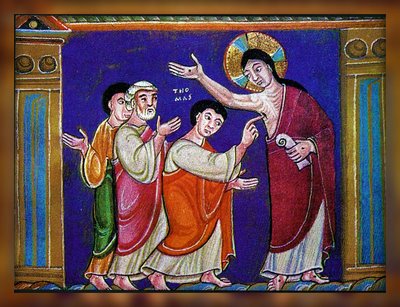
John 20-28 st-thomas

John 20:19-29 (20:19, 26) – April 19, 2020

Have you ever been afraid? I mean, really scared? I am talking about so scared that you wanted to hide away from the people in charge, permanently? Maybe it was you, maybe it was some acquaintance or friend, but some people have really been scared so much that they stay holed up in some hiding place, some attic or some upper room—just like the disciples, after they watched their Rabbi Jesus get arrested, beaten and then crucified.

Two thousand years later, we all know the rest of the story. Jesus rose from the dead on the first day of the week, that first Easter morning. What was it like for the disciples? I mean, the men disciples? Sure, they had heard from the women disciples that the tomb was empty. Peter and John had even checked things out at the tomb for themselves. It was true! The tomb was empty! I am sure that news caused a great deal of excitement, discussion, and wonder!

But, what about other feelings? What kinds of other emotions were happening to the disciples? How did they feel on the insides? Were their stomachs doing flips? Were their hearts in their mouths? Were they filled with amazement? Fear? Doubt? Or all of these emotions, all at once, or in stages? Could the disciples be hiding out behind locked doors because they were afraid, embarrassed and ashamed? What were they doing as Jesus died? They certainly were not with Jesus at the cross—except for John. Were they afraid of what Jesus would say to them about all their desertions if He really were alive again? [1]

John’s Gospel tells us, plainly, that the disciples were afraid. Fear is a legitimate emotion and reaction to a dangerous, scary experience.  Sure, the disciples knew that the tomb was empty, but that did not stop them from being afraid. I also suspect that they feared that the Roman authorities might come after them, as known associates of the Rabbi Jesus. The disciples did have good reason to be afraid and anxious of the people in charge.

And right into the middle of all this fear and anxiety—even though the disciples knew about the empty tomb—Jesus walked through a locked door into the upper room, greeted the disciples, and they were suddenly overjoyed! As if a modern switch were flipped, the disciples’ emotional expression flipped, too.

Except—for some reason, the disciple Thomas was not present in the upper room on that occasion. We don’t know why. The Gospel of John does not say. The other disciples told him, excitedly, “We have seen the Lord Jesus!”  But, Thomas was skeptical. He responded, “I need proof for myself. Unless I see the nail marks and put my hand in the wound in His side, I will not believe.” I can just see Thomas crossing his arms across his chest and turning his back to his friends. “Nope. No way. That is too big a whopper for me to swallow.”

Do you know someone who needs concrete proof in order to believe something? Different people’s minds work in different ways. Certain types of people need concrete evidence in order to convince them of the truth, or of the facts, or of someone’s honesty. Thomas was that sort of a person: a “show me” sort of guy. He needed that kind of proof in order to truly believe.

Whether we are talking about two thousand years ago, or about today, people have not changed. One type—one size does not fit all. Some people hear about the Gospel and believe right away. Other people hear about heavenly coincidences, or “God-incidences,” and then come to believe. We can compare Thomas’s skepticism before belief to Paul’s Road to Damascus experience, where the apostle Paul had a sudden “come to Jesus” moment. (Literally.) The New Testament holds up both of these very different experiences as valid.

I have heard sermons about “doubting Thomas.” As if there is something shameful or wrong with being skeptical! I suspect Thomas didn’t know whether to believe or not to believe; there is no shame in being skeptical! We can see that different people come to their own sense of belief in their own individual way, because God has created each of us as unique individuals. Is it any wonder that each of us comes to God in our own personal way?

When you and I think about this Gospel narrative in light of today’s events, there is indeed a great deal of fear and anxiety. Just as there was with the disciples, so it is right now. All over the nation, all over the world the virus COVID-19 makes all of us afraid and anxious. This virus is even more dangerous than the Roman authorities, forcing vast groups of people all over the world to curtail their travel, their interaction, even to the point of quarantine.

Yet, just as our risen Lord Jesus spoke to the disciples and declared, “Peace be with you!” He says the same thing to us. “Peace be with you!” Jesus has declared His peace to fearful people and to dreadful situations over and over again, throughout history. In times of serious illness, in times of conflict and war, in times of natural disaster—Jesus has these hopeful, heartening words for us: “Peace be with you!”

Jesus can come alongside of each of us, through fear, through anger, through desperation, and through grief. And if Jesus is at our sides, walking next to us even though we walk through dark valleys, that is peace, indeed. Jesus gives us His peace, no matter what.

Amen, alleluia!

@chaplaineliza

(Suggestion: visit me at my regular blog for 2020: matterofprayer: A Year of Everyday Prayers. #PursuePEACE – and my other blog,  A Year of Being Kind . Thanks!

[1] http://worshipingwithchildren.blogspot.com/2014/03/year-the-second-sunday-of-easter-april_13.html

Worshiping with Children, Easter 2A, Including children in the congregation’s worship, using the Revised Common Lectionary, Carolyn C. Brown, 2014.

Unknown's avatar

Words of Wondrous Love

“Words of Wondrous Love”

resurrection Jesus - medieval manuscript

Luke 24:1-12 – March 27, 2016

Have you ever had a very full week? Where a month of experiences have been packed into seven hectic days? At such a busy, sometimes tumultuous time, it’s hard to focus. Difficult to pick up the thread of conversations. Challenging to decide what important thing to do when, especially when there are so many urgent matters waiting for you. Calling for you. Nudging your elbow, clamoring for your attention. Add to all that tumult the trauma of a sudden death.

That is the situation for these faithful women. These women have gone through some gut-wrenching things, these past few days. After the Triumphal Entry into Jerusalem just a short seven days ago, these companions of the Rabbi Jesus had seen their leader in debate with some of the most learned religious teachers and leaders of Israel. Jesus had delivered one of His most stirring sermons—the Olivet Discourse from Matthew’s Gospel, as well as one of the most poignant—the Discourse from the Upper Room, from John’s Gospel.

As if all of that heavy theology from Rabbi Jesus wasn’t enough, their leader Jesus showed Himself to be everyone’s servant. Since there was no servant present at that Passover dinner on Thursday night to wash the guests’ feet, Jesus did it Himself. He took the position of a servant and washed His disciples’ feet. Talk about a mind-blowing experience. Your Rabbi, your teacher, whom you have been following for several years, hanging on His every word and action. This Rabbi, this Jesus becomes a lowly servant and washes everyone’s feet.

But, wait. We’re only getting started. Their Teacher, Rabbi Jesus did something completely unprecedented at supper that night. He took one of the loaves of bread, tore it apart, and said, “This bread? It’s my body. It’s going to be broken for all of you. Take it, and eat it.” Shortly after that, Jesus took one of the cups of wine and said, “This cup? This is the new covenant in my blood, given for you. Take it, and drink.” Jesus took the familiar Passover supper and instituted a new thing—the Lord’s Supper. What we call communion, the Eucharist.

Things really started to follow in rapid succession. The time of intense prayer in the Garden of Gethsemane. The betrayal of Judas, and the arrest of Rabbi Jesus. Repeated trials before Pilate, Herod, the Sanhedrin, the whipping and the scourging. I am certain all of this was reported to the disciples in great detail.

Pilate bringing Jesus before the crowd that Friday morning. The crowd yelling, “Crucify Him! Crucify Him!” So, Pilate sentenced this Rabbi Jesus to death. The Roman death of a criminal, death on a cross. Crucifixion.

Some of Jesus’s followers were there as He bore His cross out of the city of Jerusalem. They saw that agonized walk down the Via Dolorosa, the way of sorrows. Finally, as the cross was raised on Golgotha, Jesus suffered that most painful death, death on a cross.

All of that heartbreaking trauma, horror, and extreme grief were packed into just a few days. Plus, for all good Jews, Saturday was the Sabbath. Not only a regular Sabbath, but the special Sabbath during Passover. The women—the rest of the disciples hardly had a chance to begin to process all of those tumultuous events. They did their best to rest, to hide, to grieve on that seventh day of the week, on that Saturday.

I include the women as disciples of Jesus. As commentator Dennis Bratcher says, “Luke tells us that these women followed Jesus from Galilee and watched Him die on the cross (23:49). The Greek word for “follow” is the usual word used for a disciple …. It seems that Luke wants the readers to understand these women to be disciples of Jesus.” [1]

After all this, the women—trying so hard to be faithful in their friendship and following of their leader and teacher Jesus—take spices to anoint the body. They go to the tomb where Jesus had been hurriedly laid late on Friday, before sundown. As the Gospel tells us, they found the stone rolled away. And, the tomb was—empty!

Can you imagine how confused they were? Distracted? Astonished? Yes, it was early in the morning. The women had difficulty comprehending what was before their eyes. After all the horror and trauma of the last few days, while the women were talking amongst themselves, things got even weirder. As Luke says, “suddenly two men in clothes that gleamed like lightning stood beside them. In their fright the women bowed down with their faces to the ground.”

What would you do if two guys in gleaming white clothes showed up, suddenly appeared right here, in St. Luke’s Church? Pretty scary! Talk about being amazed. Astonished.

The men (we can call them angels, because that’s what they were) said, “Why do you look for the living among the dead? He is not here; He has risen!”

What did I say, a few minutes ago? How at such a busy, sometimes tumultuous time, it’s hard to focus. Difficult to pick up the thread of conversations, to pay attention. What on earth is going on here? We hear the angels say, “Remember how He told you, while He was still with you in Galilee: ‘The Son of Man must be delivered over to the hands of sinners, be crucified and on the third day be raised again.’”

Then—finally!—the women remember the words of their Teacher Jesus. They run back to their friends, the other disciples, telling them what happened. They are witnesses! They say, “The tomb is empty! Jesus is gone! And, we saw angels!”

I suspect we all can predict the reaction of the other disciples. “What? You saw … what? Are you crazy? What is the matter with you?” Luke tells us, “They did not believe the women, because their words seemed to them like nonsense.”

What must it have been like for the disciples to hear the Good News the angels brought? A little far-fetched. Maybe a whole lot far-fetched. They couldn’t take it all in. They didn’t believe it! They thought what the women were saying was crazy talk!

What is it like for us, today, to hear the Good News the angels brought?

Who do you identify with? Do you identify with the women? Do you believe in those words the angels brought, and run and tell your friends? Are you witnesses to the Resurrection? Or, are you like the other disciples? Doubting. Skeptical. Thinking those words seem like nonsense! Crazy talk! Perhaps the disciples didn’t remember the words of Jesus. No, not yet.

Ah, that first Easter morning. As Luke says, the angels remind us that our Lord Jesus told us what was going to happen beforehand. Our Lord Jesus predicted that He must be delivered over to the hands of sinners, be crucified and on the third day be raised again. Those were the words that the women remembered. And just like the women, we, too, can witness to the Resurrection. We can proclaim that powerful, loving, transforming experience that has happened!

What does that message, that Good News the angels brought, mean to you and me? Do we know the wondrous love of Jesus? The wondrous love that led Him to the cross, the wondrous love that pierced Him for our transgressions. And, by His wounds we—all of us are healed. Thank God Jesus died in our place, so we don’t have to be separated from God for eternity. Thank God Jesus conquered death. We have been reconciled to God. That is the Good News of wondrous love the angels brought.

Believe the Good News of the Gospel—Christ is risen! He is risen, indeed!       


(I appreciate Readings, Analysis of Texts and Preaching Paths, Dennis Bratcher, Christian Resource Institute. Thanks for the assistance in understanding the text from Luke.)

[1] http://www.crivoice.org/lectionary/YearC/Ceaster1nt.html#text2

@chaplaineliza

Suggestion: visit me at my daily blog: matterofprayer: A Year of Everyday Prayers– where I am doing a Lenten journey.  #PursuePEACE – And my other blog,  A Year of Being Kind -Thanks!