Unknown's avatar

A Foreign Neighbor’s Faith

“A Foreign Neighbor’s Faith”
Matthew 15:21-28 (15:28) – July 27, 2025

When I worked as a hospital chaplain at Swedish Covenant Hospital (now called Swedish Hospital), more than 10 years ago, one of the points of working there highlighted was the multi-cultural setting of that hospital and that neighborhood. The ZIP code that Swedish is in is one of the most diverse in the country, in all kinds of ways. In terms of languages spoken, various countries of origin, differing faith traditions, and wide economic differences in that ZIP code alone make Swedish Hospital a unique place to work, of great cultural diversity.

In our Scripture reading today, the Rabbi Jesus traveled up north of the Sea of Galilee, on the border of Palestine. It was in an area called the Decapolis, the Ten Cities, which also was a multi-cultural crossing point. Perhaps not as widely diverse as the ZIP code around Swedish Hospital, but with a number of diverse cultures, faith traditions, and languages spoken.

Our Gospel writer Matthew was quite particular about how he presented the information in his Gospel, which was written specifically for a Jewish audience. Let us look at how Matthew begins this vignette in the life of the Rabbi Jesus. “Jesus withdrew to the region of Tyre and Sidon. 22 A Canaanite woman from that vicinity came to him, crying out, ‘Lord, Son of David, have mercy on me! My daughter is demon-possessed and suffering terribly.’”

We learn a lot from these two sentences! Matthew wants his readers to know where the Rabbi Jesus had gone – into the area of the Decapolis, on the border of Israel – and that this woman who came to Jesus for help is not Jewish, but instead is a Canaanite woman – what the Gospel writer Mark in his parallel account calls a Syro-Phoenician woman.

The Canaanites were hated by the Jews, and were among those the Jews termed “Gentiles,” since they were polytheists and prayed to various gods like Baal and Asherah.

Up until this point, Jesus had ministered to very few people who were not Jewish. So, here we are, in a cross-cultural situation. Here the spotlight shines on a woman who is not Jewish, asking Jesus for help. And, help not for her, but for her daughter, who is suffering terribly! This request is familiar territory for the Rabbi Jesus, certainly!  

I have mentioned the Rev. Janet Hunt before. She tells a heartfelt story, some of which I repeat here. “Mental illness carries all kinds of stigma today. I have known this since I was a child and we experienced it in our own family. Back then it was something whose name you whispered.  I’m not sure it is so very different now.  When I was young during that time during the prayers of the church where we stood in silence and remembered people in need, I would close my eyes shut tight and silently plead for Aunt Donna’s healing. It didn’t come.” [1]
            In the case of our Gospel narrative, we are not sure what is the matter with this daughter of the Canaanite woman. Certainly, it could well be mental illness! This was often seen as demon-possession in past centuries. Mental illness carried a huge stigma in the first century, just as now, in the twenty-first.

It is Jesus’s response that is surprising. Or rather, His non-response. “The disciples, obviously aggravated by her persistence, ask Jesus to deal with her request so that they can be on their way. Jesus then explains that his mission (under the authority of God) is to call out the faithful remnant of Israel. This doesn’t deny a future mission to the Gentiles, only that for the present, ‘salvation is from the Jews.’” [2]

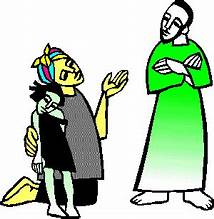
The all-important point of this narrative comes from this mother, this neighbor from a different neighborhood. Our summer sermon series this summer is all about Fred Rogers. He met with a lot of different people from many, many different neighborhoods. Diverse cultures, and from foreign shores, or neighborhoods, too. As this Biblical narrative continues, the woman speaks to Jesus again. “The woman came and knelt before him. “Lord, help me!” she said.26 Jesus replied, “It is not right to take the children’s bread and toss it to the dogs.” 27 “Yes it is, Lord,” she said. “Even the dogs eat the crumbs that fall from their master’s table.”

28 Then Jesus said to her, “Woman, you have great faith! Your request is granted.” And her daughter was healed at that moment.

Did you hear? This woman from a different culture, from a different neighborhood, had great faith! Jesus acknowledges that, and her daughter is miraculously healed at that moment! It is marvelous that this faithful foreign woman – who knew that Jesus was the Chosen One of God, and called Jesus by the Messianic title “Son of David” – did indeed have great faith!

Except, where does that leave us today? What are we supposed to do with this narrative from Matthew’s Gospel? As commentator Karoline Lewis tells us, “A lot of how we talk about faith indeed ends up being about measurement. Life’s consequences are attributed to whether or not someone had enough faith, whatever the circumstance may be. “Just have faith!” Well, how much? It doesn’t seem like a little will do. And how do you get more? Are you stuck with what you have? Are we genetically disposed to a certain level of faith?” [3]

I sometimes wonder whether I would have had even half, even a quarter of the amount of faith this Canaanite woman had! I suspect that these are the kinds of issues about faith with which all of us struggle — and which we may likely hear in the Canaanite woman’s deep, heartbreaking request. “We wonder at the faith that is already working within her.  Even though she is a Gentile, somehow she sees Jesus as having come for her as well.[4]

At the same time, I do not want us to assume that because we do not have great faith that the Lord Jesus turns His back on us, or refuses to do anything for us at all. Which is what false teachers of the Gospel often tell their followers: “Oh, you did not receive that healing – or that answer to prayer – because you just didn’t have enough faith!”

No, Christianity is not a cheap marketplace, or a mercenary vending machine in the sky where we deposit our money and miracles and healings magically come forth. No, this Canaanite woman had faith in the Lord Jesus, the Messiah, the Son of David. She developed a relationship with Jesus. And, it all started with a mother’s willingness not only to speak, but to shout.  For the sake of love. For the sake of a much beloved daughter, desperately ill.

Our faith in God – your faith and mine – “lays claim on how you are in the world, how you choose to be, how [each of us] decide to live, in each specific moment of your life…. faith is not a fixed collection of beliefs but a state of being. Your faith is great, not because of what you do, but because of who you are.” [5]

Fred Rogers had a wide variety of diverse neighbors in Mister Rogers’ Neighborhood. These were both real neighbors in the real neighborhood, and the puppets and people of the Neighborhood of Make-Believe. They all interacted with one another with kindness and respect. Fred Rogers tells us, “As different as we are from one another, as unique as each one of us is, we are much more the same than we are different. That may be the most essential message of all, as we help our children grow toward being caring, compassionate, and charitable adults.” [6]

Yes, Jesus healed this daughter of a neighbor from a different neighborhood, a foreign neighborhood. As you and I travel through different neighborhoods in our lives, we can have the same openness, care and compassion that Jesus had. That Fred Rogers had.  

Be like Jesus. Be like Fred Rogers. Go into multicultural places with openness and respect, care and compassion. Go, do that.

(A big thank you to the online resources for Mr. Rogers Day – the Sunday nearest March 20th, Fred Rogers’ birthday. These resources come from the Presbyterian Church (USA). https://www.pcusastore.com/Content/Site119/Basics/13792MrRogersIG_00000154465.pdf )

@chaplaineliza

(Suggestion: visit me at my other blogs: matterofprayer: A Year of Everyday Prayers. #PursuePEACE – and  A Year of Being Kind . Thanks!


[1] http://words.dancingwiththeword.com/2014/08/a-mothers-cry.html

[2] https://www.lectionarystudies.com/studyg/sunday20ag.html

[3] https://www.workingpreacher.org/dear-working-preacher/getting-great-faith

[4] http://words.dancingwiththeword.com/2014/08/a-mothers-cry.html

[5] https://www.workingpreacher.org/dear-working-preacher/getting-great-faith

[6] https://www.misterrogers.org/articles/he-helped-us-with-our-relationships-with-others/ 

Unknown's avatar

God-Given Gifts!

“God-Given Gifts!”

1 Corinthians 12:12-27 (12:12) – January 26, 2025

At this time of the year, many people get all excited about sports. Hockey, basketball, and especially football. The end of the football season is upon us! There are many different types of positions on a football team. I was wondering: how good would a team be if all of the players were big and bulky, like offensive linemen? Or, how about if all the players wiry and nimble, like wide receivers? How successful would a team like that be? 

The Apostle Paul told the church in Corinth about another group, or team. Except, he called it a body—God’s Body. God put together all the different believers into a team, or body called the church. God’s team. When we consider our Bible reading for today, we can also see that God made different kinds of gifts. God’s plan is for human beings to live together in one body. That is, with one another, in a great big community, in all its colorful diversity.

What on earth is Paul talking about? A body? Why is he mentioning a metaphor like that? He was responding to a letter from the church in the city of Corinth. He had spent a number of months in the city, teaching and preaching. Then, he went on his way to spread the Good News of Jesus Christ to other cities. He was an itinerant preacher and missionary, after all.  I suspect Paul had a great number of people sending him letters, asking him questions, wanting his advice about continuing problems in the various churches he had founded. A number of big things were the matter with the church in Corinth. In his letter, Paul tried to correct several issues, including this important issue about spiritual gifts, and unity in the church.

What is the background of today’s reading? One chapter before, in chapter 11, Paul offers instruction on public worship. He deals with the believers in church acting inappropriately, and lets them know they ought to straighten up, and be unified – together! Then, in chapter 12, Paul continues the theme of unity – except he brings in the wonderful concept of spiritual gifts in the Church. Diversity of spiritual gifts, given to each member of the Church, of the Body of Christ.

That is not just a few members, or only some members of the Church. It is not even most members of the Church. God gives gifts to ALL members of the Church, of the Body of Christ. Each person in the Church, no matter who, no matter where they are from, is a beloved member of the Body of Christ. That is the Church Universal, and God gives gifts to all.

Not just the church on this side of Morton Grove, not just the church that holds their worship services in English, not just the church that has people who “look like us.” No, each individual person is beloved, and is given a share in the diverse gifts of the worldwide Body of Christ. Can you, can I possibly imagine the diversity in that worldwide body? And, can you, can I possibly begin to understand that God is so pleased when we all, worldwide, agree together and act and worship and live together in unity as a loving Body of Christ?

We all are probably familiar with a popular children’s toy. Put out by Hasbro, small children have played with it for decades. Made even more famous by an appearance in Toy Story movies from Pixar. Mr. Potato Head, accompanied by his partner, Mrs. Potato Head, of course. You remember how Mr. Potato Head works. A large potato. And, the separate parts of the body: eyes, ears, nose, mouth. Hands, feet.

Reminds me of the Apostle Paul’s metaphor of the Church, the body of Christ, doesn’t it? But what if our Potato Head had all eyes, and no hands? Or, all ears and no feet? What then? Lopsided? Wouldn’t work properly? Just imagine if our local church, St. Luke’s Church, was all lopsided like this? Wouldn’t work properly? Not only is the Church meant to have unity, and work well together, it is also made up of diverse or different parts, on purpose!

            Looking back at Genesis, we can see that diversity is definitely in God’s plan for humanity from the very beginning. The sheer creativity of God in creation is so big and so varied. A countless variety of individuals made in every size, shape, color, ethnicity. Having endless variations of gifts and abilities that God gave to each of us.

This is a recurring problem in Corinth – the people were convinced that some people and some gifts were better than others. They completely missed Paul’s repeated statements that God gives a multitude of diverse gifts and abilities to all of God’s beloved, diverse church members! Not that some church members were better, or more popular, or had a greater gift than everyone else. No! Paul states plainly that every person counts! Every gift counts, and every single person in each of their lovely, multi-colored, multicultural diversity is beloved of God. What is more, has received God’s spiritual gifts for free use in the multi-colored, multicultural Body of Christ!

Yes, tension and division and racism and enmity exist – all within the Body of Christ. I cannot even imagine how that breaks God’s heart, knowing that churches on one side of town are arguing with churches on the other side of town. Or, that some churches are ignoring the plain words of the prophet Micah to do justice, to love mercy, and to walk humbly with our God. Or, ignoring the plain words of Jesus to be merciful to the powerless and the least of these.

Yes, in today’s uncertain times, the Church has “tensions from within and without which are bringing doubt and confusion to the Body as we face the challenges of the near and distant future.” [1] Thank God we have a firm foundation on which we all stand. Thank God we have the words of Paul here in 1 Corinthians calling us to unity under God, rejoicing in our diversity with all the multi-colored, multicultural people of God, worldwide.

Yes, each of us is different from each other. And, yes, we are all one in Christ Jesus. We can celebrate that blessed both/and reality today! Just imagine what a marvelous job each Church could do, if each member used what God has freely given to each one, to the best of their ability! What an opportunity for ministry and outreach!

What possibilities lie before us as a church, as the Body of Christ in this place? May each of us prayerfully ask today what God would have us to do with the gifts and abilities God has given each of us.  Amen, alleluia!

@chaplaineliza

(Suggestion: visit me at my other blogs: matterofprayer: A Year of Everyday Prayers. #PursuePEACE – and  A Year of Being Kind . Thanks!


[1] https://www.churchofscotland.org.uk/worship/weekly-worship/monthly/2025-january/sunday-26-january-2025-third-sunday-after-epiphany-year-c

Unknown's avatar

Full of God’s Glory!

“Full of God’s Glory!”

Isaiah 6:1-8 (6:3) – May 26, 2024 

Have you ever visited a really beautiful church? Magnificent, with lovely stained glass windows, carved pews, high, vaulted ceilings? What comes to my mind is the National Cathedral in Washington D.C., or St. Paul’s Church in London, or perhaps one of the great Gothic cathedrals in the Rhine valley in France or Germany. Think of a church like that, only magnify the beauty and wonder of the building ten times. I cannot even imagine a place that spectacular.

Yet that is just what Isaiah is trying to describe for us in our scripture passage today. A church—or, more specifically, a heavenly temple—so magnificent that he can hardly even begin to describe it.

That is only the beginning! What is even more magnificent, more awe-inspiring is what Isaiah sees inside that heavenly temple. The prophet says he “saw the Lord, high and exalted, seated on a throne; and the train of his robe filled the temple. Above him were seraphim, each with six wings: With two wings they covered their faces, with two they covered their feet, and with two they were flying. And they were calling to one another: “Holy, holy, holy is the Lord Almighty; the whole earth is full of his glory.”

Isaiah finds himself in the throne room of heaven in the presence of the Lord of creation. Awe-inspiring, terrifying, humbling, overwhelming. I don’t know about you, but God’s magnificence and glory can knock me off my feet when I least expect it. God can bump me and shake me up. God can turn my self-sufficiency inside out. Has that happened to you, too?

Perhaps you recognize the words from our opening hymn this morning: “Holy, Holy, Holy, Lord God Almighty!” Today is Trinity Sunday, that day in the church year, the week after Pentecost, when we lift up one of the ineffable mysteries of the Church: the holy Trinity itself. I love this passage from Isaiah for several reasons. First, this is Isaiah’s call story, how the Lord God reached out to Isaiah and touched this man with the power of God, and placed him on the road of being a prophet for God.

Such a moving story, and one that resonates with anyone who has been similarly called by the Lord into a God-ordained calling or vocation. (And not necessarily just a “churchy” vocation.) Some people feel very strongly that they have been called to be doctors or nurses, teachers or social workers, farmers or mechanics. God can call people to a variety of positions, all to serve to God’s glory and for the good of humanity.

Yet, this reading today is much more than that. Not only is Isaiah’s experience one of marvel and awe. This reading is one of the sources for our worship service today.

As Dr. Lisa Hancock advises, “The whole encounter begins with Isaiah showing up at the temple. So, consider taking some time to welcome and orient the congregation toward showing up to God’s presence in their midst. Acknowledge all that we bring with us into worship, the burdens and joys and everything in between.” [1] We as a congregation strive to tune into God’s presence with us even as we have come to be present to God and one another. The most amazing part is, we come into God’s presence each time we gather to worship!

            Orthodox Christianity confesses the Holy Trinity each time a congregation repeats the Apostles Creed. Confessing belief in the Father, Son and the Holy Spirit – or in more modern language, Creator, Redeemer and Sustainer – is an intellectual, static form of statement of faith. Yet, as we consider the Trinity more deeply, even more theologically, we often are thrust into the midst of relationship! This awe-inspiring, terrifying Presence that Isaiah saw in the heavenly temple is also a vibrant Three-Persons-in-One. Difficult for us to even comprehend, but the idea of a Divine Relationship, companionship, a heavenly Community-in-One is the beginning of our understanding. As complex and mind-blowing as it can be.             

            Just as those seraphim sang, “Holy, holy, holy is the Lord of Hosts!” and just as we are welcomed into God’s presence each time our congregation enters into worship, so the Holy Trinity is here in this place. The Three Persons of God are in beautiful relationship with one another, and we are invited into that heavenly relationship, too!      

            We are cautioned, however. God does not only want the people from this particular neighborhood as a part of that heavenly relationship. God does not only belong to this particular church. God also is God of our Catholic friends, and of Holy Name Cathedral in downtown Chicago, and of Trinity UCC and San Lucas United Church of Christ. God is also God of the Quaker meeting in Evanston as well as Chinese Christian Union Church in Chinatown, and our Korean friends Love Sharing Disciple Church in Morton Grove. A whole multitude of different faith traditions, too, from every tribe, every nation under heaven.

            As my online friend Rev. Bosco Peters says, “We live in a world that so often fears difference. We bully them, persecute them, will not employ them, do not want to live in their neighbourhood, kill them, go to war with them. Yet the universe…holds wonderful diversity in unity. This beautiful multiplicity held in harmony in our universe is no accident because the source and heart of all reality is the one we call “God” – three in one. To live the Trinity life is to rejoice in diversity and to work towards holding it in unity.” [2]

It does not matter to God – the awe-inspiring, humbling and overwhelming God is above all and over all. Just as the Holy Trinity is in relationship and in heavenly community, Triune Three-in-One, our God wants a relationship with each of us! The Lord desires to develop an intimate relationship with every person, in beautiful diversity, promoting harmony and unity regardless of color, creed, cultural difference, language or nation of origin.

We are encouraged to enter into relationship just as we are encouraged to enter into worship each week! With God, yes! And with every other person in diversity, regardless of color, creed, cultural difference, language or nation of origin. God created each one of us to live the Trinity life! Rejoice in diversity and work towards holding it in unity. That means each and every person, each and every child of God. Including you, including me. Alleluia, amen.

@chaplaineliza

(Suggestion: visit me at my other blogs: matterofprayer: A Year of Everyday Prayers. and  A Year of Being Kind . Thanks!


[1] https://www.umcdiscipleship.org/worship-planning/ascribe-to-god/trinity-sunday-year-b-lectionary-planning-notes

[2] https://liturgy.co.nz/trinity-sunday-2024?fbclid=IwZXh0bgNhZW0CMTAAAR30CzSonnCEtgz7V1bvjxP9SYmzEmRrJj2NYa4L3R2dl-dmA1nf3cPFzL4_aem_ATWps3Va7lMKpyFuppPtoxnznrMJ8apyP_Fq3to2Rlo1zOv7fsosZJtrIT-639n4JB33Yo04O1K_sCdt-hhKevdp

Unknown's avatar

Great Faithfulness, Indeed!

“Great Faithfulness, Indeed!”

Lam 3-23 faithfulness, clouds

Lamentations 3:19-26 – October 6, 2019

About twenty years ago, I attended a church with a pastor who preached very powerful sermons. This pastor would occasionally mention that he prayed his preaching “would comfort the afflicted and afflict the comfortable.” That sounds very like the Bible book we read from this morning. The little book of Lamentations was written at a complicated time in the history of the nation of Israel, and the prophet who wrote it was conflicted at the time he wrote.

I wonder, can anyone here relate to being sad, troubled and conflicted, sometimes? Does anyone here have bad or sad or troubling things happening in their lives right now, either in their lives or the lives of their loved ones? I know many people do have all kinds of things raining down on their heads.

Perhaps it’s health concerns. At countless hospitals, chaplains or nurses or doctors can tell us about patients with very serious health concerns like heart attacks or strokes. Or, what about continuing health conditions like kidney disease, COPD, multiple sclerosis, or Parkinson’s disease? I am certain that everyone here today knows at least one friend or family member who suffers from some difficulty, disease or condition like these.

Let’s look at some other concerns, like lack of finances. Loss of employment can certainly affect not only individuals, but whole families as well. What about floods or hurricanes? How many lives in the United States have been devastated by these horrible happenings, just in the past two or three months? The number is astronomical.

Add situations such as “your house has burned to the ground,” or “your family member is getting a divorce.” In these situations, what kinds of things would be going through your mind? What are the feelings of the people in these situations?  What are some of the things these conditions make you want to say to God? What are some of the questions you’d like to ask God about these situations?

That is exactly the problem our prophet and writer of Lamentations has. This little book is a series of laments, asking God about the serious situation the nation of Israel is in, asking—in a word—why? That is a question that so many people are asking!

We know the prophet Jeremiah, the probable author of this book, was no stranger to despair.  Consider how he opens in verse 1: “How lonely sits the city that once was full of people” (Lam. 1:1). His city—Jerusalem—has been ransacked by the Babylonian army and left for dead. It seemed God’s very purpose and people had been abandoned. [1]

As commentator Carolyn Brown tells us, many places in the Hebrew Scriptures have “people talking back to God.  These are deeply hurt, terribly sad, and totally angry people, and they are willing to tell God so.  We talk to children often about telling God the happy things, confessing our sins to God, and asking God for help.  But, we also need to give them permission, even encourage them to tell God when they are angry, when life seems unfair, when it looks to them as if God isn’t doing God’s job the way it should be done.” [2]

I would like to stop right here, and let us consider this particularly important task of allowing, of permitting children to grieve. We all need to grieve and mourn, from time to time. Grieving is an important thing to do. We as adults do, indeed, need to model for children our way of dealing with difficulties, problems, even catastrophes. Otherwise, many more people would pull their heads into their shells, like turtles, to escape from these serious difficulties.

And yet—and yet—amid all of this sorrow, suffering and despair, the prophet writes of how blessed he finds the present difficult situation.

What a contrast! What a puzzle! How can this be? Great question!

Commentator Steve Godfrey goes further, “From the depths of his despair Jeremiah turns to something he has come to know well, the loyal love of God.  The Hebrew word used here, hesed, is a constant theme throughout the Old Testament.  It is sometimes translated ‘steadfast love’ or ‘faithful lovingkindness.’”  [3]

What a marvelous thing to have faith in! After so many awful descriptions of horrible things during the past poems of distress, the prophet gives us a ringing endorsement of faith in God’s steadfast loving-kindness in chapter 3 of Lamentations.

Commentator Steve Godfrey has more than the usual difficulty with sad or disturbing things. He has low-grade depression, and he would like for us to know about his occasional mental condition. “As someone who has managed low-grade depression for 31 years of his adult life these are words that encourage profoundly. They don’t minimize or avoid the issue….

“These words don’t mean that Christians should never get depressed.  The Prophet Jeremiah got depressed and I’ll put his character up against depression deniers any day of the week!  The beauty of the gospel is that it embraces both anguish and hope.  Paul had a thorn in the flesh; low-grade depression is mine.  By God’s grace I manage it through diet, exercise, medication, and counseling.  It’s something I inherited through genetics, and that’s okay.” [4]

Praise God for such a constructive attitude. I doubt very much whether I would be able to maintain such a positive attitude and expression. Knowing that God is there with me, through it all, is so helpful to me when I am going through difficult, even traumatic times. I can share a testimony of God’s presence, of God’s chesed, “steadfast love” or “faithful lovingkindness,” with those who are also having difficulties in life.

But, let us shift our focus from our reading today to why we gather this morning.

We celebrate World Communion Sunday today. This sacrament has been celebrated in good times and in bad, during war and during peace, during times of turbulence and trial as well as times of great joy. Communion has also celebrated by many different people groups in many, many different places throughout the globe. Whether we call it the Lord’s Supper, the Eucharist or Communion makes little difference. The unity between various, diverse ministers leading and coordinating observances of this meal our Lord Jesus commanded us to observe is a wonderful glimpse of what this world can be.

Whether we are glad, mad or sad, whether we have only a little or have a lot of goods in this world, whether we are in good health or not-so-good, our Lord Jesus bids us join together in this meal, to be unified and one body, celebrating our diversity. He welcomes each of us to His table, no matter what.

Praise God, what a welcome! Our Lord bids us, come! Thank You, Lord Jesus.

[1] https://churchintheworld.com/2013/09/30/navigating-depression-2/

“Navigating Depression,” Steve Godfrey, Church in the World, 2013.

[2] http://worshipingwithchildren.blogspot.com/2010/09/year-c-27th-sunday-of-ordinary.html

Worshiping with Children, Ordinary 27C (World Communion Sunday), Including children in the congregation’s worship, using the Revised Common Lectionary, Carolyn C. Brown, 2010.

[3] https://churchintheworld.com/2013/09/30/navigating-depression-2/

“Navigating Depression,” Steve Godfrey, Church in the World, 2013.

[4] Ibid.

@chaplaineliza

(Suggestion: visit me at my regular blog for 2019: matterofprayer: A Year of Everyday Prayers. #PursuePEACE – and my other blog,  A Year of Being Kind . Thanks!

Unknown's avatar

Unity of Christ’s Church

“Unity of Christ’s Church”

Gal 3-28 all one in Christ

Galatians 3:26-29 – August 28, 2016

One of my sisters lives in the New York City area, on Long Island. She has lived there for more than twenty-five years. She is a wonderful, generous hostess, and often takes her family and friends to various places around New York, site-seeing. We love to visit my sister. When my children were younger, we went with my sister to the top of the Statue of Liberty—on two different occasions!

The Statue of Liberty. A beacon of light for generations. When my grandfather was a boy in the early 1900’s, he and his family emigrated to the United States from a shtetl in western Ukraine. He remembered standing on the deck of a steam ship from Europe, coming into New York harbor.  He gazed over the rail at the welcoming sight, along with everyone else on that ship. The Statue of Liberty was etched vividly into his memory. I know, because he told me so.

This country has been called a melting pot, containing different nationalities, cultures, and ethnicities. Some call this country a mosaic or a kaleidoscope of people. Whatever you call it, the United States is truly an amazing nation made up of a multitude of individuals (or, their ancestors) who came from all over the world.

Unity. Unity amidst diversity. That is what this country is all about.

Let’s take a second look at our Scripture passage for today from Galatians 3. The Apostle Paul writes to the believers in the region (or area) called Galatia in Asia Minor. He makes an all-important point at the end of chapter 3: our text for today. “26 So in Christ Jesus you are all children of God through faith, 27 for all of you who were baptized into Christ have clothed yourselves with Christ. 28 There is neither Jew nor Gentile, neither slave nor free, nor is there male and female, for you are all one in Christ Jesus.”

I think you all might suspect what the theme for today’s service is. Unity!

Just as our nation incorporates strong unity amidst wonderful diversity, so does the Church. Not only this congregation, this fellowship of believers, but I am talking about the Church Universal. The Church around the world.

Taking a closer look at verse 3:28, at first glance, we might focus on the differences. Wow! There are some pretty big differences here. Paul mentions some significant separations and divisions. Different categories. What does this diversity look like?

First, “there is no longer Jew nor Gentile.” That is a serious thing for the Apostle Paul to say. Before his conversion on the road to Damascus, Paul was a Hebrew of the Hebrews; a member of the Sanhedrin (that is, the ruling religious council of Jerusalem). A top-notch Pharisee who probably prided himself on his meticulous keeping of the Mosaic Law code, down to the smallest detail. Good, law-keeping, observant Jews of that time would not allow themselves to associate with, or even talk to a Gentile. So—after he became a Christian, we can see how serious Paul was about this unity of everyone, in Christ Jesus.

The second difference? “There is neither slave nor free.” Jesus Christ takes away all distinctions of social class and standing!

Wait a minute! That is not strictly true. In this troubled world, there are lots of differences, lots of separations in social hierarchy. In Morton Grove, we see many people who are solidly middle class. Different from wealthy people living on the Gold Coast, just off Michigan Avenue near the Water Tower. Go just a few miles further south, to the Englewood area of Chicago. I saw some of areas of extreme poverty when I visited there, earlier this month.

However, when people come to believe in Jesus Christ, social class and power can be dissolved, and go away. The unity of all believers is emphasized in this verse, again.

The third difference we notice? Paul mentions “nor is there male and female.”

Subtle difference! Yes, God created people male and female. Yet, when people come to faith in Christ Jesus, there is a new creation. All things are become new, as Paul tells us in 2 Corinthians 5. Even gender is given a back seat. Each person’s belief in Christ is emphasized in this new creation, differences are dissolved, and the unity of all believers is lifted up. We are all one big family.

Earlier in this letter, Paul mentions circumcision. That’s something that is very Jewish. And, very male. In the time before the common era, women and girls could not be considered full children of Abraham because they could not be circumcised. (For obvious reasons.) That was fully half of all religious people who could not fully participate in religious functions. Yet now, in this new creation in Christ Jesus, the old differences and distinctions no longer separate male and female. All things have become new.

Let me remind everyone of how earthshaking this all must have been for the Apostle Paul. Talk about having his entire worldview and frame of reference turned upside down! A good, observant Jew who studied with one of the leading rabbis of that day, now associating and eating with Gentiles. Staying in their homes. What a huge change of Paul’s way of thinking.

One big theme of the letter to the Galatians is that of identity. Who are we? What are our identity markers? How do we tell who others are, in our group? Paul says so, right here. Those who are baptized in Christ are children of God. Everyone who is baptized is our brother, our sister. That’s a whole lot of people, when we consider all the people who are believers, not only in the United States, but in the whole world!

I don’t know how many of you remember your own baptism, as infants and children. However, Paul is talking to people who were baptized as adults. The weeks beforehand must have been significant, too, in which these new believers were fully instructed and immersed in the understanding of Christ as their Messiah, their Lord and Savior. Then, often on Easter Sunday, the new believers were baptized. When possible, they were fully immersed, or at least had water poured over them in a large tub. Sometimes, naked, because they often would remove their clothing before the ceremony. After the baptism, they put on a new, white garment, signifying their new life in Christ. They were truly “clothed in Christ,” just as Paul says here.

As diverse and different as we are, considering world-wide Christianity, we all have become one humongous family of God. We are all God’s children.

How many of us, today, can say that? Yes, when babies and children are baptized today, we make a big fuss. We buy them special outfits for the occasion. But, do we truly take the new reality—this new identity—to heart? We have all been transformed, through Christ.

What a transformation! What an identity shift. We here at St. Luke’s Church are just as much God’s children as the Catholics worshipping at St. Martha’s Catholic Church south of Dempster. And, both groups of believers are just as much God’s children as those baptized at St. Haralambos Greek Orthodox Church on Caldwell. And, what about our friends at Love Sharing Disciple Church here, who will be worshipping in this sanctuary later today? This is duplicated at churches and auditoriums all over the Chicago area, with diverse ethnic and cultural groups of believers. We can enlarge that to a wide variation of church practices, all over the world. Wow! Double wow!

What a mosaic of identity in Christ. What a kaleidoscope of difference, made one huge family of God. Remember our sentence for the week, from the United Church of Christ Statement of Mission? Empowered by the Holy Spirit, we are called to embrace the unity of Christ’s church.”

The unity of Christ’s church, in such beautiful, rich, worldwide diversity. This is truly something to celebrate! Alleluia, amen.

[Thanks to Dr. Richard B. Hays for concepts and ideas from his commentary on Galatians 3, from The New Interpreter’s Bible Commentary (Nashville, TN: Abingdon Press, 1996).]

@chaplaineliza

(Suggestion: visit me at my regular blog for 2016: matterofprayer: A Year of Everyday Prayers. #PursuePEACE – and my other blog,  A Year of Being Kind . Thanks!)

Unknown's avatar

A Great Multitude

“A Great Multitude”

Rev 7 multitude white-robes

Revelation 7:9-17 – April 17, 2016

This past Friday, April 15, 2016, I convened a Peace Breakfast at Kappy’s Restaurant, here in Morton Grove. We had a diverse group assembled! Not quite as diverse as this great multitude that John talked about in Revelation 7, but still, diverse. Culturally, ethnically, and religiously different from one another.

Let’s step back, and think about the book of Revelation. This is not your typical bible passage to read on a Sunday morning. Not your usual sermon text, either. The book of Revelation is a series of interconnected visions alerting believers to the last days of the church.

Chapter 7 comes towards the beginning of John’s visions.

I’d like everyone to think of an old-fashioned radio or television serial, in multiple parts, or episodes. Here we have yet another fantastic episode of this amazing book.

For centuries, many preachers, teachers, and bible interpreters have read Revelation, and completely pick it apart. Find all types of supposed references to actual people, places and things. Use it as a guidebook for the End Times. It sounds like the political hype we lament but can’t quite seem to escape. (Let me say—bible interpreters have been “identifying” people, places and things in Revelation for centuries. Different anti-Christs, different identifications for the Four Horsemen of the Apocalypse, and all the rest—every century, every era, every place.)

If John wrote this book to bring hope to his readers, how in the world can this passage of Revelation provide a different, more life-giving vision to us, today?

Our bible passage today opens with a great multitude. It’s like John has a huge video screen in front of him. He’s watching this fantastic vision play out in front of him.

I encourage you all to get into the spirit of this passage. Shut your eyes, and imagine yourself seated in a heavenly theater (an iMax theater, if that helps you). John is seated right next to you, and suddenly, you see a great multitude on this massive screen in front of you. Every racial group, every ethnicity, every language spoken. All of them! All the things, as the young people say today.

Yes, in the larger picture, all of these people in the great multitude are going to go through a time of great trial. However—I would like to focus on this multi-racial, multi-ethnic, multi-lingual multitude of people.

We are all aware of other separations and designations for groups of people. Upper class, working class. City folk, country folk, North side, South side. With all of this fantastic stuff going on in the book of Revelation, on that huge theater screen in front of us, who has time to think about these divisions? Who would be concerned—in heaven? Standing before the throne of God Almighty, in the full sight of God.

Yet—here in this world, here in the United States, in the Chicago area, those things do matter. As a pastor, I talk to a number of people many times in a week. Some of these people share about their fears and hopes for the future. More and more, I notice a shift in the mindsets of people—a shift towards deeper feelings of uncertainty and general anxiety.

I am distressed and dismayed at the overt anger, undisguised racism, and blatant xenophobia that is increasingly happening in this country. The shouting, yelling, name-calling, and general mud-slinging in this political primary process, just for an example. Note: I am not taking sides, but I am truly dismayed by the marked increase in such attitudes due to people’s ethnicity, culture, or religion. That is what I see as a big problem today.

Perhaps I am an idealist, but I would like to believe that we as a nation are truly a melting pot. This country is one of the most like this image, this part of the vision that John saw. That is such a strength of the United States! Yay! Go, us!!

We are going to switch gears. Let us look at the beginnings of the church.

In Acts, shortly after the day of Pentecost, a disagreement came up in the church. As Rev. Findlayson mentions, “The Jewish world was divided between Aramaic-speaking Jews from Palestine [Hebrews—home grown], and Greek-speaking Jews from the dispersion [or Hellenists—who had grown up outside Palestine]. Racial tension, often focused on religious purity, existed in the wider Jewish community and found its way into the New Testament church. [The tension] revealed itself in a dispute over the care of widows. The [Greek-speaking Jews] claimed that their widows were not getting a fair share of the church’s welfare budget.”

Do you hear the problem? Two separate groups of people in the early Church—all Jews, and one group—a minority group, no less—claimed they were being overlooked. Discriminated against. Now, multiply that 100 times. No, 1000 times. And, you begin to see the problems we all have today with rampant, widespread hatred, racism, fear, and xenophobia.

I guess I was one of those people who wanted to believe that we as a country and maybe even as a human race were becoming more open, integrated, and generous. I wanted to believe that humans were moving past this kind of hatred, fear, and violence. I thought we were on the way towards making it as difficult as possible for anyone to intimidate or harm others simply because they are of a certain religion, or racial background, or culture.

What can conquer such deep set feelings?

John 3:16 is a wonderful verse. So much promise, so much love, so much grace. And—so much power!

Let us consider John 3:16. I suspect many of you can say it with me. We are just going to quote the beginning of the verse: “For God so loved the world that He gave His only begotten Son.” I wondered: let’s unpack this verse. God loves? With a God-sized love. We all agree. God gave His Son—God’s ultimate Gift. Again, we all agree.  

The last phrase of this sentence? God so loved—the world.

Who is not part of the world that God loved? Let us consider racist feelings. Does God love the racist person? Yes. How about the person who is racially profiled? Yes.

Let’s consider xenophobic fears. Does God love the person who is so afraid of people who look different from them, or speak another language, or come from another part of the world? Yes, God does. God loves everyone. No matter what.

That is the hope we can gather from this passage in Revelation 7 today. God loves you. God loves me. Even though we may be flawed, and make mistakes, and do or say bad things. God still loves us.

The Peace Breakfast was a beginning, a chance to continue the conversation. We all live and work together, in community. Let’s promote positivity and friendship, not distrust and alienation. Here, in Niles and Morton Grove—and in Des Plaines, Glenview, Skokie—all over the Chicago area—we have such a multitude of diverse people! And it’s an opportunity to shine forth as a light of the Gospel, right here on this corner of Shermer and Harlem.

Finally, we can all praise God along with the great multitude from Revelation, and say, “Amen! Praise and glory and wisdom and thanks and honor and power and strength be to our God for ever and ever. Amen!”

@chaplaineliza

(Suggestion: visit me at my daily blog for 2015: matterofprayer: A Year of Everyday Prayers. and my other blog,  A Year of Being Kind .  Thanks!)

Unknown's avatar

One Family of God

“One Family of God”

unity how good it is

1 Corinthians 12:12-14 – January 24, 2016

At this time of the year, many people get all excited about sports. Hockey, basketball, and especially football. The end of the football season is upon us! There are many different types of positions on a football team. I was wondering: how good would a team be if all of the players were big and bulky, like offensive linemen? Or, how about if all the players wiry and nimble, like wide receivers? How successful would a team like that be?

The Apostle Paul told the church in Corinth about another group, or team. Except, he called it a body—God’s body. God put together all the different believers into a team, or body called the church. God’s team. When we consider our passage for today, we can also see that God made different kinds of gifts, as well. God’s plan is for human beings to live together in one body. That is, with one another, in a great big community.

What on earth is Paul talking about? A body? Why is he mentioning a metaphor like that? Well, he was responding to a letter from the church in the city of Corinth. He had spent a number of months in the city, teaching and preaching. Then, he went on his way to other towns, to spread the Good News of Jesus Christ. He was an itinerant preacher and missionary, after all.

I suspect Paul had a great number of people sending him letters, asking him questions, wanting his advice about continuing problems in the various churches he had founded. A number of things were the matter with the church in Corinth. In his letter, Paul tried to correct several issues, including this important issue about spiritual gifts, and unity in the church.

Reading from chapter 12 of 1 Corinthians again: “12 Just as a body, though one, has many parts, but all its many parts form one body, so it is with Christ.” That’s Paul’s main point! Yes, we in the church are one body! Yes, we in the church have different strengths, and roles, and gifts! Just like a body has many, many different parts. Those different parts do countless tasks. Certain parts of the body are versatile! And, other parts of the body do just one thing. But, that doesn’t make any smaller part any less a part of the body. Big parts, important parts, little parts, behind-the-scenes parts. All different kinds of parts of the body.

One of my favorite commentators had a radio program for years. J. Vernon McGee broadcast a show called “Thru the Bible,” in which he would do just that; methodically go through the Bible in five years, teaching and giving comments in his homespun, aw shucks kind of way. This Presbyterian pastor Dr. McGee had incredible insights!

Dr. McGee told several stories about this particular chapter from 1 Corinthians. On one occasion, Dr. McGee went to a school in Georgia to deliver a commencement address. Afterwards, he went to a doctor’s home for dinner. Quoting from his commentary, “[The doctor] asked me whether I knew which was the most important part of my body while I had been speaking. I guessed it was my tongue. ‘No,’ he said, ‘the most important part of your body today was a member that no one was conscious of. It was your big toe. If you didn’t have a couple of big toes, you wouldn’t have been able to stand up there at all.’” [1]

We all are probably familiar with a popular children’s toy. Put out by Hasbro, small children have played with it for decades. Made even more famous by an appearance in all three Toy Story movies from Pixar. Mr. Potato Head, accompanied by his partner, Mrs. Potato Head, of course. You remember how Mr. Potato Head works. A large potato. And, the separate parts of the body: eyes, ears, nose, mouth. Hands, feet. Reminds me quite a bit of the Apostle Paul’s metaphor of the Church, the body of Christ, doesn’t it? But what if our Potato Head had all eyes, and no hands? Or, all ears and no feet? What then? Would it be all lopsided? Wouldn’t work properly?

Just imagine if our local church, St. Luke’s Church, was all lopsided like this? Wouldn’t work properly? Not only is the Church meant to have unity, or work well together, it is also made up of diverse or different parts, on purpose!

Looking back at Genesis, we can see that diversity is definitely in God’s plan for humanity from the very beginning. The sheer creativity of God in creation is so big and so varied. A countless variety of individuals made in every size, shape, color, ethnicity. Having endless variations of gifts that God gave to each of us.

The only way I can figure this, is God is pleased when we use our God-given creativity in any one of a myriad of ways—inventing, designing, doing, helping, making, thinking, crafting, composing, giving. And when we use our God-given gifts, it plain feels good inside.

When we look at this chapter in 1 Corinthians, Paul stresses that the church—the group of believers in Christ he was writing to—in all of its diversity, is a community. A great, big extended family, if that helps you think about it in that way. I know that can remind us of the whole topic of the families each of us were born into–and some people don’t want to go there—with in-laws, out-laws, black sheep, and all the rest. But biblically speaking, this is God’s family. Unity? Yes! Diversity? Again, yes!

There is a wrinkle in this happy, unified picture the Apostle Paul paints for us. I suspect you are already thinking about it.

The missiologist, Donald McGavran of Fuller Seminary, talks about it. “If you expect people to convert and churches to grow, said McGavran, you must appeal to a common denominator around which they can gather — ethnicity, language, level of education, and so on. And homogeneity is what we mainly see when we look at churches — black Pentecostals enjoy their lively worship, Episcopalians prefer their quiet formality, some people like the organ, others like praise bands, and never the twain shall meet.” [2]

I know the Apostle Paul didn’t study different approaches to mission or worship, like people in seminary do today. He was more immediate, and I suspect more of a nuts and bolts kind of guy, for all his education and fancy titles. He talked in our passage today about the unity of the Body of Christ. He knew about diversity, since many of the groups of believers he preached to were just that—diverse, with people from all different strata, coming to faith in Jesus Christ.

It doesn’t matter whether we have obvious differences, or an infinite number of variations. God calls us to unity; the unity of Jesus Christ, and to a diversity without division. To the church in Colossae Paul writes, “There is no Gentile or Jew, circumcised or uncircumcised, Scythian, slave or free, male or female, but Christ is all, and is in all.”

Yes, there is diversity! Yes, we are all different from each other. And, yes, we are all one in Christ Jesus. We can celebrate that blessed reality today!

Just imagine. Just imagine what a marvelous job each Church could do, if each member used what God had given to each one, to the best of their ability! What an opportunity for ministry! What an opportunity for outreach!

What possibilities lie before us as a church, as the Body of Christ in this place? May each of us prayerfully ask what God would have us to do with the gifts God has given each of us, today. Amen, alleluia!


[1] McGee, J. Vernon, Thru the Bible with J. Vernon McGee, Vol. V, 1 Corinthians—Revelation (Nashville, Thomas Nelson Publishers: 1983), 60.

[2] Epiphany 3C, The Journey with Jesus: Notes to Myself, Daniel B. Clendenin, Journey with Jesus Foundation, 2013. http://www.journeywithjesus.net/Essays/20130121JJ.shtml

@chaplaineliza

Suggestion: visit me at my sometimes-blog: matterofprayer: A Year of Everyday Prayers. and my other blog,  A Year of Being Kind .  Thanks!