(I was privileged to celebrate the wedding of two of my friends last weekend! Here is the meditation I gave at the wedding.)
1 John 4:13-17 (4:17) – November 15, 2025
Weddings are wonderful events. Brides and grooms try their best to make them meaningful, personalized, and one-of-a-kind! This is especially true about the music chosen.
I have strong feelings about certain songs that are featured at weddings. I won’t name any specific song, but I think you can recognize them when you hear them. I’m thinking of hearts and flowers, sappy songs that highlight love as a warm and fuzzy, surface-kind-of feeling. What happens when that warm and fuzzy feeling called “love” goes away?
We are here today to celebrate the wedding of our two friends. How wonderful, how fitting that we also talk about celebrating how much we love one another! Not a sappy, fuzzy kind of love, but a kind of love that goes the distance. A deep-down love that endures.
Many people, indeed, many ministers lift up the Bible reading from 1 Corinthians 13, where the Apostle Paul talks all about love. The “Love Chapter” from the New Testament is a wonderful statement about love.
I am a chaplain, and it’s part of my job description to talk about the Bible. How does the Bible describe love? I prefer the Apostle John and his marvelous description, his plain words on the subject of love – God’s love. Our Bible reading from the first letter of John written to his scattered church members describes love – the way God sees love. St. John writes: “Dear friends, since God so loved us, we also ought to love one another. 12 No one has ever seen God; but if we love one another, God lives in us and God’s love is made complete in us.”
Here in this description, St. John tells his friends all about love – God’s love. And, John raises love to the next level. Or, perhaps another way of describing it: John raises the bar for measuring love. “Since God so loved us, we also ought to love one another.”
When I think of the number one example of love, I think of our Lord Jesus, while He was here on this earth. I think of how Jesus lived, how He acted, and how He carried out His ministry. Jesus showed us how to love, by displaying love in action. Jesus truly showed His friends (as well as all the world) a life of love – and caring and compassion for all people.
What better thing to do than to think of our Lord Jesus, when He was here on this earth, and ask ourselves “What would Jesus do?” How would Jesus act? Who would Jesus love?”
In recovery circles, a common saying is “do the next right thing.” I had a friend in recovery, of blessed memory, who is now with the Lord. He always tried his very best to be loving, caring and giving. He knew that common recovery saying very well, except he would change one word. He would often say “do the next loving thing.” That’s how to fulfill John’s definition of love from 1 John chapter 4.
So – what would Jesus do? Do the next loving thing. Go. Do that.
Have you ever watched a bunch of people gang up on one poor person? I’m thinking in elementary school, in the playground. Or, what about at the lunch table in high school? Even in the break room at work? A few mean words can turn nasty, fast! Sometimes if it goes too far, a group of people really start to pick on one poor person, or shun them, even ostracize them! And worst of all, the people doing the shunning can be such hypocrites!
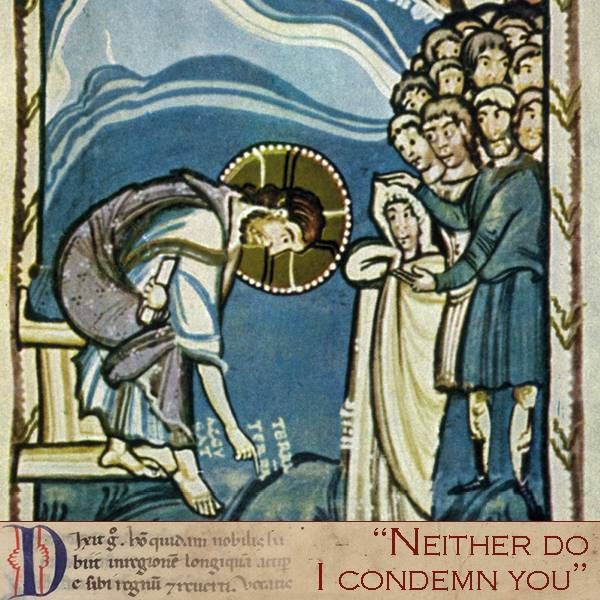
Now we are entering the sketchy neighborhood of our Scripture reading for this morning. We have a group of Jewish leaders, big shots in their synagogues. You know what happened. These Jewish leaders have grabbed a woman in the very act of adultery. She may have been a married woman, and she was having sex with a man who was not her husband.
The Rabbi Jesus has been talking with and discussing with groups of these leaders for some time. And, Jesus has been very successful at dialoging with these leaders, too! But, wait – they finally think they have got a situation that the Rabbi Jesus cannot squirm out of!
“Imagine the sense of urgency and the heightened emotions of the crowd swarming in on Jesus as he taught in the temple. They put this woman in front of the crowd. The Pharisees used her as an item, an object, a thing to entrap Jesus. I can imagine the contempt in the Pharisee’s voice as he asked, ‘Teacher, this woman was caught in the act of adultery. . . . Moses commanded us to stone such women. Now what do you say?’”[1]
Now, wait just a moment! The Jewish leaders have dragged this woman in front of Jesus, in front of the crowd in the Temple, and are accusing her, with baited breath! I can just see the crowd getting all agitated and upset! “Of course the Law of Moses tells us that adultery is bad! Of course this woman is guilty – our Jewish leaders say so! Of course she should be punished!” I can just hear the voices and noises of the crowd becoming more and more frantic and angry!
And, what does Jesus do? Nothing. He does not respond. He does not fly off the handle, as some people would. He does not react abruptly to the leaders or the crowd, either. Instead, Jesus stooped down and began writing on the ground with His finger. Finally, after the Jewish leaders kept badgering Him with questions, the Rabbi Jesus does respond.
Except, that makes me wonder. I know in our culture, in the United States, we do not stone people. Except, we still will ignore, and even jeer at people sometimes. We still practice shunning individuals in this country, sometimes.
These Jewish leaders and big shots at their synagogues seemed to have it all together. Except, these men were hypocrites, all the way! Saying one thing and doing another is the height of hypocrisy! I suspect these men – because the Jewish leaders were all men – these men felt fully justified in themselves. Fully self-righteous, and they couldn’t be bothered with pesky little things like their own repeated sin, or their conscience pricking them on the inside.
I want each of us to understand how damaging it is to say one thing but do something totally different. “Do as I say, not as I do!” This is definitely the work of a hypocrite.
“Hypocrisy creates barriers, harms relationships, and leads people away from God. In Matthew 23:27, Jesus calls out the Pharisees, saying, ‘Woe to you, scribes and Pharisees, hypocrites! You are like whitewashed tombs, which appear beautiful on the outside, but inside are full of dead men’s bones.’ The Pharisees focused on appearing holy, while ignoring God’s call to live with integrity and compassion.” [2]
The angry leaders who brought the woman to Jesus clearly were accusing and vicious towards the unnamed woman, and considered her simply a thing, an object of sin. I wonder whether they even considered the fact that this woman was a person of worth, or that she was created by God, just as much as each of them were? These were ways in which these leaders of the community could certainly live out God’s call to live each day with integrity and compassion – which the Rabbi Jesus did each day.
Jesus did not suddenly react or defend either Himself or the woman. Instead, He slowed down the frenetic emotion and action. Jesus reflected, and listened. Finally, Jesus made a comment. I imagine Him making that comment in a quiet but firm voice: “Let any one of you who is without sin be the first to throw a stone at her.” Then, “those who heard began to go away one at a time, the older ones first, until only Jesus was left, with the woman still standing there.”
Our summer sermon series features Fred Rogers, of Mister Rogers’ Neighborhood. We have considered several serious narratives from the Gospels during this series, and this week is no exception. Fred Rogers was no stranger to serious matters. A number of his television shows discussed very serious things – to children, yes, but also to adults. Divorce, death, war, and even the terrorist activity in 2001, on 9/11.
Fred Rogers excelled at listening to people. “Reflective listening, which does not imply agreement, pauses your agenda and aims to understand first. Fred listened intently and often agreed with the children since he was tuned into their fears and frustrations. [One of Fred’s signature messages,] ‘I like you just the way you are’ can’t get any more validating – pure emotional gold.” [3]
When Jesus practiced reflective listening in this extremely emotional situation in the Temple, we can see how tuned in Jesus was to the crowd’s fears and frustrations. And then, He turned the situation around, even turned it on its head by stating to the accusers in a quiet but firm voice: “Let any one of you who is without sin be the first to throw a stone at her.”
Jesus saw this woman as someone worthy of respect, a creation of God, unlike the men who accused her. Jesus’ words and actions offers this woman self-reflection and changed behavior at the realization of sin, just as He offered to the Jewish leaders and the crowds, multiple times throughout His ministry. “Jesus’s actions were scandalous because they broadened acceptance, extended mercy and forgiveness to the undeserving, and brought justice to the overpowered and abused. Will the church ever do the same?” [4]
Yes, today’s Scripture reading is extremely serious. And yes, Jesus makes His offer of grace and mercy, forgiveness and compassion to this woman, to the Jewish leaders who accused her, to the crowd, and to each one of us today. We can live honest, compassionate lives, with kindness and humility, today.
Here’s a challenge: “try to pay close attention to any moments when you might feel yourself slipping into judgment or hypocrisy. Maybe it’s a small thought about someone’s behavior, or a reaction to something they said. When you notice this, take a step back and remind yourself that we aren’t perfect either. Instead of letting judgment grow, try saying a silent prayer—for that person and for yourself. Ask God to help you see them through His eyes, with compassion and understanding.” [5]
I know I often ask in my sermons “what would Jesus do?” Who would Jesus forgive?
This week, I am going to change up my question, and ask “what would Fred Rogers do?” Who would Fred listen to? Who would Fred call his neighbor? I think, everyone. Each and every person, no matter who. Go. Go, and do that.
May is Mental Health Awareness Month. This month is particularly meaningful to me, since I deal with people who have mental health challenges almost all the time. Both professionally, as a hospice chaplain, and personally, since I have a number of people in my extended family who have mental health challenges.
I have highlighted May and mental health awareness for years, as a hospice chaplain working in the Chicago community. As a friend of mine, the Rev. Kathy MacNair said many times, everyone knows someone. Every single person knows someone who is struggling with mental health issues – and sometimes, they know several someones. Or, are related to several someones. Or, perhaps you are one of these people who have mental health challenges.
Our Lord Jesus was very familiar with mental health challenges. As we can see from all four Gospels, the Rabbi Jesus traveled from place to place, preaching, teaching and healing. Sure, some of these healings were physical healings, but some of these healings were also spiritual, mental, and I believe psychological, too. Our Lord Jesus truly healed these dear folks. His compassionate action and treatment is always truly loving, and infinitely caring.
John chapter 13 comes from the Upper Room Discourse, that last night the Rabbi Jesus was with His disciples. Remember, this was at the Passover meal they all shared together, just before Jesus was arrested later that evening, beaten, tried, appeared before Pontius Pilate, and later the next day crucified outside the city of Jerusalem.
Do you understand how important and poignant these words of Jesus are? Just think back to a particularly important conversation you had with someone very meaningful in your life. Perhaps it was one of the last conversations you remember having with that loved one. Just so, our Gospel writer is aware of how important these last hours with his Lord Jesus actually were! I am certain all the disciples remembered these memorable words of Jesus with particular care.
Let us read again the words of Jesus, from John 13: “34 A new command I give you: Love one another. As I have loved you, so you must love one another.35 By this everyone will know that you are my disciples, if you love one another.” Shallow people comment about what they call love, thinking about valentines, candy and chocolates, and champagne toasts of undying affection. Can’t you hear them already? “Oh, how wonderful of Jesus! I love everybody already. I’m a good Christian.” Let’s take a closer look at exactly what Jesus was commanding.
Sure, the Gospel of John mentions the disciples loving one another. But – John’s Gospel also has passages about other kinds of people, too. Nicodemus was a respected member of the Jewish religious rulers, the Sanhedrin, the religious upper class. By and large, the Jewish rulers were no friends of the Rabbi Jesus. What about the half-Jew, the Samaritan woman of chapter 4? What is more, she was also an outcast in her own town.
Did Jesus show any hesitation in His interaction with either one? Wasn’t He caring, loving and honest with each of them, just as He was with everyone else?
Jesus was the ultimate in being open, loving and honest to everyone. No matter who, no matter where, no matter what faith tradition, social strata, ethnicity, or any other designation. Jesus is commanding us to love in the same way. Not only towards strangers, but towards friends, as well. That can be even more difficult sometimes.
“Here in John chapter 13, Jesus demonstrates his love for the same disciples who will fail him miserably. Jesus washes and feeds Judas who will betray him, Peter who will deny him, and all the rest who will fail to stand by him in his hour of greatest distress. The love that Jesus demonstrates is certainly not based on the merit of the recipients, and Jesus commands his disciples to love others in the same way.” [1]
I get set back a bit when I realize the full ramifications of that boundless, amazing love of Jesus. It’s a tall order! Whoa, Lord! You don’t really expect me to be that way with people who insult me, or are mean to me, or disrespect me, do You? I kind of think that is exactly what Jesus means. Love them. No “but, what if…?” Love all of them unconditionally.
Which brings us back to where we started. It’s easy to love lovable people, to love babies and small children. Easier to love those in our families, and friends. But what about those we don’t even know? What about people we actively dislike? And, what about people who are scary, who we don’t understand, who are in dementia or who throw tantrums, or have addictions?
I have permission from our friend Irene to talk about her adult daughter, who does have mental health challenges, was living at Thresholds social services for years, and who currently lives in Wisconsin. Now that the daughter is regularly taking her prescribed medication, things are stable and under control. This dear daughter is quite helpful to Irene when she comes to visit. Thank God, this story has a happy ending, and this mother and daughter are reunited and grateful to God for all the help and support from friends, doctors and from support groups.
That is exactly what Jesus means. Love all people. Even the scary ones, even the ones we dislike. No “but, what if…?” Love all of them, unconditionally.
This is not just a suggestion. Jesus makes it a command. If you and I want to follow Jesus, this is one of the requirements. Some well-meaning believers say that other people may not merit Jesus’ love, for whatever reason. Gosh, I don’t merit Jesus’ love a lot of the time! But, that makes no difference. Jesus still loves each of us, unconditionally. No matter what. Plus, Jesus commands us to love others in the same way. The same ultimate, above-and-beyond, bottomless way.
So, whether you and I succeed or fail in our attempts to love one another this week, yet God in Jesus loves us more than we can possibly imagine. And hearing of this deep Jesus-love we are set free and sent forth, once again, to “love one another.”
We have the familiar parable of the Prodigal as our Gospel reading today. One of the best known of the parables, one that resonates with the heart and soul of many. It’s the story of two brothers and a father, the story of discontent and disgruntlement, the story of wandering in a far country, the story of return, and most of all, the story of forgiveness, reconciliation and redemption.
What is the setting for this parable? In verse 1 of chapter 15 we see Jesus sitting down to dinner with a bunch of social outcasts. As far as the scribes and Pharisees were concerned, that is—they were outright offended! How could Rabbi Jesus, a self-respecting, reputable rabbi, be associating with riff-raff, with undesirables, with people like that?
Tax collectors, outcasts and sinners. The upright, righteous Jewish leaders even had rules about associating with those people. They just didn’t. They were forbidden to have any dealings with them at all. But—Rabbi Jesus welcomed the tax collectors and sinners. Get this—He even ate dinner with them!
Except, Jesus wanted to stay in dialogue with these Jewish leaders, so He did was he often did – He told them parables. What a story! “And yet, the characters, the scenario, the family dynamics, are so familiar to us, it is real. And it is true in all the ways that matter, of course, for in one way or another we have lived this story. From one viewpoint or another, this experience is ours.” [1] It’s a story about brothers (or, siblings), about family, a loving father, repentance, and ultimately, about forgiveness.
This younger son was no prize, was he? He had been selfish and self-centered, for sure! Imagine, asking his father for his inheritance right then and there! (Which is kind of like saying that he wished his father had died already!) The nerve of that kid! However, his father went along with it, maybe cashed in some stocks or sold some property, and gave the younger son what he demanded. And, the ungrateful kid promptly goes out of the country to live it up.
One title this parable could have is “The Story of the Lost Son,” because the younger brother goes to a far country, spends all his money in riotous, profligate living, eventually doesn’t have a penny to his name, and is forced to herd pigs for a farmer just to scrape by and earn a pittance.
We heard the first half of this parable in our Scripture reading today. I continue now:
Remember, we left the younger son starving in the pigsty, with the pigs. ““When he came to his senses, he said, ‘How many of my father’s hired servants have food to spare, and here I am starving to death! 18 I will set out and go back to my father and say to him: Father, I have sinned against heaven and against you. 19 I am no longer worthy to be called your son; make me like one of your hired servants.’ 20 So he got up and went to his father.”
It’s so easy to point the finger at this younger son, isn’t it? He was selfish and self-centered, wasn’t he? He didn’t think of anyone else, except for himself. Especially when he lived it up in the far country with high living, wine, women and song. Yet – how often are you and I selfish? Thinking only of our own interests, not caring for anyone else?Sound familiar?
Let’s continue with the parable. “But while he was still a long way off, his father saw him and was filled with compassion for him; he ran to his son, threw his arms around him and kissed him. 21 “The son said to him, ‘Father, I have sinned against heaven and against you. I am no longer worthy to be called your son.’”
My, goodness! What a turnaround this young guy has had! Sure enough, he has had a major change of heart and mind. We can see how much the father loved his younger son, can’t we? Imagine, a fine, upstanding middle-aged landowner comes running to meet his son, from far away down the road! The father must have had an eye out for his son for some time!
Yet, what about the older brother? What has he been doing all this time that the younger son has been partying it up in the far country? “Meanwhile, the older son was in the field. When he came near the house, he heard music and dancing. 26 So he called one of the servants and asked him what was going on. 27 ‘Your brother has come,’ he replied, ‘and your father has killed the fattened calf because he has him back safe and sound.’
28 “The older brother became angry and refused to go in. So his father went out and pleaded with him. 29 But he answered his father, ‘Look! All these years I’ve been slaving for you and never disobeyed your orders. Yet you never gave me even a young goat so I could celebrate with my friends. 30 But when this son of yours who has squandered your property with prostitutes comes home, you kill the fattened calf for him!’”
Think about it. You and I can easily see how “lost” this younger son was. But, what about the older son? On the surface, he’s the perfect son. Always obedient, always compliant.But underneath? Discontented, disgruntled, resentful, angry. Do we see anything selfish and self-centered about the older son? Even though he stayed at home, he was pretty “lost,” as well.
We are in the middle of Lent, a season of reflection, contemplation, particularly on our human brokenness and our need for God’s redemption, God’s forgiveness.[2] If we are honest, Lent helps us see the “lostness” of all of us – just as much as both the younger and the older sons were “lost,” too.
Both sons need a change of heart, a repentant heart. And, both sons are equally loved and forgiven by their father. We are considering the part of the Lord’s Prayer this week where we say “Forgive us our sins as we forgive those who sin against us.” It doesn’t matter whether we say “sins” or “trespasses” or “debts.” What we are asking God to do is to forgive us! Except, we ask God to forgive us exactly in the same way we forgive others!
Just think about that. If you and I are unforgiving people, why on earth ought God forgive our sins? If I come to the Lord, praying the Lord’s Prayer and asking – petitioning – for God to forgive my sins, how can I – you – we – possibly think we are going to get away with regularly being mean, nasty, and especially unforgiving to others?
Finally, we consider that Lent is the time when we are following Jesus on His journey towards the cross. “the cross is not a means of payment [for our sins] but rather shows us just how far our prodigal God will go to tell us of God’s immeasurable love. Period.” [3]
Did you ever think of God being a prodigal? Our prodigal God, wandering in the wilderness, seeking each one of us as we sojourn in the far country. Just like the younger son. And, just like the older son – resentful and disgruntled, and especially unforgiving to others?
In our parable, what is the father’s response? “‘My son,’ the father said, ‘you are always with me, and everything I have is yours. 32 But we had to celebrate and be glad, because this brother of yours was dead and is alive again; he was lost and is found.’”
If we had a title of this parable from the father’s point of view, it could very well be “The Story of the Forgiving Father.” Yes, he freely forgave the younger son for his extreme disrespect, for spending all his father’s hard-earned money, and for crawling back home in such a disreputable condition. Plus, the father was loving and welcoming to his older son, the one who seemed to be permanently disgruntled and resentful, with a huge chip on his shoulder.
Praise God, we know how far our Lord Jesus went to tell us about God’s immeasurable love. He went to the cross, for our redemption. For our forgiveness. And with this parable, Jesus wants us to see how much God loves each one of us, and how willing our loving, caring, nurturing God is to welcome us home. Even going so far as to run down the road to embrace us when we return in penitence and tears, or when we stay at home doing our duty in self-righteous disgruntlement and discontent.
Yes, God forgives! And yes, we are to do the same. As the petition of the Lord’s Prayer says, “forgive us our sins, as we forgive those who sin against us.” God offers forgiveness to both prodigal sons, all wayward children, no matter what. Remember, what a loving, caring God we have. Always loving, caring and welcoming toward each one of us. Amen!
How many of you remember being really sick? So sick that you had to stay in bed for days, or perhaps even had to go to the hospital? Thank goodness here in the Chicago area we have many devoted doctors and excellent hospitals to choose from, and to figure out exactly what is ailing us. And, thank goodness we are able to have effective medicine prescribed for us when we are sick, too!
Except – what do we do when our hearts and spirits are feeling sick? Anxious, or disturbed?Where do you and I go when our faith in God seems shaky? We could perhaps go to the doctor or the hospital, but they probably will not have the right tools or equipment to help when you or I have spiritual afflictions. [1]
This is our fifth week looking into the letter of James, and we have seen over the past few weeks that James is a very practical man. He displays a great deal of common sense, and does not pull punches when it comes to talking straight to his friends scattered around Asia Minor. (The area to the north and east of present-day Palestine.)
Let’s hear from James about this very problem: “Are any among you in trouble? They should pray. Are any among you happy? They should sing praises. 14 Are any among you sick? They should send for the church elders, who will pray for them and rub olive oil on them in the name of the Lord. 15 This prayer made in faith will heal the sick; the Lord will restore them to health, and the sins they have committed will be forgiven.”
What I have seen in these past weeks and months are the overwhelming number of people with heightened emotions and reactions to anxious, even fearful situations. As someone involved in pastoral care and trained as a chaplain, I notice these things. In our scripture reading today, we find the apostle James talking straight about how to pray, and thus deal with things similar to these things he mentions: heightened, negative emotions and reactions to anxious situations, not to mention physical needs, too.
The apostle James was a practical kind of guy. We can see that from this short letter, the only letter he wrote, included in the New Testament. He gives some practical advice to his readers on how to live a faithful and effective Christian life: how to live faithfully with others in society, how to control the tongue, how to turn away from evil and towards God. Here, in the fifth chapter of James, he turns to prayer. As we look at this passage, James tells his friends how to pray, in very practical terms, almost the same way as a doctor with a prescription pad might write it out.
What are the beginnings of this spiritual prescription? You and I need a special place and a special way to access God; we need to be open and willing, in this place! You and I need God – especially through the Holy Spirit – to help our hearts and spirits feel renewed, and we need the body of Christ–all of us–to help us strengthen our faith. In fact, we all need each other. [2]
When I was a hospital chaplain, working in critical care units like the Emergency Department, Intensive Care, and trauma support all over the hospital, my primary job would be that of compassionate listener—even before prayer, and also as a heartfelt part of prayer.
Now that I am a hospice chaplain, compassionate listening becomes an even more important part of what I do, not only for my patients, but for their loved ones. I suggest for all of us to consider a heart of compassion and a gentle hand of mercy. It’s time to put our defenses down and instead experience the vulnerability of listening to one another.
“If someone has a story to tell, the greatest gift you can offer is simply to listen. You don’t need to have answers or wisdom. You probably don’t need to say anything except, ‘I hear you. I believe you. I’m sorry you experienced that.’ In the compassionate version of the world I yearn for, we offer one another solidarity, a listening ear, and a tender heart.“ [3]
Another way of defining this spiritual prescription is through prayer – corporate prayer. James says, “16 So then, confess your sins to one another and pray for one another, so that you will be healed. The prayer of a good person has a powerful effect.“
Again, I am reminding us all, this exercise of prayer is not meant to be only for persons in isolation. It’s true, as a hospice chaplain, I see many people isolated in hospitals, in care centers, all alone in their rooms with no one to hold their hands or offer them a kind word of compassion or comfort. James would give us – fellow Christians – the practical advice to come alongside the sick persons in prayer and fellowship, even solidarity.
My commentator Dr. James Boyce echoes this very call from our letter-writer: “James knows a wisdom that is communal, especially in its faithful exercise of prayer. Twice he charges that confession should be “to one another,” and that we should pray “for one another,” if we have any expectation that the promised healing is to take place (James 5.16). Such prayer exercised within and on behalf of the community has power — James says it is “effective.” [4]
I think all of us can agree that as God’s people, we all need regular repentance and soul-searching, no matter what. We are also all in need of healing, personally, and certainly communally. Isn’t that what James tells us here?
At the end of this 5th chapter, this practical how-to manual on the Christian life, we can follow the heavenly prescription James sets forth. We can pray. We can worship. “We learn about how to be God’s people by reading the Bible. We find ways to serve – to do spiritual exercises that both help the world and strengthen us.We develop relationships within our faith community [or church] that are healing and helpful. And we learn to be generous – to share the many good things God has given us with others.” [5]
Whether it is the healing touch of the laying on of hands, or a simple hug from a sister or brother in Christ, or the potent power of prayer or the relief of corporate confession, active participation in the Body of Christ is preventative medicine at its best. What are you waiting for? There’s no co-pay, third-party billing, or lifetime limits on God’s grace and love. Prayer is our heavenly prescription from God.
Today is Father’s Day, the day people set aside in the United States to honor fathers, grandfathers, uncles, brothers – everyone who takes on a fatherly role in the lives of families and individuals across the country. Even, fathers across the world.
The Scripture reading today is the Gospel reading for this week, from the Revised Common Lectionary. I haven’t chosen an alternative reading for today, because the set reading from the Gospel of Matthew chapter 9 is so appropriate for our Summer Sermon series. We are re-imaging God. Seeing God from a different point of view.
Many, many people throughout the world look at the Holy, the Divine, and see something impersonal. This view of the Almighty can seem to be really far away. Distant and cold. Even forbidding and scary. Other times, some people see our God as a strong and mighty Deliverer. The Lord is described many times in the Hebrew Scriptures as a Rock, or a Fortress. That can be helpful, especially when we are in need of Someone strong to help us fight our battles, or when we need a safe, divine Shelter to hide inside – but quite impersonal.
But, what about when some of us (yes, I include all of us here!) need our God to be something other than distant, cold, and scary? Or Someone else than just a super-strong tough-guy? What then? It is really difficult for certain people to believe that their God could be that way! They cannot even conceive of God being warm, welcoming, caring and compassionate!
In Matthew 9:36, our Lord Jesus feels great compassion, and through the words chosen shows us just how deeply He cares. “When [Jesus] saw the crowds, he had compassion on them, because they were harassed and helpless, like sheep without a shepherd.”
I wanted to see what a proper, in-depth word study on the word “compassion” had to say. According to one word study, “Com-passio literally means to “suffer with.” In Latin, com means “with” and passio means “to suffer.” “Passion” is suffering, which is why we talk about “the Passion of Christ” during Holy Week.” [1]
As He traveled throughout Palestine from place to place, the Rabbi Jesus had the opportunity to see a whole lot of people. Plus, many of the individuals who came to Him (or, were brought to Him) were not in good health. Many of these souls were distressed. Two other words for that state are “troubled” or the old-fashioned “vexed.” Have you seen troubled souls? Sometimes, these souls carry all their troubles inside, and the only way we know is by looking at their haunted eyes. Other times, some souls have physical aspects of their bodies that show us their distress and anxiety.
Many of these hurting souls are dispirited. This word means “downcast” or “thrown down.” When people are inwardly helpless and forsaken, often we can see their souls as dispirited. “Philip Keller, in A Shepherd Looks at Psalm 23 [Zondervan], describes how sheep can get turned over on their backs and not be able to get up by themselves again. Such sheep are called “cast” or “cast down” sheep (p. 60). These sheep flail at the air with their legs, but they can’t get back on their feet without the aid of the shepherd. Left in this condition, helpless and vulnerable to their enemies, they will die after a few hours or days.” [2]
We can easily see how Jesus as our Good Shepherd would be greatly concerned and compassionate for these dear souls! I would like to return to the word “compassion.” We looked at the Latin roots of that word, but the Gospel of Matthew was written in Greek.
If we take a closer look at what the Greek word “compassion” means, we see the word splagchna, which appears in the letter to the Philippians. The Apostle Paul’s words in the King James Version say: “I long after you all with the bowels of Jesus Christ.” The word splagchna means “bowels” – literally, the innards in your belly. It’s an earthy image that might offend some. “The people of the ancient world believed that all of the most intense feelings originated in the belly. For them, “guts” did not mean “courage,” but depth of feeling.
It’s easy for us to understand why they would believe that, because when we feel anxious or afraid, our stomachs churn. Our lower innards give away how much we are affected by our circumstances. The Greek phrase Splagchna oiktirmou means something like “’the bowels of deep feeling.’” [3]
Our Lord Jesus felt like this for the crowds surrounding Him. He had deep compassion, caring and love! As the classic hymn tells us, “O, the deep, deep love of Jesus, love of ev’ry love the best! ‘Tis an ocean vast of blessing, ‘tis a haven sweet of rest!”
No matter how our popular culture makes fun of the “kinder, gentler” emotions like compassion, or labels them as “unmanly,” we can readily see from passages like these that our Lord Jesus felt them deeply. No matter how much some scoff at strong, mighty people also being caring and loving, we have a Divine example right here to hold up. To hold on to.
Moreover, this does not only refer to the crowds Jesus saw in Palestine. Jesus has compassion on us, today, too. “He sees us in our lostness, in our emptiness, under attack by enemies within and without; and he loves us. Although we are harassed and helpless, he loves us. He doesn’t say, “Well, they should have known better.” He doesn’t say, “You’d think that by now they would have figured it out.” He doesn’t say, “What a bunch of losers.” [4]
Jesus has deep compassion for the sheep without a shepherd, centuries ago, and for us sheep, too! Jesus loves us all, cares for us all, down to the very depths of His being.
We can rejoice in the deep compassion, the deep caring, and yes, the “deep, deep love of Jesus.” This is for each of us today, and this is the Gospel truth. Alleluia, amen.
Weddings are wonderful events. Brides and grooms try to make them meaningful and personalized, as much as they can. Except – I have strong feelings about certain songs that are featured at weddings. I won’t name any specific song, but I think you can recognize them when you hear them. I’m thinking of songs that highlight love as a warm and fuzzy emotion, and that is about it. Where will the newly-married couple be when the rose-colored glasses come off? What happens when that warm and fuzzy feeling called “love” goes away?
This is the last sermon in our series on spiritual gifts, and we look more closely at the last part of Paul’s discussion on the greatest spiritual gift – love. After Paul spends all of 1 Corinthians 12 talking about the great variety of spiritual gifts that God gladly gives to believers in Christ, he turns to the greatest of all gifts, that of love.
But, what is love all about, anyway? Last week, we talked about all the things that love is not, as listed right here in this chapter. According to 1 Corinthians 13, love is not just an emotion, not just a feeling. The description I read last week definitely had more about aspects of what love is not; these can be greatly helpful as we hammer out the biblical definition of love.
As I reflect more on popular culture today, and how sentimental and sappy modern love songs can be, I can see how we – as an American culture – might have different ideas about love than those we read here in 1 Corinthians 13.
Some church folk today might have different ideas about the Corinthian church, too. Corinth was a diverse, multi-cultural, multi-ethnic city in Greece, at the crossroads of several major roads through the region. The church was founded by Paul, an ethnic Jew, but certainly was not all one ethnicity. No, this was a diverse, multi-cultural, multi-ethnic group of believers!
As we read further in 1 Corinthians, we can see how much discord really was in action in that dysfunctional group of believers, too. As our commentator Doug Bratt says, “challenges and controversies dogged their church. They disagreed theologically. They struggled with persistent sin, lawsuits among themselves, sexual immorality, and marriage. Corinth’s Christians disagreed on how to deal with food that had been sacrificed to idols and religious freedom.” [1]
With that large amount of discord and disagreement among the church members in Corinth, is there any wonder why their former pastor Paul wrote them a letter detailing spiritual gifts which God gives to benefit the whole church? And further, why Paul lifts up love as the best and greatest spiritual gift of all?
We return to the question “what is the biblical definition of love?” I know we discussed this last week, and I mentioned a number of things love was NOT. Let’s turn around and see what Paul says that love IS. “6 Love does not delight in evil but rejoices with the truth. 7 It always protects, always trusts, always hopes, always perseveres. 8 Love never fails.”
I sometimes read an online sermon chat board, where preachers share their reflections on the week’s scripture passages before Sunday comes. I thought Rev. L’Anni from the Netherlands had some very pertinent reflections on this reading.
“When I do premarital counseling I often will read I Cor. 13:4-7 with the couple and note that in this definition of love there is not one single verse that refers to a feeling. No warm fuzzies. No Hallmark honey and sweetness. It refers to ACTION. Being patient—when you FEEL im-patient. Being kind—when you feel like being un-kind. Keeping no score of wrongs—when you feel like holding a grudge. This is how Christian marriage can not only survive but thrive. But not just marriage but any relationship where both are willing to love each other as defined by this passage.” [2]
These are things that love DOES, actions that people can take that are loving, caring and compassionate. When I think of the number one example of love, I think of our Lord Jesus, while He was here on this earth. I think of how Jesus lived, how He acted, and how He carried out His ministry. Jesus showed us how to love, by displaying love in action. Jesus truly showed His friends (as well as all the world) a life of love – and caring and compassion.
What better thing to do than to think of our Lord Jesus, when He was here on this earth, and ask ourselves “What would Jesus do?” How would Jesus act? How would Jesus love?
In recovery circles, a common saying is “do the next right thing.” I had a friend of blessed memory, who is now with the Lord, who always tried his very best to be loving, caring and giving. He knew that common recovery saying very well, except he would change one word. He would often say “do the next loving thing.” That’s how to fulfill Paul’s definition of love from 1 Corinthians 13.
So – what would Jesus do? Do the next loving thing. Go. Do that.
Have you ever had a really busy day? Or, even worse, a really busy week? I know I have. Sometimes, so much can crowd into an already full schedule that I might feel overwhelmed!
That’s how busy it was for the Rabbi Jesus, all too often. The Gospel of Mark particularly points this out. Mark always tells his readers what Jesus did, where He went, and what happened next. “And immediately—” is one of Mark’s favorite connecting phrases. Jesus immediately went somewhere else, did something, or spoke to someone—”and, immediately!”
Any busy person knows that you can not continue at this breakneck speed forever. Or, for even a long time. All of us need to take breaks, periodically! Time to slow down, and rest.
That was what I suspect Jesus and His disciples had plans to do. Listen to what Mark reports: “31 Jesus said to them, “Come away to a deserted place all by yourselves and rest a while.” For many were coming and going, and they had no leisure even to eat. 32 And they went away in the boat to a deserted place by themselves.”
Perhaps our Lord Jesus was better at self-care, periodic resting, and at pacing Himself. But, the hurry-hurry, rush-rush disciples are another matter! “The time soon comes to get away, to refresh the body and soul. As with us, so too did the apostles need a quiet time and place to renew their spirits and their relationship with Jesus.” [1] Time to take stock, step back, and size up a continuing situation, perhaps.
And then, in the middle of Jesus and the disciples going to a deserted, out-of-the-way place to rest, what happens? “33 Now many saw them going and recognized them, and they hurried there on foot from all the towns and arrived ahead of them.” Imagine, Jesus and His disciples plan a brief time away to recharge and renew, and all of a sudden, they are surprised by all of these unexpected (and possibly, unwelcome!) visitors!
But, just a minute. I am looking at this situation from a 21st century point of view. How would the people of 1st century Palestine see Jesus and the disciples, in a deserted place?
One of my commentators, Larry Broding, gave me some useful insight into this: “For moderns, scenic visas and vacant areas for relief represent relaxation. But, the contemporaries of Jesus saw “deserted” places as the home of evil and danger. Moderns seek personal space. Jews in the times of Jesus had no such concept. They banded together in a few Palestinian cities (like Jerusalem) or in small hamlets (50-150 population) for survival. Moderns seek privacy. Ancients sought social connection to the extent that personal identity almost solely depended upon one’s place in family (and, hence, society).” [2]
Mark tells us in verse 34 “34 As Jesus went ashore, he saw a great crowd; and he had compassion for them, because they were like sheep without a shepherd; and he began to teach them many things.”
It did not matter to Jesus whether He was dealing with 1st century Jews or 21st century Americans. He still understood (and understands, right now!) how people operate. He saw with compassion how much they needed His touch, His presence, His healing.
I wonder – can you see others with the eyes of Jesus? Can you reach out with caring and kindness, in the way Jesus did? Sure, we all can request a touch from our Lord Jesus. It’s so wonderful to receive His caring, His presence, and His blessing! However, we are not to simply receive, and say, “Gimme, gimme, gimme!” Such a selfish, self-centered point of view!
No, our Lord Jesus means for us to respond, after we have received. He makes a point of it! Just as He taught His disciples repeatedly, nothing pleases God more than for God’s children to respond to others with caring, with kindness, and with compassion.
Except—sometimes you and I are stretched too thin. Sometimes we are too burdened with our personal troubles and concerns. Sometimes it all seems like we might be on that never-ending merry-go-round, except it is not at all a good time on that carnival ride. Jesus understands when life gets tough and feels too heavy. That is all right.
As commentator Janet Hunt says, “Perhaps we are simply too wounded, some of us. Or just too uncertain about what is next. So more and more I am reminded that there is nowhere else to begin but to at least try to see myself and those among whom I live and serve, with the very eyes of Jesus which with deep compassion recognize what I otherwise too often fail to see.” [3]
Yes, Jesus is there for us, just as much as He was there for the crowd that so unexpectedly came upon Him and His disciples. Jesus shows caring, kindness and compassion to us, just as much as He did in first-century Palestine. He acts as a gentle Shepherd to His sheep who are wandering in the wilderness with no one to guide them, especially in this brave new world, post-pandemic.
Can you see the world through the eyes of Jesus? He calls all of us to be kind, gentle, caring and compassionate to others. And yes, we can also lean on our gentle Shepherd for ourselves, the one who brings rest and restoration, comfort and protection, whose goodness and mercy will follow us all the days of our lives.
Do you see with the compassionate eyes of Jesus? God willing, we all can.
[1]“Times of Refreshment,” Ordinary 16B, Larry Broding’s Word-Sunday.Com: A Catholic Resource for This Sunday’s Gospel
Have you ever wondered what love looks like? If you asked ten different people that question, I suspect you would get ten different answers. What does love look like, anyway?
The apostle John talks about love a great deal, both in his Gospel as well as his letters. We just read a portion of 1 John chapter 4, where John gives us a straight-forward definition of love. Love is an action word, and the definition comes from God’s point of view. The Lord God almighty, who made heaven and earth and all that is in it, shows humanity what love is.
Repeatedly, in both the Hebrew Scriptures and the New Testament, the Bible testifies to the loving, living nature of God. Yes, the Lord God is the almighty Creator of all things, the Source of all light and love. And yes, the Lord God is also shown in the person of Jesus, the God made flesh, the One humans have touched and laughed with and eaten with.
We come back to the question: what does love look like? For a more intellectual answer, we can read from 1 John chapters 3 and 4. Or, we can take a closer look at the Gospel account of Jesus, at His words and actions, and how He lived His life, and that will show us a lot about what love looks like.
1 John 4:7 says, “Dear friends, let us love one another, because love comes from God. Whoever loves is a child of God and knows God.”
In Matthew 14, our Lord Jesus showed compassion – He showed love for the multitudes gathered around Him, and healed the sick. This was just one of a repeated number of times He did this. With a lack of medicines and a high prevalence of incurable diseases (especially at that time), Jesus regularly showed His love and compassion for many people in the most fundamental of ways: He healed them.
How often are we called to be healers? How often are you and I requested or moved to show love for one another through our healing actions, words and prayers? Is this not a way you and I can carry out the commands of Jesus?
1 John 4:9 says, “And God showed his love for us by sending his only Son into the world, so that we might have life through him.” We know that Jesus came into the world to show humanity what love is.
In Mark chapter 6, Jesus showed compassion – He shared love to the crowds. He truly saw their hearts, realized they were sheep without a shepherd, and taught them many things. Jesus gave them – taught them the Word of God, the words of eternal life. What’s more, Jesus was the Word of God incarnate, life-giving to all who would come to Him.
1 John 4:10 says, “This is what love is: it is not that we have loved God, but that he loved us and sent his Son to be the means by which our sins are forgiven.”
In the Gospel of John chapter 3, Jesus and the Jewish leader Nicodemus had a long conversation. In that conversation, John makes the editorial statement “God so loved the world that He gave His only Son, that whoever believes in Him shall not perish, but have eternal life.” This is why Jesus came into the world: so that you and I will not be separated from God for eternity, but instead be reconciled to God, and be with God in eternity.
Jesus showed this love through His in-depth conversations with a large number of people. He not only talked with the academics and religious elites, like Nicodemus and the other Jewish leaders, but Jesus also talked with people on the outskirts of society, like the woman at the well in John chapter 4 and the tax collector Zacchaeus in Luke 19.
How about us? Do we show love by our conversations with a large number of people, from a diverse group of backgrounds? Or, are our friends and acquaintances all people “like us?” Would Jesus just come and hang out with good, upstanding church folk – and no one else? People from our little group or clique or neighborhood? What about our nationality group or political party – and no one else? Or what about this particular church, and not the church down the street? Much less the temple or mosque across town? Would Jesus show love to everyone?
God so loved the world. Does that exclude anyone? Perhaps you and I might like to exclude some folks – but would God exclude them? Who would God exclude? God so loved the world. That’s everyone. That’s what John 3:16 says.
So, what does God’s love look like? It looks like Jesus, as He shows His life, love and death for us.And, we have the ability to love because God first loved us.
“God’s love does not depend on our initiative or on our worthiness. We don’t have to reach out to God or even believe in God in order to be loved. We don’t have to clean up our act before God can love us. We don’t have to measure up to some standard in order to be lovable. No, God showers love on us whether we deserve it or not. And honestly, who could ever deserve such amazing, immeasurable love?” [1]
Everything begins and ends with God’s love. God showers us with love, whether we deserve it or not. What amazing, immeasurable, wondrous love is this.
I have several friends who are wonderful hosts and hostesses. They love to have friends and relatives come to their homes, and provide such excellent hospitality. In fact, I had the great good fortune to be the recipient of such fine hospitality a few months ago, at the home of my niece Josie’s uncles (on her mom’s side), in Washington state. Jeff was a marvelous host!
What does hospitality have to do with this bible reading from Matthew 10? At first glance, this reading talks about prophets, or God’s messengers. Jesus tells us how it’s important to accept, or to welcome the messengers of God.
Hospitality was huge in the Middle East. It still is, today. If someone comes to your home, you go all out for them, making them comfortable, feeding them, and otherwise supplying their needs. That hospitality has been a hallmark and a highlight of visiting this region of the world, for centuries.
When the Rabbi Jesus made this statement about receiving the prophets, God’s messengers, what do you immediately think of? What is the first thing that comes to mind? The first thing I thought of was an old-fashioned Sunday dinner after church, where one of the prominent families at the church invites the minister over for a fine meal following the morning services. Well, that cannot happen now, because of COVID-19. Not the socializing at each other’s houses, and not the in-person worship services.
But – can this reading mean more than that?
Somehow, I don’t think the Rabbi Jesus was thinking about the chief rabbi from the most prosperous synagogue in town. I don’t think Jesus had the hot-shot leading elders of the largest congregation in mind, either.
I suspect you can immediately think of someone—maybe a couple of someones—who is absolutely marvelous at hospitality. Putting on parties and get-togethers, gathering friends, relatives, acquaintances. I know, I have been at a few of these gatherings. They are almost always wonderful times to connect. Wonderful times for eating and drinking, too.
What about you? Are you grateful to friends or relatives who have the spiritual gift of hospitality? This absolutely is a spiritual gift, listed among the other more acknowledged or appreciated biblical gifts. Some have that gift of hospitality in abundance.
Except, the words of Jesus do not excuse some of us who are not so hospitality-gifted. No, Jesus’s words are intended for all of us. That means every believer has the responsibility to extend hospitality, whether they have that spiritual gift or not.
I could expound upon the gifts of the Holy Spirit that are given to each believer when they come to believe in Jesus Christ. The apostle Paul has written several lists where he runs down a good number of these gifts: in chapters Romans 12, 1 Corinthians 12, and Ephesians 4, among others. Gifts like teaching, discernment, helps, and administration.
I can hear some people say, “Oh, I just don’t have a hospitable bone in my body. I can’t welcome people into my tiny apartment. I’m all thumbs when it comes to spreading a wonderful table, and I don’t know the first thing about throwing a big party.” Well, guess what? Jesus did not say, “This command is just for the people among you who really like Martha Stewart.” Or, “This command only applies to the people who can throw the best parties.”
Jesus wants ALL of us to be hospitable. He wants ALL of us to extend a welcome. But, to whom? Who is it Jesus wants us to welcome in such a way? It’s just our friends and relatives, right? It’s just the people from my church, or from my side of town. It’s just the people who look like me. Isn’t that who You mean, Jesus?
Let’s read verse 10:42 again. ”And if you give even a cup of cold water to one of the least of my followers, you will surely be rewarded.” Acts of mercy and deeds of compassion, no matter how small. My goodness. Is Jesus talking about being kind to – anyone? Everyone? No matter what? No matter who? No matter what they look like? Or, where they were born?
Yes, mercy and compassion are two of those spiritual gifts the apostle Paul talks about. Except, Jesus commands all of us to show compassion and mercy, right here. By doing these compassionate things for anyone and to everyone, we give witness to the unconditional love of our Lord Jesus. Jesus does not make this expression of compassion and mercy something exclusive to “only our kind.” No, He specifically says that we are commanded to show mercy and compassion to “the least of these.” Some translations use the words “these little ones.”
Okay, Jesus. I guess I get the idea. You want me to show mercy and compassion to just about everyone who needs help. But, I need some ideas.
Dr. David Lose, one of my favorite commentators, gives us some excellent suggestions. He says: “at other times, Jesus seems to say, it’s nothing more than giving a cup of cold water to one in need. Or offering a hug to someone who is grieving. Or a listening ear to someone in need of a friend. Or offering a ride to someone without a car. Or volunteering at the local foodbank. Or making a donation to an agency like Luther World Relief. Or…you get the idea.” [1]
Jesus does not simply make a suggestion. This cup of cold water, this mercy and compassion is something He is really serious about. Let us take our Lord’s words to heart, and put them into action. Now. Go, do, in Jesus’ name. Amen.






 Pastor, Preacher, Pray-er