Unknown's avatar

Came to Serve in the Neighborhood

“Came to Serve in the Neighborhood”

Mark 10:42-45 (10:43) – June 22, 2025

I’ve had a great respect and fondness for Fred Rogers, for many years. You know, Fred Rogers, of Mister Rogers’ Neighborhood. I watched the television show with my small children – all four of them, at various times. I so appreciated Fred’s gentle, caring, loving way of speaking to everyone. Not only the children. He was the real deal. Fred was a genuine, caring, compassionate person, interested in everyone and everything. And, especially in children.

Right now, with bombings and raids and rumors of war on the minds of many people worldwide, right now seems like a strategic time for us to be starting a summer sermon series on Fred Rogers. Today’s uncertain time in history is somewhat similar to the uncertain times in the area where the Rabbi Jesus grew up and was teaching and preaching. Occupied territory. I fear that your typical person on that first-century street in Israel did not have guarantees of security or comfort in their lives, either.  

Our reading is from Mark 10, just a few verses before the beginning of chapter 11, where Jesus enters Jerusalem on Palm Sunday for the final Passion week of His life. This is the very end of Rabbi Jesus’s three-year ministry. His disciples had been with Him, and learned from Him for three whole years. At this time just before the Passion week, Jesus calls all the disciples together to give them a short recap on the Gentiles—the Romans—the worldly way of dealing with pre-eminence, greatness, and authority.

I would like us to focus especially on a few verses from our Gospel reading today.  “whoever wants to become great among you must be your servant, 44 and whoever wants to be first must be servant of all. 45 For even the Son of Man did not come to be served, but to serve, and to give his life as a ransom for many.”

If we notice, Jesus did not want to be a big shot, strong-man, autocratic leader. Instead, we see the life of Jesus as offering unique insights and inspiration to all of us. Our Lord Jesus shows us how to live as a servant leader. In His life and teachings, Jesus consistently demonstrated the core principles of servant leadership. Our Lord Jesus embodied servant leadership in its purest form. [1]

People in the first century just did not understand. Not even when the Rabbi Jesus explained to the disciples that they needed to become completely of no account, like children, they still did not have any idea of what Jesus was talking about.

What is the overarching disconnect and problem here? “Power has been the perennial problem in human history. The reality of power is complex; its use and misuse in all human, social and political relations and interactions has been a question of utmost importance for all peoples.” [2]  

I strongly suspect that Fred Rogers would have objected to have his life compared to the earthly life of our Lord Jesus. However, I see some definite parallels. It is here that Fred Rogers shines. Yes, he totally understood and appreciated becoming like a child. He became vulnerable, totally open, on a daily basis. Fred Rogers turned the power dynamics of the popular world and of politicians and of world leaders on their head. Just exactly like Jesus did.

I’m going to tell you about a church I attended, years back, while I was still at seminary. Smaller church, here in the north suburbs of Chicago. The church was going to have a clean-up day in the nursery and small children’s area, after the morning worship service. The Sunday school and children’s ministry people had been planning it for a number of weeks. A number of people had dressed for church with their cleaning clothes on, blue jeans and t-shirts. The group even sent out for sandwiches for a quick lunch before they began to clean up.

            My husband Kevin approved of the clean-up; our children weren’t that far beyond that younger age group. We couldn’t stay after service that day, but said our good-byes to the cleaners. On our way out, we ran into the associate pastor. She had delivered the sermon that morning and worn her clerical robes in church. However, she had transformed; she had changed into blue jeans and a sweatshirt. She had a bucket and a spray bottle of cleanser in her hands, and cheerfully wished us well as my husband and I went off to the next event.

            My husband’s opinion of that associate pastor rose by leaps and bounds that day. He told me how impressed and pleased he was to see that she was willing to go to work without blowing her own horn. She was willing to get her hands dirty for the church, not just look pastoral and holy up front in the sanctuary. She was willing to be a servant, as well as a leader!

            I know I have mentioned this before, in my past sermons. I’ll mention it again. Fred Rogers was not only the star, puppet performer, writer and producer of Mister Rogers’ Neighborhood, he was also a Presbyterian minister in the PC(USA) denomination. He was ordained into the ministry of communication to families via the medium of television. “Fred Rogers committed his life to making television programs for the very young because he saw its potential as an instrument for good as a gift. He cared deeply about those on the other side of the screen – their needs, concerns, struggles and joys.” [3]

            Years ago, I sensed that deep caring through the television, as my small children watched Mister Rogers. I rejoice that my children – and countless others – had the opportunity and blessing to meet with this television neighbor, who strove to give his absolute best in a way that young children could readily understand.

That is exactly who and what Fred Rogers was, too. Each and every day. He said, “I’d like to be remembered for being a compassionate human being who happened to be fortunate enough to be born at a time when there was a fabulous thing called television that could allow me to use all the talents that I had been given.” [4]

I do not imagine that I have one quarter, even one tenth of the compassionate skills, talents and spiritual gifts that Fred Rogers was blessed with. But, I have the ability to be my honest, caring self in my ministry with others. God has given us all the opportunity and the blessing to be a blessing to others, each and every day.

How can you be a blessing to others, today? Tomorrow? Next month? We don’t need to be television personalities or leaders on the state or national level to follow in the way of Fred Rogers, and of other servant leaders. We can also be faithful in the little things, like clean-up day at the church. How can you and I serve God and serve others, today? We are all called to serve by Jesus. Let us serve in all honesty, caring, and love for others, in our neighborhood today.  

@chaplaineliza

(Suggestion: visit me at my other blogs: matterofprayer: A Year of Everyday Prayers. #PursuePEACE – and  A Year of Being Kind . Thanks!


[1] https://chieflings.com/examples-of-servant-leaders-in-the-bible/

[2] “Minjung and Power: A Biblical and Theological Perspective on Doularchy (Servanthood),” Kim Yong-Bock, at Religion OnLine.


[3] https://www.misterrogers.org/about-fred-rogers/

[4] https://www.misterrogers.org/about-fred-rogers/

Unknown's avatar

Remember Your Baptism!

“Remember Your Baptism!”

Luke 3:15-17, 21-22 (3:21) – January 12, 2025

Photos are marvelous at capturing memories. Now, of course, almost everyone snaps photos with their cell phones. But, can you remember looking at old photos? Especially when we are together with good friends or relatives, and several of us look at the photos together, pointing out special features, memories can come to life!

Memories are special things. Perhaps you have a memory of an exciting event, or of a special friend or relative, and the photo perfectly captures your memory. And, when you are with others now who were there for that special event in the past – something wonderful can happen.

I wonder how many of us can remember our baptisms? In this particular church’s tradition, I know the pastors almost always baptize babies and small children. That is a particular theological view of baptism, and one where we affirm that God extends heavenly blessing and grace to all, regardless of when they come before God in baptism.

How often have you have seen someone get baptized? What do you think of when you remember? The darling little child, getting baptized? The proud parents and sponsors, bringing their child forward to be welcomed into God’s forever family? The congregation, promising to teach this little one the ways of God, and to help the parents bring up this child in a manner pleasing to God?

            Well, that’s today. That’s one common understanding we now have of baptism.

            What about our scripture passage today? This section of Luke’s gospel tells about John the Baptist, baptizing people in the wilderness. John was a prophet of God. He was set apart for a special purpose, to give out a special message from God. The companion Gospel of Mark even tells us a little about John—about the rough clothes he wore, and the food he was able to scrounge from subsistence living where he was in the wilderness, some distance from Jerusalem.

            Two thousand years ago, John the Baptist wanted adults to confess their own sinfulness, to realize that each one had sinned and fallen short before God. As a result of that confession, John would then baptize each one. This is a slightly different view of baptism, and one that was (and is) just as valid. And, we come back to Jesus, waiting patiently. Jesus wanted John to baptize Him, too – even though Jesus never sinned.

The Rev. Jeff Campbell relates, “A loving God is constantly reaching out, wanting to be at the center of our lives. And although we might still have questions, we are directed to Jesus, just as John directed those gathered who were seeking a Messiah.” [1]

As we consider this baptism of Jesus focus of our service today, some may wonder about who John was. As we see in these Gospel accounts of Jesus’ baptism, some wondered there, too. In Mark’s Gospel, he tells us they were questioning in their hearts whether John the Baptist might possibly be the Messiah. John redirected their questioning and their gaze by pointing to one who would come after him. John pointed to Jesus. 

Jesus was an extra-special case, since He already had an intimate relationship with His Heavenly Father. Looking at today’s reading, we can see what happened, from Luke’s account: “And as [Jesus] was praying, heaven was opened 22 and the Holy Spirit descended on him in bodily form like a dove. And a voice came from heaven: “You are my Son, whom I love; with you I am well pleased.”

As we consider these loving words of the Lord, there are several things that are abundantly clear.  God says this about Jesus before he has taught anybody, healed anyone, or died on the cross.  As we remember this remarkable event at the beginning of a new year, God’s statement especially reminds us that God loved Jesus and loves us not because of anything we do but just because God loves us.  Period. [2]

Some people have the idea that baptism is needed and necessary for salvation. Other people see the baptism of infants and young children as a sort of rite of passage, something that needs to be done, and so they want their minister to “do the baptism.” Some faith traditions encourage this way of thinking and this kind of theology. [3]

John baptizes Jesus. In centuries to come, many differing views arise about John’s simple, straight-forward act of baptism. We don’t know if Jesus was immersed or sprinkled. We don’t know which liturgy John prefers, or if the vows that Jesus made were the same as the ones we make or not.

However, baptism is a sign of this marvelous, free gift of God’s love. God’s rich and abundant love and grace are poured out. As we can see from our reading today in Luke, all the people present received this marvelous gift, this love and grace from God. And, each of us is encouraged to follow the example of our Lord Jesus, and be baptized, too.

Just a short time ago we celebrated the birth of the Baby born in Bethlehem. We remember in the fullness of time, Jesus was nurtured in the water of Mary’s uterus. We remember Jesus was baptized by John in the water of the Jordan. We remember that Jesus became living water to a woman at a Samaritan well. We remember Jesus washed the feet of the disciples. And, we remember Jesus sent His friends forth to baptize all peoples, all nations, by water and the Holy Spirit.

Yes, Jesus was baptized, and received this affirmation of God’s love at the beginning of His ministry! As we remember our baptism, we also remember that each of us received this same love and grace from God through water and the Word.

Praise God. What wondrous love towards our Lord Jesus. What wondrous love toward each of us. God calls each of us beloved. With each one of us God is pleased.

            Alleluia, amen!

@chaplaineliza

(Suggestion: visit me at my other blogs: matterofprayer: A Year of Everyday Prayers. #PursuePEACE – and  A Year of Being Kind . Thanks!


[1] https://www.umcdiscipleship.org/worship/season-after-epiphany-2019-part-1-worship-planning-series/january-13-baptism-of-the-lord-sunday-year-c/baptism-of-the-lord-2019-year-c-preaching-notes

[2] http://worshipingwithchildren.blogspot.com/2012/11/year-c-baptism-of-lord-january-13-2013.html

[3] https://www.stewardshipoflife.org/2013/01/remember-your-baptism-live-it/

Unknown's avatar

On Eagle’s Wings

“On Eagle’s Wings” – Memorial Meditation

Isaiah 40:28-31 – Sunday, October 20, 2024

            My husband Kevin is a homebody – most of the time. However, he does enjoy occasionally hitting the road. I suggested to him about two months ago that we take a road trip, so we planned to go to the Smokies National Park next week. That is, until Hurricane Helene blasted right through that region, causing devastation all the way from landfall in Florida to many points north. The official Smokies park service website now pleads with prospective visitors not to visit, at least for a while, because of the massive clean-up that needs to be done.

            So, since I have PTO time reserved away from work already, my husband and I made a quick switch to someplace closer to home. On Wednesday, we are heading to Cahokia Mounds near St. Louis, to Pere Marquette State Park, on the Mississippi River, and to Starved Rock State Park. I know this is not prime time to see eagles, but I hope that perhaps we will catch a glimpse of these magnificent birds on their migration south to open waters for the winter! 

One of Carol Metler’s favorite church hymns was “On Eagle’s Wings.” This lovely, newer gospel song was originally written as a verse and refrain for Psalm 91, which affirms that we find refuge under God’s wings. The refrain of this gospel song is most sung in Protestant congregations – “And God will raise you up on eagles’ wings, bear you on the breath of dawn, make you to shine like the sun and hold you in the palm of God’s hand.” 

            Whether we consider Psalm 91 or Isaiah chapter 40, both sections of the Bible talk about God’s protecting hand – and more! Listen to the words of the prophet again: those who hope in the Lord will renew their strength. They will soar on wings like eagles; they will run and not grow weary, they will walk and not be faint.”

This chapter in Isaiah especially mentions the followers of God soaring on wings like eagles. You know and I know the followers of God often do not have an easy time of it. Life is not a walk in the park. Life is a challenge, sometimes. Even, more often than that, sometimes.

            I suspect our dear Carol knew that life was a challenge, many times in her life. She was stubborn, and persistent, and she made it through – with God’s help!

            However, I would like to step back and consider the historical context of this biblical passage. Isaiah chapter 40 was written while the Jewish people were in exile in Babylon, and it is  in the section of the book that deals with comfort. This reading comes from the very middle of Exile.  The Jewish people had been stuck in the foreign country long enough to feel like everything was going wrong and God wasn’t doing anything to help them. [1]

Commentator Dr. Steed Davidson stresses God’s power at work. The prophet does a compare/contrast thing here. Human people are inadequate to change the long distances of history and the circumstances of life. But – but – God is the Creator of heaven and earth! God has strength and power that transcends faulty human striving. Plus, verse 31 calls on “listeners to participate in God’s processes in order to experience transformation.” [2]

            God gives strength to the weary to continue. God comes alongside those who are bone tired, so weak and dispirited that, of themselves, they could not take even one more step. But, God! But – God! Have you ever been so tired, or worn out, or anxious, fearful, discouraged – or one of a dozen other downhearted emotions? And then – but, God!

            Imagine trying your hardest on a challenging project, and feeling like you got to the end of yourself. You can’t give any more. And then, but, God! Or, imagine you are sitting by the bed of a loved one recovering from serious surgery or in the middle of chemotherapy, and you feel so helpless to help your dear loved one. And then, but, God! God transforms everything.

            “But” is usually a negative, a placeholder, a frowny face kind of a word, in so many situations. “But” so often has negative connotations – except for this one, here – but, God!

            God transcends the negative language that we use. God transforms any downhearted stammering of “but, but, but…” into a positive, blooming, blessing of “but – God!” Showing the renewing, revitalizing possibilities of our Lord. Like the Refuge we run to, like a sturdy, safe Rock in the wilderness, God is so much more than we can possibly ask or think.

            The pastoral musician Father Michael Joncas wrote this song in the 1970’s, and it has been sung countless times, and in some very harrowing situations. Imagine the ultimate shock, horror and heart-rending grief of the September 11th attacks; this song was performed at many of the funerals of the victims of that attack. This song is often performed during or at the end of a Catholic funeral mass. And, we will have this song played later on in this worship service, too.

Countless people have been touched by the words and music of this hymn, and many of those same grieving, hurting people would testify that God did indeed come close to them through their difficult times, just as this song tells us.

            This is just what the authors of our two sections of Scripture wanted us to remember. Time and again, stories and narratives from the Bible remind us that the saints of old had challenges – difficulties – they had to deal with – walk through – even, soar above, on eagle’s wings. Can you relate? Hoping in the Lord is expecting that God’s promise of strength is a reality. God can come alongside. God can comfort and strengthen. Just as it was when our prophet wrote these words, just as it is now, today. God can assist us when we are alone as well as when we are together in one group, one congregation, one family.

“Do you not know? Have you not heard?” Praise the Lord, we know God’s protection and care is always with us, always holding us in the palm of God’s hand.

And to that, we all may say, alleluia, amen.

@chaplaineliza

(Suggestion: visit me at my other blogs: matterofprayer: A Year of Everyday Prayers. #PursuePEACE – and  A Year of Being Kind . Thanks!


[1] http://worshipingwithchildren.blogspot.com/2015/01/year-b-5th-sunday-after-epiphany-5th.html

[2] https://www.workingpreacher.org/commentaries/revised-common-lectionary/fifth-sunday-after-epiphany-2/commentary-on-isaiah-4021-31

Unknown's avatar

Healing and Hope

“Healing and Hope”

Matthew 5:1-12 (5:1-2) – June 19, 2022

Have you ever been particularly in need of hope? I know that hope is usually an internal thing. Hope is often quiet and even smooths challenging emotions and buoys people up when they are going through difficult times. Healing is something that many folks are in need of! The healing that many people immediately think of is physical healing. Have you ever thought about the other ways we can need to be healed? Emotionally, psychologically. Spiritually, as well. The need for healing of any kind is truly great in this world!

The Beatitudes from Matthew 5 are a wonderful description of hope and healing, from our Lord Jesus Christ. The Rabbi Jesus preached this sermon of hope and healing very early in His ministry. People flocked to hear Him, and to see the miracles He did.

Who was He preaching to, we might ask? Answer: lots of people! People not only local from Nazareth and the rest of Galilee, but from further south in Palestine, from the area north of the sea of Galilee, and from the area east of the Jordan River, too.

Except – how did the people who heard these Beatitudes feel? Did they have hope? Did they need healing? Our Lord Jesus had been spending a lot of time healing people. Remember, He was getting quite the reputation already as a miracle-worker. So, yes. He was ministering to many, many people’s physical needs.

Jesus had been spending a lot of time healing people. I don’t know about you, but when I reflect on the Rabbi Jesus’ public ministry, I can’t help but see His first disciples as not only His students in the way of God’s kingdom, but they needed to be good at crowd control. Seriously, any person who had the reputation that Jesus did would have been mobbed wherever He went! It would only make sense in today’s world that such an important, high-profile person – healer – an in-demand preacher and teacher – would have staff, and assistants, and handlers, and be really difficult for common folks to reach and talk to.

Have you ever tried to talk to someone really important and high-profile? Or, get a few minutes of their time? Imagine going through a secretary or administrative assistant. I’ve met with administrators and presidents on college or seminary campuses, and that was difficult enough! I cannot imagine how difficult it probably is to meet with someone really big, like the CEO of a multi-national corporation or the owner of a major league sports team or a high-profile media personality.

Except, Jesus wasn’t like that. Our Lord Jesus when He was here on the earth was accessible to anyone. He recognized that the people surrounding Him had broken hearts and unsteady hope. They needed healing in so many ways. One important way for these dear people to receive care from Jesus was to hear His teaching about healing and hope. That is why the Rabbi Jesus led them to a mountain in order to preach and teach. (And, I suspect the mountain had an area similar to a natural amphitheater, where Jesus’s voice was naturally amplified.) Plus, mountains are traditionally places that remind people of God’s presence ith them.

We know that sermons are talks meant to teach and to help people grow in their love for and relationship with God. People were so committed to Jesus and His ministry and message that they followed right along to listen to Him and as the expression goes, to sit at His feet.

The Beatitudes are the opening segment in this Sermon on the Mount that Jesus delivers. I’d like to point out that Jesus meant the Beatitudes for different groups of people from this wide crowd He was preaching to! Unexpected individuals, not typical, on the borders or off to one side in the typical congregation. And, Jesus was deliberate in His teaching and preaching. He knew He was being reactionary and unconventional, and that was okay. Our Lord Jesus never shied away from doing and saying reactionary and unconventional things!    

Jesus knew very well that many people in His day had an unclear or incorrect understanding of how to live their lives. Jesus knew they were living with the wrong goal in mind. So, the Rabbi Jesus purposely said unconventional things to shake up the establishment and to show them God’s way of living. Lo and behold, it was the opposite of the way many people understood it to be! [1]

The highlights of the Beatitudes were (and are) granting blessing, hope and healing for those who did not normally receive hope and healing. Jesus purposely turned the spotlight on groups that were dismissed, or glossed over, or ignored, or slighted. We have groups like “the poor in spirit,” “the mourners,” “the meek,” “the merciful,” and “the pure in heart.”  

In raising these disparate, separated people to prominence and granting each one His blessing, our Lord Jesus shows He cares for each and every one listening. No matter what, no matter who. What an inclusive sermon! Leaving no one out! Including many different groups and individuals from all over, from all segments of society, and beyond!

What is more, that wasn’t only just two thousand years ago. Our Lord Jesus is still raising disparate, separated people to prominence. He still proclaims His care and grants His blessing to all, in an inclusive embrace that leaves no one out. Sure, Jesus welcomes faithful, church-going folk! And Christmas-and-Easter church attenders, too! And people who would never darken the door of a house of worship, as well!

Don’t you think Jesus can heal people from the inside out? Don’t you think Jesus can give hope to the hopeless, sight to the spiritually-blind and unstop the ears of those who are stubbornly hearing just their own opinions?

            May our Lord open all of our eyes and ears to the all-inclusive message of the Beatitudes today. Alleluia, amen!

@chaplaineliza

(Suggestion: visit me at my other blogs: matterofprayer: A Year of Everyday Prayers. #PursuePEACE – and  A Year of Being Kind . Thanks!

(Thanks to illustratedministries.com for their excellent curriculum on the Beatitudes. I will be using this curriculum all summer as source material for a summer sermon series on Topsy-Turvy Teachings of Jesus!)


[1] https://bible.org/seriespage/2-kingdom-life-matthew-5

Unknown's avatar

All the Children of the World

“All the Children of the World”

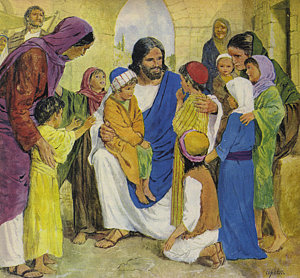
jesus loved-children-clive-uptton

Mark 10:13-16 (10:13) – October 7, 2018

Today, the first Sunday in October, is World Communion Sunday. Today, we celebrate the holy practice of Communion, along with the millions of Christians in thousands of churches and gathering places all over the world. I know I asked already about the many different Communion services we all have been to, in different churches. I would like to go back further, before the Passion Week, before the time Jesus instituted Communion at that Passover dinner.

We have a little, short Gospel reading today. This situation is not long before Palm Sunday. We are not exactly sure how long. A number of days perhaps, or a few weeks before Jesus and His disciples enter Jerusalem for that last week, that Passion Week.

What is the Rabbi Jesus doing here? Teaching, as usual. Also, arguing with the Pharisees and teachers of the Law of Moses. These smart guys were always testing each other, to see whether each of them could give wise answers—and correct answers. A lot of the Gospel writings were responses of Jesus to these questions. He had just finished one of these verbal duels with the Pharisees when this particular situation with the children came up.

“People were bringing little children to Jesus to have Him touch them.” Both in the first century as well as in later centuries, it was common for parents to bring their children to rabbis for a blessing. This was a very common thing, often done. However, the disciples here rebuked the parents. “Children should not be allowed to disturb the teacher and his students.” [1]

They considered themselves more important. Rabbi Jesus was doing very important teaching, teaching His Very Important Students, the disciples. We can see they just did not get it. The disciples completely missed the point of Jesus and His ministry. Again.

We have one group of men—the disciples of Jesus—and another group of men—the Pharisees—bickering and arguing about who is right, and who is more important, and who gets to listen to the Rabbi. Then, we have a third group, probably mothers and maybe grandmothers, bringing small children for a blessing from the Rabbi Jesus.

Let’s come at this from a different point of view, and look at the feelings, emotions and the power struggle going on.

A snooty, self-important group of Pharisees have been asking Jesus challenging questions, again. As is always the case, Jesus answers their questions well. The beleaguered disciples are probably relieved that they have finally gotten rid of the Pharisees, and finally are able to sit and listen to their Rabbi’s teaching by themselves, for a change. Some women with small children in tow come to the door of the house, tap-tap-tapping. They would like a blessing for their young kids, if it isn’t too much trouble. Can you see the picture?

A couple of the disciples poke their heads out the door. “What? Now? Come in and bother our Rabbi? He just got done with the Pharisees, and He’s doing some important work right now. Get lost. Take off. The Rabbi doesn’t have time for you, anyhow.”

But, Jesus finds out. I don’t know whether He overhears the disciples, or what, but Jesus gets upset with them.

In English, we usually need to use special words for emphasis or to show something is really important. The language the New Testament was written in, Koine Greek, has specific verb tenses, the aorist active imperative tense. Jesus uses one of these verbs right here: “Let—or, permit—the little children to come to Me.” Jesus was particularly urgent and intense, here. He caught His friends in the middle of turning these moms and kids away, and publicly rebuked the disciples. In front of the women and children. Jesus really meant what He said!

What is more, in the act of shoving away the unimportant folks Jesus capped that rebuke of the disciples. Jesus said, “Let the little children come to Me, and do not hinder them, for the kingdom of God belongs to such as these. I tell you the truth, anyone who will not receive the kingdom of God like a little child will never enter it.”

The view of children in the first century was radically different than today’s view. Modern readers or listeners of this Gospel lesson often romanticize children. Oh, how innocent! Oh, how accepting a child is! However, “ancient societies lacked such romantic notions of childhood. Jesus directs His comments to adult male disciples who are shoving away the ‘non-persons.’” [2] The child in ancient culture was not even considered a “person.” Children belonged to their father, and were dependent and subject to him even as adults.

Do we understand how radical the words of Jesus are, yet? If we see the children of the first century as totally dependent on their father, we can take His words one step further. Jesus tells His disciples they need to become like children—become totally dependent on their Father in heaven. The disciples—and by extension, the followers of the disciples, that is, us!—must understand we are totally dependent upon God’s grace and care and welcome.

And, after Jesus gives this stinging rebuke to His disciples, Jesus then turns around and blesses the small children. He takes them up in His arms, and holds them. What a picture! Can you imagine holding a little one in your arms, perhaps smoothing back their hair, smiling back at them, maybe even tickling their tummy—and then blessing them? That is what Jesus did. He cared for them. He blessed them. And, probably blessed their moms, too.

Children were considered “non-persons,” not yet adults, not yet important like the Pharisees or rabbis or priests or teachers of the Law. And, certainly similar to the status of women, who were often considered “non-persons,” at best second-class citizens, if that. Not males, not the important ones. Who might be considered “non-persons” today? Would the handicapped be considered “non-persons?” What about the mentally ill? What about the homeless, or the street people? Are they all “non-persons?”

All of these individuals are important to Jesus. He reached out to children, to women, to lepers, to the blind and lame, to foreigners, to ritually unclean people, and the mentally ill. Jesus was not exclusive, but radically inclusive. Jesus raises the social standing and the self-worth of all individuals. His welcome transcends all barriers, all boundaries, all colors, all separations of class and language and ability.

What a marvelous welcome each of us has on this World Communion Sunday. Our Lord Jesus bids us all come. All are welcome here.

Amen, alleluia.

(Postscript)

  • The image of Jesus gathering up the children has me imagining Jesus gathering up those most vulnerable among us — particularly now those whose memories have been rendered raw by the necessity of reliving their most traumatic moments in these last days. Who among us most needs the safety of that divine embrace? And what does it look like, what does it mean for you and me to extend it in Jesus’ name?
  • The National Sexual Assault Hotline number is 1-800-656-4673. If you have need of it, use it. If not, pass it along. Indeed, may we continue to hold close in prayer those whose suffering is ongoing. And may we keep on seeking to shape a world where such a hotline is no longer necessary. [3]

[1] Perkins, Phemie, The Gospel of Mark, New Interpreters Bible Commentary, Vol. 8 (Nashville, TN: Abingdon Press, 1995), 647.

[2] Ibid.

[3] http://dancingwiththeword.com/jesus-gathers-the-most-vulnerable-into-his-arms-then-and-now/  Pastor Janet Hunt has served as a Lutheran pastor in a variety of contexts in Northern Illinois. Currently she serves as pastor at First Lutheran, DeKalb, IL.

@chaplaineliza

(Suggestion: visit me at my regular blog for 2018: matterofprayer: A Year of Everyday Prayers. #PursuePEACE – and my other blog,  A Year of Being Kind . Thanks!


Unknown's avatar

Every Blessing in Abundance

“Every Blessing in Abundance”

2-cor-9-7-thanksgiving-word-cloud

2 Corinthians 9:7-12 (9:8) – November 13, 2016

At this thanksgiving time of the year, people are more liberal with their donations. Soon the Salvation Army kettles will be out in front of stores and supermarkets, and we will hear the ding dong of bell ringers asking for gifts. The food pantries and clothes closets appreciate extra donations, and all manner of other charities will receive additional gifts, too. The holidays are a time to give liberally to all kinds of organizations and charitable institutions.

This brings me to our Scripture passage for today. This giving time of the year reminds us of what Paul wrote to the church in Corinth. In the paragraphs before today’s reading in chapter 9, Paul asks for a collection to be gathered together. This collection of money is to be given to the persecuted, needy church in Jerusalem.

It’s then Paul tells more about giving, in general. How to give, and why. How not to give, too. People have all kinds of reasons to give: giving to provide for others, in a righteous kind of way. Giving to help others, in a loving way. Or, giving out of obligation, in a grudging way. There are many different kinds of ways to give, and attitudes to have while we contribute. The Apostle Paul talks about a few of them in this reading today.

God loves a cheerful giver. Paul says so! In the verses just before today’s passage, Paul praises the believers in Corinth for such a bountiful gift for the persecuted church in Jerusalem. So generous! They understood why the money was needed, certainly.

We have a proverb of Paul’s day included here, in our first verse: “the one who sows sparingly will also reap sparingly, and the one who sows bountifully will also reap bountifully.” Here Paul is including a common saying of the day to illustrate his point. Talking about bounty, about being generous, and about grudging giving—being stingy.

What is all this about sowing and reaping? To us, in a 21st century, urban context, most of us are not very familiar with planting and harvest, sowing and reaping illustrations. Some are—those of us who have green thumbs, plant lovely gardens, and reap a bountiful harvest. You will more easily understand what Paul is saying here.

We have it in a little different fashion, a verse later. Each of you must give as you have made up your mind, not reluctantly or under compulsion.”

Let me give an illustration. Better than that, let me show you what Paul is talking about here. I have some bookmarks with 2 Corinthians 9:7 printed on them. I will take the liberty of passing them out.

(I pass out the bookmarks, first, reluctantly. With a somber face, not looking people in the eye, sighing, rolling my eyes, and not very pleased to be giving out bookmarks at all. Halfway through, I change my demeanor. I pass out bookmarks with a cheerful smile, with a happy attitude, and wishing people the best as I give them bookmarks.)

Did anyone notice a difference? What was that difference?

Was I a reluctant giver of the bookmarks, at first? “I can’t believe I have to do this.” And “I wonder whether I can leave soon?” Rolling my eyes, and sighing. I did not show a very good attitude, at all!

How about the second half of the bookmarks? The second half of my giving? How was that? Was I a cheerful giver? Was I kind and welcoming?

How did you feel receiving the bookmark from a reluctant giver? How about the cheerful giver? Which kind of giver would you prefer? Which kind of giver do you think God prefers?

We will read this verse once more: “Each of you must give as you have made up your mind, not reluctantly or under compulsion, for God loves a cheerful giver.” These are wise words from the Apostle Paul. This giving cannot be done reluctantly, or under compulsion, because then it isn’t for real. The reluctant giving is grudging. Out of obligation, and a heavy, unpleasant responsibility.

Paul would tell us, “No! That isn’t that way God wants you to give!” Instead, we are to give in cheerfulness, with joy in our hearts. We are to give freely and positively. God will love us for that positive, cheerful attitude. What is more, the whole action and the whole feeling of the heart will then be framed by love. God’s love! God will express love toward us, and each of us will express love toward our fellow people in need. And, whomever else we need to give to.

But, wait! There is more! Paul goes on to talk about what more God will do. If we have this generous attitude towards giving, being open-handed, positive and cheerful, then God will bless us abundantly with every blessing.

You can kind of see this from the way the sentence is translated into English, but Paul is making sure his readers know that God will absolutely, abundantly provide. God will certainly multiply all with great abundance. If we have generous attitudes, God will provide every increase, so that we will abound in every good work.

Let me caution everyone here. God is not talking about purchasing salvation. That is not even being discussed. We are saved already.

We have been justified by God, and we are now and always God’s children, beloved and cherished. However—as we know from our own children, beloved children are not always cheerful and generous. That is just Paul’s point here!

God wants us to live abundant lives. God wants us to be kind and cheerful and generous. God wants us to be abundantly blessed, and have heavenly gifts rain on our heads. What is the hinge, here? Giving. If we have a kind, cheerful and generous attitude towards giving, God is essentially giving us a high five!

We will live abundant lives, blessed and enriched in every way.

What a marvelous promise. What wonderful words. And, this is not “maybe,” or “I hope so,” but it is a blessed promise from God! This is not only for our gifts of treasure, for our gifts of money. But, this blessing is for our gifts of time and of talents, as well.

For the person who comes and volunteers on Sunday mornings to start the coffee, stuff the bulletins in the hymnals, or turns on the lights in the sanctuary and lights the candles—thank you, so much. For the person who bakes a cake or makes a table decoration or repairs the church building—thank you. Those are the gifts of time and of talent, and God is so pleased with that. All of those things, and many, many more.

Paul’s final words from this reading today: “11 You will be enriched in every way for your great generosity, which will produce thanksgiving to God through us; 12 for the rendering of this ministry not only supplies the needs of the saints but also overflows with many thanksgivings to God.” See? Our cheerful, generous giving supplies the needs of the saints. The needs of the local church.

We end as we begin, with thanksgiving. Thanksgiving to our fellow church members, to our friends and neighbors, and ultimately, to God. Thanks be to God for God’s abundant blessings. And, thanks be to God for the indescribable gift of salvation.

Alleluia, amen!

(Thanks to Pam Auble and http://www.ucc.org/oghs_resources_2013-resources_activities for the excellent suggestion of a reluctant giver and a cheerful giver.)

Unknown's avatar

A Blessing from Jesus

“A Blessing from Jesus”

Mark 10 Jesus blesses the children

Mark 10:13-16 – October 4, 2015

Who doesn’t love babies and small children? A small minority of people do not care for them, but by and large, babies and toddlers bring a smile to many people’s faces. Take social media, for example. Facebook, or Instagram, or Twitter. Do you want a lot of “likes” or “retweets?” Put up a photo or a picture of a darling baby or toddler, and watch how many people share or retweet your post.

We see, today, pictures of Jesus welcoming small children, even babies. Wonderful scenes! Darling, adorable, even touching pictures. However, I caution you—modern ideas of the innocence of children and the freedom we in 21st century America associate with young ones is not consistent with the first century understanding of children. But I’ll get back to that, later on.

This week’s sermon is a continuation of last week’s sermon. Last week—I’m reminded of my summer sermon series, which I compared to a radio serial. “When last we left Jesus, our intrepid hero—!” As I was saying, last week we talked about how much the disciples just didn’t understand the point Jesus was talking about.

In last week’s sermon, to make His point with the disciples, Jesus brought a small child into the middle of their group. Mark tells us that Jesus took the child into His arms. Then said, “Whoever welcomes one of these little children in My name welcomes me; and whoever welcomes Me does not welcome Me but the One who sent Me.” Here, again, same story. The disciples are really dense. Very similar situation in this case, and they just don’t seem to understand what Jesus is saying.

Let me set the scene for today’s reading The Rabbi Jesus is teaching, as He so often does. He does not discriminate! He doesn’t only teach to men, but also to women. And the women, often being moms, grandmothers, aunts or older sisters, sometimes bring their children with them to the open-air teaching sessions.

I suspect that Jesus was one of those people who loved and cared about children. Was good with little ones. Can’t you imagine Jesus as being welcoming towards babies, toddlers, children, adolescents? All the kids! Just from His brief interactions with children in the Gospels, I get that feeling. And, I bet moms and grandmas could tell that about the Rabbi Jesus, too.

So, when women try to bring their children to the Rabbi Jesus for a blessing, what happens? Our reading from the Gospel of Mark says that the disciples rebuke those who are bringing the children to Jesus. As I looked at alternate translations, one had the disciples censuring the adults for trying to pester their Rabbi! That’s a strong expression of disapproval!

Hadn’t these guys learned anything from their recent discussion with Jesus? When Jesus brings a small child into the middle of the circle, lifts the child in His arms, and says, “Whoever welcomes one of these little children in My name welcomes Me.” Are these men that dense? I guess they are, because in today’s reading Jesus gets really upset with them when He finds out that the disciples are turning parents and children away.

Now, I want everyone to think of our 21st century kind of warm, fuzzy, frolicking idea of childhood, the concept where every child is lifted up as an individual, special, unique and loved. Is everyone thinking of that idea? That idea is absolutely true. However, I have news for you: the first century had no such idea.

I’ll give you a snapshot of two competing but similar ideas from the first century. One, the Roman view. The father—and by that I mean the oldest brother in a family—was the top dog. He ruled the roost. He was the head of the whole extended family. That means younger brothers, and their wives, sisters, and any other dependents. Like elderly relatives, or babies, children, or young adolescents. He was the head of the family, or in Latin, the pater familias.

Children were on the very bottom of the ladder, socially and in terms of that culture. The pater familias could decide whether a baby or small child would be accepted into the family group! So, a baby, a child, did not have any standing in society. At all.

But Jesus and the disciples lived in Palestine. On top of the Greco-Roman culture, they also had Jewish culture to deal with. The Jewish concept of the patriarch was somewhat similar, but not exactly the same. Children were seen as a blessing from the Lord. But, again—the position of children was vulnerable. In both cases—the Greco-Roman culture as well as the Jewish culture, children were dependent, even disregarded. Children were very much counted among “the least of these,” that expression Jesus used in Matthew 25. The ignored of society, overlooked, left out, less than.

All very interesting, you might be thinking. But what has that to do with you and me, in the here and now?

What about these children? These little ones, the downtrodden of society, the overlooked? Jesus rebukes His disciples for their poor treatment of children! In essence, He tells them off! And then, Jesus welcomes the children to Him. I bet He even took them into His lap. Mark tells us He held them in His arms, certainly. And blessed them.

What about last week, when Pope Francis was here in the United States? What do you think parents and grandparents thought when the Pope—personally—blessed their children? I understand that Pope Francis has a special place in his heart for children and young people. I think Jesus did, too!

I have a further question. Does Jesus love only Jewish children? That’s who He was blessing, here in Mark. Do you think Jesus also loved Samaritan children? What about Greek children? Roman children? What about children from all over Africa? Or, from India? Or China or Mongolia? Or children from Gaul (now parts of France and Germany)? Or, across the ocean, indigenous American children? Or indigenous Australian children?

You remember the song “Jesus loves the little children, All the children of the world. Red and yellow, black and white, they are precious in His sight. Jesus loves the little children of the world.” It does not matter what a person’s culture is, or social standing, or any other ranking system. Jesus still wants to embrace them, bless them, and welcome them. That goes for children as well as for adults. Multi-ethnic? Jesus welcomes you! Multi-cultural? Jesus welcomes you, too! No matter what, no matter where, no matter who.

A minister, who used to post to a sermon discussion group I sometimes look at, put up this entry a few years ago. “One of the greatest joys of my ministry is that I serve a church which welcomes children of all ages to the Table. It is so meaningful to serve children as their parents help them break off the bread and dip it in the cup. True communion, true welcoming. … As I invited people to come to the Table, I realized that no one had told me they would be helping me serve, so asked, “Who will help me serve today.” An 8 year old boy who was already up and ready to receive to communion, said, “I will” “Oh dear,” I thought, “what will people think if I have him serve?” I was sure most would be okay, but I thought some may take exception. But I realized there was no way I could refuse such an eager heartfelt offer. So he stood beside me and offered the bread. … I’m certain it was a meaningful experience for him— it certainly was for me. I realize that the “legalities” of some would have said no to his serving, but I know that our Lord said, “Let the little children come to me…”

Here’s a final thought. Jesus transforms children from their lowly, insignificant, disregarded state into wonderful examples for the disciples to follow. Jesus here tells us we all ought to approach Him in the same way as little children do. Wonderful examples for us adults to follow today, too.

When we come to worship, and when we come to communion, we are to come as little children. Trusting, dependent, vulnerable. We do not give ourselves grace and mercy. Instead, Jesus freely offers grace and mercy to all who come to Him. We can praise God for the boundless love and the radical grace extended to each of us, each day.

@chaplaineliza

Suggestion: visit me at my daily blog for 2015: matterofprayer: A Year of Everyday Prayers. and my other blog,  A Year of Being Kind .  Thanks!