Unknown's avatar

Thanksgiving for All

“Thanksgiving for All”

1 Tim 2-2 pray, words

1 Timothy 2:1-4 – November 18, 2018

Have you ever had a community leader in the local news—perhaps even someone you know—who annoyed you? Got you so mad, you wanted to hang them up by their toes? Something they said, or did, or some stand they were taking. How could they do such a thing? What cockamamie words to come out of their mouth! We mutter, “Good grief!” or “I cannot believe it!” and roll our eyes, again.

Why did Paul even write to Timothy? True, Paul and Timothy had a close relationship. Just think of someone older, who showed you how to do some work, or perhaps had some good advice for you. A mentor, someone who was wiser than you, back when you were first learning how to do things, or first were an apprentice. Or, perhaps you were a mentor for some young protégé, and had the joy and satisfaction of teaching them the ropes.

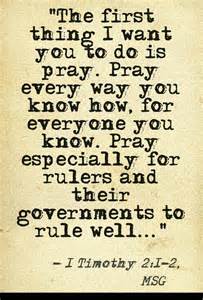
The Apostle Paul had some wise words for his young protégé Timothy about just such a situation. What does Paul say again? We are to pray. Listen: “I urge, then, above all, that petitions, prayers, intercession and thanksgiving be made for all people.”

Great advice! But, all of these describing words are kinds of prayer. Paul is being quite specific about prayer. Each of these four terms has a different meaning or nuance. The four Greek words used here have different applications, too. First, petitions, or deesis. This is an appeal for a particular need. Then, prayer, proseuche, a general word for prayer that often occurs in petitions. Third, intercession—exteuxis, which captures an urgent and bold request. Last, eucharistia, or thanksgiving, which means an expression of gratitude. [1]

Isn’t that what we celebrate today, on Thanksgiving Sunday? Isn’t that what we concentrate on at this time of the year? There is a problem. Paul mentions that we are supposed to pray for rulers and those in authority over us. Which brings me back to where I started.

I say again, have you ever had a community leader in the local news—perhaps even someone you know—who annoyed you? Got you so mad? Something they said, or did, or some stand they were taking. How could they do or say such a thing?

If ever there was a time that would test our willingness to pray for those in authority, now would be the time. Am I the only one who is aggravated by politicians? Not to mention the contentiousness of the recent election season! This bible passage could well be a real test of our willingness to follow God’s word.

Except, in Paul’s day, the local politicians—rulers—those in authority—had a lot more control over their constituents than those here in the United States. This is the second time Paul advises his readers to pray for those in authority. (He does so in Romans 13, too.) The emperor at this time was Nero, who was quite antagonistic towards the brand-new sect called Christians.

The commentator J. Vernon McGee says we are to pray even if we have a corrupt administration. If we transpose Paul’s words to today, McGee says the Democrats ought to pray for the Republicans, and the Republicans ought to pray for the Democrats. In a polarized nation and world this is a call to pray for people with whom we agree and for people with whom we disagree.  “We are to pray for whoever is in power. Remember that the man who was in power in Rome when Paul wrote was bloody Nero, yet he says we are to pray for kings and those in authority, whoever they are.” [2] Some of the leaders Timothy and his friends were to pray for were Romans who were trying to imprison and even kill as many Christians as possible.

God willing, we need to pray for all those in authority over us, no matter what, no matter who or where they may be. Paul’s words remind us that our leaders and those in authority depend on God’s guidance, grace and mercy.

Timothy is not only encouraged by his mentor Paul to pray for leaders—above all—but also to pray for all people. Not only to pray, but to intercede for, and give thanks for all people. That is every single person. All. All means all.

That is really difficult! Pray for ALL people? Pray for the funny looking guy at the drug store? Pray for the lady who talks to herself at the supermarket? Pray for that couple across the street with the weird looking clothes? What about the homeless person sitting on the sidewalk? Yes, yes, yes, and yes. We are to pray for, intercede for, and give thanks for ALL people. Especially these people who seem strange, or weird, or don’t speak like we do, or who walk funny, or a hundred other differences. All means all. Paul tells us to pray for everybody.

This is the thankful season of the year, when we express our gratitude to God for all the gifts we receive throughout the year. Gifts of family, friends, food, shelter, and many other blessings. Things that make us happy to be alive! But, where did this modern idea of Thanksgiving come from? Frances Woodruff has a brief history of the origin of our holiday.

“This week we celebrate Thanksgiving. On Thursday, everyone in our country will stop and give thanks for all their blessings. In the early days of our country, families picked their own day of thanksgiving. People celebrated on different days whenever it fit their schedule. Then 150 years ago, President Abraham Lincoln received a letter from Sarah Hale. Mrs. Hale suggested that there be a National holiday of Thanksgiving—that everyone in the country stop on the same day and give thanks. But at that time, our country was at war. The fighting made times sad, food scarce, and money tight. It was hard for people to feel thankful. People thought, We can’t have a holiday now! We don’t have time for a party! There are too many problems to be solved! But President Lincoln and the people soon realized that gathering together was just what they needed to do, especially in those tough times.” [3]

Whether the times are tough, or not-so-tough, whether fraught with danger or filled with peace, Paul tells us to be thankful. He tells us to have an expression of gratitude in our hearts, which will help us to stay positive and keep our eyes on God. Just as people through the years found that gathering together and being thankful together was a wonderful corporate celebration, so, too, with today. So it was in Paul’s day, as well.

Prayer, intercession, and being thankful are surely attitudes and practices that draw us together. Just as at the Interfaith Thanksgiving Eve service this coming Wednesday, where diverse friends from all over the Morton Grove, Niles, Skokie and Glenview neighborhoods come together, we all can be thankful. We all can praise God for another harvest safely gathered in. We all can praise God for warm families, good friends, and another year coming to a close.

All this thanksgiving is good, and it pleases God our Savior,” who wants all people to be saved and to come to a knowledge of the truth.” That is, all people, from all over the world.

God willing, amen. May it be so.

[1] http://www.workingpreacher.org/preaching.aspx?commentary_id=1769

Commentary, 1 Timothy 2:1-7, Christian A. Eberhart, Preaching This Week, WorkingPreacher.org, 2013.

[2] McGee, J. Vernon, Through the Bible, Vol. V., (Nashville: Thomas Nelson, 1983), 436.

[3] https://onthechancelsteps.wordpress.com/2012/11/05/gather/

“We Gather Together,” Frances Woodruff, On the Chancel Steps, 2012.

@chaplaineliza

(Suggestion: visit me at my regular blog for 2018: matterofprayer: A Year of Everyday Prayers. #PursuePEACE – and my other blog,  A Year of Being Kind . Thanks!

Unknown's avatar

To God Alone Be Glory

“To God Alone Be Glory”

1 Tim 1-17 immortal, invisible, words

1 Timothy 1:12-17 (1:17) – October 8, 2017

When I was young, I was a member of a Lutheran church on the northwest side of Chicago, baptized and confirmed Lutheran, and well trained in liturgical practice and classic hymnody. Later in high school and into my twenties, I spent a number of years in Evangelical churches. I memorized dozens of bible verses, learned pietistic practices, and completed an undergraduate degree in church music from a local bible college. I sang many beloved old hymns and gospel songs, including “Rock of Ages,” “Amazing Grace,” “Blessed Assurance,” and “To God Be the Glory.”

It’s this last gospel song I would like to quote: “To God be the glory—great things He hath done! So loved He the world that He gave us His Son, Who yielded His life an atonement for sin, And opened the Life-gate that all may go in.”

“To God be the glory!” Exactly the topic of my sermon today. Pastor Kevin asked me to preach on one of the “solas,” the foundations or main principles of the Protestant faith. Soli Deo Gloria is one of the “solas” or “onlies” of the Reformation. As we remember Martin Luther and his posting of the 95 Theses, or grievances against the Catholic Church on that chapel door in the town of Wittenberg in October 1517, this October 31, 2017 is the 500th anniversary of his brave act that sparked the Protestant Reformation.

“Soli Deo Gloria,” or, to God alone be glory, is one of the foundational principles that sets Protestants apart. One of the rallying cries of the Reformation, this principle meant that all glory (and honor and worship) is due to God, alone. Not God plus the saints, not God plus the Virgin Mary, not God plus the church hierarchy. God alone is worthy of our glory—and only God is to be worshipped. That was one principle that Protestants were willing to die for, and did.

Our Scripture reading today comes from 1 Timothy 1, starting at verse 12. Paul states: “I thank Christ Jesus our Lord, who has given me strength, that He considered me trustworthy, appointing me to His service.” Paul is just overflowing with thankfulness here. He is absolutely grateful to the Lord Jesus for extending His grace to Paul and designating Paul a worker for God, in the service of Jesus Christ.

Just to refresh everyone’s memories, the Apostle Paul was not always a follower of Christ. Before he had that sudden, come-to-Jesus experience on the Damascus Road, Paul was called Saul. He was a Pharisee of the Pharisees, and an up-and-coming member of the Sanhedrin—the ruling council of the Jews in Jerusalem. Saul/Paul had studied at the equivalent of the University of Tarsus, a cosmopolitan city where he grew up, in modern-day Turkey. He saw this breakaway sect of Jews following some “false Messiah” as a clear danger to the worship of the one God who made heaven and earth.

Paul tells us himself what his personal situation was—in brief—in the next verse of 1 Timothy 1: “13 Even though I was once a blasphemer and a persecutor and a violent man, I was shown mercy because I acted in ignorance and unbelief.” Sure, Saul/Paul was a fire-breathing zealot, ready to grab these “Christians” off the street and throw them in prison. As he himself states, Paul was formerly “a blasphemer and a persecutor and a violent man.”

How on earth could God use someone awful like this? A self-admitted bad guy, too! But, wait. This isn’t the end of the story. Not by a long shot. Jesus steps into the picture.

What does Paul say in the next verse? “14 The grace of our Lord was poured out on me abundantly, along with the faith and love that are in Christ Jesus.” What happened? Jesus Christ happened. God’s grace was poured out on Paul, and he had a true conversion experience. He once was blind but suddenly was given the gift of sight—spiritual sight.

Here in this letter to Timothy, the Apostle Paul gives his testimony. He tells everyone what a rotten guy he was, and how God reached down and saved him, and what’s more, put Paul into his service. In many Baptist and Evangelical churches, “the sharing of testimony was [and is] a vital practice of faith. Such sharing of stories, such narrating of God’s faithfulness in our lives was not a moment to extol the speaker’s virtues as a follower of Jesus so much as a way to name God’s acting.” [1]

Paul certainly had a different kind of past life, before coming to Christ, and he definitely remembered aspects of that life. We can see that from these two verses: “15 Here is a trustworthy saying that deserves full acceptance: Christ Jesus came into the world to save sinners—of whom I am the worst. 16 But for that very reason I was shown mercy so that in me, the worst of sinners, Christ Jesus might display His immense patience as an example for those who would believe in Him and receive eternal life.”

We can hear rumblings of several other “solas” from our Reformation in these verses, can’t we? Sola Fide—faith alone, and Sola Gratia—grace alone, and certainly Solus Christus—by Christ alone. It is at this earthshaking, deep emotional point that Paul can’t stand it any more and breaks into a glorious doxology: “17 Now to the King eternal, immortal, invisible, the only God, be honor and glory for ever and ever. Amen.”

If we are paying close attention to what he just said, it is at this point that we—all of us—ought to join Paul on our knees and lift our arms to God in praise and awe and honor and glory. Here, in brief, is the tremendous order of events that Paul wrote about at the beginning of his letter to Timothy. Saul/Paul was “the chief of sinners,” came face to face with Jesus, went into God’s service, had his life amazingly changed, and wrote a glorious doxology about it.

Look at this Protestant principle from the point of view of the 1500’s. Was it God—plus the saints, or the Virgin Mary—that caused such a life-changing experience for Paul? I think not. Was it God—plus the church hierarchy—that made Paul do a complete 180 degree turn? No, not that either. It was God alone who brought Paul to his knees. God alone, God’s grace and mercy in Paul’s life, heart and soul had a life-changing effect on Paul. Heart-changing and soul-changing, too!

Sadly, in Martin Luther’s day, many people had (in effect) contingency plans for their salvation. Or, add-ons to get to heaven. For example, they would believe in Jesus Christ and His atonement—plus prayers to the saints; or Jesus Christ and His blood shed on the cross—plus the petitions of the Virgin Mary. All of these additional things were and are blessings, and were and are embraced by people all over the world. Just not to be elevated to the point of worship.

However, Martin Luther and John Calvin and the other Reformers said that it is God alone who was to receive our worship, honor and glory. That is what bursts out of Paul here in 1 Timothy 1. “Immortal, invisible, God only wise, In light inaccessible, hid from our eyes. Most blessed, most glorious, the Ancient of Days, Almighty, victorious—Thy great name we praise.”

Which leads us to our response. Yes, we can celebrate! Yes, such a marvelous God is truly to be given all praise. Blessing and honor, glory and power be unto God and to the Lamb.

But, some of us do not readily burst into speech that might be mistaken as quotes from the King James version of the Bible. I was moved by several paragraphs of a recent book by the noted Christian author Anne Lamott. It comes from the third section of the book “Help Thanks Wow,” which is an exploration of three essential prayers that we all pray at one time or another.

“The third great prayer, Wow, is often offered with a gasp, a sharp intake of breath, when we can’t think of another way to capture the sight of shocking beauty or destruction, of a sudden unbidden insight or an unexpected flash of grace. “Wow” means we are not dulled to wonder.” [2]

Isn’t this another way of expressing Paul’s glorious doxology? It might not be as elegant, but if the Holy Spirit can take the deep, wordless groanings of our hearts and make them understood in prayer, why not the heartfelt, or exuberant, or awestruck simple “Wow!”

As the Reformers tell us, all of us are sinners, saved by God’s grace. So, all of us can say with Paul that God alone is to be worshiped—to God alone be the glory.

We can see from the life of the apostle Paul as well as from the lives of countless followers of Christ throughout the centuries, God can use anyone whom God wishes to use. Paul’s heart-stirring testimony can move us to pray, to serve, to live for God. Our Lord Jesus can take us, wherever and whomever we are, and use us. Here I am, God. Here are we. Send me. Send us.

[1] http://www.workingpreacher.org/preaching.aspx?commentary_id=3034 , September 11, 2016, Eric Barreto

[2] Help Thanks Wow, Anne Lamott, (United States of America: Riverhead Books, published by the Penguin Group, 2012) 71.

@chaplaineliza

(Suggestion: visit me at my regular blog for 2017: matterofprayer: A Year of Everyday Prayers. #PursuePEACE – and my other blog,  A Year of Being Kind . Thanks!)

Unknown's avatar

Our Debt? Love One Another

“Our Debt? Love One Another”

Rom 13-8 love one another, script

Romans 13:8-11 (13:8) – September 24, 2017

I am very pleased to announce that a big anniversary is coming up at the end of October. It is not just a big anniversary, it is a huge anniversary. October 31, 1517. This year, on All Hallow’s Eve, we celebrate the 500th anniversary of Martin Luther and his posting of the 95 Theses, or grievances against the hierarchy of the Catholic Church, on the chapel door at Wittenberg University, in Germany.

Many people do not even know anything about this event. Some people really could not care less. However, I care very much. I was baptized and confirmed a Lutheran and spent two years studying Luther’s Small Catechism in confirmation preparation. I was a history and theology nerd throughout high school, learning as much as I could about the Reformation of the 1500’s, and Martin Luther in particular. I was not your typical teenager.

Today, I want to finish up our short series on the book of Romans, our Epistle readings from the Revised Common Lectionary that we have focused on for the past weeks. The Apostle Paul was also one of Martin Luther’s favorite biblical authors.

The Apostle Paul gets a bad rap from some people. True, he was a Pharisee of the Pharisees. He came from impeccable bloodlines, from the tribe of Benjamin, trained at the secular college in the city of Tarsus in Asia Minor, and mentored by the renowned rabbi Gamaliel. He was puffed up about his ancestry and about his superior schooling.

Can you imagine the high-and-mighty Pharisee Saul-that-was, suddenly transformed into lowly Paul, a follower of the Messiah Jesus? Losing all that prestige, losing his position on the Sanhedrin, and also his position as an up-and-coming leader of the religious Jews. After all that, after such a come-down, Paul is not only following Jesus, but he is using his substantial rhetorical skills at persuading anyone who comes by that they ought to follow Jesus, too! That’s the situation right here, in the letter to the Roman church. We are in the middle of the practical section of the letter, where Paul gives advice and commands for his readers to listen to, and heed.

When it comes to the Hebrew Scriptures and the commands listed there, we recall the Big Ten, the Commandments given by God on Mount Sinai to Moses. The Ten Commandments were the ultimate in the commands given to the people of Israel. Even though there were more than six hundred various laws in the Law Code of Moses as written down by various biblical scholars and religious lawyers in centuries following, the Big Ten commands led the list.

Here, in our reading today, Paul lists four of these commandments, the chief commands that refer to our relationships with each other. Do not commit adultery, do not murder, do not steal, and do not covet. As a former Pharisee, I suspect Paul had learned them when very young. Repeating them was something the devout followers of the Law of Moses did on a regular basis.

Paul could have given us a repetition of the Commandments and left it at that.

But, no. Paul wanted to go beyond just a rote repetition of the Law of Moses, of the Commandments—even the Ten Commandments that the Lord God gave on Mount Sinai. What he says in this reading today is nothing short of amazing, especially coming from a former Pharisee. Listen again to verse 8: “Let no debt remain outstanding, except the continuing debt to love one another, for whoever loves others has fulfilled the law.” Full stop. Period.

And, again in verse 10, just in case anyone was not clear about what Paul was saying: “Love does no harm to a neighbor. Therefore, love is the fulfillment of the law.”

Going back to our discussion about the Reformation of the 1500’s, one of the great confessions of the Protestant Church is the Heidelberg Catechism, completed in 1562. Perhaps some of you are familiar with the first question at the beginning: “What is your only comfort, in life and in death?” The response: “That I belong—body and soul, in life and in death—not to myself but to my faithful Savior, Jesus Christ, who at the cost of His own blood has fully paid for all my sins and has completely freed me from the dominion of the devil; that He protects me so well that without the will of my Father in heaven not a hair can fall from my head.”

This Catechism was written in uncertain times, when religious wars were causing upheaval over large parts of Europe. Yet, the writers of this document have the sure certainty that Jesus Christ is, indeed, our faithful Savior, protecting us from ultimate, eternal separation from God our Heavenly Father.

Look more closely at this Catechism, which talks of human redemption, God the Father, Son and Spirit, the sacraments, prayer, and the Ten Commandments.

The section on the eighth commandment, “You shall not steal,” went right to my heart. Question 111 says: “What does God require of you in this commandment?” The response: “That I work for the good of my neighbor wherever I can and may, deal with him/her as I would have others deal with me, and do my work well so that I may be able to help the poor in their need.” What was it that Paul just said in Romans 13:10? ““Love does no harm to a neighbor. Therefore, love is the fulfillment of the law.”

Okay, love one another. But, what does that look like? How do we go about loving each other? The Rev. Dr. Alan Brehm preached on this reading from Romans, several years ago. He said, “loving your neighbor means, “if your neighbor is hungry, feed him.” It means “if your neighbor is thirsty, give her something to drink.” If there are people who are sick or hurting or suffering or alone in the world, visit them. It’s not rocket science! But it’s not easy.” [1]

The problem is, with us fallible people who sin from time to time, we forget. We fall back into old patterns, familiar but not-so-good habits. It’s all very well for Paul and the other Apostles to tell us, “love one another.” Martin Luther would be the first to tell us of his struggles with this very thing! How do we go against the grain and “love one another?” I mean, love all others? No matter who they are? I think we just heard from Dr. Brehm.

As Dr. Brehm tells us, our sinful, fallible selves are “always in the mode of “what’s in it for me?” But that’s not the kind of love the Bible teaches us. The kind of love that Jesus modeled for us and that the Apostles taught us to practice is a kind of love that simply gives to another person—without any wish to get anything in return.” [2]

The Apostle Paul gives us a big challenge today, and also a big blessing. God wants us to love one another! The Lord is so pleased when we try to love each other. As we try to love more and more, we draw closer and closer to God, and to each other. No matter who they are.

I know—from experience!—how difficult this can be. Some of us are stubborn. Some of us are afraid. Loving one another can be a really, really hard challenge. I want all of us to help each other. We can all think of one or two people we encounter on a regular basis who are difficult for us to love. I invite you all to write their names on a piece of paper. We will collect the names and the ushers will bring them forward for us all to pray over. We can ask God’s forgiveness for not loving them, and ask Jesus for His help to love one another as He loved us.

The last question in the Heidelberg Catechism is, “What is the meaning of the little word ‘Amen?’” The answer: “Amen means: this shall truly and certainly be. For my prayer is much more certainly heard by God than I am persuaded in my heart that I desire such things from Him.” We can all say, “Alleluia, amen” to that earnest, heartfelt prayer to God.

[1] http://thewakingdreamer.blogspot.com/2011/09/charity-never-fails-rom.html

A sermon preached by Rev. Dr. Alan Brehm on 9/4/11 at First Presbyterian Church, Dickinson, TX and at A Community of the Servant-Savior Presbyterian Church, Houston, TX.

[2]  Ibid.

@chaplaineliza

(Suggestion: visit me at my regular blog for 2017: matterofprayer: A Year of Everyday Prayers. #PursuePEACE – and my other blog,  A Year of Being Kind . Thanks!)

Unknown's avatar

Christ is All!

Colossians 3:9-15 – January 15, 2017

col-3-11-christ-is-all-words

“Christ is All!”

Did you ever get a brand-new suit? A lovely new dress? Were you dressed in new clothes from head to toe? What about when one or your children or grandchildren was dressed in a wonderful new outfit? That can cause a person to feel brand new, all over.

That’s what the Apostle Paul is talking about, here in Colossians 3, verses 9 and 10: seeing that you have stripped off the old self with its practices 10 and have clothed yourselves with the new self.” That is exactly the word picture Paul is using, about taking off an old shirt or coat, and putting on a new, clean garment.

Paul not only is talking about our new selves and our new identity. He is also alluding to what happened at baptism. He makes mention of it in the letter to the Galatian church, and he mentions it here, too.

In the early Church, people often got baptized as adults. They would go through a several-week period of preparation, teaching and study, and finally be pronounced ready to be baptized. After the time of baptism, which often took place on Easter, the newly-baptized person would put on a new, clean white garment. This would show everyone that they were washed clean and ready to claim their new identity in Christ.

Some people might be wondering what I am doing up here, with no robe. I wanted to show everyone what Paul was describing here. See, I am just plain old me. Nothing special, nothing to write home about. But, now, I am going to take off the old self. Take off my old jacket. What is it that Paul said, again? I put on—we put on the new self. Like, right now, when I put on my robe. I am clothing myself in Christ. We all have done this, already! It has already happened, and is a blessed reality!

However, there is a problem. Paul reminds us about that. Did you know we can fool ourselves into thinking that this has not happened? Paul says exactly that, in verse 9: “Do not lie to one another, seeing that you have stripped off the old self with its practices.”

Paul knows how easy it is to lie. Maybe not tell big whoppers, but certainly bend the truth. Some people lie a little, and others lie a lot. Whether it’s a lot or a little, whether it’s lying to other people or lying to ourselves, some people can act like they still have their dingy old clothes on, and haven’t put on their brand new Jesus garment yet. Some people can talk like they haven’t had much of an acquaintance with Jesus, either. Jesus is not affecting them much at all. Not in the way they talk, or act, or think.

We all know how easy it is to stretch the truth to other people. It’s just human, after all! This might be a challenge for us to hear, but, let’s think about lying to ourselves. Yes, not acting or talking like we have put on Christ. What about when we fool ourselves a lot, or beat ourselves up? When we say, “no one will ever know!” or “I guess nobody ever expected much,” or even, “what’s the use? I never can measure up.” Settling for cut-rate, lying to ourselves that whatever we are doing is okay, or giving up, not even trying at all. It’s a really difficult habit to break.

That is a big, big problem! What are we going to do about such a state of affairs?

Sometimes, people do end up stuck in the middle. Right before the scripture passage we read today, in the letter to the church at Colossae, Paul mentions a laundry list of practices and other things that can get in the way. Things that come between us and God.

We believers may think we have gotten rid of the malice, impurity, even blasphemy that Paul describes in verse 8. Yes, Paul matter-of-factly ticks off bad habits and sinfulness from the list, but spiritually, these people haven’t put on their brand-new Jesus garment. Do you know people like that? I’m afraid some people are too focused on themselves, either in a puffed-up self-centered manner, or in a negative, self-defeating way.

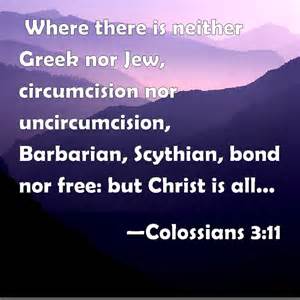
I discovered verse 11 of this chapter a long time ago. Paul says, “you have clothed yourselves with the new self…. In that renewal, there is no longer Greek nor Jew, circumcised nor uncircumcised, barbarian, Scythian, slave and free; but Christ is all and in all!”

One commentary I consulted was particular about the translation of this verse from Greek: “There is no such thing as Greek and Jew (the difference of privilege between those born of the natural seed of Abraham and those not, is abolished), [no such thing as] circumcision and uncircumcision (the difference of legal standing between the circumcised and uncircumcised is done away with)—and [no such thing as the difference between] bondman, freeman.” [1]

So many people just skim over this verse, not even considering the inclusiveness and social justice that the text implies. Instead, they are—we are—still focused on ourselves, as if we all are wearing blinders. They—we celebrate the day they were “saved”, but fail to do the work of God’s realm, including the removal of barriers. Those who are stuck halfway between their old, sinful clothes and their new, clean Jesus garment may even be creating new barriers.

Today is Martin Luther King Jr.’s birthday. In August 1963, he made his “I have a dream” speech from the steps of the Lincoln Memorial, on the Mall in Washington, D.C. He said, “I have a dream that my four little children will one day live in a nation where they will not be judged by the color of their skin but by the content of their character.”

That sentence resounds with the quality and the content of this verse from Colossians, as well as the similar verse from Galatians 3:28, which talks about neither male nor female, neither Jew nor Gentile, and neither slave nor free. All of us—that is, everyone—are one in Christ Jesus our Lord. Or, as Colossians 3 states: “Christ is all, and in all!”

Martin Luther King was highlighting people’s insides, not their outsides, and looking at the quality of their character, not the color of their skin. Or how nice their clothes look. Or how expensive their shoes are. Or whether they have been to college or not. Or which side of the train tracks they are from. Or what ethnicity or culture they grew up in.

“There’s a great line from a movie where two African Americans are walking past a whites-only church, and one of them says, ‘I’ve been trying to get into that church since I was a kid.’ His friend responds by saying, ‘That’s nothing, Jesus has been trying to get in there for a lot longer and he hasn’t gotten in yet.’” [2]

The larger church is hurting. Most believers have witnessed divisions and separation both inside and outside the church. Hurt, grief, anger, dashed expectations, frustration, fear…. a mass of emotions. Hurting people, hurting each other.

Jesus will help us. He will not leave us alone, hurting and separated from others. He will not leave us wearing old, dirty, sinful clothes, but will help us to put on a brand-new, clean Jesus garment. Jesus will come alongside of each one of us. He wants all of His children to come together, to love each other, no matter what.

I close with the words of Jesus from the Gospel of John, chapter 15: “This is my commandment, that you love one another as I have loved you.” No matter what. How much did Jesus love us? He loved us this much. (spread out arms) Alleluia. Amen!

[1] http://www.ccel.org/ccel/jamieson/jfb.xi.xii.iv.html  Commentary on the Whole Bible (Jamieson, Fausset and Brown, 1871). When

[2] http://www.lectionarystudies.com/sunday18ce.html “Real Life in Christ,” Rev. Bryan Findlayson, Lectionary Bible Studies and Sermons, Pumpkin Cottage Ministry Resources.

@chaplaineliza

(Suggestion: visit me at my regular blog for 2017: matterofprayer: A Year of Everyday Prayers. #PursuePEACE – and my other blog,  A Year of Being Kind . Thanks!)


Unknown's avatar

Peaceful and Quiet Lives

“Peaceful and Quiet Lives”

1-tim-2-2-pray-message

1 Timothy 2:1-8 – September 18, 2016

It’s good to be in the habit of doing certain things. Say, going to the gym. Exercise is a beneficial thing, and if I go to the gym on a regular basis, like three times a week, I will be healthier for it. Same for other things—like practicing the piano, or practicing football or baseball—it’s beneficial to get into the habit of regular repetition, week in, and week out.

Worship and prayer are regular, comfortable things, things many churches do the same way, week in and week out. Here in our scripture passage today, Paul gives his younger friend Timothy some words of wisdom. Recommendations, if you will, of some things Timothy’s church can do in worship and prayer that will be beneficial to them all.

Reading again from 1 Timothy 2, “I urge, then, first of all, that petitions, prayers, intercession and thanksgiving be made for all people— for kings and all those in authority, that we may live peaceful and quiet lives in all godliness and holiness. This is good, and pleases God our Savior.”

I’ll stop right there. Not because the rest of the reading is unimportant. No! But, because Paul has so many ideas that are bursting out of him one on top of the other, I am afraid we might be overloaded if I read them all.

Paul begins the chapter by encouraging Timothy to offer prayers for all members of the human family during church services. He mentions prayer in the terms of: petitions (humble, general requests to God), intercessions (requests, pleading for those in need), supplications (requests for ourselves, especially when faced with a crisis) and thanksgivings (expressing gratitude for blessings we receive). [1] All people need to be held up to God in prayer. All. That is, everyone. Not just one particular neighborhood, not just one particular ethnicity, not just one particular denomination. Paul tells Timothy—Paul tells us—pray for all people.

Yes, this is a wonderful passage that gives us the basics of prayer and worship, and lets us know more about Paul’s ideas concerning this important aspect of our lives. However, I was drawn to one particular phrase in this passage that went beyond the basics of worship: that we may live peaceful and quiet lives in all godliness and holiness.” I pursued it all week.

I was fascinated to dig into this passage of scripture. I have not read the Pastoral Letters as often as the rest of the New Testament. So, this week was a good excuse for me to dust off those seldom-opened commentaries and brush up on what was going on in this highly charged situation. For, highly charged it certainly was!

There was a complication, in the case of these house churches. Let’s take a look at the historical context. In the first century, small house churches like the ones where Timothy and Paul worshipped were in a precarious situation. They were constantly involved in “the struggle to secure and maintain a foothold within a hostile environment, where political authorities would always tend to be suspicious of the little house groups whose legal status was at best ambiguous and be ready to act against them at short notice with little excuse.” [2] Many of these small groups of emerging Christians desperately wanted to gain basic respect. Not even respectability, but hoping for just a bit of respect from the authorities.

These groups, or house churches, are identical to house churches meeting all over the world today, in fear for their leaders, if not the group members’ very lives. House churches in parts of Vietnam and Thailand, China, Pakistan, Nepal, and large parts of the Middle East. These groups are—today, here and now—struggling to survive in precarious political situations.

Is it any wonder that these small house churches wanted to pray for those in authority over them, so that they might have some peace and quiet? Quiet and tranquil lives?

Good habits—beneficial, certainly! Habits like prayer and worship are something that Paul would tell Timothy that his house church ought to follow, each time they gather.

How does this prayer and worship counteract the complication of overbearing and even unjust authorities that hold sway over these little groups of believers?

Both Paul and Peter tell their friends that the Godly thing to do is to pray for the authorities. I read from Romans 13:1: “Let everyone be subject to the governing authorities, for there is no authority except that which God has established.” And 1 Peter 2:17: “Show proper respect to everyone, love the family of believers, fear God, honor the emperor.” The New Testament tells us so, in several places, including this letter from Paul to Timothy.

We can see Timothy and his church are prompted to pray for the government. As Rev. Findlayson comments, “We are encouraged to pray for the political process such that it provides an environment where ‘we may live peaceful and quiet lives in all godliness and holiness’ (verse 2:2). This verse actually contains a clue to the content of our prayer for government. We are to pray for “peace”, but what kind of peace? Is it peace in the sense of freedom from war, social and industrial strife and revolution?” [3]

Ah. We have arrived at the topic of the day. The theme of our service today. What kind of peace do we pray for, indeed?

I have been talking about peace ever since February, the beginning of Lent. Remember, I went to a number of different churches, church groups, and schools to ask individuals what their personal definition of peace was. What is peace to you?                I got many fascinating definitions and expressions. Everything ranging from “Peace is serenity” to “Peace is Jesus Christ in my heart” to “Peace is quiet and calm” and “Peace is no war and no fighting.” And, a whole lot of other things, besides.

This kind of peace Paul describes is not just personal peace, and individual peace. This kind of peace Paul talks about is peace in the larger sense. Peace among regions, between people groups, and even between countries. We can see the progression in Paul’s thought. The spread of truth and of the Good News of Jesus Christ is facilitated when peace exists among the nations. In Paul’s day, the Roman Empire, the Roman transportation system and the Pax Romana made the spread of the Gospel easier. Then as today, peaceful interaction between countries and regions opens doors for the Good News.

See what Paul says in verse 4. God “wants all people to be saved and to come to a knowledge of the truth.” So then, when we pray for government and for the authorities, we can confidently pray that there be peace for the maximizing of the spread of the Good News.

Paul gives us the basics of prayer and worship. Remember what I often say? Prayer time is one of my favorite times in the worship service. Paul tells us we are to pray for all people; and we are to follow Paul’s lead in supplications, prayers, intercessions and thanksgivings. The intention of such prayers is so that we Christians in society will be able to live tranquil and quiet lives. This isn’t me saying it. It’s the apostle Paul!

Regardless of whether there is peace in our church, peace in our neighborhood, or peace in our country, prayer is always a good idea. A close relationship with our Lord and Savior Jesus Christ is the reason we are here. Praise God! Thank You, Jesus. Alleluia, amen.

If anyone would like to know more about how to come to know God in a closer, more intimate way, I would be glad to tell you.

[1]  http://www.lectionarystudies.com/sunday25ce.html Rev. Bryan Findlayson, Lectionary Bible Studies and Sermons, Pumpkin Cottage Ministry Resources.

[2] New Interpreter’s Bible Commentary on 1 Timothy, James D.G. Dunn, (Nashville, TN: Abingdon Press, 1994)

[3] http://www.lectionarystudies.com/sunday25ce.html Rev. Bryan Findlayson, Lectionary Bible Studies and Sermons, Pumpkin Cottage Ministry Resources.

@chaplaineliza

(Suggestion: visit me at my regular blog for 2016: matterofprayer: A Year of Everyday Prayers. #PursuePEACE – and my other blog,  A Year of Being Kind . Thanks!)


Unknown's avatar

What the World Needs Now

“What the World Needs Now”

1 Cor 13 love, ring

1 Corinthians 13:1-8 – January 31, 2016

One of the most popular themes for songs is that of love. Songs that describe love of one person for another, or songs that tell about how awful it is to have unrequited love. Also, songs that tell about the emotions and feelings that come with being “in love.”

One song written by Burt Bacharach and Hal David talks about love in a basic and simple way. Saying, “What the world needs now is love, sweet love.”

What is the state of the world, anyway? Judging from a quick view of the local news, the city of Chicago, the state of Illinois, the federal government, unemployment, the drug and substance abuse problem, not to mention abuse of different kinds—against women, children, and seniors. That is not even mentioning the various armed conflicts throughout the world—fights over territory, disputes over resources, differences between people of different religious beliefs.

What can possibly bring harmony, hope and wholeness into the world today?

This brings us to our scripture reading for the day, from 1 Corinthians 13. This chapter is called the Love Chapter. So often used as a scripture text for weddings! Perhaps you or a friend or relative had this chapter read at a wedding. But, did you know that the apostle Paul did not write this chapter to glorify romantic love?

I appreciate Brian Peterson’s words. “What is often missed, and perhaps actively ignored, is that this text was first written to a community that was having a very difficult time staying together. Perhaps preached with that in mind, it makes a surprisingly helpful text for a wedding! It is in the difficult realities of relationships and communities that the love described by Paul needs to be lived out in costly ways.” [1] We can see how much discord and infighting is happening in the church at Corinth. Maybe because of that dynamic, this bible passage is exactly what that group of believers needed to hear.

Yes, verses 4 through 8 give a good deal of information about love. Not eros love, the romantic type of love, or phileo love, brotherly love or the love between friends. Instead, the Apostle Paul talks of agape love, the love that comes from God, which is a higher and purer form of love. Agape is the Greek word for love that Paul uses throughout 1 Corinthians 13.

“All of the lovely poetry in verses 4-7 is designed to show a divided church how agape love looks and acts. I emphasize ‘show,’ as opposed to ‘tell.’ Paul doesn’t give a definition with a few words; he paints a picture with a full pallet of words (16 in all). It is a verbal picture, that is, a picture that focuses on verbs. That is, Paul tells us what love does, not how it feels.” [2]

Yes, Paul shows us in these verses what love does. However—he also mentions some things that love is not; what love does not do.

Starting with verse 4, love does not envy. Envy: if I envy some other pastor because of their huge church, that means I’m actively jealous of them. But, love does not work that way.

Moving on, love does not boast. Boasting? There is a fine line here. It is beneficial to have a good opinion of yourself! But, not to go overboard. I suspect we all know of someone who is boastful. That would be like me, speaking of my church administration skills with excessive pride and vanity. (False! Church administration is one area where I can learn a great deal! I am learning so much from Pastor Gordon. He is marvelous at church administration!)

Next, love does not dishonor others. This made me think for a bit. I checked out the original Greek word. I found that Paul was talking about being arrogant and conceited. You know, walking around with my nose stuck in the air. That would be like a minister who climbed so high up on a pedestal that there wouldn’t be a way of getting him or her down. Without a great big fall, or a huge crash, when the minister finally came tumbling down.

Love is not self-seeking. It doesn’t insist on its own way! I’m reminded of the character Veruca Salt from the children’s story Charlie and the Chocolate Factory. Veruca is rude and has absolutely no manners, and always insists on her own way! Enough said.

What is more, love is not easily angered. I love the way the Amplified Bible has this phrase: “[love] is not touchy or fretful or resentful.” We all know what those emotions are like. Anyone who is showing those qualities is not showing love.

Love does not delight in evil. That means that love does not rejoice at injustice and unrighteousness. When I watch television or read articles in the newspaper or online, sometimes I see horrible injustices. For example, I just read an article in the BBC World Service of a province in India where the birth of every girl child is met with mourning and great laments. That’s right—for every girl child born. One doctor, Dr. Ganesh Rakh, runs a hospital in that province. He thought that was not right. So, he has decided that every girl baby he delivers with be delivered for free. But the boy babies—for those he still charges.

In the four years since he started this campaign, he has delivered 464 baby girls. What a way to change the closeminded injustice of a group’s mindset. He now gets praise from many Indian ministers and government officials. All because he shows love to girl babies. [3]

Here, in this sermon, I have given several examples of what not to do. How not to love.

This is a penetrating way to teach people. Show them by example—examples of how not to love. Examples of jealousy or boasting, arrogance or rudeness. And especially, an example of a horrible injustice, where people are openly bigoted against females. (This can also be true of people who are bigoted about other differences, too, like about slavery, or people of color, or of a different class of people, or of other nationalities or countries of origin.)

Those bad examples? Paul shows us clearly in this passage—don’t do those things! Don’t be that way! Sometimes, a bad example is the quickest way to our hearts and minds.

We can clearly see that Paul’s ministry of love, harmony and wholeness is for the whole world. Not just about taking care of those in our family, although that’s important. It’s more than “taking care of our own,” although that is certainly laudable. It’s about showing love for everyone. For those affected by loneliness, or despair, disaster or disease wherever they are, without exclusion of those not like us or even of those we fear.

What did the Apostle Paul tell us about love? Love always protects, always trusts, always hopes, always perseveres. (That is, always. Always.)

Love never fails.

Ending as I began, we look at the Bacharach and David song, “What the World Needs Now.” The chorus of the song tells us the world needs love, sweet love. Badly.

“No, not just for some, but for every, every, everyone.”

Amen, Lord. Amen.

[1] http://www.workingpreacher.org/preaching.aspx?commentary_id=2734, Commentary, 1 Corinthians 13:1-13, Brian Peterson, Preaching This Week, WorkingPreacher.org, 2013.

[2] http://cep.calvinseminary.edu/sermon-starters/epiphany-4c/?type=lectionary_epistle

[3] http://www.bbc.com/news/world-asia-india-35379231

@chaplaineliza

Suggestion: visit me at my sometimes-blog: matterofprayer: A Year of Everyday Prayers. and my other blog,  A Year of Being Kind .  Thanks!

Unknown's avatar

Open Our Hearts!

“Open Our Hearts!”

Acts 16 St. Lydia

Acts 16:6-15 – August 30, 2015

Men, men, men! Here in the United States, men still take center place in many areas today. Look at most sports broadcasts. What you see is—men! Look at many industries and places of work, still, today. Firefighters? Mostly men. Police officers? Mostly men. Truckers? Construction workers? Mostly men here, too.

The sermon I have for you this morning is not the typical sermon. I would like us to consider the passage from Acts 16 that was read just now. This passage is interesting because of its highlight on women. Let’s take a closer look at the subject at hand.

We are looking at Acts, chapter 16, as part of our summer sermon series, Postcards from the Early Church. The events recorded in this book take place later in the first century after the birth of Christ, a long, long time ago. The concepts of welcoming and celebrating multi-culturalism—as we do today—were not even thought of.

The apostle Paul and his friends had a bit of a culture shock themselves. They had been itinerant preachers and missionaries throughout Asia Minor for the past several years. They were on the front lines, spreading the good news of Jesus Christ on the frontier, to people who had never heard that good news before. And now, at the beginning of Acts 16, they take the huge step of crossing into Europe. They are now in Philippi, in what is now northern Greece, in the region of Macedonia. So they are truly missionaries, bridging continents, crossing cultures, coming into a new situation with their good news.

Now, there was one structure Paul and his friends had to deal with, wherever they went: the Roman Empire. The Roman Empire embraced many different cultures, from western Europe to northern Africa, to the edges of what is Iraq today. But within that polyglot of cultures, one basic aspect remained constant: the pre-eminence of men, and the subordination of women.

We can still see this fact of life in certain societies and cultures today; in certain cultures, women are still subordinate, not allowed to do things or to be involved in activities that are normal and matter of course for both women and men today, in our culture and society here in the United States.

Let’s return to the scripture passage we are examining today. Dr. Luke is different from the other biblical authors, since he was a Gentile, and a doctor. He was used to dealing with women and children as a doctor, as a matter of course, and I believe they were important to him, professionally as well as personally. Thus, he mentions them more often in his writings. Here in Acts 16, almost the first thing that Dr. Luke tells us about Paul and his friends in Philippi is their encounter with a gathering of women outside of the city.

Let me say how unusual this is, for the Bible. In either the Hebrew Scriptures or the New Testament, the mention of a gathering of women, only, is almost unheard of. The mention of a woman, on her own, at all, is unusual.

Just think about it: women in the Bible are usually mentioned in reference to a man: Abraham’s wife, Sarah; Judah’s daughter-in-law, Tamar; Samuel’s mother, Hannah; Mordecai’s cousin, Esther; Aquila’s wife, Priscilla; Jesus’ mother, Mary.

Some women in the Bible are not even mentioned by name: the woman at the well from John 4, the woman with the flow of blood from Luke 8, and the faith of the Syro-Phoenician woman from Mark 7—anonymous women, known only to God. But wherever they appear in the Bible, the women of the Hebrew Scriptures and New Testament are clearly examples for anyone who reads the Bible today or has read the Bible, throughout the centuries.

Let’s look at this situation in Acts 16 from a different perspective, for a moment. Quite an odd occurrence, to be sure! Here we have a small group of men, strangers from out of town, coming and sitting down among a larger group of women. What is going on here?

I could mention the fascinating information I researched about Jewish synagogues among majority Gentile towns in the first centuries of this common era, or about the possibility that there was no synagogue in Philippi, which led the God-fearing people who wished to worship outside of the town. However, that is not where I wish to focus today. I would like to look at the rabbi Paul and his companions coming to pray and worship with this group of women. Rabbi Paul was probably the guest preacher for the morning, supported by his colleagues in ministry.

This prayer meeting was an open-air meeting outside the town, probably at a marginal location near the river. It was a meeting of God-fearing women, probably mostly Gentile in makeup. The amazing thing about this mention in Acts 16 is that Dr. Luke mentions the women.

Women are not mentioned often in the Bible, period. But without the active participation and support of women, and some of them of high standing, too, Paul and his companions would not have been able to accomplish half of what they did. Women, especially of high standing, were involved in local politics throughout the region, and economically involved, as well. Women were important to the ongoing life of the new church and to the spreading of the good news for several years before this occasion in Philippi. I believe Paul was acknowledging this through his willingness to talk with and preach for the women.

It is unusual for women to be mentioned on their own, self-sufficient, having their own accountability and standing in the city where they live. Yet here we have just that. Dr. Luke particularly mentions Lydia, and he gives us lots of personal information about her. We can tell by her name that she is a Gentile woman, and we are told she was born in a city called Thyatira, and is a dealer in purple cloth, which for that time was a luxury item, for sure. What we can compare this to is a dealer in high-end designer clothing in our culture and context, today. We can readily see that she not only owns her own business, but she also has her own house, and household servants and maybe even assistants and others in her entourage.

What did the Lord do? Here in verse 14, the passage says that the Lord opened Lydia’s heart to listen eagerly to the things Paul preached. And because of her attention to the message, she came to faith in the Lord Jesus Christ. And as an expression of that sincere faith in the Lord, she went the next step, and was baptized, thereby making a public declaration of her realization of coming to faith. And not only Lydia, but also her whole household was baptized.

Then, after she was baptized, she offers her own house as a hotel, as a place for Paul and his companions to stay, a base of operations while they were in Philippi. She is hospitable, showing good character and a definite spiritual gift. She had been a God-fearer, a worshiper of God, and now she was a Christian, a believer in the good news.

That’s Lydia’s story. But, how about you? Lydia was a God-fearer. Lydia was a proselyte, probably coming faithfully to prayer and worship Sabbath after Sabbath. It could even have been for years, faithful in her attendance, faithful in her giving to others. But it took the Lord to open Lydia’s heart to listen eagerly to the message of the good news. It took the Lord to lead Lydia to faith in the good news of Jesus Christ.

What about you? Have you come to that point in your life where you accept what Jesus Christ has done for you? Have you come to believe in that good news that Paul preached? Paul’s answer from Acts 16 still stands today. It is still valid. “Believe on the Lord Jesus, and you will be saved, you and your household.”

And if you are a believer in the Lord already, praise God! You can join Lydia and Dr. Luke and Paul and Silas and the rest of the saints, throughout the centuries.

And even if we do know the Lord, there may be some who have been far away from Him, and not as attentive to God’s will and God’s ways. I know I have sinned, often, and I think there may be others in the same circumstance. The Lord does not turn His back, and ignore us when we come to say we’re sorry, and we have sinned. No.

The Lord is ready to welcome us, to extend God’s mercy and grace to us. Each one of us.

Have you come to the Lord? Have you asked forgiveness for your sins, and thanked God for welcoming you to Him? See, today is the day of salvation. Let this day be the day when you open your heart to the Lord.

@chaplaineliza

Suggestion: visit me at my daily blog for 2015: matterofprayer: A Year of Everyday Prayers. and my other blog,  A Year of Being Kind .  Thanks!
 

Unknown's avatar

“Who Are You, Lord?”

Who Are You, Lord?

Acts 9 conversionofsaintpaul - ethiopian icon

Acts 9:1-19 – August 2, 2015

Sometimes, asking good questions can be difficult.

In the 1400’s and 1500’s, the astronomers in Europe were discovering wonderful things about our solar system. It wasn’t until 1543 that astronomer Nicolaus Copernicus asked, “Could it be that the Earth orbits the Sun?” This was a dangerous question to ask, in his time. Common knowledge and expert opinion were in agreement, in the 1500’s: the Earth was the center of everything. But Copernicus had the courage to ask this simple—and profound—question, which turned the scientific community on its heads, and changed the world.

We turn to our Scripture passage for today. Acts chapter 9. Saul, a Pharisee of the Pharisees, was one of the chief persecutors of the early Church in the area of Jerusalem. He had been a witness to the stoning of Stephen, a short time before this reading today. Saul’s zeal in pursuing these “Jewish heretics,” these followers of “The Way” had become legendary. Let me read the Acts passage from an excellent translation by J.B. Phillips.

“1-2 But Saul, still breathing murderous threats against the disciples of the Lord, went to the High Priest and begged him for letters to the synagogues in Damascus, so that if he should find there any followers of the Way, whether men or women, he could bring them back to Jerusalem as prisoners.”

That was the situation. Saul was filled with religious zeal! It wasn’t enough that he had been instrumental in kicking out most of the believers and breaking up the Jerusalem church. He was going to round up these Jewish heretics in Damascus, more than one hundred miles away. Nab these false believers! And, extradite them. Bring them back to face the Chief Priest and the Sanhedrin in Jerusalem.

Who was Saul, anyway? Born a Roman citizen in Asia Minor, he was one of the graduates of the equivalent of an Ivy League school—the University of Tarsus, one of the finest universities of the first century. He had been a student of the Rabbi Gamaliel, one of the most prominent Jewish scholars of that day. As far as knowledge and book learning was concerned? Saul had it, in abundance! He was trained as a Pharisee, in every aspect of the Jewish religion. And, he was on fire to haul in every upstart Jewish heretic he could lay his hands on!

Just like the scientific establishment in the 1500’s in Europe, Saul had his mind set, for once and for all. He knew he was right, and nothing could make him swerve from his desire, his zeal to see justice done. Let’s go back to our reading from Acts. “3-4 But on his journey, as Saul neared Damascus, a light from Heaven suddenly blazed around him, and he fell to the ground. Then he heard a voice speaking to him, “Saul, Saul, why are you persecuting Me?””

Whoa! Wait a minute, here! Saul is one of the top religious law-followers in Jerusalem. As he said himself, a Pharisee of the Pharisees! But, BAM! Here is a clear, Heavenly event happening to Saul. You might have heard about “a Damascus road experience,” meaning a sudden, dramatic conversion experience? This is it. Right here, right now. Paul’s—I mean, Saul’s dramatic conversion experience.

Time after time in the Hebrew Scriptures, the prophets have encounters with the living God. We can see from descriptions in the books of Isaiah, Ezekiel and Daniel, just to name several. And the most significant—that of Moses, in Exodus, at the burning bush. Just as God called Moses twice: “Moses, Moses!” So the risen Lord Jesus also calls twice: “Saul, Saul!”

I have a suspicion that Saul immediately “got it.” The mental puzzle pieces started falling into place. Saul finally asked a really good question: “Who are you, Lord?

Isn’t that the way it is with you or with me, sometimes? Here we are, headed down Life Road, going about our business. When, boom! A sudden event happens. Maybe not as serious as Paul’s Damascus Road encounter, but all the same, earth-shaking. It could be something that happens to our health, or our jobs, an accident or some type of traumatic or sudden happening. Or, if it doesn’t happen to us, it happens to one of our loved ones. Our best friend. Or a next door neighbor.

Even if it’s something really fantastic, it can still be earth-shaking. Just as much of a shift or a change in life. Similar to the dramatic shift in the scientific world after Copernicus proved that the Earth really did orbit the Sun. He turned the whole world’s attitudes and ideas on their heads and paved the way for a whole new way of thinking. New frames for good questions.

As Saul was lying there in the dust of the road, I am sure a few new thoughts broke into his mind. “Who are you, Lord?” As one commentary says, Saul’s really good question was that “of a devout Jew who understands the significance of his experience from reading Scripture.”

Let’s continue with our reading: “6-7 “I am Jesus whom you are persecuting,” was the reply. “But now stand up and go into the city and there you will be told what you must do.”

His companions on the journey stood there speechless, for they had heard the voice but could see no one.”

Do you understand what’s going on here? The others in this vigilante posse can hear a voice, but have no idea Who is speaking. On top of that, Saul is suddenly struck blind. The companions don’t have a clue what is going on. They need to lead Saul by the hand into Damascus, blind and helpless. There he sits, and fasts, for three whole days.

I need to finish the narrative. It doesn’t end here! Not by a long shot!

10 Now in Damascus there was a disciple by the name of Ananias. The Lord spoke to this man in a dream. calling him by his name. “I am here, Lord,” he replied. 11-12 Then the Lord said to him, “Get up and go down to the street called Straight, and inquire at the house of Judas for a man named Saul from Tarsus. At this moment he is praying and he sees in his mind’s eye a man by the name of Ananias coming into the house, and placing his hands upon him to restore his sight.” 13-14 But Ananias replied, “Lord, I have heard on all hands about this man and how much harm he has done to Your holy people in Jerusalem! Why even now he holds papers from the chief priests to arrest all who call upon Your name.” 15-16 But the Lord said to him, “Go on your way, for this man is My chosen instrument to bear My name before the Gentiles and their kings, as well as to the sons of Israel. Indeed, I Myself will show him what he must suffer for the sake of My name.”

17 Then Ananias set out and went to the house, and there he laid his hands upon Saul, and said, “Saul, brother, the Lord has sent me—Jesus who appeared to you on your journey here—so that you may recover your sight and be filled with the Holy Spirit.” 18-19a Immediately something like scales fell from Saul’s eyes, and he could see again. He got to his feet and was baptised. Then he took some food and regained his strength.”

We see how a persecutor of Christians became the foremost preacher of Christ. By asking a really good question.

John Holbert mentions in his study on Acts 9, “Luke seals his portrait of the great apostle by reminding us that God is forever in the business of choosing the least likely of persons to do the great work of God.” Remember God’s “chosen instrument” mentioned in Acts 9:15? Paul refers to himself again as a cracked pot (in Greek, skeuos) for Jesus, in 2 Corinthians 4:7. We are all flawed, cracked pots. Each of us is a chosen instrument for God, yes! And a less-than-perfect cracked pot, too.

Do I have the amazing gifts of planning, leadership and public speaking that the Apostle Paul had? Not likely. However, I do what I can with what God has given me. You can, too! God calls each of us. Some to small tasks, others to larger ones. We are all flawed vessels—less-than-perfect cracked pots for Jesus.

Saul—shortly to become the Apostle Paul—was called by God to go to the Gentiles. To go to the nations, and not to just preach to Jews. I wonder. The Lord has called each one of us. God has welcomed each of us into a heavenly relationship. I wonder. The nations are coming to us—to Morton Grove, to Glenview, to Niles, to Des Plaines, and all over the Chicago area. Is God calling us to be God’s chosen instruments to our neighbors? To those we work with? To the person at the coffee shop or the clerk at the grocery store?

I offer you—I offer all of us the opportunity to hear God’s call! Chances are, it won’t be as dramatic as Saul’s conversion. But can you hear God’s call with gladness? God calls each of us. Some to small tasks, others to larger ones. Paul’s conversion narrative fires the imagination! May we find in its depths a call on every single one of us, for change and new possibility.

Alleluia! Amen.

@chaplaineliza

Suggestion: visit me at my daily blog for 2015: matterofprayer: A Year of Everyday Prayers. and my other blog,  A Year of Being Kind .  Thanks!