Unknown's avatar

Sacrifice of Praise

“Sacrifice of Praise”
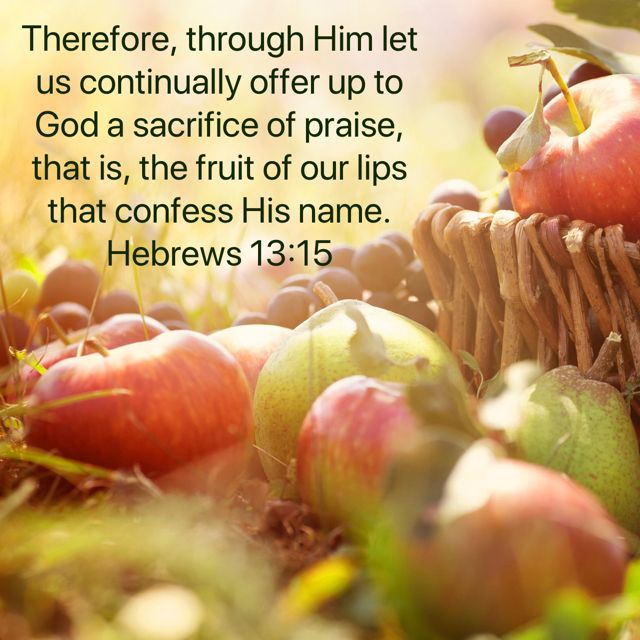
Hebrews 13:5-8, 15-16 (13:15) – August 31, 2025

            Have you ever known anyone who was really proper? Always every hair in place, always did the socially acceptable thing, and never put a toe out of line? Imagine a stern teacher, keeping order in the classroom by a mere look and a slow stare. Someone with high standards. Thinking about satisfying this kind of person makes me anxious, and nervous. I always need to be on my best behavior, minding my p’s and q’s. Just being around someone like this puts me on edge.

            But, what about putting God into the conversation? I know we are probably stretching our imaginations, but it is hard to imagine God wearing a wrinkled shirt, or with a sloppy haircut, or having a dirty face. For that matter, isn’t God perfect? Isn’t God prim and proper, always doing the right thing, never stepping out of line? Doesn’t God have incredibly high standards? Don’t we need to be on our best behavior with God, minding our p’s and q’s? Doesn’t that sum up many people’s conception of God?

Our Scripture reading today can sound like a list of rules. Do this! And, do that! And, don’t do this other thing! I can just imagine several stern Heavenly angels frowning, shaking their fingers at me if I step out of line!

However, the letter to the Hebrews was written to a bunch of scattered Jews who believed in Jesus as their Messiah, scattered in small groups throughout Asia Minor. What we know as Turkey, today. They had been chased out of Palestine by the Jewish and Roman authorities. Many of these scattered Hebrews were refugees. Migrants. People chased out of the land of their birth by an oppressive government that was out to imprison them, if not kill them, because they claimed Jesus as Lord and Messiah. So similar to migrants throughout history who come to other countries seeking asylum, because the place where they were born is very dangerous.

That is the background of the small congregations receiving this letter. This letter was copied and sent from place to place, a breath of fresh air, sound biblical teaching coming to these small groups of believers in Jesus.

Let us turn to our reading today, from Hebrews 13. At the beginning of the reading, the writer of this letter talked about sacrifice—the sacrifice for sin, which was one major way the Jews came before God in worship. In the time of the Jewish temple, it was common for Jews to bring animal offerings to God to make up for sins, to cover their sins and the sins of their loved ones, under the old covenant. One first-century Jewish idea of God was distant, angry, and even vengeful. God had incredibly high standards. God was someone to be placated. Even today, many people have that kind of view of God—a scary view. Not the view of God as loving, caring, and kind, at all.

However, we are going to flip that idea of a distant, angry, scary God. Many, many people are in fear for their religious beliefs. Governments throughout history have been cruel, indeed. Is the fear, anger and disturbance of the powerful governments today much different from the fear, anger and disturbance of the powerful people of Jesus’ day? I think not.

If we consider the wider picture today, around the world, countless followers of Christ are being actively and bitterly persecuted. It’s happening right now, in dozens of countries, officially sanctioned by their governments. Just as it was in the first century, for the small scattered congregations of Jesus followers.  

True, these scattered Hebrews in small groups have good reason to be afraid! On edge! Ready to run again. However, at the heart of this letter is a Kingdom ethic that turns worldly values upside down. Much like my summer sermon series of three years ago, when I preached on the Beatitudes, the first section of our Lord Jesus’s Sermon on the Mount from Matthew 5. That summer we looked at the Topsy Turvy Teachings of Jesus, talking about our service to others, loving mercy and kindness, and even being glad when we are persecuted, for Christ’s sake

Here, today, we can see the practical teachings in Hebrews chapter 13 as teachings of God’s Kingdom, a topsy turvy teaching which tells us that “greatness is revealed through serving others, worship is expressed in doing good, and righteousness is rooted in trusting God and acting with love. This radical re-ordering of values calls believers to live in a way that reflects the grace, justice and compassion of Christ.” [1] Truly, a topsy turvy way of living, then and now.

Instead of “pie in the sky” theological platitudes, this reading today talks about practical ways of living – and acting. These are practical ways to love others, just as Jesus told us to do. When Meier’s Bakery was donating many baked goods to our church, up until just a few years ago, we would donate those baked goods in turn to a local YMCA, for their men’s residence, which had many low-income residents. And then when we needed to stop that during the COVID shutdown, I quickly found another mission that was very grateful to receive those baked goods.

I’ve spoken about this worthy mission outreach before. A Just Harvest, which is located a block from the Howard Street El station, serves a hot meal to 200 to 250 low-income people every day, 365 days a year. This Christian group with their radical hospitality has boots on the ground. They truly welcome the stranger and reach out. They truly experience Christ’s constancy and amazing grace on a regular basis. In their daily ministry and outreach, they also rely on the Lord, as do the people in poverty they serve.[2]

            As we imitate these friends in welcoming the stranger, can there be a better way for any of us to be freed from fear, and become free to serve and praise and really live for God?

            And finally, as our instructions from Hebrews tell us, we can expand our vision of worship. Not just worship at 10:00 on Sunday morning! No, “True worship, the writer says, includes not just praise on our lips, but generosity and good works. I remind everyone: we are not doing these good works to get on God’s good side! No, the point of our good works is in response to what Jesus has done for us. Just as the whole book of Hebrews tells us!

Our freely given good works, generosity and radical welcome to all are “sacrifices pleasing to God.” It’s a complete picture of faith—one that blends word and deed, praise and practice, belief and behaviour.” [3]

            Yes, we truly bring God our sacrifice of praise! And, with boots on the ground, we can truly welcome the stranger and reach out in radical hospitality. And, we truly experience Christ’s constancy and amazing grace on a regular basis. What a way to live, the Jesus way.

Alleluia, amen.

@chaplaineliza

(Suggestion: visit me at my other blogs: matterofprayer: A Year of Everyday Prayers. #PursuePEACE – and  A Year of Being Kind . Thanks!


[1] https://www.churchofscotland.org.uk/worship/weekly-worship/weekly-worship-2025-august/31-august-twelfth-sunday-after-pentecost-year-c

[2] https://www.stewardshipoflife.org/2016/08/to-be-continued/

[3] https://www.churchofscotland.org.uk/worship/weekly-worship/weekly-worship-2025-august/31-august-twelfth-sunday-after-pentecost-year-c

Unknown's avatar

By Grace Alone

“By Grace Alone”


sola gratia, sola scriptura, sola fide

Ephesians 2:4-10 (2:8) – October 22, 2017

How many people catch their breath or look troubled when they see an ambulance whiz by, sirens blaring, and lights flaring? I think that is a common reaction. I feel that way from time to time, too. Sometimes, I feel helpless, even useless, just watching from the sidelines. Or, in some cases, the sidewalk. Working as a chaplain, I met ambulances in the Emergency Department where they would unload their critically ill patients.

This is so like the situation that the apostle Paul talks about in our scripture reading for this morning. Let’s read Ephesians 2:4-5. “But because of His great love for us, God, who is rich in mercy, made us alive with Christ even when we were dead in transgressions.”

I know how difficult this discussion is for some people. Some of you or some of your friends or relatives might have traveled to the hospital, following that ambulance. I know, because I met with many families and loved ones in the Emergency Department. I’ve sat next to beds in the intensive care unit or other critical care units and prayed with seriously ill patients. I’ve comforted both patients and their loved ones. Sadly, I have been with a large number of people who died in the hospital. That is what Paul is talking about here. This is the situation. Paul says we—all of us—are dead in transgressions.

This is looking at things from a really dismal point of view. Absolutely! Sure, we might be walking around, physically breathing, hearts pumping. But as Paul tells us, we are dead because of our trespasses. Our transgressions. Our sins. Our thoughts, words and deeds that are not what God wants from us, and not who God wants us to be.

If you think of it in contemporary, even humorous terms, think of the whole human race like zombies—spiritual zombies. Sure, our bodies are walking and breathing, but we are all spiritually dead.

The apostle Paul is really clear about this. We—all of us—are spiritually dead in our trespasses and transgressions. Because of sin. What can we possibly do to heal ourselves from this spiritual death?

Some people might think they are not too bad off, not as bad as other people. I can hear them now: “I haven’t murdered or cheated anybody. I can’t be that sinful.” Or, “Look at that gal. She did all that illegal, nasty stuff. I’m not half as bad as she is.” Well, I have news for you. Really bad news. Everyone has sinned and fallen short of the glory of God. (Same apostle, different New Testament letter.)

For some, it might help if you can picture this. It’s as if each of us is in a spiritual boxing ring, boxing with the Devil. The tricky Devil flattens us with the one-two punch of temptation and sin. On our own, we are permanently knocked out, down for the count, forever.

Sin hits different people in different ways. Sometimes it’s sin like anger or envy or jealousy. Other times it’s the sin of pride or gossip or nasty words. Sometimes it’s the sin of mean, unkind thoughts—like Jesus told us, wishing you had something that belonged to somebody else—that is called coveting. Or, getting so angry at a friend or relative you call them, “You idiotic fool!” And, really mean worse than that. Jesus called all of that sin, too.

Let’s read from Ephesians 2:4-5 again: “But because of his great love for us, God, who is rich in mercy, made us alive with Christ even when we were dead in transgressions—it is by grace you have been saved.”

Wait a minute. I’ve heard some people with another take on this sin thing. They try to work their way onto God’s good side. “There must be something I can do! Maybe, pray a bunch of times a day—really earnest prayers, too!” Or, “Maybe bringing some extra special offerings will make God happy. Maybe that will take away some of the black marks against me.” Or, “Maybe doing lots of good deeds. Maybe God will look at that and be satisfied.”

Paul says there is a problem with that. We cannot work our way to heaven by ourselves. What does Ephesians 2:8-9 say “For it is by grace you have been saved, through faith—and this is not from yourselves, it is the gift of God— not by works, so that no one can boast.” In other words, the only way we can be accepted by God is only God’s doing. It is all God’s mercy, love, kindness and grace. Especially grace. Grace alone. Sola gratia. Not grace plus good works, no!

“Scripture is clear that we are saved by grace apart from works. If we were saved based on our works we would all be going to hell because our greatest works are filthy rags before God.[1] All we need to do to check that out is to read Isaiah 64:6 – “All of us have become like one who is unclean, and all our righteous deeds are like filthy rags.”

Stan Mast from Calvin Theological Seminary had this to say: “I love the old story about C.S. Lewis wandering into an august gathering of theologians in Britain in the last century. They were debating how Christianity differed from other religions. Was it the doctrine of the Incarnation? No, some argued, they found stories of gods appearing in human form in other religions, though not in the precise form as the Gospel. So, was it the Resurrection? No, argued others, there are stories of people rising from the dead in other religions, though not in the precise form as the Gospel. Eventually, Lewis, the great Oxford scholar, wandered into the room and asked what the rumpus was about. When told that they were discussing Christianity’s unique contribution to the world’s religions, he said, “That’s easy. It’s grace.” [2]

God’s grace. Amazing grace. Marvelous grace of our loving Lord.

As I said to the children at the beginning of the service today, grace is undeserved. We do not deserve it. A newborn baby cannot do anything to make his or her parents or grandparents love him or her. We don’t expect them to! Can the newborn baby say “I love you?” Can the newborn baby give people hugs? Yet, the baby’s family loves that tiny human very much.

Remember the definition of grace (actually, Carolyn Brown’s definition): “grace is loving someone even when they don’t deserve it and God’s grace is the fact that God continues to love us, care for us, and forgive us even when we really do not deserve it.” [3]

I used to enjoy taking my children to the park, to the playground with all of the play equipment. I would often bring a book and read while the children played for a good long time. Sooner or later, it would be time to go home. Occasionally, when I would call my children, one or the other of them wouldn’t be ready to leave. Every once in a while, they would take off running in the opposite direction. I would have to go running after them.

Sure, I’d get upset. Sometimes, I’d be afraid and even angry, because they might wander off the playground and run near a busy street. But, I wouldn’t stop loving them. I’m a human, fallible parent. How much more does God love my children? And, how much more does God love me? And, you?

I am okay with God speaking of me—of us—as a small child (which the Bible does, on several occasions). When you or I disobey or run away from God, does God keep loving us? Remember Carolyn Brown’s definition of grace? “God’s grace is the fact that God continues to love us, care for us, and forgive us even when we really do not deserve it.”

From the beginning, in the middle, and to the end, we all are saved, justified by God’s grace alone. By God’s grace, “we become the creatures God had intended from the beginning, God’s magnificent workmanship, God’s masterpiece.” [4]

God’s grace. Marvelous grace of our loving Lord. Amazing grace. Alleluia, amen.


[1] God’s Grace…… Earned or Freely Given?  http://www.reformedgnome.com/  Posted on February 9, 2016

[2] The Center for Excellence in Preaching, Stan Mast, resources from Calvin Theological Seminary: Comments & Observations, Textual Points, illustration ideas, 2015. http://cep.calvinseminary.edu/sermon-starters/lent-4b-2/?type=lectionary_epistle

[3] Worshiping with Children, Lent 4B, Including children in the congregation’s worship, using the Revised Common Lectionary, Carolyn C. Brown, 2015. 2012http://worshipingwithchildren.blogspot.com/2015/02/year-b-fourth-sunday-in-lent-march-15.html

[4] The Center for Excellence in Preaching, Stan Mast, resources from Calvin Theological Seminary: Comments & Observations, Textual Points, illustration ideas, 2015. http://cep.calvinseminary.edu/sermon-starters/lent-4b-2/?type=lectionary_epistle

@chaplaineliza

(Suggestion: visit me at my regular blog for 2017: matterofprayer: A Year of Everyday Prayers. #PursuePEACE – and my other blog,  A Year of Being Kind . Thanks!)