Unknown's avatar

God’s Kind of Love

“God’s Kind of Love”

(I was privileged to celebrate the wedding of two of my friends last weekend! Here is the meditation I gave at the wedding.)

1 John 4:13-17 (4:17) – November 15, 2025

            Weddings are wonderful events. Brides and grooms try their best to make them meaningful, personalized, and one-of-a-kind! This is especially true about the music chosen.

I have strong feelings about certain songs that are featured at weddings. I won’t name any specific song, but I think you can recognize them when you hear them. I’m thinking of hearts and flowers, sappy songs that highlight love as a warm and fuzzy, surface-kind-of feeling. What happens when that warm and fuzzy feeling called “love” goes away?

We are here today to celebrate the wedding of our two friends. How wonderful, how fitting that we also talk about celebrating how much we love one another! Not a sappy, fuzzy kind of love, but a kind of love that goes the distance. A deep-down love that endures.

Many people, indeed, many ministers lift up the Bible reading from 1 Corinthians 13, where the Apostle Paul talks all about love. The “Love Chapter” from the New Testament is a wonderful statement about love.

I am a chaplain, and it’s part of my job description to talk about the Bible. How does the Bible describe love? I prefer the Apostle John and his marvelous description, his plain words on the subject of love – God’s love. Our Bible reading from the first letter of John written to his scattered church members describes love – the way God sees love. St. John writes: “Dear friends, since God so loved us, we also ought to love one another. 12 No one has ever seen God; but if we love one another, God lives in us and God’s love is made complete in us.”

Here in this description, St. John tells his friends all about love – God’s love. And, John raises love to the next level. Or, perhaps another way of describing it: John raises the bar for measuring love. “Since God so loved us, we also ought to love one another.”

When I think of the number one example of love, I think of our Lord Jesus, while He was here on this earth. I think of how Jesus lived, how He acted, and how He carried out His ministry. Jesus showed us how to love, by displaying love in action. Jesus truly showed His friends (as well as all the world) a life of love – and caring and compassion for all people.

            What better thing to do than to think of our Lord Jesus, when He was here on this earth, and ask ourselves “What would Jesus do?” How would Jesus act?  Who would Jesus love?”

            In recovery circles, a common saying is “do the next right thing.” I had a friend in recovery, of blessed memory, who is now with the Lord. He always tried his very best to be loving, caring and giving. He knew that common recovery saying very well, except he would change one word. He would often say “do the next loving thing.” That’s how to fulfill John’s definition of love from 1 John chapter 4.

            So – what would Jesus do? Do the next loving thing. Go. Do that.

            Alleluia, amen.

@chaplaineliza

(Suggestion: visit me at my other blogs: matterofprayer: A Year of Everyday Prayers. #PursuePEACE – and  A Year of Being Kind . Thanks!

Unknown's avatar

Because of God’s Love!

“Because of God’s Love!”

1 John 4:7-11 – April 28, 2024 

Have you ever had a small child run up to you and say, “I love you so much!” Children are so spontaneous! It is wonderful to be on the receiving end of that kind of running hug. It just warms my heart, remembering my small children, running up to me and saying “I love you!”

Since almost everywhere in this highly commercialized culture I look recently I am deluged by the word “love,” I wondered . . where can I find a good description of love? One of the first places I thought of was the New Testament, in the first letter of the Apostle John. When I took Greek some years ago, I translated most of this book. The apostle certainly has love for one of his major themes. Chapter 4 specifically mentions love from several different angles.

But, wait! I’m getting ahead of myself. I have to—I need to remember who I am. I am a Reformed theologian. I firmly believe in the sinfulness of humanity. I believe that as a sinful, fallen human being, I have been plunked down in this world to fend for myself, look out for number one, to be selfish, self-centered, and basically, a not-very-nice person. That’s me, in my natural, sinful, fallen state. That is all of humanity, too.

It doesn’t sound very good, does it? Sentiments like these wouldn’t sell too many Valentine’s Day cards. The Apostle John has a pretty black-and-white view of humanity, when it comes to things like sin and love. Either you are, or you aren’t. Either you do, or you don’t. Either you love, or you hate.

Here in Chapter 4, verse 20, John makes one of these kinds of statements. “If anyone boasts, ‘I love God,’ while continuing to hate their brother, they are a liar. For the person who has no love for their brother whom they have seen cannot love the God they have never seen.”

Here am I, stuck in this sinful, fallen position in this sinful, fallen world. I even drag myself to church on a Sunday and I may even boast from time to time (like a good church-goer and pew-sitter), “I love God!” But according to the Apostle John, if I have hatred in my heart for my brother (or sister), I am a liar.

            It’s so easy, isn’t it, to have hatred in my heart, to have resentment, anger, frustration, bitterness towards others. And especially towards those closest to me—my family, friends and neighbors, work associates and school classmates.

Not just that driver of the late model Ford Explorer that cut in front of me on my way to the grocery store (which is a very important destination, I hope everyone understands). Not just that pushy lady with the heavy makeup who cut ahead of me in line at the post office. I’m talking about real resentments, bitterness that goes deep, harsh frustration that continues for months, even years. Whatever negative attitude is in your life, I’m sure you can fill in the blanks.

What was my original question?  Where did love come from, in the first place?  1 John 4:7 says, “Dear friends, let us love one another, because love comes from God. Whoever loves is a child of God and knows God.”

Do you remember how stubborn small children can be? Folding their arms across their chests, refusing to do what you ask, sometimes even running away across the playground when you tell them, “It’s time to go home!”

A number of times in Scripture, God’s people are referred to as small children. I can relate. I’ll be the first to say that I am very much like a small child, sometimes. Wayward and stubborn. Can you relate, too? Love is how God has chosen to communicate with us wayward, stubborn children.

If I understand the Apostle John correctly, then, the only way I can have love in my heart at all is because God loved me first. And moreover, God loved me so much that He sent His Son as an atonement, a covering, an offering, a sacrifice. God sent His Son Jesus, the blessed Lamb of God who takes away the sin of the world, as an atonement for my sins, in fact, this verse says for our sins.

It is not our own, faulty, limited kind of love that John is talking about here. It’s not about saccharine-sweet pop songs about love, about stars in the sky or about lovey-dovey billing and cooing. Instead, John tells us about “the radical death-defying love of Jesus, the savior of the world. It’s not about [us] earning or deserving love, either. It’s about a love so amazing and so limitless that it continues to pour forth in bread and wine, Word and water, and Spirit-wind. Love is, in fact, the very nature and essence of God, and we are only able to love because God first loved us.[1]

God gave each one of us a one-of-a-kind gift, God gave us Love, revealed in Jesus Christ on that Christmas morning in Bethlehem, even though we don’t deserve it!

God loved us first, even though we were (and are!!) sinful, fallen, mixed-up, broken human beings. The only reason we have the ability, the capacity to love is because God loved us first. God demonstrated that love through our Lord Jesus and His death on the cross as a sacrifice, an atonement for our sins.

What is more, God gives us a next step. We have a God-given responsibility. One commentary says, “God continues to do this by expecting each of us to be a part of loving relationships and communities. We both receive communications of God’s love through the love of others and are communicators of God’s love when we live in love.” [2] 

Something for all of us to remember. Something for all of us to practice, too.

Praise God for God’s love, revealed to us in Jesus Christ. God showers us with love, whether we deserve it or not. What amazing, immeasurable, wondrous love is this.

Thanks be to God. Alleluia, amen.

@chaplaineliza

(Suggestion: visit me at my other blogs: matterofprayer: A Year of Everyday Prayers. and  A Year of Being Kind . Thanks!


[1] https://www.stewardshipoflife.org/2015/04/abiding-in-love/

[2] https://revgalblogpals.org/2014/07/29/love-love-love-narrative-lectionary-for-august-3-2014/

Unknown's avatar

This Is Love!

“This Is Love!”

1 John 4:7-13 (4:10) – May 2, 2021

            Have you ever wondered what love looks like? If you asked ten different people that question, I suspect you would get ten different answers. What does love look like, anyway?

            The apostle John talks about love a great deal, both in his Gospel as well as his letters. We just read a portion of 1 John chapter 4, where John gives us a straight-forward definition of love. Love is an action word, and the definition comes from God’s point of view. The Lord God almighty, who made heaven and earth and all that is in it, shows humanity what love is.

            Repeatedly, in both the Hebrew Scriptures and the New Testament, the Bible testifies to the loving, living nature of God. Yes, the Lord God is the almighty Creator of all things, the Source of all light and love. And yes, the Lord God is also shown in the person of Jesus, the God made flesh, the One humans have touched and laughed with and eaten with.

            We come back to the question: what does love look like? For a more intellectual answer, we can read from 1 John chapters 3 and 4. Or, we can take a closer look at the Gospel account of Jesus, at His words and actions, and how He lived His life, and that will show us a lot about what love looks like.  

            1 John 4:7 says, “Dear friends, let us love one another, because love comes from God. Whoever loves is a child of God and knows God.”

            In Matthew 14, our Lord Jesus showed compassion – He showed love for the multitudes gathered around Him, and healed the sick. This was just one of a repeated number of times He did this. With a lack of medicines and a high prevalence of incurable diseases (especially at that time), Jesus regularly showed His love and compassion for many people in the most fundamental of ways: He healed them.

            How often are we called to be healers? How often are you and I requested or moved to show love for one another through our healing actions, words and prayers? Is this not a way you and I can carry out the commands of Jesus?

            1 John 4:9 says, “And God showed his love for us by sending his only Son into the world, so that we might have life through him.” We know that Jesus came into the world to show humanity what love is. 

            In Mark chapter 6, Jesus showed compassion – He shared love to the crowds. He truly saw their hearts, realized they were sheep without a shepherd, and taught them many things. Jesus gave them – taught them the Word of God, the words of eternal life. What’s more, Jesus was the Word of God incarnate, life-giving to all who would come to Him.

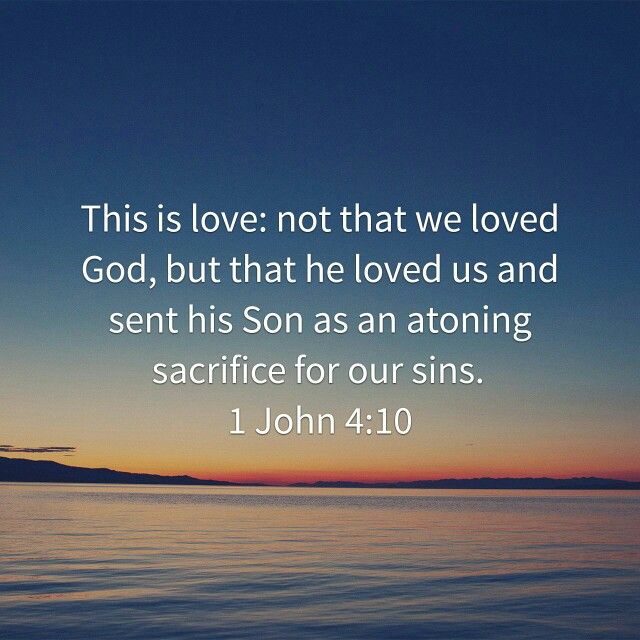
            1 John 4:10 says, “This is what love is: it is not that we have loved God, but that he loved us and sent his Son to be the means by which our sins are forgiven.”

            In the Gospel of John chapter 3, Jesus and the Jewish leader Nicodemus had a long conversation. In that conversation, John makes the editorial statement “God so loved the world that He gave His only Son, that whoever believes in Him shall not perish, but have eternal life.” This is why Jesus came into the world: so that you and I will not be separated from God for eternity, but instead be reconciled to God, and be with God in eternity.

            Jesus showed this love through His in-depth conversations with a large number of people. He not only talked with the academics and religious elites, like Nicodemus and the other Jewish leaders, but Jesus also talked with people on the outskirts of society, like the woman at the well in John chapter 4 and the tax collector Zacchaeus in Luke 19.

            How about us? Do we show love by our conversations with a large number of people, from a diverse group of backgrounds? Or, are our friends and acquaintances all people “like us?” Would Jesus just come and hang out with good, upstanding church folk – and no one else? People from our little group or clique or neighborhood? What about our nationality group or political party – and no one else? Or what about this particular church, and not the church down the street? Much less the temple or mosque across town? Would Jesus show love to everyone?

            God so loved the world. Does that exclude anyone? Perhaps you and I might like to exclude some folks – but would God exclude them? Who would God exclude? God so loved the world. That’s everyone. That’s what John 3:16 says.

So, what does God’s love look like? It looks like Jesus, as He shows His life, love and death for us. And, we have the ability to love because God first loved us.        

            “God’s love does not depend on our initiative or on our worthiness. We don’t have to reach out to God or even believe in God in order to be loved. We don’t have to clean up our act before God can love us. We don’t have to measure up to some standard in order to be lovable. No, God showers love on us whether we deserve it or not. And honestly, who could ever deserve such amazing, immeasurable love?” [1]

            Everything begins and ends with God’s love. God showers us with love, whether we deserve it or not. What amazing, immeasurable, wondrous love is this.

            Alleluia, amen.


[1] https://www.workingpreacher.org/commentaries/revised-common-lectionary/fifth-sunday-of-easter-2/commentary-on-1-john-47-21-4

Commentary, 1 John 4:7-21, Judith Jones, Preaching This Week, WorkingPreacher.org, 2015.

@chaplaineliza

(Suggestion: visit me at my other blogs: matterofprayer: A Year of Everyday Prayers. #PursuePEACE – and  A Year of Being Kind . Thanks!