Unknown's avatar

Love: God’s Better Way

“Love: God’s Better Way”

1 Corinthians 13:1-7 (13:4) – February 2, 2025

One of the most popular themes for songs is that of love. Songs that describe love of one person for another, or songs that tell about how awful it is to have unrequited love. Also, songs that tell about the emotions and feelings that come with being “in love.”

            One classic popular song written by Burt Bacharach and Hal David talks about love in a basic and simple way. Saying, “What the world needs now is love, sweet love.”

What is the state of the world, anyway? Judging from a quick view of the local news, the city of Chicago, the state of Illinois, the federal government, the uproar in Washington D.C., unemployment, not to mention abuse of different kinds—against women, children, and seniors. That is not even mentioning the various armed conflicts throughout the world—fights over territory, disputes over resources, differences between people of different religious beliefs.

            What can possibly bring harmony, hope and wholeness into the world today?

            This brings us to our scripture reading for the day, from 1 Corinthians 13. This chapter is called the Love Chapter. It is so often used as a scripture text for weddings! Perhaps you or a friend or relative had this chapter read at a wedding. But, did you know that the apostle Paul did not write this chapter to glorify romantic love?

One of my favorite commentators, Karoline Lewis, states “that this “Wedding Text” is not a passive, observable event that seeks our affirmation and support, but something that calls for our participation. This is not a text where we are asked to look on as guests, dressed for a party and seated dutifully in the church pews, but rather necessitates our involvement.” [1] Did you hear? Our participation! Our involvement!  

We are not supposed to sit quietly in a pew and let love happen to us. We are not supposed to sit in the bleachers while the professionals handle this love business. No! Let us take a closer look at exactly what Paul tells us to do, and how we are to get involved.

            Let us listen again to a portion of the words of 1 Corinthians 13, as brought up to date by Eugene Peterson in his modern translation “The Message.” “Love never gives up. Love cares more for others than for self. Love doesn’t want what it doesn’t have. Love doesn’t strut, Doesn’t have a swelled head, Doesn’t force itself on others, Isn’t always “me first,” Doesn’t fly off the handle, Doesn’t keep score of the sins of others, Doesn’t revel when others grovel.”

This is a penetrating way to teach people. Show them by example—examples of how not to love. Examples of jealousy or boasting, arrogance or rudeness. And especially, an example of a horrible injustice, where people are openly bigoted against females. (This can also be true of people who are bigoted about other differences, too, like about handicaps, or people of color, or of a different class of people, or of other nationalities or countries of origin.)

Those bad examples? Paul shows us clearly in this passage—don’t do those things! Don’t be that way! Sometimes, a bad example is the quickest way to our hearts and minds.

Paul was involved in a longer argument here in chapters 12 and 13 of his first letter to the Corinthian believers. Chapter 12 was all about the spiritual gifts that came from God, and meant for the strengthening of the body of Christ – the Church. Then in chapter 13, Paul zeros in on the most excellent of all of these God-given gifts. The gift of love. (or, charity, if we are speaking in a more flowery, King-James-version kind of a way).

            In this section I just read, Paul tells his friends and former church members what love is definitely not! Doesn’t strut, doesn’t have a swelled head, isn’t always “Me First!” Paul was making comparisons here! He had lived in the city of Corinth for many months, while he was pastor of this young church. He knew the rough and tumble, political attitude of the general population of the city of Corinth. Plus, he knew that this uncaring, callous attitude was rubbing off on the people inside of the church, too! That is why he wrote these words.

If we want to find out more about 1st century Corinth, “Charity [or, love] was not the activity of his opponents that spread their agenda. They promoted themselves, acted with arrogance, even engaged in shameful activities (backdoor politics?). As they sought personal gain, they provoked others, instilled animosities, and celebrated when others “lost face.” These were not the hallmarks of Christian community.” [2] In fact, all this crony-ism and inside politics sounds sadly familiar to me. But then, I grew up here in Chicago.

Instead, the apostle Paul gives us a marvelous example of what true love – and Godly caring, support, empathy – looks like. Listen again: “Love never gives up. Love cares more for others than for self. Takes pleasure in the flowering of truth, Puts up with anything, Trusts God always, Always looks for the best, Never looks back, But keeps going to the end.”

I don’t need to scramble and strive to love all by myself, trying really, really hard. It’s not all me, putting together my own faulty, human kind of caring. No! God freely gives gifts of love to all God’s children. That is what true love looks like. This is what true church looks like, too.

We can clearly see that Paul’s ministry of love, harmony and wholeness is for the whole world. Not just about taking care of those in our own families, although that’s important. It’s more than “taking care of our own,” although that is certainly laudable. It’s about showing love for everyone. For those affected by loneliness, or despair, disaster or disease wherever they are, without exclusion of those not like us or even of those we fear. Everyone.

Ending as I began, we look again at the Bacharach and David song, “What the World Needs Now.” The chorus of the song tells us the world needs love, sweet Godly love. Needs it badly. “No, not just for some, but for every, every, everyone.” Amen, Lord. Amen.

@chaplaineliza

(Suggestion: visit me at my other blogs: matterofprayer: A Year of Everyday Prayers. #PursuePEACE – and  A Year of Being Kind . Thanks!


[1] https://www.workingpreacher.org/commentaries/revised-common-lectionary/fourth-sunday-after-epiphany-3/commentary-on-1-corinthians-131-13-3

[2] http://www.word-sunday.com/Files/c/4-c/SR-4-c.html

Unknown's avatar

It’s All About Love

“It’s All About Love”

1 Corinthians 13:6-13 (13:13) – February 6, 2022

            Weddings are wonderful events. Brides and grooms try to make them meaningful and personalized, as much as they can. Except – I have strong feelings about certain songs that are featured at weddings. I won’t name any specific song, but I think you can recognize them when you hear them. I’m thinking of songs that highlight love as a warm and fuzzy emotion, and that is about it. Where will the newly-married couple be when the rose-colored glasses come off? What happens when that warm and fuzzy feeling called “love” goes away?

            This is the last sermon in our series on spiritual gifts, and we look more closely at the last part of Paul’s discussion on the greatest spiritual gift – love. After Paul spends all of 1 Corinthians 12 talking about the great variety of spiritual gifts that God gladly gives to believers in Christ, he turns to the greatest of all gifts, that of love.

            But, what is love all about, anyway? Last week, we talked about all the things that love is not, as listed right here in this chapter. According to 1 Corinthians 13, love is not just an emotion, not just a feeling. The description I read last week definitely had more about aspects of what love is not; these can be greatly helpful as we hammer out the biblical definition of love.  

            As I reflect more on popular culture today, and how sentimental and sappy modern love songs can be, I can see how we – as an American culture – might have different ideas about love than those we read here in 1 Corinthians 13.  

            Some church folk today might have different ideas about the Corinthian church, too. Corinth was a diverse, multi-cultural, multi-ethnic city in Greece, at the crossroads of several major roads through the region. The church was founded by Paul, an ethnic Jew, but certainly was not all one ethnicity. No, this was a diverse, multi-cultural, multi-ethnic group of believers!

            As we read further in 1 Corinthians, we can see how much discord really was in action in that dysfunctional group of believers, too. As our commentator Doug Bratt says, “challenges and controversies dogged their church. They disagreed theologically. They struggled with persistent sin, lawsuits among themselves, sexual immorality, and marriage. Corinth’s Christians disagreed on how to deal with food that had been sacrificed to idols and religious freedom.” [1]

            With that large amount of discord and disagreement among the church members in Corinth, is there any wonder why their former pastor Paul wrote them a letter detailing spiritual gifts which God gives to benefit the whole church? And further, why Paul lifts up love as the best and greatest spiritual gift of all?

            We return to the question “what is the biblical definition of love?” I know we discussed this last week, and I mentioned a number of things love was NOT. Let’s turn around and see what Paul says that love IS. “Love does not delight in evil but rejoices with the truth. It always protects, always trusts, always hopes, always perseveres. Love never fails.”

            I sometimes read an online sermon chat board, where preachers share their reflections on the week’s scripture passages before Sunday comes. I thought Rev. L’Anni from the Netherlands had some very pertinent reflections on this reading.

“When I do premarital counseling I often will read I Cor. 13:4-7 with the couple and note that in this definition of love there is not one single verse that refers to a feeling. No warm fuzzies. No Hallmark honey and sweetness. It refers to ACTION. Being patient—when you FEEL im-patient. Being kind—when you feel like being un-kind. Keeping no score of wrongs—when you feel like holding a grudge. This is how Christian marriage can not only survive but thrive. But not just marriage but any relationship where both are willing to love each other as defined by this passage.” [2]

These are things that love DOES, actions that people can take that are loving, caring and compassionate. When I think of the number one example of love, I think of our Lord Jesus, while He was here on this earth. I think of how Jesus lived, how He acted, and how He carried out His ministry. Jesus showed us how to love, by displaying love in action. Jesus truly showed His friends (as well as all the world) a life of love – and caring and compassion.

            What better thing to do than to think of our Lord Jesus, when He was here on this earth, and ask ourselves “What would Jesus do?” How would Jesus act?  How would Jesus love?

            In recovery circles, a common saying is “do the next right thing.” I had a friend of blessed memory, who is now with the Lord, who always tried his very best to be loving, caring and giving. He knew that common recovery saying very well, except he would change one word. He would often say “do the next loving thing.” That’s how to fulfill Paul’s definition of love from 1 Corinthians 13.

            So – what would Jesus do? Do the next loving thing. Go. Do that.

            Alleluia, amen.

@chaplaineliza

(Suggestion: visit me at my other blogs: matterofprayer: A Year of Everyday Prayers. #PursuePEACE – and  A Year of Being Kind . Thanks!


[1] https://cepreaching.org/commentary/2022-01-24/1-corinthians-131-13-3/

[2] https://www.desperatepreacher.com/texts/1cor13_1/1cor13_1.htm

Unknown's avatar

Love – No Matter What

“Love – No Matter What”

1 Corinthians 13:1-10 (13:7) – January 30, 2022

            With February right around the corner, many people start thinking about hearts and flowers. Thinking about chocolates and candy. Sweets for the sweet, as the old saying goes! Yes, Valentine’s Day is just two weeks away, and stores and card shops are full of red and pink displays and hearts and roses.

            As many hear this chapter on love from 1 Corinthians 13, some people wax sentimental. This chapter is a favorite to read at many wedding services in the church. “Everyone will nod along with a smile on their face. They’ll be remembering a wedding somewhere where these words were used to somehow capture the essence of this wild and crazy promise being made before the gathered overdressed assembly, this human enterprise that escapes human capabilities on a regular basis. [Or,] they’ll be remembering the Pinterest or Instagram post in fancy calligraphy, or the needlepoint in Grandma’s sitting room.” [1]

What if I were to tell you that love – the Bible’s definition of love – does not have anything to do with red and pink store displays, or hearts and flowers for Valentine’s Day?

            As we reflect on the biblical definition of love, let’s see what Paul says love does NOT do. I’m turning again to the wonderful modern translation of Eugene Peterson, The Message. “Love doesn’t want what it doesn’t have. Love doesn’t strut, Doesn’t have a swelled head, Doesn’t force itself on others.”

            That doesn’t sound much like lace and chocolates, hearts and big red bows, does it? No romanticized consumer version of love here! Do you recognize this honest, genuine kind of a feeling in the people you are close to, in the people you call family? Loved ones, and ones you cherish? This description is more of a love that is right down to earth, an honest, genuine feeling that is real and isn’t afraid to get its hands dirty.

            Let’s see a little more of what Paul says love does NOT do: “Isn’t always “me first,”
Doesn’t fly off the handle, Doesn’t keep score of the sins of others, Doesn’t revel when others grovel.” When I read all of these things love does NOT do, sometimes I get discouraged. It’s like I can’t measure up. I could never be that kind of person or be described that way; could you?

This enlarged, continued description of the biblical definition of love sounds too good to be true. For real people, I mean. To me, it sounds a lot like Mother Teresa, or Fred Rogers, two people who are considered to be the pinnacle of loving, caring people.

Wait a minute! Have we talked to God about this? Paul has been telling us for almost two chapters in 1 Corinthians that God freely gives believers spiritual gifts. What is more, Paul says that love is the absolute best of these different, diverse spiritual gifts. That means that God gives out love freely! With both hands! Right here, Paul is describing the gift of love that comes through people from the Lord. Isn’t that some of the best news ever?

I don’t need to scramble and strive to love, trying really, really hard. It’s not all me, putting together my own faulty kind of caring. No! God freely gives gifts of love to God’s children. God helps us to show love and caring, kindness and unselfishness. That is such a relief for me, and such a blessing to others!

We believers here on this earth may stumble on our way of walking the Christian journey, and that is okay. We do not need to fulfill each and every part of this long, involved definition that Paul given to us, either. And, it is not just up to our fallible striving or hard work to be the most loving and caring Christian believers possible. No! God will help!

When I think of God’s love, I think of certain people who modern society might not consider. Two individuals come to mind, who I knew years ago. Both are with the Lord now, and both had the diagnosis of Down syndrome. Both people were as loving and caring as anyone I have ever met. Both were selfless, totally concerned for others, and unfailingly kind, loving and giving. Isn’t this another example of love, according to the Bible? Isn’t it what love is all about?

Let’s take a final look at the last section of Paul’s definition of love, according to God. The previous entries or parts of the description were couched in the language of what love was NOT. At last, Paul describes what love IS. “Takes pleasure in the flowering of truth, Puts up with anything, Trusts God always, Always looks for the best, Never looks back, But keeps going to the end.” These are positive, affirming, uplifting traits, indeed.

We may not be able to walk the walk or talk the talk as perfectly as Paul describes here. “But we can stand in Paul’s certainty that there is a new way of being alive in the world, a new way of seeing the world and everyone in it. Must we simply accept everything going on in our messed-up world with a smile and nod? Of course not; evil exists. But we aren’t always the best at identifying where the real evil resides. Paul argues that it would better to lead with love.”[2] Again, you and I cannot generate this kind of spiritual gift in and of our own imperfect humanity, or of our own good works. We are welcome to ask the Lord for help and lead with God’s love.

This transformation is truly a gift – a gift of love! This gift comes from God, and is freely    offered to all believers! Let us thank God for this gift of love we all can display, and we all may give to others, just as freely. Alleluia, amen!


Thanks so much to Rev. Dr. Derek Weber, Director of Preaching Ministries for www.umcdiscipleship.com and his excellent preaching notes for this week’s worship service and sermon. I used several ideas from these notes for the sermon today

@chaplaineliza

(Suggestion: visit me at my other blogs: matterofprayer: A Year of Everyday Prayers. #PursuePEACE – and  A Year of Being Kind . Thanks!


[1] https://www.umcdiscipleship.org/worship-planning/love-never-ends-being-the-body-of-christ/fourth-sunday-after-the-epiphany-year-c-lectionary-planning-notes/fourth-sunday-after-the-epiphany-year-c-preaching-notes

[2] https://www.umcdiscipleship.org/worship-planning/love-never-ends-being-the-body-of-christ/fourth-sunday-after-the-epiphany-year-c-lectionary-planning-notes/fourth-sunday-after-the-epiphany-year-c-preaching-notes

Unknown's avatar

The Most Excellent Gift

“Love: The Most Excellent Gift”

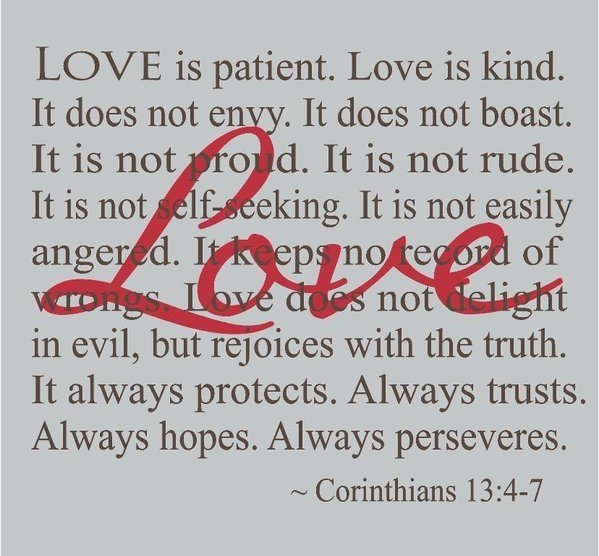
1 Cor 13 love, ring

1 Corinthians 13:4-8 (12:31) – February 3, 2019

In less than two weeks, the yearly holiday of romance and love will be celebrated. Yes, the holiday of Valentine’s Day is right around the corner. According to the popular women’s magazine Woman’s Day, people here in the United States spend a lot of money on their Valentines: an estimated $18.2 billion in 2017, including 144 million Valentine’s Day cards. [1] Gifts, cards and chocolates are wonderful for that special someone in your life! But—is this idea of love what the Apostle Paul had in mind when he wrote the Scripture passage we read today?

As we come to the end of our series of gifts from God, we can think back over the past month. As we celebrated Epiphany the first Sunday of January, we not only saw the gifts the foreign-born Magi gave to the toddler Jesus, but we celebrated the greatest Christmas gift of all time: the gift of God’s Son, Jesus Christ. We also rejoice as we remember our baptism and the tremendous gift of God’s grace bestowed upon all of us.

We consider what Paul was talking about in the previous chapter, 1 Corinthians 12. Spiritual gifts! We spent two weeks discussing the generous gifts God gives each of us—all of us. Gifts of helps, service, teaching, healing, wisdom, understanding—and then some. What is more, Paul encourages us to put these gifts into practice for the common good of others. And last week, we explored the interconnectedness of each of us and each of the gifts that we bring to this family of faith. We learned that we need one another in a fundamental way. [2]

Which leads us to our Scripture reading for today, from 1 Corinthians 13. Paul caps off this discussion of spiritual gifts with the most excellent gift of all: love.

Many people relate the reading of the this “Love chapter” with weddings. Romance and hearts and flowers—and Valentine’s Day—seem to go hand in hand with this chapter. That is, on the surface. But, when the Apostle Paul really gets going on the depth and breadth of God’s love, he does not mean hearts and flowers and candy at all. God’s love is what is offered to all of us.

What does God’s love look like? Paul gives us some vivid examples. Reading from The Message: “If I speak God’s Word with power, revealing all God’s mysteries and making everything plain as day, and if I have faith that says to a mountain, ‘Jump,’ and it jumps, but I don’t love, I am nothing. 3-7 If I give everything I own to the poor and even go to the stake to be burned as a martyr, but I don’t love, I’ve gotten nowhere. So, no matter what I say, what I believe, and what I do, I’m bankrupt without love.”

Forgive me. I’ve just told you what God’s love does not look like. This is what happens when a person does not have God’s love living within him or her. A very sad, despairing state of affairs, to be sure.

Paul does tell us what love is, however. Again, from the Message; “Love never gives up. Love cares more for others than for self. Love doesn’t want what it doesn’t have. Love doesn’t strut, Doesn’t have a swelled head, Doesn’t force itself on others, Isn’t always “me first,” Doesn’t fly off the handle, Doesn’t keep score of the sins of others, Doesn’t revel when others grovel, Takes pleasure in the flowering of truth, Puts up with anything, Trusts God always, Always looks for the best, Never looks back, But keeps going to the end.”

This description from Paul tells us what love is.

Very sadly, if we read the newspaper and turn on the news, we see another expression of God-talk. This kind of black-and-white thinking, all-or-nothing talk comes from rigid or extreme religious groups. You know the groups I mean. Groups that say unequivocally “I’m on God’s good side, and you’re not. I’m going to heaven because I do the things God wants. You don’t, so you are going to hell.” It doesn’t matter whether they are stringent Christians, fundamentalist Catholics, extreme Muslims, or radical Hindus. Such hurtful thinking and corrosive speech lets us know these religious groups have likely not experienced God’s life-changing, wondrous love. You know, all of the wonderful, life-giving parts of love that the Apostle Paul just described to us.

Father Richard Rohr, Franciscan priest and director of the Center for Action and Contemplation in New Mexico, has written and taught extensively on God’s love. He spoke of these hurtful religious groups, and then asked, “How can we do better? To begin, we might put ourselves in the other’s shoes and imagine why someone is so hateful.”

Father Rohr continues: “While working in the Albuquerque jail for over a decade, I met many men who had been raised in a punitive, authoritarian, absolutist way, often with an absent or abusive father. Understanding another’s story can teach us compassion. It doesn’t mean that we shouldn’t set some healthy boundaries. But it does open our hearts and help us recognize that other people are victims, too. They’ve been wounded, too. Yet they are still objectively an image of God, created in God’s image.” [3]

We are not all called to work in prisons, like Father Rohr. But, God has gifted each of us to offer our gifts to others. Each of us have been given gifts to reach out to our friends and neighbors with the love of God. Remember what we talked about last week, how all of our spiritual gifts are interconnected? Each of us is needed by the others in this family of faith. And, God’s love is one of the greatest connectors of all.

One of my absolute favorite people ever is Mister Rogers. Fred Rogers was a Presbyterian minister, ordained to ministry in television and mass communication by the Presbytery of Pittsburgh in 1963. He had a marvelous, moving ministry to children—and to adults—for decades—in public television.

One of the ways Mister Rogers reached out and communicated to children with his television show was through music. He wrote over two hundred songs about important things and things that concern children very much. Like this one: “There are many ways to say I love you. There are many ways to say I care about you. Many ways, many ways, many ways to say I love you. Cleaning up a room can say I love you. Hanging up a coat before you’re asked to do it. Drawing special pictures for the holidays and making plays.” [4]

Important words from a loving, honest, generous man, Fred Rogers. He let us know that love can be as simple as hanging up a coat—or doing the dishes—or sending a greeting card. Mister Rogers would definitely agree that showing love is being kind to others, and being your honest, caring self. No matter what.

A reminder, from the Message: “[Love] Takes pleasure in the flowering of truth, Puts up with anything, Trusts God always, Always looks for the best, Never looks back, But keeps going to the end.” That is the kind of God we have. Love is a gift God offers to all of us, freely.

It doesn’t matter how each of us expresses God’s love. God gives many gifts to all of us, freely. Let us give love away to everyone, no matter what. Just as freely as God gives to us.

Alleluia, amen.

[1] https://www.womansday.com/relationships/a4702/10-fun-valentines-day-facts-103385/

[2] https://www.umcdiscipleship.org/worship/season-after-epiphany-2019-part-1-worship-planning-series/february-3-fourth-sunday-after-the-epiphany-year-c/fourth-sunday-after-the-epiphany-2019-year-c-preaching-notes

[3] Adapted from Richard Rohr, Exploring and Experiencing the Naked Now, disc 3 (Center for Action and Contemplation: 2010).

[4] http://www.neighborhoodarchive.com/music/songs/many_ways.html

(Many thanks to the Rev. Jeff Campbell and http://www.umcdiscipleship.org for ideas and assistance for this series on spiritual gifts.)

@chaplaineliza

(Suggestion: visit me at my regular blog for 2019: matterofprayer: A Year of Everyday Prayers. #PursuePEACE – and my other blog,  A Year of Being Kind . Thanks!