Unknown's avatar

Jesus Seeks and Saves

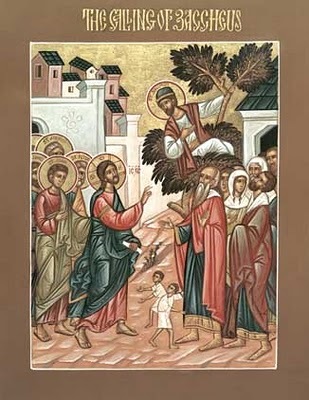
Luke 19 zaccchaeus-the-publican

“Jesus Seeks and Saves”

Luke 19:1-10 – September 1, 2019

Do you know anyone who is really unpopular? I mean, so unpopular that people turn their backs and ignore them when they come around? That is just the sort of person we are going to talk about today: a particularly unpopular, even despised person.

The Gospel of Luke chapter 19 tells us of the tax collector Zacchaeus and the encounter he had with the Rabbi Jesus. Jesus had been in ministry for almost three years, and I suspect that He was a celebrity in the Jewish population. Perhaps even of rock-star-status, given Jesus had healed people, cast demons out of people, and performed all sorts of other miracles for the past three years. It’s no wonder Jesus attracted such a crowd wherever He went!

When you or I read about tax collectors during the first century, we might think they were simply unpleasant people tasked with an unfortunate job. Because, someone had to do it! The Roman Empire occupied a huge territory, including the region of what is now Israel and Palestine. The Roman army was the occupying force that policed the region. The conquered Jewish people were a subjugated people. But, that was not all.

No one likes to pay taxes. And, taxes are even worse when they are being collected by an occupying force, like the Romans. Except—the Romans were fiendishly clever. Some of the native population was used to collect taxes. Here’s what happened. The taxation system the Romans used was ripe for abuse. The Roman government farmed out the collection of taxes and sold off the right to do tax collection to the highest bidder. All that was necessary was that the Romans receive their assessed financial amount at the end of the year. Any money over that amount could be kept by the native-born tax collector. And, boy, did they collect the money! As I said before, this was a scheme sure to be abused. Talk about a shakedown racket!

Was it any wonder that these tax collectors were especially despised by their fellow Jews? These Jewish shakedown artists collaborated with the Roman overlords, besides being seen as extortionists for collecting double, and even triple the amount stipulated by the Roman tax assessment.

Some people think the United States tax code is punishing. They haven’t seen anything, compared to these tax collectors who were backed up by the force of the occupying Romans. In other words, just in case any Jewish person was even thinking of not paying taxes, the Roman army could come knocking at the door and drag them off to prison for tax dereliction. What is more, Zacchaeus was the chief tax collector, in charge of all the other tax collectors in the region. He must have been simply rolling in dough.

There is more, in terms of social consequences. Even though he was very wealthy, Zacchaeus had lost his place in the local synagogue, was not permitted to attend worship services, and was totally ostracized from all “decent society” in town. I mention all this to let everyone know what a scandal it was.

On top of everything else, Zacchaeus was extremely short, and probably felt even worse because of his little stature. New Testament scholar Anselm Grun theorizes that “Zacchaeus wanted to stand out to gain recognition, but the result was that he was isolated and rejected. He felt compelled to set himself above people because, alongside them, he felt too small. So perhaps there was a vicious cycle of insecurity, exploitation of others, loneliness, and rejection at work in Zacchaeus’s relationships in the community, or, more accurately, his lack of relationships.” [1]

But, no matter what, this guy really wanted to see the Rabbi Jesus!

We know what happened. Reading from Luke 19, Zacchaeus “wanted desperately to see Jesus, but the crowd was in his way—he was a short man and couldn’t see over the crowd. So, he ran on ahead and climbed up in a sycamore tree so he could see Jesus when he came by.” Can you just see Zacchaeus, his head and shoulders poking out between the branches of a sycamore tree? What about the Rabbi Jesus? He called Zacchaeus by name! Can you imagine? Calling a hated tax collector by name, and even proclaiming that He would eat dinner at that tax collector’s house that evening?

What a scandal! What a horrible thing for a respectable Jewish Rabbi to do! Can you imagine what all the “decent folk” in Jericho had to say about that?

Yet, isn’t this just like Jesus?

Again and again in the Gospels, especially in Luke’s Gospel, we see Jesus side with those on the margins, those who are the least of these, those who are disrespected and dismissed. Jesus comes alongside of the down and out and those not accounted as much in the eyes of the world. “While Zacchaeus is rich, he is nevertheless despised by his neighbors, counted as nothing, even as worse than nothing. Yet Jesus singles him out.” [2]

I follow the social media account Invisible People on Twitter. This account regularly posts articles and photos of those people who are invisible to society at large: the homeless. The vignettes and stories are heartbreaking, on a daily basis. The followers who read Invisible People meet person after person who had a job and lost it, or had a spouse and lost them, or had an extended health reversal and lost their apartment, or any one of a dozen other sad scenarios. These people teetering on the poverty line, or even below it, pull at anyone’s heart strings.

Yet, to many people across our country, any mention of the homeless or those in shelters or camping in the woods because they do not have any other place to stay is certainly similar to mentioning “tax collectors” in first century Palestine. These “invisible” friends are despised by many “decent folk,” many who have money, education, experience, or moderately good health.

These “invisible people” of today are on the margins of society, similar to the tax collectors of the first century. Reading from Luke 19, we get some indication of what the onlookers said: “Everyone who saw the incident was indignant and grumped, “What business does Jesus have getting cozy with this crook?” 8 Zacchaeus just stood there, a little stunned. He stammered apologetically, “Master, I give away half my income to the poor—and if I’m caught cheating, I pay four times the damages.”

Jesus responds in typical, loving, caring Jesus-fashion: He lets everyone know that Zacchaeus is just as good as any of the “decent folk.” 9-10 Jesus said, “Today is salvation day in this home! Here he is: Zacchaeus, son of Abraham! For the Son of Man came to find and restore the lost.”

Who has a corner on perfect righteousness and standing before God? Which of us is not lost and wandering, at times? Don’t we all need to be found and restored to God’s loving embrace? Jesus has come to seek and save the lost, the wandering, the people on the margins and the outskirts of society, as well as “decent folk.” Jesus has His arms open wide to welcome each of us, no matter what.

Surely it is God who saves me—God has arms open to save all of us. Amen, alleluia.

[1] https://www.patheos.com/progressive-christian/power-persistence-alyce-mckenzie-10-28-2013.html

“The Power of Persistence, Part 3,” Alyce M. McKenzie, Edgy Exegesis, 2013.

[2] http://www.workingpreacher.org/preaching.aspx?commentary_id=2968  October 30, 2016

David Lose

@chaplaineliza

(Suggestion: visit me at my regular blog for 2019: matterofprayer: A Year of Everyday Prayers. #PursuePEACE – and my other blog,  A Year of Being Kind . Thanks!
Unknown's avatar

Saved—By Prayer

“Saved—By Prayer”

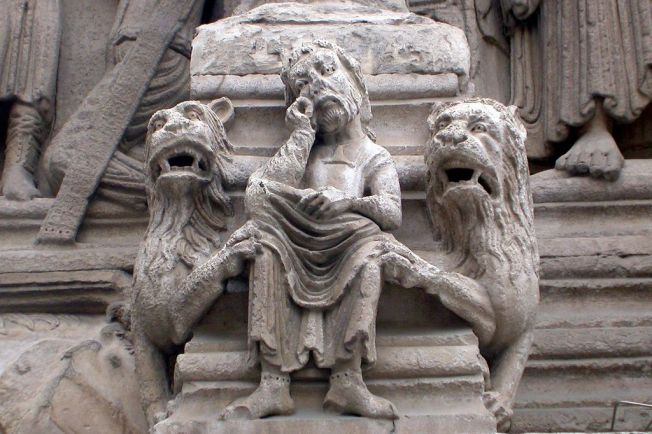
Dan 6 Daniel with lions

Daniel 6:22-23 – August 25, 2019

Have you ever prayed hard? I have heard from friends about people in their lives who prayed, and sincerely felt heard. Usually, it’s been someone’s grandma, or great-aunt, or perhaps their father. Or, perhaps you remember some respected person from a church where you attended as a child or young person. There was someone in that church who seemed to have a special connection to God; so much so that others in the church would notice and remark about it.

I suspect the prophet Daniel was just such a person. Daniel had a special connection to God, and he regularly prayed. Each and every day, several times a day.

Yes, Daniel was a prophet, in exile. A large number of young people—most probably from the nobility and well-to-do class—were taken captive to Babylon when the Babylonian army conquered Israel. He and his three friends were especially chosen to work in the king’s palace as civil servants. Long story short, all four were filled with integrity, honesty and an excellent work ethic. The king noticed their hard work, and promoted them.

This story about Daniel in the Lions’ Den is well-known, probably the best known among the stories of the Hebrew prophets. At this point, Daniel continues to be in great favor with the king for years, since he is always hard-working, honest and filled with integrity. Except—the homegrown Babylonian civil servants become so jealous and resentful that they hardly can see straight. We can just see them plotting and planning in their nefarious way.

Sometimes, that is the way it happens, when other people in your department or in your neighborhood see your integrity or honesty or hard work. These other vindictive people not only can grumble and engage in backbiting or smear campaigns against these honest, upright people, they may retaliate or even go one step further. Sometimes, bad things happen to good people.

We can find accounts of bad things happening to good people all over the place. Not only in the Bible, but throughout history. We see people of faith, people filled with integrity, prayerful people who are persecuted, maligned, abandoned, exiled, and even martyred. The story of Daniel in the Lions’ Den does not end that way. But, I’m getting ahead of myself.

We are told in Daniel 6 that the king was so pleased with Daniel that he was going to promote him to a position of great authority over the whole kingdom, like being vice-chancellor, second-in-command over all government affairs. Here is where the plotting and planning comes in. We read: “the administrators and the satraps tried to find grounds for charges against Daniel in his conduct of government affairs, but they were unable to do so. They could find no corruption in him, because he was trustworthy and neither corrupt nor negligent. Finally these men said, “We will never find any basis for charges against this man Daniel unless it has something to do with the law of his God.”

Yes, Daniel was a person of prayer, too. He had the daily habit of praying three times a day, in addition to being a man of integrity. It was this feature of prayer that the Babylonian administrators were going to attack. These bad guys from Babylon cook up a scheme to convince the king to pass a law that for thirty days would condemn anyone who had the audacity to pray and ask things of anyone except the king himself.

An aside here; an important aside. Kings in those days were absolute rulers, with the power of life and death over the people they ruled. Commentator John Walvoord thought “The probability is that Darius regarded this act as a pledge of loyalty to himself and a token of their desire to respect his authority to the utmost.” [1] This was a way of ensuring that the people of Babylon were completely subservient to the king and his authority. After the law was signed, Daniel continued to pray to the Lord God, creator of heaven and earth, three times a day. He knew he would be liable to die for his actions. He not only was a man of prayer, he was also a man of deep convictions.

I suspect we all are in awe of Daniel and his strength of purpose. I do not think I would have the strength to go out on a limb, in the same way our favorite prophet did. It is a hard thing, to stand up for your faith, stand apart from the crowd, be honest, filled with integrity and prayer. The bad Babylonian administrators were delighted to find that Daniel was steadfastly praying, just as he had done before. Can you see them scurrying to tell King Darius about Daniel?

Reading from the Message:  “The conspirators came and found Daniel praying, asking God for help. They went straight to the king and reminded him of the royal decree that he had signed. “Did you not,” they said, “sign a decree forbidding anyone to pray to any god or man except you for the next thirty days? And anyone caught doing it would be thrown into the lions’ den?” “Absolutely,” said the king. “Written in stone, like all the laws of the Medes and Persians.”

13 Then they said, “Daniel, one of the Jewish exiles, ignores you, O king, and defies your decree. Three times a day he prays.” 14 At this, the king was very upset and tried his best to get Daniel out of the fix he’d put him in. He worked at it the whole day long. 15 But then the conspirators were back: “Remember, O king, it’s the law of the Medes and Persians that the king’s decree can never be changed.”

We know that Daniel was thrown into the lions’ den overnight. The king was worried to death, and went back in the morning, afraid to peep into the enclosure. However, Daniel was sitting there unharmed. God had shut the lions’ mouths and kept Daniel safe. And the prophet was a mighty witness to God in that place and in that time. Even the king acknowledged God.

We can name countless others who were not saved from the lions’ den, who were hurt, maligned, tortured, and even killed for the faith they so stubbornly held. Yet, we also hear of occasional people for whom God did do a miracle. We do not know why some were saved, and others were not. I think we can leave that question to God. Something more to ask when we all get to heaven.

I would like to lift up Daniel as an example of faithful prayer. Jesus reminds us several times in the Gospels that prayer is like children coming to their parents. We know that children come with all kinds of things. Crazy requests as well as expressions of love that make our hearts melt. It is the same way with us and God. Just as Daniel did, we are encouraged to have regular, intimate, ongoing interaction with our Heavenly Parent.

Yes, things can be difficult in this life. Yes, life can have twists and turns, yet we can be encouraged by the witness and example of Daniel. Even though our journey through life can go through valleys, up hills, and down winding roads, we have a faithful Friend and loving Companion. We have the opportunity to have regular, intimate, ongoing interaction with our God. Just like Daniel.

Alleluia, amen.

[1] https://bible.org/seriespage/6-daniel-lions-den

https://walvoord.com/article/247  John F. Walvoord, Theologian, Educator, Author

@chaplaineliza

(Suggestion: visit me at my regular blog for 2019: matterofprayer: A Year of Everyday Prayers. #PursuePEACE – and my other blog,  A Year of Being Kind . Thanks!
Unknown's avatar

A Whale of a Tale

“A Whale of a Tale”

Jonah spitout, painting

Jonah 1:12, 2:1 – August 18, 2019

Jonah and the whale is a much beloved bible story often told to children. Many young ones listen with wide eyes and ears to the story of Jonah being swallowed by a great fish. Every bible story book I have ever seen mentions that the great fish was sent by God, so children (and adults) will know God was with Jonah even in the belly of the whale—or, great fish.

That lesson is definitely one everyone can use! Children, young people, adults, seniors alike, how valuable it is to know that God is with all people—even in the metaphorical or actual belly of a whale.

But, with our adult-sized viewpoint, let’s go back to the beginning of this story, to the beginning of Jonah chapter 1. Jonah was an acknowledged prophet of God. Prophets of God were held to particularly high standards. Everything they said in the name of God had to come true: this was stated in Deuteronomy, in the Law Code of Moses. And, Jonah understood he needed to follow God’s commands. Except—he didn’t. He stubbornly decided to turn tail and run, run in the opposite direction.

What about you and me? What if there is a command Jesus plainly sets forth in the Gospels—like give away your money and you will have treasure in heaven, or love your neighbor as yourself, or especially, love your enemies? And, some Christians—maybe even you and me—do not follow those commands? What then?

We follow Jonah as he runs away in the opposite direction. He goes west, taking a ship for Tarshish, across the Mediterranean Sea. The Lord pursues Jonah with a great storm, the ship almost founders at sea, and the sailors ask Jonah why the storm has come upon them. Jonah is finally honest and says it is all his fault. He is the cause of the great storm. Throw him overboard, and the storm will stop. The sailors were unwilling at first, but finally they did throw Jonah overboard. And, lo and behold, the storm did indeed stop.

Have you ever wished that God could talk to you as clearly as God talked to people in the Hebrew Scriptures? I know I certainly have. Except—even if God talked clearly to us as a dear friend and close companion, are we sure we would listen to God’s spoken words? Or would we be disobedient sometimes, just like Jonah?

Finally, Jonah stops running. Finally, in the belly of the great fish, Jonah repents and asks God for forgiveness. What does God do? The Lord is gracious, forgiving and compassionate, of course! That is God, all over. Exactly the Lord’s gracious, compassionate heart.

As we follow Jonah in the fish’s stomach, and as he gets vomited up on land on the third day, we have a sudden glimpse of why Jonah did not want to go preach to Nineveh. For anyone who knows the history of the book of Jonah, the Assyrians controlled large parts of what is now Syria, Iran and Iraq, among other nearby regions. The Assyrian armies were particularly cruel and bloodthirsty to the nations they fought with and conquered—similar to other armies.

Is anyone surprised to learn that Jonah did not want to preach to Nineveh, the capital city of the Assyrian Empire?

Jonah finally goes to Nineveh and tells them to repent, otherwise God will destroy Ninevah! What happens? The Assyrians and the King of Nineveh do repent. In fact, this is what the King says. “Everyone must turn around, turn back from an evil life and the violent ways that stain their hands. Who knows? Maybe God will turn around and change his mind about us, quit being angry with us and let us live!” 10 God saw what they had done, that they had turned away from their evil lives. God did change his mind about them. What God said he would do to them God didn’t do.”

What is more, Jonah was furious with God for not destroying Nineveh! Here’s what he  said to God: “1-2 Jonah lost his temper. He yelled at God, “God! I knew it—when I was back home, I knew this was going to happen! That’s why I ran off to Tarshish! I knew you were sheer grace and mercy, not easily angered, rich in love, and ready at the drop of a hat to turn your plans of punishment into a program of forgiveness!”

We can laugh at Jonah for getting furious with God and stalking off, essentially slamming an imaginary door and leaving an imaginary room. But—God forgave Jonah for Jonah’s sins and disobedience. God created the people of Nineveh. Can God not express divine love and compassion and forgiveness for all the people in the world God made?

When you and I allow hatred and fear to take residence in our hearts and blind us to the fact that God created each person on earth. Father Richard Rohr warns, “you will go back to dualistic thinking and judgments: good guy/bad guy, win/lose, either/or.” [1] That is not the way of God, the way of heavenly compassion and mercy, grace and truth.

Sure, God knows very well that we all are sinful. Sure, God knows that we all mess up. Even, stealing from the weak and old, killing with knives or guns or bare hands. What about the other ways of hurting people, like destroying someone’s reputation by spreading false rumors? Or destroying a marriage by sleeping with someone’s spouse? Or, destroying the well-being of a temple or church by embezzling a large sum of money?

Sure, you and I are very glad and grateful when God forgives us, when God has compassion and mercy and grace on us. But, if we slip into the fearful, dualistic thinking and judging of good guy/bad guy, win/lose, either/or, we are in danger of missing the path of God’s heavenly love and compassion, God’s love and mercy, God’s everlasting arms of forgiveness.

Yes, this is so challenging for all of us. I do not know how, but God was somehow in the midst of horror and violence and desperation, of victims and post-traumatic stress and even the horrendous death and torture that the Assyrian armies were responsible for. And, God forgave the Assyrian people of Nineveh. God has forgiven countless countries, because each country is made up of individuals created by God.

We can move that to the 20th century, and the 21st. God created each person in the American military, the German army, the Russian navy, the Japanese military, the French or Palestinian resistance, and all their families. God created each person in the Nigerian army, the Iraqi military, the British or Chinese navy, and all their families. People are wounded and many died. Yet, God loves all of those people—both the ones who did the awful things as well as those who were wounded or killed. I do not understand how, but God does love them.

Yes, this is a challenge for which we need God’s help. Jesus calls us to love our enemies, no matter what. Jesus did not give us a loophole, a way out. We can look at the original disciples, and Christians of the first few centuries. None of the original disciples died in their beds except John, and he was exiled to a tiny island. God is somehow in the midst of all of the horror and anxiety and despair. I don’t know how, but the Lord is with us, no matter what.

Just like King David said in Psalm 23: “Yea, though I walk through the valley of the shadow of death, You are with me.” God is faithful, merciful, and forgiving, and will remain at our sides through pain, suffering, fear, anger, desperation—no matter what. What a comforting thought. Each of us can say a heartfelt “Amen!”

Thanks be to God for God’s abundant mercy and grace—towards each one of us.


[1] Richard Rohr Meditation: The Perennial Tradition: Weekly Summary Aug. 11-Aug. 16, 2019   Center for Action and Contemplation (WeeklySummary@cac.org)

@chaplaineliza

(Suggestion: visit me at my regular blog for 2019: matterofprayer: A Year of Everyday Prayers. #PursuePEACE – and my other blog,  A Year of Being Kind . Thanks!

Unknown's avatar

Where’s Your Treasure?

“Where’s Your Treasure?”

Luke 12-34 your treasure, words

Luke 12:29-34 – August 11, 2019

I greet you all in the name of our loving, gracious God and our Lord Jesus Christ. It is good to be back here with you at Epiphany United Church of Christ.

Is anyone here familiar with a particularly challenging time? Either in your life, or the life of someone close to you? I’ve been through a number of challenging, even difficult times, over the years. Periods of unemployment, strained and broken relationships, times of extended illness of loved ones, even death and periods of grieving and loss—of many kinds. Sadly familiar to many here, I suspect.

On the flip side, I have experienced times of great happiness and contentment in my life, periods of harmony and peace, times when I felt I was in a good place, in terms of relationships, employment, and my personal and family life. Those are times I suspect many people want to continue to experience, long-term. Even, your whole lives long.

What did Jesus have to say about both of these long-term situations? Both the up-side as well as the down-side?  Our Scripture reading from the Gospel of Luke sheds some light on that question. Our Lord Jesus gives many instructions in Luke 12, and tells His listeners a number of important things. He talks about the positive times in life as well as the times of sadness and heartache. And—Jesus does not shy away from challenging His listeners. By no means! He talks straight, and lays things on the line, not pulling any punches.

Let’s pull back, and look at today’s short, power-packed reading from Luke chapter 12 in context. Luke 12 comes from what bible scholars call the Sermon on the Plain, a section from the Gospel of Luke that parallels the Sermon on the Mount closely, Matthew chapters 5 through 7. Many of these statements in Luke state or summarize statements we find in Matthew. (Both Sermons have versions of the Lord’s Prayer, for example.) But, these words of the Rabbi Jesus—from either sermon, Luke or Matthew—have both comforting as well as challenging moments. For example, the words from our Scripture reading today.

This reminds me of two years ago, when I preached a series of sermons on the Sermon on the Mount, from Matthew 5. Those were the lectionary readings for February 2017. Yes, the words of Jesus are familiar. We are the light of the world, the city on a hill. We need to take care of our tongues and not call each other names. And, especially, Jesus’ command to love our enemies and pray for those who persecute us. Jesus meant all that. All of it. I found it particularly challenging to faithfully lift up the words of Jesus for those Sundays. I tried to do my best, but I know our Lord’s words can sometimes be difficult to hear, and even a rebuke for us.

So, it is with a similar feeling of anxiety that I come to this reading today. What is Jesus saying in this section of the Sermon on the Plain, anyway?

I included a part of last week’s reading from Luke to begin our reflection this morning. Words of a reassuring nature for people going through some difficult, challenging times. Concentrate on God. Keep our eyes focused on things that matter to God, and don’t worry about the peripheral but distracting stuff that happens in our lives. That sounds great! I could just stop right there, couldn’t I?

But, Jesus does not stop there. He continues: “Sell your possessions and give to the poor. Provide purses for yourselves that will not wear out, a treasure in heaven that will never fail, where no thief comes near and no moth destroys.”

Wait a second, Jesus! It’s all very well to tell us comforting stuff like “Do not be afraid, little flock,” and “your Father (or Parent) knows what you need.” Those things are great, and reassuring, and encouraging, especially when we are going through difficult times in our lives. But, “Sell your possessions and give to the poor?” and, “provide for yourselves a treasure in heaven?” What kind of stuff is that? Sounds pretty suspect to me. I can imagine two hecklers in the back of the room glancing at each other, and elbowing each other. Yeah, I always knew this Rabbi Jesus was running some sort of con game.

Except, it isn’t a con game. Jesus is really for real.

Sure, economic security is certainly a concern for almost everyone. And, appropriately so. Concern for ourselves and for our families is to be commended. But, I think we can better understand where Jesus is focused: “For where your treasure is, there your heart will be also.”

Commentator Matt Skinner notes that “we can train our wills and our ways of thinking (for that is what the heart symbolized in his culture) through the ways we use our money.” [1]

Jesus is really asking each one of us: where are your priorities? What do we put first in our lives? Are my priorities “me, me, me!” and “my house, my car, my 401 K!” Or—are my priorities something else? Something that would be pleasing to God? Something involving having an open heart and loving compassion?

These words of Jesus tell us a lot about God’s view on charity, on being open-hearted and open-handed. The parable of the rich fool is found just a few verses back in Luke 12, where Jesus talks about a foolish man who had big barns stuffed full of all his crops and other goods—all his wealth. And then, after doing a tour of all his barns stuffed chock full of stuff that he was hoarding for himself, he had a sudden, massive heart attack and died.

Jesus’s words for us today are closely connected to this mindset. Where is our treasure? Where are our priorities? If we spend all our money on ourselves, guess where our hearts will be. What is more, we can extrapolate further. Perhaps some do not have too much money, but are particularly focused on their house, or their car, or have some other focus for their life. What is their priority in life? What would Jesus say about that particular priority?

Are we leaving our relationship with Jesus in the dust, in a far distant second or even third place?

I am going to start a third chaplain internship next week, two days a week, and I will still be pastor at St. Luke’s Church in Morton Grove. (And, I would appreciate your prayers, both for my challenging internship and my faithful service to the lovely congregation at St. Luke’s.) When I considered this Scripture passage this past week, I couldn’t help but think of people in the hospital. The patients and their loved ones who I will meet.

I am familiar with that environment, since I was a hospital chaplain for some years, before I came to St. Luke’s Church. I remember many who had total reliance on God, who were spread thin, in trauma. Many of these folks had been pushed so far, and had very little left in the way of resilience. They had fears, anxieties, trials and tribulations. But, they also had faith in God, in whatever faith tradition they came from.

When they—when we—reach a traumatic situation, God is there. God is faithful. That was some of what Jesus was saying in the first part of our Scripture reading today. And, for those who have not faced such sadness and trauma in our lives—yet—this statement of Jesus applies, as well. Where are your priorities? Where are mine?

When we put God first and allow other things to take second place, it is amazing how things sort themselves out. God has a personal hand in sorting things out in each of our lives, and that is truly a wonderful thing. So, where is your treasure?

I’ll let Jesus have the last word: “For where your treasure is, there your heart will be also.”

Alleluia, amen.

[1] http://www.workingpreacher.org/preaching.aspx?commentary_id=4142  Matt Skinner

@chaplaineliza

(Suggestion: visit me at my regular blog for 2019: matterofprayer: A Year of Everyday Prayers. #PursuePEACE – and my other blog,  A Year of Being Kind . Thanks!

Unknown's avatar

Happy Birthday, Jesus!

“Happy Birthday, Jesus!“


Shepherds adore the Christ child, Jan de Bisschop

Luke 2:4-15 – August 4, 2019

What events are particularly meaningful to children? Birthdays, of course. The birthday is not only a marking of the day the child was born, but is often (in this society, at least) a day for parties, presents and special things like ice cream and cake. And, children naturally love to go to birthday parties, too. No wonder many people celebrate birthdays as something really special.

Our two Scripture readings this morning both tell about the birthday of a really special Someone: the Baby born in Bethlehem, the baby Jesus. Except—I do not think it was common to celebrate birthdays with a birthday cake in those days.

When Isaiah wrote his prophecies six hundred years before the birth of Jesus, he was writing to a contemporary situation, it is true. But there is another situation, another prophetic announcement that people have marked from that point on. But, more about that birth announcement in a few minutes.

Yes, it is common for small children to concentrate on the baby Jesus and his birthday on Christmas Day. But, why did Jesus get born to a teenage girl in Bethlehem, anyhow? Why was this birth announcement made by the prophet six hundred years before the event?

For some of the answer to that question we need to go all the way back to the beginning, in the book of Genesis.

We know that God created the world, and God made plants and animals and humans. God created time and the seasons and great beauty and complexity in this marvelous world, and called it all good. In fact, very good. But, we know what happened. Sin happened, and entered into this world. Sin has caused tons of evil, heartache, misery, hatred, and disaster. We all know how much sadness and badness there are in this world.

Yesterday, in a shopping mall in the city of El Paso, Texas, we saw a horrific example of evil. The young, white shooter took the lives of twenty people, and did horrible harm to the lives of countless more. Is there a more visible example of corrosive sin and evil that can be shown to us? Sadly, violent situations such as this happen all too often, with tragic repercussions.

Yet, God the eternal Son, the second person of the Trinity, saw this horrible, pervasive evil of sin and nastiness and hatred that entered into the world, and knew its sweeping, widespread effects. God the eternal Son emptied Himself of all Godhood, and became a tiny, helpless baby human.

As the Apostles Creed tells us, We believe in Jesus Christ, God’s only Son, our Lord. He was conceived by the power of the Holy Spirit, and born of the Virgin Mary. Every time we say those words of that ancient—most ancient of creeds, we affirm those eternal truths. Are many Christians aware that in repeating this creed, we regularly proclaim the Good News of Christmas, the miracle of God the eternal Son breaking into human history and becoming a tiny baby?

As we examine that ancient birth announcement from Isaiah chapter 9, we reflect on those words that reverberate deep in the soul. “For to us a child is born, to us a son is given, and the government will be on his shoulders. And he will be called Wonderful Counselor, Mighty God, Everlasting Father, Prince of Peace.” The music that George Frederick Handel used in his oratorio “Messiah” for this chorus ring in my mind whenever this Scripture passage is read.

Yes, God the eternal Son was born as a baby, just as this verse from Isaiah says. But not just a human child, but much, much more! Wonderful Counselor, Mighty God, Everlasting Father, and Prince of Peace. This baby was sent into the world to change the world. This baby was sent into the world as the Prince of Peace, to bring peace to a troubled world and dispirited people. This baby was mighty to save.

It is sort of a challenge to communicate all of that difficult, mind-blowing stuff about sin and salvation to little children. I can well understand how the ease of having a birthday party for the Baby Jesus would appeal to them instead. Small children understand about birthdays and birthday parties. That is within their experience. And, we certainly tell them about the Baby Jesus being born in Bethlehem at Christmas.

As we move to the second chapter of Luke, this narrative of the Nativity is so familiar. Is there anything here we haven’t looked at before?

We see Mary and Joseph, check. Knocking on lots of doors in Bethlehem, check. Refusal at an inn, but welcomed to a stable, check. We examine this next important part of the story. “There were shepherds in the fields, keeping watch over their flocks by night. Suddenly, an angel appeared to them and said, ‘Don’t be afraid! I bring you good tidings of great joy, which shall be known to all people.”

While Mary and Joseph were busy with the birth of their firstborn Son, our scene shifts to the shepherds on the hills surrounding Bethlehem. We are familiar with this next part of the story: shepherds guarding their sheep at night, and the heavenly angel breaking onto the scene.

Does anyone remember what we just looked at from the book of Isaiah? The Lord God had a wonderful birth announcement, given a few hundred years beforehand. But, this is the time! This is when the prophet was talking about. The angel told the shepherds that a newborn Savior had arrived. He is not only a Savior, He is Messiah, too, with everything that that means to an oppressed, downtrodden people in an occupied country. Believe me, Rome was not exactly a gentle group of overlords. No, the Roman empire was an oppressive regime. I can just imagine how welcome this heavenly announcement was! God-sent, indeed.

Plus, the name given to this special Baby by the angel Gabriel had great meaning. Mary and Joseph did not go to a bookstore and pour over the selection of names in a baby book to help them name their son.  If we go back a chapter to Luke 1, the angel who tells the teenager Mary she is going to bear the Messiah also tells her what His name will be: “You will have a son, and you will call His name Jesus.” In Hebrew, the name Jesus means “the Lord saves.” That is just what the angel tells the shepherds—”Today in the town of David a Savior has been born to you; he is the Messiah, the Lord.

What a build-up for this heavenly event! Imagine, repeated birth announcements for this wondrous Child born in Bethlehem. Is it any wonder that this was the biggest, best birthday ever? If we go back to our first example, with the children having a party celebrating someone’s birthday, we could have a humdinger of a huge birthday bash, indeed.

Happy birthday, Jesus! We can celebrate, because Jesus came into the world on that Christmas Day. We can celebrate, because there is no other name given among people that can save us from our sins. Praise God, we have a Savior, indeed!

Alleluia, amen.

@chaplaineliza

(Suggestion: visit me at my regular blog for 2019: matterofprayer: A Year of Everyday Prayers. #PursuePEACE – and my other blog,  A Year of Being Kind . Thanks!

Unknown's avatar

David Triumphs over a Bully

“David Triumphs over a Bully “

1 Sam 17 david-goliath, Peter Boon

1 Samuel 17:1, 4, 8-11, 20-24, 31-32, 41-51 – July 28, 2019

Who has experience dealing with a bully? It could be on the playground, or in your neighborhood, or at work, or even in a local church. It does not matter where you or your siblings or children or grandchildren or parents happen to be, chances are that bullies can be found all over.

Our scripture reading features a big bully. Saul is king of Israel, and the perennial enemy of Israel, the Philistines, come to attack Israel yet again. Instead of fighting with the two armies coming up against each other, the Philistines send out their acknowledged champion, a huge man called Goliath, to challenge someone from Israel to fight. Did I mention he was a big bully?

Children often encounter bullies at school or on the playground. As adults, we often have thicker skins and are able to deal with the physical, psychological and verbal abuse bullies so often heap on the smaller and weaker ones around them. Bullies can and do seek out their victims, intimidate, and prey upon them, even if teachers, coaches, administrators and other adults are on the lookout for bullying behavior.

When my husband was growing up on the west side of Winnetka, a neighborhood bully named Adam lived just a couple of blocks away, to the east. You may even have seen him on television or on the big screen after he grew up.

According to common knowledge around the neighborhood, Adam had an unhappy home life, and I feel badly about that. That probably contributed to his negative attitude. Adam was antagonistic to other boys in his neighborhood. He was a sizeable kid, and would intimidate and beat up many other boys. My husband was fortunate, since he never tangled with Adam. I suspect Adam was well known at the local school, and not for a good reason.

Is this similar to Goliath’s backstory? A great question, and one we cannot answer.

1st Samuel 17 tells us for forty days the army of the Philistines were in attack formation, drawn up in battle gear across the valley from the army of Israel. For forty days the large man (some would call him a giant) Goliath would stride in front of the Philistine battle lines to challenge the army of Israel to send out a champion of theirs, to fight. As Ralph Klein, retired professor of Old Testament at Lutheran School of Theology in Chicago tells us, “The idea that a combat between two champions could decide a battle is well known in ancient sources. Goliath was 9′ 9″ tall and extremely well armed. His armor would have weighed about 125 pounds.” [1]

Just think—a huge guy with impressive armor and weapons. Goliath was massive!  That alone would be disheartening. But, wait. When we add physical and verbal intimidation to what the Philistine army would be guilty of, we see what a horrible impression they made on the army of Israel. And not only the army of Israel, but for the whole nation of Israel by extension.

Does this sound familiar? Do we have bullies in our neighborhoods? Our schools or workplaces? When we examine and break down how Goliath used intimidation and fear, we can see that Goliath was a master intimidator. (Or, at least, how antagonistic and intimidating were the people who wrote the words for Goliath to say. He might have had great writers.)

What about the other side of this lopsided-looking match-up? We do know what David looked like, from this and other descriptions in 1 and 2 Samuel. At this point, while David is only a teenager, he has not become tall and broad-shouldered yet. He is described as ruddy and good looking. We can also see how full-grown warriors of Israel are afraid and intimidated by the insults and trash talk of Goliath and the Philistine army, and the teenaged David has a very different response. He is horrified at the blasphemies and trash talk Goliath spouts.

Let’s examine what Goliath said, more closely: “Choose a man for yourselves, and let him come down to me.  If he is able to fight with me and kill me, then we will be your servants; but if I prevail against him and kill him, then you shall be our servants and serve us.”  And the Philistine said, “Today I defy the ranks of Israel! Give me a man, that we may fight together.”

Goliath was a soldier by profession, and very good at what he did. He had probably honed and fine-tuned his scare tactics. We see classic manipulation and intimidation patterns.

I would like to highlight one type of person from our modern context. This can be an office manipulator, a neighborhood busybody, or an overbearing and mocking know-it-all. This type of person is not necessarily a huge menacing presence. They might not be physically intimidating, but their verbal browbeating and coercion can be just as terrorizing. This poisonous activity can induce just as much fear and demoralization in the attitudes and behavior of those surrounding this toxic person. This toxic person can be a virtual Goliath, and might come in many shapes or sizes. We need to be aware and on the lookout for mean bullies like this.

Let’s go back to David. He comes to the army camp with supplies for his older brothers, but the whole camp is away at the battle lines for Goliath’s daily intimidation. “There, David finds his brothers, and as he talks with them, Goliath steps forward to repeat his challenge for the 81st time (see 1 Samuel 17:16). Goliath says what he always does, but this is the first time David has heard him. David listens to this giant’s challenge and his cursing of Israel and her God. He watches the frightened Israelites (including his brothers) draw back, their courage shattered by this man’s words and appearance.” [2]

Wait, says David! Who is this Philistine, and why is the army of Israel cowering in fear?

Great question! We all know the rest of the story. David volunteers to challenge Goliath, comes at him with only a slingshot and smooth stones, and nails Goliath between the eyes with an Olympic-worthy shot from his sling. As the huge man falls to the ground, dead, David hews off Goliath’s head with his own sword, and thus becomes the darling of all of Israel for defeating Goliath. The original David vs. Goliath match-up.

The point of this bible story often displayed for children in Sunday school is that God is with us even when we are afraid, just like God was with David when he faced Goliath. However, from an adult understanding, we can go further. Yes, absolutely, God will be with us in all kinds of unequal, David-versus-Goliath battles. What is more, using God’s perspective can be lifechanging. From God’s point of view, David was the winner even before he used his slingshot. David was a teenager after God’s own heart. He kept his eyes on God and prevailed against a bully, against all human odds.

Are you facing a continuing battle today? Is there a mean bully in your workplace or neighborhood? Finding God’s perspective on the toxic problem is a great help. Continue doing what you know is right, in a winsome and positive way. And, God will continue to be with us, against all the Goliaths that come into our lives.

Alleluia, amen!

[1] http://www.workingpreacher.org/preaching.aspx?commentary_id=331

Commentary, 1 Samuel 17:[1a, 4-11, 19-23] 32-49, Ralph W. Klein, Preaching This Week, WorkingPreacher.org, 2009.

[2] https://bible.org/seriespage/14-david-and-goliath-1-samuel-171-58

“David and Goliath (1 Samuel 17:1-58),” by Robert Deffinbaugh at the Biblical Studies Foundation.

@chaplaineliza

(Suggestion: visit me at my regular blog for 2019: matterofprayer: A Year of Everyday Prayers. #PursuePEACE – and my other blog,  A Year of Being Kind . Thanks!

Unknown's avatar

Jericho’s Walls Tumbled Down

“Jericho’s Walls Tumbled Down“

Josh 6 Walls_of_Jericho_1217-94

Joshua 6:1-7, 15-17, 24-25 – July 14, 2019

Obedience can be a really good thing. Parents at home, managers in the workplace and teachers in the schoolroom depend on obedience for good, orderly behavior, conduct and communication in a group setting. It makes so much sense: when people listen, understand and obey, everything works so much more smoothly. So much more easily, too.

The people of Israel were not always obedient to God and God’s Word. Not by a long shot! Remember after Moses led the people out of Egypt, and they wandered around the area of the Sinai peninsula for forty years? Repeatedly, the people of Israel were disobedient to God’s commands. God finally had enough with their rebellion and disobedience, and said that every person who had come out of Egypt across the Red Sea (where the Lord did a mighty miracle) would die in the wilderness—the sad penalty for grumbling, rebellion and disobedience.

It is a new day, with a new administration. Moses’s trusty lieutenant Joshua is now the leader of the wandering nation of Israel. After some celebration at crossing the River Jordan into the land of Canaan, and ritual preparation—circumcising every adult male—Joshua sends two spies into the city of Jericho. A covert operation, to check out the lay of the land.

The two spies are welcomed into the house of Rahab, a prostitute. She quite possibly had rooms to rent, and this was also a source of money for herself. The spies quickly find a friend in Rahab, and get some valuable information about the great fear and anxiety that had entered into the hearts of all the people of Jericho. More than that, Rahab even hides the spies when the city authorities come to her house to check out more about the whereabouts of these spies.

After the spies bring the news of the great fear and anxiety filling the hearts of all people in Jericho, Joshua our fearless leader prepares his army to fight.

Thus far, everyone among the people of Israel has been obedient to the voice of God.

I wonder, are you and I obedient to the word of God? Do we follow all of God’s commands? We might say, with the rich young ruler, we have followed all of the Big Ten. Jesus even tells us of the commands in His interaction with the rich young man: “You know the commandments: ‘You shall not murder, you shall not commit adultery, you shall not steal, you shall not give false testimony, you shall not defraud, honor your father and mother.”

I suspect the people of Israel followed the Ten Commandments, too. This was part of the Law that Moses brought down from the top of Mount Sinai just a few decades before. Although, lots of those people of Israel grumbled, rebelled, and disobeyed God, and Moses, while they were in the wilderness. As punishment, they all died without seeing the Promised Land.

As I said, this was the dawn of a new era. Joshua was the new leader of Israel now. The people of Israel were young, vital, and excited to enter the land of Canaan. The army of Israel made themselves ready to attack the city of Jericho, buoyed up by the positive report of the spies.

Except—what kind of a battle plan was this? Joshua, are you crazy? Are you drunk? What on earth were you thinking? Just walking around the well-protected city of Jericho once a day, in total silence, for six days? Not just with the army, but with the priests and the Ark of the Covenant, too?  Then on the seventh day, to walk around the city seven times, in total silence. And then, give a mighty shout, all together! Shout, and blow trumpets, and the thick, high walls will fall down all by themselves.

What kind of battle plan is that? God’s battle plan. God was going to fight for the people of Israel, and show everyone that God was on the side of the nation of Israel.

Lo and behold, the army and priests obeyed Joshua and the command of the Lord. Lo and behold, when the trumpets blew and the army shouted on the seventh day, the walls did come tumbling down. “In the face of such a great obstacle, Joshua complied with the plan of God. Though he may not have completely understood the plan or its significance, he followed God. Joshua moved the people to action.” [1] Obedience was the key to Israel’s success.

I wonder, again. Are you and I obedient to the commands of the Lord, today? Do we follow all the words of Jesus in the Gospels? Here is more of Jesus’s conversation with the rich young man: ““Teacher,” he declared, “all these commands I have kept since I was a boy.” 21 Jesus looked at him and loved him. “One thing you lack,” he said. “Go, sell everything you have and give to the poor, and you will have treasure in heaven. Then come, follow me.” 22 At this the man’s face fell. He went away sad, because he had great wealth.”

How do we square love of money and possessions with the concept of obedience to a just God? I don’t care who we are, one commentary on this passage said we each have “virtual strongholds that impede our spiritual progress. It may be a weakness in our character, a physical infirmity, it may be indifference to spiritual things in general or to a specific area we are neglecting. It could be materialism or some life-dominating pattern. It may be a difficulty at one’s place of work, in the home, with a particular personality, or it may be a financial burden.” [2] Each of us has difficulty obeying God, in one area or even several at once.

I return once more to the question of the day: are you and I obedient to the commands of the Lord, today? Do we follow all the words of Jesus in the Gospels? Commands like being a good neighbor to absolutely anyone, even a Samaritan? Even someone of a different color, or a different religion? Let’s look at another command of Jesus. Love one another. Sure, it’s easy to love our neighbors and those in our families. But, what about loving the stranger? Yet, the Bible tells us we have to do that, too. Do we? Or, would we rather turn our backs on the foreigner, put the stranger in detention, or perhaps even deport them?

Let’s look at some commands Moses gave to the nation of Israel, the commands this nation of Israel must have been very familiar with. From Deuteronomy 10:19 – “You shall also love the stranger, for you were strangers in the land of Egypt.” And, from Leviticus 19:34 – “The alien who resides with you shall be to you as the citizen among you; you shall love the alien as yourself, for you were aliens in the land of Egypt: I am the Lord your God.” In the books of the Torah—the first five books of the Bible alone, Israel is commanded to care for the stranger or non-citizen thirty-six times.

These are some important commands of the Lord. Are we going to be obedient to these commands, or are we going to grumble, rebel and be disobedient? These commands tell us to be open, welcoming, loving and caring to all—just like our God. These are challenging commands. Yet, they are echoed again and again throughout the Hebrew Scriptures and the New Testament.

Looking at a children’s bible story from an adult point of view? This serious reading about obedience from the book of Joshua pulls us all up short, and gets our attention. May God aid our understanding of our Scripture reading and sermon this morning.

Alleluia, amen.

[1] https://www.lifeway.com/en/articles/sermon-overcome-obstacles-jericho-promised-land-joshua-6

Michael Rochelle is pastor of Shadow Hills Baptist Church in Las Vegas, Nevada.

[2] https://bible.org/seriespage/destroying-fortresses-victory-jericho-joshua-61-27

@chaplaineliza

(Suggestion: visit me at my regular blog for 2019: matterofprayer: A Year of Everyday Prayers. #PursuePEACE – and my other blog,  A Year of Being Kind . Thanks!

Unknown's avatar

Moses in a Basket

“Moses in a Basket”

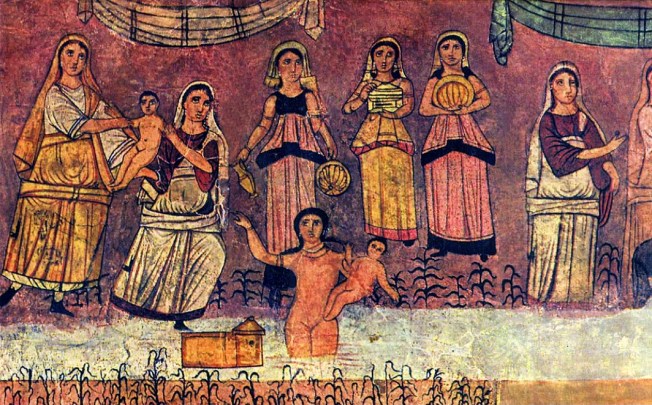
Exod 2 Pharaoh's daughter and Moses in the Dura-Europos synagogue fresco, c. AD 244

Exodus 1:15-2:6 – July 7, 2019

On social media, one sure way to get loads of “likes” and “shares” is to post the photo of a cute baby. So many people love seeing photos of little babies looking adorable. And when photos of crying or unhappy babies are posted, many people pour out their sad, shocked, and comforting emotions in their responses online.

Is it much different in our Scripture reading today from Exodus? As we hear about the infants born to the Israelite women in Egypt so long ago, I suspect many in our congregation are sad and shocked, and wish to comfort those women and families involved.

And yet—this narrative about infants from Exodus has a much starker, darker impact, as we read it over again in the clear light of day. With the typical economy of words that Hebrew often employs, our narrative opens with: “Then a new king, to whom Joseph meant nothing, came to power in Egypt.” In other words, a number of generations had passed, and as commentator Karla Suomala suggests “the new king didn’t remember Joseph’s role in keeping the Egyptians alive during a time of famine or simply chose to ignore this piece of history. It seems to be more willful than a simple act of forgetting.” [1]

The people of Israel, resident aliens living in Egypt for several hundred years, have become extremely numerous. So numerous, in fact, that the new Pharaoh and other racist Egyptian leaders feared the people of Israel would be guilty of insurrection or an alliance with a foreign nation. The Egyptians ruthlessly worked them even harder, but they continued to multiply and grow as a sub-people group within the nation.

I give a trigger warning, since this sermon is going to speak of some horrible events.

Further compounding [Pharaoh’s] false statement, is a clear strategy to create an “enemy within” and to stir up fear of the foreign or immigrant other. The Pharaoh then wastes no time in putting a plan together to deal with this dangerous element in their midst.” [2] Pharaoh and the other leaders became so fearful and anxious that they come up with a nefarious scheme—killing all the Jewish boy babies, from that point onward.

We take a side trip to consider women in healthcare, specifically working as midwives. This work as midwives outside the home has been an accepted thing for certain women to do for millenia. The two women we look at come at the beginning of Exodus, in the middle of this narrative about the Israelite—or, Hebrew boy children.

These women were diligent in their work. We even know the names of these midwives—Shiprah and Puah. The biblical writer honors them by recording their names for posterity. Plus, they were God-fearing women, who understood their work was important in God’s eyes.

As we know, Pharaoh’s evil plan was to command the Hebrew midwives to kill all baby boys, to commit male infanticide, yet allow the baby girls to live. This is a slow yet sure way of eradicating Egypt’s problem population. What do we think about such horrendous acts of cruelty? No, even worse, acts of murder? What would you consider doing, if you had been in the place of these Hebrew midwives?

The midwives Shiprah and Pual were civil servants; they worked for the Egyptian government, and so the all-powerful Pharaoh was their ultimate boss. However, Pharaoh and his cronies did not have much power. Pharaoh needed to meet with the Israelite midwives in a huge turnover in power. Imagine, we are faced with the question: where—with whom—does true power reside?

Apparently, Pharaoh is not aware of this power differential. What is more, Pharaoh tries to deputize these Hebrew midwives to do his dirty work for him. He does not want to get his hands (or the hands of his fellow Egyptian leaders) bloody.

The midwives are honorable and God-fearing, and most probably cannot even consider killing the newborn infants they assist bringing into the world. However, when Pharaoh asks them why they are not killing the baby boys, “the midwives respond by playing to his own stereotypes about immigrants and their breeding habits. “Because the Hebrew women are not like the Egyptian women; for they are vigorous and give birth before the midwife comes to them,” they say.” [3]

Here we see that racist stereotypes are sadly perpetuated from generation to generation. Has this frightening, common, xenophobic mindset changed today? I think not.

The Pharaoh clearly sees that he won’t be able to convince the Israelites to kill their own children. So, he and other racist, xenophobic Egyptian leaders turn to the Egyptian population, telling them to throw the Jewish baby boys into the Nile River. This is where we pick up with the story of Moses. His mother gave birth to Moses in secret, hid him for three months, and then finally did put him in the Nile River—in a floating, waterproof basket.

We follow Miriam, Moses’s older sister, watching from the riverbank, as Pharaoh’s daughter finds the floating basket. Pharaoh’s daughter is charmed with the darling baby who she correctly identifies as a Jewish baby, spies Miriam nearby, and asks whether Miriam can find a wet nurse for this baby she decides on the spot to adopt. Thus, the adopted Moses is suckled by his own mom—and even paid to nurse her own child. Such are the amazing incidents that happen in God’s providence.

One fascinating insight about the male Pharaoh and the female midwives: one of the most striking points of this section is the fact that the text names the midwives. Why do we need to know the names of these two women, Shiphrah and Puah, who never appear again in the story? Names are very important in the Book of Exodus. Moses’s sister Miriam is named, too, further on in the book.

Who remains nameless? Pharaoh. Pharaoh is unnamed. Pharaoh’s royal family members are unnamed. Pharaoh’s officers are unnamed. Pharaoh’s royal advisors are unnamed. Every Egyptian in the book of Exodus remains nameless. All public figures in Egypt take great efforts at self-promotion and control. [4] But when God steps in and raises up the women in this story, we need to sit up and take notice.

A final act of defiance to the Pharaoh’s authority and will comes from his own daughter. Moses will grow up under the protection of the princess even before he is officially adopted. [5] Sure, we can see the patriarchal mindset and attitude shown in the Bible remains deeply entrenched, through the centuries. However, in God’s providence and outworking in these connected situations, we can see defiance and subversion of Pharaohs’ commands, even from within his own house at the hands of his own daughter.

God be praised. Yes, there is continuing horror, despair, death and destruction. But, God’s purposes shine through all the darkness. Moses rose to prominence, to lead his people out of Egypt. And, God’s purposes continue to shine through.

That is something to truly celebrate. Alleluia, amen.

@chaplaineliza

(Suggestion: visit me at my regular blog for 2019: matterofprayer: A Year of Everyday Prayers. #PursuePEACE – and my other blog,  A Year of Being Kind . Thanks!
This entry was tagged angry, arrogant, coat of many colors, dysfunctional, favorite, Genesis 37, God’s purposes, hurt feelings, Joseph, praise God, reconcile, sibling rivalry.


[1] http://www.workingpreacher.org/preaching.aspx?commentary_id=3380

Commentary, Karla Suomala, Preaching This Week, WorkingPreacher.org, 2017.

[2] Ibid.

[3] http://www.workingpreacher.org/preaching.aspx?commentary_id=3380

Commentary, Karla Suomala, Preaching This Week, WorkingPreacher.org, 2017.

[4] https://juniaproject.com/midwives-vs-pharaoh-exodus-question-of-power/

[5] http://www.workingpreacher.org/preaching.aspx?commentary_id=972

Commentary, Exodus 1:8-2:10, Amy Merrill Willis, Preaching This Week, WorkingPreacher.org, 2011.

Unknown's avatar

Dad’s Favorite!

“Dad’s Favorite!”

Gen 37 Jacob shown bloodstained coat - Rembrandt

Genesis 37:3-4 – June 30, 2019

“It’s not fair!” Who remembers hearing brothers, sisters, or cousins say that? “He gets more!” “I don’t have any!” “He has fancy gym shoes!” or, “She takes special classes, but what do I do? Nothing!” At its worst, sibling rivalry can tear a family apart. When brothers and sisters fight among themselves, hurt feelings and disgruntled relations often result as bickering and arguments break out. These hurt feelings can fester for years, even for decades.

But, what if the whispers and even shouts of “It’s not fair!” happen because a parent plays favorites, elevating one sibling over all the rest? Hurt feelings can become downright animosity, which can fester, simmer, and flare up repeatedly in a lifetime. This animosity can be a devastating family-destroyer.

This very sad topic is what we see, taking a closer look at Genesis 37. Jacob plays favorites with his favorite son, Joseph.

In Sunday school, children often learn about young Joseph and his coat of many colors. Or, as lyricist Tim Rice and composer Andrew Lloyd Weber referred to it in their classic musical, Joseph and the Amazing Technicolor Dreamcoat. Children get all excited by the many-colored coat. This bible story from Genesis is a great opportunity for making something colorful and memorable for a children’s craft. Often, children do learn about Joseph being his father’s favorite, but not as much about how Joseph tattled on his older brothers, and brought the tales back to his father Jacob. Being a rat like that would not help relations between siblings, either.

But, what was this coat that Jacob gave to Joseph? One of my favorite commentators, Carolyn Brown, wonders about this, too. “Depending on the translation, it was a fancy coat, a beautifully decorated coat, a coat with long sleeves (for one who does not have to work), or a coat of many colors. The Bible was written in another language centuries ago and no one knows exactly what kind of coat it was.” [1] Whatever kind of coat it was, it certainly caused trouble. 

Jacob did not have a simple marriage like those we are familiar with—like we do, in the United States today. No, Jacob had two wives, Rachel and Leah. Plus, Rachel and Leah each had a maidservant, Bilhah and Zilpah. According to the customs of several thousand years ago, Rachel—being a legitimate wife of Jacob—could claim any sons her maid bore if Jacob slept with her. The same went for Leah, being a legitimate wife of Jacob. So, Jacob ended up having four wives, essentially. And, lots of sons. That was where Jacob’s twelve sons came from: from Jacob sleeping with Rachel, Leah, Bilhah and Zilpah.

We might also be familiar with a big pack of kids, cousins, brothers and sisters, kids on the block or the playground. This was what Joseph and his brothers were—a really large family. Plus, little brother Joseph was a little big for his britches. He boasted a lot. You know the type.

After Joseph got the fancy coat from his dad, Jacob, he had a dream. “Listen to this dream I had: We were binding sheaves of grain out in the field when suddenly my sheaf rose and stood upright, while your sheaves gathered around mine and bowed down to it.” His brothers said to him, “Do you intend to reign over us? Will you actually rule us?” And they hated him all the more because of his dream and what he had said.”

Even his father Jacob and mother Rachel got sick and tired of Joseph and his arrogant boasting. Here is Joseph’s second dream: “Listen,” he said, “I had another dream, and this time the sun and moon and eleven stars were bowing down to me.” 10 When he told his father as well as his brothers, his father rebuked him and said, “What is this dream you had? Will your mother and I and your brothers actually come and bow down to the ground before you?” 11 His brothers were jealous of him, but his father kept the matter in mind.” That is, Jacob remembered the boasting dreams that Joseph had. What is more, these dreams would work out to be true in an unimaginable way. But, we are jumping years ahead to the end of the story, already.

If we take a closer look at Jacob, the dad of these twelve brothers, Jacob was no ideal father figure. He not only played favorites with one particular son, but he chose one favorite above the others among his wives and concubines. Rachel was his cherished, favorite wife, and Joseph was her older son. Benjamin was Rachel’s younger son—Jacob’s youngest son, and Rachel died of complications from his birth.

Yes, there was tumult, tragedy and trauma in the whole extended family, going all the way back to the time Jacob was working for Leah’s and Rachel’s, the two sisters’ dad—Laban. Father-in-law Laban was no prize winner where his ethics were concerned. He hoodwinked Jacob into marrying the more unattractive older sister Leah in addition to the beautiful younger sister Rachel. This whole family was messed up, from way back. So, are we surprised if sibling rivalry, hurt feelings and even outright animosity affect all twelve brothers?    

In many ways, a lot of us sympathize with the other brothers. Joseph was a boastful, arrogant pain in the backside. Plus, the brothers had a legitimate complaint against their father who was playing favorites. So many have heard this sadly familiar refrain over and over again. “It wasn’t fair that Joseph got the fancy coat and they had their old clothes. It wasn’t fair that the youngest brother was not required to work with the others and was actually sent to check up on them. Where the brothers got into trouble was when they used an unfair strategy (selling their defenseless brother [as a slave]) to get what seemed only fair for themselves.” [2]

When family members plot and plan against other members of their own family, that is definitely a sign that something is really wrong and really dysfunctional. Perhaps we have been so angry at one of our family members—or a good friend—that we might even have wanted to do something mean or hurtful to them. This seems like something a person who is far from God might want to do—complete with rubbing the hands together and an evil laugh.

Our New Testament reading today is from Romans 2. The apostle Paul lets the believers in Rome know that God judges all people the same—Jews and Gentiles alike. God does not play favorites—unlike Jacob in our sermon passage from Genesis 37.

We know how Jesus responded to people who were unkind to Him, even hated Him. He loved them—all of them. How do you think God wants us to respond when people are unkind to us, or when we don’t like other people? Would God want us to be mean and nasty, and turn our backs on them? Or, would God want us to be kind and loving, even if others are mean and bad? Remember that next time you—we—are tempted to get angry, curse, or fly off the handle.

Face it, this can be really difficult to do, say or think things that are pleasing to God while anger is twisting and roiling deep inside of each one of us.

Going all the way to the end of the story of Joseph, we know he did forgive his brothers for selling him into slavery. In retrospect, Joseph realized that God’s purposes were accomplished, and he reconciled with his brothers,

God can help us reconcile all kinds of families, and friends and acquaintances, too. God can help bring peace and repair relations. God can even bring reconciliation and love back to what some might view as hopeless situations.

Praise God, we indeed have a wonder-working God! Alleluia, amen.

[1] http://worshipingwithchildren.blogspot.com/2014/07/year-proper-14-19th-sunday-in-ordinary.html

Worshiping with Children, Including children in the congregation’s worship, using the Revised Common Lectionary, Carolyn C. Brown, 2014.

[2] Ibid.

@chaplaineliza

(Suggestion: visit me at my regular blog for 2019: matterofprayer: A Year of Everyday Prayers. #PursuePEACE – and my other blog,  A Year of Being Kind . Thanks!

Unknown's avatar

Believe and Obey!

“Believe and Obey!”

Gen 8 Noah's Ark 5

Genesis 7:5, 23, 8:1 – June 23, 2019

Who remembers Sunday school? If not your own experience in Sunday school, perhaps your children’s time there? Or even your experiences teaching Sunday school? Children’s bible stories play a big part in Sunday school. We are going to look at ten children’s Sunday school stories for our summer sermon series, starting with Noah and the ark from Genesis.

I have memories of Sunday school and Vacation Bible School where the children sang songs about Noah and his ark, including “Rise and Shine!” complete with hand motions and hand claps. I suspect many of us have memories about Noah, Mrs. Noah, the ark, the animals coming two by two, the rain falling for forty days and forty nights, and finally the rainbow at the end of the story. We can learn some things as adults from this narrative in Genesis, too.

First, imagine yourself—ourselves—back in Noah’s time, in Genesis. According to the Bible, the world was different, in a lot of ways. People had a huge tendency to do things and say things that were contrary to God’s will and God’s ways. (Some things have not changed.) People were so downright disobedient to the Lord’s manner of living and the ways God had instructed people to act that God got extremely angry with all the people. Except, for Noah and his family.

This is not the version of Noah and the ark that is found in Sunday school stories for children. That warm, fuzzy, sanitized version tells children about Noah and his sons building the ark, the animals coming two by two (carnivorous beasts, too!), and everyone living in harmony on the ark while it rained. Which is one version of the events.

Are you familiar with what some other groups say about the God of the Old Testament? About how God is a mean, angry, vengeful God, ready to smite anyone who steps even a toe out of line? These groups emphasize narratives like this one from Genesis, “a story that is most definitely not for children. In this interpretation, God is so angered by human rebellion that God floods the whole earth, wiping out nearly everything in a fit of divine rage. This is a story about a God whom you’d be crazy to want to have anything to do with, a God of wrath who is ready and willing to strike down sinners.” [1]

This second interpretation does not quite hit the mark either. We have two ends of a pendulum swing—the first version warm and fuzzy and happily-ever-after, and the second version mean and vengeful and smiting and wiping out everything on the face of the earth.

What does the book of Genesis say? As Eileen read from Genesis earlier in the service, “The Lord then said to Noah, “Go into the ark, you and your whole family, because I have found you righteous in this generation.” And, “Noah did all that the Lord commanded him.”

This is in contrast with the whole rest of humanity that God had created. In Genesis chapter 6, “The Lord saw how great the wickedness of the human race had become on the earth, and that every inclination of the thoughts of the human heart was only evil all the time. The Lord regretted that he had made human beings on the earth, and his heart was deeply troubled.”

Or as Eugene Peterson’s translation “The Message” says so poignantly, “People thought evil, imagined evil—evil, evil, evil from morning to night. God was sorry that he had made the human race in the first place; it broke his heart.” And, “As far as God was concerned, the Earth had become a sewer; there was violence everywhere. God took one look and saw how bad it was, everyone corrupt and corrupting—life itself corrupt to the core.”

It is difficult for me even to contemplate such extreme evil and wickedness as Genesis describes—until I think of murder, slaughter, concentration camps, internment camps, gas chambers, razor-wire fences, genocide, people “disappearing” and abducted in plain sight, carpet bombing of civilians, and napalm raids. There have been so many people approving of these horrible activities throughout history, in hatred and fear of other people-groups, or in the name of their country’s security. Even today.

God’s heart, in striking contrast to the evil inclination of the human heart, is grieved by their betrayal. God is pained by the brokenness of creation. God sends the flood, then, not as an act of revenge, but out of grief over the rending of right human relationship with God.” [2] Perhaps I can see why the Lord was sorry God had made the human race in the first place. Perhaps all of this horror and human-made devastation can break our hearts, too.

But—Noah alone believed God. Noah was a righteous man, and was obedient to the words and ways of the Lord. As The Message says in Genesis 6, “Noah was a good man, a man of integrity in his community. Noah walked with God.”

How many of us can say that about ourselves? How many of us are good people, and people of integrity? For that matter, can we point to anyone, any single person we know and say, “That person walks with God!” Yet, the Bible says that about Noah.

So, Noah and his sons (and perhaps their wives, too) built the ark, believed God and were obedient. The Lord sent the rain upon the earth to wipe away every living creature, for forty days and forty nights. Only Noah and those with him on the ark were saved. And finally, “But God remembered Noah and all the wild animals and the livestock that were with him in the ark, and he sent a wind over the earth, and the waters receded.”

After Noah and his family finally left the ark, the Lord made a covenant with Noah. Perhaps we remember this covenant of the rainbow. “At the heart of that covenant with Noah and his descendants is God’s promise that “Never again will the waters become a flood to destroy all life” (11b).  In other words, God seems to promise that God will never again use a natural catastrophe to destroy all earthly life. Yet while God says “never again,” God doesn’t add, as we might expect, “but in order for me to spare creation, you must do this and that.”  God’s post-Flood covenant is unconditional.” [3] In other words, no strings attached.

As commentator Doug Bratt reminds us, perhaps the Lord knows if we try to keep up our end of the bargain by acting in a manner pleasing to God, we will just fail completely. Again. “People after the Flood, after all, aren’t much different than they were before it.” [4]

Just as the rainbow covenant (or promise) was unconditional—no strings attached, so is the promise of Resurrection we have in the risen Lord Jesus. God promises through Christ Jesus and His death on the cross to forgive us our sins; just as the Lord promises through the rainbow to never flood the earth again.

Can we believe God, today? Can we obey God, instead of going our own way?

We have the opportunity to believe and be obedient to God, just like Noah. We can strive to be people of integrity, walking before the Lord in righteous living, and treating each other as God would have us do. We can thank the Lord for the Resurrection promise we grasp hold of, the blessed truth that the risen Lord Jesus has provided salvation for us, just as the ark provided salvation for Noah and his family.

Alleluia, amen.

[1] http://www.workingpreacher.org/preaching.aspx?commentary_id=1222

Commentary, Genesis 9:8-17, Elizabeth Webb, Preaching This Week, WorkingPreacher.org, 2012.

[2] Ibid.

[3] https://cep.calvinseminary.edu/sermon-starters/lent-1b-2/?type=old_testament_lectionary

Sermon Starter of the Week, illustrations, text commentary, etc, Scott Hoezee, Center for Excellence in Preaching, 2015.

[4] Ibid.

@chaplaineliza

(Suggestion: visit me at my regular blog for 2019: matterofprayer: A Year of Everyday Prayers. #PursuePEACE – and my other blog,  A Year of Being Kind . Thanks!