Unknown's avatar

Trust in the LORD!

“Trust in the LORD!”

Psalm 20 (20:7) – June 16, 2024

            I seldom mention politics in my sermons, but today will be an exception. I am uncomfortable, even alarmed at the general political conversation in the United States right now, in June 2024. Many people across our country are polarized, in terms of political discussion. All kinds of issues – from schooling, bussing, immigrants, guns, diversity, human rights, ecology, taxes, unemployment, science – you name it. Just about any and every issue can be a battleground today. It seems like any two people, or two groups, or two countries have got to be fighting with each other all the time.

            This makes me want to come before God, and bring my concerns before the Lord about the political conversation – or downright fighting! – that is so regularly going on today! I read in one of my commentaries on Psalm 20, written more than ten years ago, that our commentator at that time saw “so many people willing to tear people’s reputations and actions to shreds; regardless of however right or wrong are their opinions, and their understanding!”

In her commentary, Joan Stott goes on to say “We are going through a particularly ‘sticky’ situation … people seem to be delighting in other people’s potential mistakes and/or problems, and ridiculing their deliberately made decisions.” [1] Wow. Double wow! If that argumentative attitude was pervasive in this country twelve years ago, imagine today, with fist fights breaking out in rooms and chambers where our elected representatives meet.   
            Here in our worship service, this space is set apart to be directed to God. We have the luxury of having this special place for worship, prayer, praise and thanksgiving. And, petition, too, when we need God’s help. That is what Psalm 20 begins with: petition to our God. “May the Lord answer you when you are in distress; may the name of the God of Jacob protect you.
May God send you help from the sanctuary and grant you support from Zion.”

From current news stories from across our country, I do not think many people step back and consider wisely before they angrily express opinions or enter into arguments. They yell and shout and sometimes even get into fist fights over political disagreements.

But, wait. This psalm also mentions war, and fighting. Except, coupled with prayer. Our psalmist is lifting up the concept of praying to God before making any decision, especially one as serious as a battle. Leaders from across the world this past Thursday gathered on the beaches in Normandy to remember the 80th anniversary of D-Day, June 6th, 1944. In one of the many articles commemorating this huge wartime operation, I read one about General Dwight Eisenhower, who supervised the invasions of France and Germany for the American forces.

General Eisenhower wrote a draft of a memo that was never released, just in case the invasion failed. Included among his remarks is: “My decision to attack at this time and place was based upon the best information available. The troops, the air and the Navy did all that Bravery and devotion to duty could do. If any blame or fault attaches to the attempt it is mine alone.” [2]  And, contemporary accounts tell us Eisenhower definitely prayed earnestly about the attack.

            Is there any solution to our anxiety about contentious or brawling arguments in politics today? Something that is definitely rare in today’s political discussion is active listening, and considerate hearing of different points of view. Commentator Joan Stott is grateful for “wise and considered decisions that in the past, have been made following earnest prayer, and hours of listening to … people’s viewpoints and needs.” [3] Oh, that we might be blessed with more leaders locally and nationally who are wise, and act in measured and rational ways.

            Which brings us back to Psalm 20. Not only does this psalm lift up the people of the nation: “May he give you the desire of your heart and make all your plans succeed. May we shout for joy over your victory and lift up our banners in the name of our God.” Moreover, this psalm points us toward the ultimate source of our strength, in verse 7! “Some trust in chariots and some in horses, but we trust in the name of the Lord our God.”

            I know that many prayers went up to God before the Normandy invasion in June of 1944. I am so grateful that meticulous planning and considered, measured judgment came into play in the whole operation. Would that a small amount of that measured thinking and considered judgment be used today, as friends, and acquaintances, and our political leaders engage in political infighting and mean-spirited arguments.

            What can you and I do about all this argumentation? I know it seems like a huge problem! Insurmountable, sometimes. Especially when you and I come up against angry words or harsh opinions, or even fist fights! However, we can take this psalm into our lives and hearts today, and ask God to be with each of us as we go about our daily activities.

            Plus, as a congregation before God, we know that God is with each of us, in power and in strength. This psalm really lifts up this image of God! The Lord is saving us for a life in heaven, yes! And, the Lord is saving us here and now, from the ways sin impacts our lives! [4]  Sin? Yes – not following God, not acting and speaking in ways that lift up our God. And, arguing and infighting about politics are certainly not pointing people to our loving and powerful God!  

            We – you and I are the sign that God is at work in the world. And, we can show people day by day that we are living lives that show forth God’s purposes. Not arguing, not bickering, and certainly no fist fights! Instead, we can all strive to apply God’s love, understanding and reconciliation to our speech and our actions, each and every day.

            The writer of this psalm knew from personal experience “that to call on God when in need was to place our lives, our thinking and planning within God’s overview, and to trust always in God’s leading and guidance.” [5] That was true thousands of years ago, and it is just as true today. Whether fighting with swords, shields, arrows and armor, or with the weapons of argument, animosity and downright hatred of one group against another. We need to go to God and have God lead us and guide us each day. May it be so! Alleluia, amen. 

@chaplaineliza

(Suggestion: visit me at my other blogs: matterofprayer: A Year of Everyday Prayers. and  A Year of Being Kind . Thanks!


[1] http://www.thetimelesspsalms.net/w_resources/pentecost3[11]b_2012.htm

[2] https://www.businessinsider.com/d-day-in-case-of-failure-letter-by-general-eisenhower-2012-6

[3] http://www.thetimelesspsalms.net/w_resources/pentecost3[11]b_2012.htm

[4] https://www.umcdiscipleship.org/worship-planning/ascribe-to-god/fourth-sunday-after-pentecost-year-b-lectionary-planning-notes

[5] http://www.thetimelesspsalms.net/w_resources/pentecost3[11]b_2012.htm

Unknown's avatar

Fearfully and Wonderfully Made!

“Fearfully and Wonderfully Made!”

Psalm 139:13-18 (Psalm 139:14) – June 2, 2024

            As some of you know, I am a new grandma. My lovely twin grandchildren were born recently, much-awaited, and very welcome to their family and their parents. I was praying for the twins each day while my daughter was pregnant, and now that they are here, growing and maturing, and being their own wonderful selves, of course I continue to pray for them.

            I have always felt a real connection with Psalm 139, but never more so than when I – with their parents – was awaiting the birth of my lovely grandchildren. This psalm was written by King David, and shows his trust and confidence that God is indeed with him, all the time. And, indeed, with all of us.

            As Dr. Streaty-Wimberly says in her commentary on this psalm, the 139th Psalm reveals an account of what may be called “an encounter of the closest kind” with God. What a statement! And, what a word-picture David paints here.

“The psalm details an intimate conversation with God in which the psalmist is speaker and God is listener. The psalmist focuses quickly in verses1-2 on the word, “know(n).” This key reference points to the psalmist’s relating to God the experience of not simply being recognized and acknowledged by God, but of belonging inseparably to God.[1]

Along with the rest of my family, I eagerly awaited the arrival of my grandchildren! And, I find my wonder and amazement echoed by so many friends and acquaintances as they welcome newborns into their larger families, too.

One of the commentators I read has an extended example of her joy and wonder at welcoming her nephew. “My nephew was born on the day I started working on this commentary [about Psalm 139]. When the picture of Mason James arrived, my initial thoughts were, “There you are. What were you doing in there all of these months?” And then I read: For it was you who formed my inward parts;you knit me together in my mother’s womb (vs. 13).

“How did you go from a hoped-for dream of your parents to flesh and blood, bones, muscles and those long, skinny fingers and those cute ears?” I wondered. Then I read: My frame was not hidden from you, when I was being made in secret, intricately woven in the depths of the earth. Your eyes beheld my unformed substance (vs. 15).

“I wanted to shout, “Mason, you are perfect.” Yet this acclamation paled in comparison to his parents’ “You are perfect!” which pales in comparison to God’s “You are PERFECT!”

My hope for this little guy on his first day, his birth day, was that one day he would realize and pray with the psalmist, I praise you, for I am fearfully and wonderfully made (vs. 14). [2]

            What a marvelous addition to this commentary on such a rich, praise-worthy psalm! Dr. Hannan usually writes in a more academic style, but enriched and awed by the birth of her nephew, this particular commentary is unusually personal. And, her prayer is heartfelt.

            Sure, if we go to biology and look at the growth of a bunch of cells inside a female mammal, we can still be intellectually amazed by the intricacy of the growing being inside of the uterus. However, when we take into consideration the reference to “being ‘knit together’ in the mother’s womb, the psalmist seems to describe God as a weaver who engages on the highly intricate, and artistic, endeavor of creating a unique and wonderfully made living being.” [3]

            How marvelous that each of us – whether parents, grandparents, siblings, great-aunts and -uncles, or dear friends of the parents – can stand by and observe these miracles that come into the world each day. What a privilege to welcome one of these little ones, and nurture and help it grow!

            Now, we need to turn from beloved babies, entering life as very much wanted members of the family (and of God’s family), and consider another sad possibility. Sadly, there are many, many babies and children who have unhappy childhoods, are not valued members of a family, and even know that they are not welcome in their homes – from a young age. This is heart-breaking, and happens much more often in this world, for any number of sad reasons.

            Rabbi Sharon Brous talks about a commentary written in the ninth century that “declares that every person is accompanied, at all times, by a procession of angels crying out, “Make way, for an image of the Holy One is approaching!” Every person, like royalty… How do we keep missing all those angels, with their trumpets and proclamations, desperate to rouse us to the dignity of every human being?” [4]

            What an earth-shaking concept! This is true not only for cute, adorable newborn babies, but also for all children. For tweens and teenagers (even if we are irked or frustrated with them). This is true for each adult, whoever and wherever they may be on their journey through life. And, this is true as well for each sick person and each senior I may encounter as a chaplain in my day-to-day travels to skilled nursing facilities and extended care centers.

            Rabbi Brous continues to reflect that this attitude “heightens the amazing and magnificent artistry of God’s creation. Indeed, this recognition becomes reason for praising God and affirming the self’s ultimate worth in the sight of God (v. 14).” [5]

            Indeed, we are all – each of us, every person in the world – fearfully and wonderfully made! Each person is accompanied, at all times, by a procession of angels crying out, “Make way, for an image of the Holy One is approaching!” That means every single person, in beautiful diversity, regardless of color, creed, cultural difference, language or nation of origin.

            We are celebrating our graduates today! Let us celebrate each other, too. In the words of the lovely children’s hymn “All things bright and beautiful, all creatures great and small, All things wise and wonderful, the Lord God made them all.” [6] God made you, me, and every single person in the world – all fearfully and wonderfully made. Alleluia, amen!


[1] http://www.theafricanamericanlectionary.org/PopupLectionaryReading.asp?LRID=27

[2] https://www.workingpreacher.org/commentaries/revised-common-lectionary/second-sunday-after-epiphany-2/commentary-on-psalm-1391-6-13-18-3

[3] http://www.theafricanamericanlectionary.org/PopupLectionaryReading.asp?LRID=27

[4] Brous, Sharon, The Amen Effect: Ancient Wisdom to Mend Our Broken Hearts and World (New York: Avery, 2024), 53–54,

[5] Ibid.

[6] https://hymnary.org/text/each_little_flower_that_opens

@chaplaineliza

(Suggestion: visit me at my other blogs: matterofprayer: A Year of Everyday Prayers. and  A Year of Being Kind . Thanks!

Unknown's avatar

Full of God’s Glory!

“Full of God’s Glory!”

Isaiah 6:1-8 (6:3) – May 26, 2024 

Have you ever visited a really beautiful church? Magnificent, with lovely stained glass windows, carved pews, high, vaulted ceilings? What comes to my mind is the National Cathedral in Washington D.C., or St. Paul’s Church in London, or perhaps one of the great Gothic cathedrals in the Rhine valley in France or Germany. Think of a church like that, only magnify the beauty and wonder of the building ten times. I cannot even imagine a place that spectacular.

Yet that is just what Isaiah is trying to describe for us in our scripture passage today. A church—or, more specifically, a heavenly temple—so magnificent that he can hardly even begin to describe it.

That is only the beginning! What is even more magnificent, more awe-inspiring is what Isaiah sees inside that heavenly temple. The prophet says he “saw the Lord, high and exalted, seated on a throne; and the train of his robe filled the temple. Above him were seraphim, each with six wings: With two wings they covered their faces, with two they covered their feet, and with two they were flying. And they were calling to one another: “Holy, holy, holy is the Lord Almighty; the whole earth is full of his glory.”

Isaiah finds himself in the throne room of heaven in the presence of the Lord of creation. Awe-inspiring, terrifying, humbling, overwhelming. I don’t know about you, but God’s magnificence and glory can knock me off my feet when I least expect it. God can bump me and shake me up. God can turn my self-sufficiency inside out. Has that happened to you, too?

Perhaps you recognize the words from our opening hymn this morning: “Holy, Holy, Holy, Lord God Almighty!” Today is Trinity Sunday, that day in the church year, the week after Pentecost, when we lift up one of the ineffable mysteries of the Church: the holy Trinity itself. I love this passage from Isaiah for several reasons. First, this is Isaiah’s call story, how the Lord God reached out to Isaiah and touched this man with the power of God, and placed him on the road of being a prophet for God.

Such a moving story, and one that resonates with anyone who has been similarly called by the Lord into a God-ordained calling or vocation. (And not necessarily just a “churchy” vocation.) Some people feel very strongly that they have been called to be doctors or nurses, teachers or social workers, farmers or mechanics. God can call people to a variety of positions, all to serve to God’s glory and for the good of humanity.

Yet, this reading today is much more than that. Not only is Isaiah’s experience one of marvel and awe. This reading is one of the sources for our worship service today.

As Dr. Lisa Hancock advises, “The whole encounter begins with Isaiah showing up at the temple. So, consider taking some time to welcome and orient the congregation toward showing up to God’s presence in their midst. Acknowledge all that we bring with us into worship, the burdens and joys and everything in between.” [1] We as a congregation strive to tune into God’s presence with us even as we have come to be present to God and one another. The most amazing part is, we come into God’s presence each time we gather to worship!

            Orthodox Christianity confesses the Holy Trinity each time a congregation repeats the Apostles Creed. Confessing belief in the Father, Son and the Holy Spirit – or in more modern language, Creator, Redeemer and Sustainer – is an intellectual, static form of statement of faith. Yet, as we consider the Trinity more deeply, even more theologically, we often are thrust into the midst of relationship! This awe-inspiring, terrifying Presence that Isaiah saw in the heavenly temple is also a vibrant Three-Persons-in-One. Difficult for us to even comprehend, but the idea of a Divine Relationship, companionship, a heavenly Community-in-One is the beginning of our understanding. As complex and mind-blowing as it can be.             

            Just as those seraphim sang, “Holy, holy, holy is the Lord of Hosts!” and just as we are welcomed into God’s presence each time our congregation enters into worship, so the Holy Trinity is here in this place. The Three Persons of God are in beautiful relationship with one another, and we are invited into that heavenly relationship, too!      

            We are cautioned, however. God does not only want the people from this particular neighborhood as a part of that heavenly relationship. God does not only belong to this particular church. God also is God of our Catholic friends, and of Holy Name Cathedral in downtown Chicago, and of Trinity UCC and San Lucas United Church of Christ. God is also God of the Quaker meeting in Evanston as well as Chinese Christian Union Church in Chinatown, and our Korean friends Love Sharing Disciple Church in Morton Grove. A whole multitude of different faith traditions, too, from every tribe, every nation under heaven.

            As my online friend Rev. Bosco Peters says, “We live in a world that so often fears difference. We bully them, persecute them, will not employ them, do not want to live in their neighbourhood, kill them, go to war with them. Yet the universe…holds wonderful diversity in unity. This beautiful multiplicity held in harmony in our universe is no accident because the source and heart of all reality is the one we call “God” – three in one. To live the Trinity life is to rejoice in diversity and to work towards holding it in unity.” [2]

It does not matter to God – the awe-inspiring, humbling and overwhelming God is above all and over all. Just as the Holy Trinity is in relationship and in heavenly community, Triune Three-in-One, our God wants a relationship with each of us! The Lord desires to develop an intimate relationship with every person, in beautiful diversity, promoting harmony and unity regardless of color, creed, cultural difference, language or nation of origin.

We are encouraged to enter into relationship just as we are encouraged to enter into worship each week! With God, yes! And with every other person in diversity, regardless of color, creed, cultural difference, language or nation of origin. God created each one of us to live the Trinity life! Rejoice in diversity and work towards holding it in unity. That means each and every person, each and every child of God. Including you, including me. Alleluia, amen.

@chaplaineliza

(Suggestion: visit me at my other blogs: matterofprayer: A Year of Everyday Prayers. and  A Year of Being Kind . Thanks!


[1] https://www.umcdiscipleship.org/worship-planning/ascribe-to-god/trinity-sunday-year-b-lectionary-planning-notes

[2] https://liturgy.co.nz/trinity-sunday-2024?fbclid=IwZXh0bgNhZW0CMTAAAR30CzSonnCEtgz7V1bvjxP9SYmzEmRrJj2NYa4L3R2dl-dmA1nf3cPFzL4_aem_ATWps3Va7lMKpyFuppPtoxnznrMJ8apyP_Fq3to2Rlo1zOv7fsosZJtrIT-639n4JB33Yo04O1K_sCdt-hhKevdp

Unknown's avatar

The Spirit Intercedes for Us!

“The Spirit Intercedes for Us!”

Romans 8:22-27 (8:26) – May 19, 2024

            Have you ever been in a building with a power outage? A brown-out? Where something disrupted the electricity? A number of years ago, I was at an evening meeting in a large building here in Evanston, and that is exactly what happened. The electrical power was somehow shut off or interrupted, and everyone had to evacuate the building.

In situations like that, there can be a real feeling of helplessness. What happened? Where did the power go? When can we get it back? What do we do now?

            This is the situation at the beginning of Acts, chapter 2. We have a small band of disciples, followers of this Jewish Rabbi Jesus, who was crucified, raised from the dead on the third day after He died, and ascended into heaven several weeks after that. Jesus was not always perfectly clear in His communication or explanations, at least as far as His followers were concerned. Even after His resurrection and ascension, Jesus’ disciples still had problems understanding exactly what they were to do.

So, after His ascension into heaven (complete with some more, rather cryptic, remarks from Jesus, recorded in Acts 1), Jesus’ followers are in possession of this really far-out story; their miracle-worker of a teacher, rabbi and leader, died, buried, resurrected, and ascended to heaven. And, they are still on the run, or at least keeping a very low profile, in the eyes of both the Jewish and Roman authorities.

Let’s turn to one of our Scripture passages for today. Acts Chapter 2. All of a sudden, things have made a surprising turnaround! Listen to verses 1 and 2. “When the day of Pentecost had come, they were all together in one place. And suddenly from heaven there came a sound like the rush of a violent wind, and it filled the entire house where they were sitting.”

Something extraordinary happened. We now know it today as the coming of the Holy Spirit, the Day of Pentecost, the birthday of the Church. But, think of what it must have been like for these few dozen followers of Jesus—something extraordinary had happened!

            Let’s fast forward. No matter where people live in this world today, no matter what their situations are, no matter what they do for a living, a common desire among many people is that desire for reassurance, a wish for something to hope in, to believe in. A desire to know exactly where their power is coming from.

Some people—for various reasons—give up on a belief in a Higher Power, and fall back on the vacuum of nothingness, or hopelessness, the concept that life ends at the point of death, and there is nothing whatsoever afterwards—that is all there is. Others raise up the substitution of some man-made idol (like the golden calf). All kinds of things can function in our lives like a golden calf—something else like money, prosperity, position, success, or comfort. Other people cling to the Higher Power of self-sufficiency, the substitution of self for God, the crazy idea that I run the show, I’m all that matters, I can be that Power-Source in everyone’s life.

One huge surprise on that first Pentecost, “was that even though Jesus had died, been raised, and then gone to heaven, his disciples were not alone.  The Holy Spirit, the very power of God, was with them giving them the power to be the body of Christ in the world!  What was true for them on the day the church was born is also true for us today, [two thousand years later].” [1] 

            Which brings us to the Scripture we highlight today. Here in Romans, the apostle Paul tells his friends about the Holy Spirit – that same Holy Spirit that was heard and felt like a powerful rushing wind on the day of Pentecost! That same Holy Spirit helps us day by day. And, that same power enables us to do God’s work here on earth.

The apostle Paul gets specific, and lets us know that the blessed Holy Spirit will not leave us alone and forsaken. Instead, the Holy Spirit comes alongside of us, giving us heavenly power when we need it. The Spirit assists us as we journey our way through this day-to-day life.

As Paul says in Romans chapter 8, “the Spirit helps us in our weakness. We do not know what we ought to pray for, but the Spirit himself intercedes for us through wordless groans. 27 And he who searches our hearts knows the mind of the Spirit, because the Spirit intercedes for God’s people in accordance with the will of God.”

Just as the Holy Spirit empowered those first disciples on that Pentecost morning so long ago, God still intends for followers of Jesus to do powerful things for God! “God gives us power that enables us to do God’s work on earth. God inspires us, gives us gifts (talents), and works through us. God expects us to ‘do something in God’s name.’” [2] Yes, we all can pray, to further God’s work in the world! And yes, our Lord Jesus encourages each of us to touch people’s lives, speak to others in Christ’s name. We are encouraged to do acts and speak words of kindness and Godliness, each and every day. Each person, to their best ability.

Just think of it. On that first Pentecost morning, the Holy Spirit, the third Person of the Trinity, the Ruach ha Kodesh came down from heaven! The Spirit blew through these people’s lives, through their hearts, turned them inside out and upside down! The Holy Spirit is still blowing through the lives and hearts of the followers of Jesus today.

Yes, Pentecost happened, two thousand years ago, and Pentecost can happen again, right here and right now. Is the Holy Spirit speaking to you right now? God’s power can be scary, but remember, God will be with us, through whatever comes our way. Thank God for turning on the power in all of our lives, today! Alleluia, amen.

@chaplaineliza

(Suggestion: visit me at my other blogs: matterofprayer: A Year of Everyday Prayers. and  A Year of Being Kind . Thanks!


[1] http://worshipingwithchildren.blogspot.com/2015/04/year-b-day-of-pentecost-may-24-2015.html

[2] Ibid.

Unknown's avatar

How Shall We Love?

“How Shall We Love?”

John 17:6-19 – May 12, 2024 

Have you ever heard the saying that “Life is fragile: handle with prayer!” This is so true! Yet, some people might scoff, and say those words are too trite, or too simplistic, or, just don’t work. I feel really sad for people who think this way, because their lives or their circumstances might be sincerely sad or awkward or downright unpleasant.

If we look back at our Lord Jesus, and how He lived, and what His regular habits were, we can see that Jesus practiced regular prayer and meditation. Multiple times in several Gospels we can see our Lord Jesus slipping away to pray, or taking time in the early morning to go away by Himself to pray. He gathered others around Him when He prayed, too. I think Jesus would agree with this saying about prayer, trite though it may seem to be!

Our Gospel reading today comes from John chapter 17, at the end of that Upper Room Discourse, the section of John where Jesus and His disciples gather the night before He was crucified, to eat the Passover dinner. This chapter is an intimate look at prayer, where our Lord Jesus prays to His Heavenly Father. And most striking of all, Jesus prays for His followers. Not only the disciples, but also for us! 

            I love how straight forward commentator Karoline Lewis is. She says, “That upper room was filled with pain and abandonment. With betrayal and loss. With unsettled hearts and fearful souls. And Jesus ends it all with a prayer for his disciples. The section before this portion of the prayer is Jesus’ prayer for himself. But this segment is for his disciples.” [1]

            Jesus has several ideas in these verses, where He talked about trouble and difficulty for His followers. Sadly, this is not new information for us. Plus, these verses contain some of the most powerful concepts about God’s love that are to be found in the whole Bible. Amazingly, Jesus talks about how much God His Heavenly Father loves Jesus, and reminds His followers that they are to love each other in the same way.

            The words of Jesus to our God are written down in the whole of chapter 17. How intimate, how meaningful is that? I want to focus especially on verse 9. Jesus says, “I pray for them. I am not praying for the world, but for those you have given me, for they are yours.”

            Jesus prays for His followers. Not just any old prayer, but a significant prayer, at a profound time of Jesus’s life. The night before His crucifixion, when He must have had a thousand and one things on His mind, Jesus takes the time to think of and to pray for His followers; His friends and disciples. How selfless, how thoughtful this is. And, how much like the Jesus we know and love!

            One amazing thing about this prayer – this High Priestly Prayer of Jesus, is that Jesus not only prayed about the disciples He had at that time, those friends He loved so dearly. “Jesus is still loving and praying for us today – and so are our parents, grandparents, and church community. We are [all] covered in prayer just like a blanket.” [2]      

            When one of my children was still very small, he had a special blanket that meant a great deal to him. Being covered with that special blanket made him feel safe and secure. Does that sound comforting and heartening? Doesn’t it make you want to feel God’s love holding you (and me) securely, like a warm, fuzzy blanket? I’ve got great news for you! Jesus promises that to us, right here in John 17!   

            Today is Mother’s Day. Today is a day to take the time to think of beloved mothers (and, those who have acted as mothers).

In many, many cases throughout this country—and beyond, around the world—many caring, loving and nurturing women have mothered those under their care. In cases of religious nurture, caring mothers, grandmothers, aunties, sisters—and others who have stood in the place of these maternal figures—have prayed for their friends, relatives and loved ones, too.

Whether nearby or far away, prayer makes that intimate connection, that bond between friends, relatives, and loved ones. It does not matter whether the pray-er and the ones prayed for are next door, in the next town, or separated by miles, mountains or oceans. Jesus was making that intimate, loving connection too, through His prayer for us in John 17.

“This [prayer] is not the Lord’s Prayer. This is not Jesus teaching his disciples how to pray. This is not only a personal prayer or privatized piety. After betrayal and predicted denial, after concerned questions and foretold rejection, the disciples do not need another lesson, another miracle, another example. They need exactly what Jesus does, because Jesus knows — for Jesus to pray for them.” [3]

Just as a devout mother or grandma prays for her loved ones, just as Jesus seeks a intimate and loving connection with His friends and followers, so we can seek to have that deep connection with one another.

Dr. David Lose invites all of us to hear these words of Jesus addressed to each of us today. To imagine – really, to know – that Jesus was praying for us all those years ago and continues to care for us, support us, and love and connect with us today. Please take a moment to think about where we need to be more whole. Where do we need to have more peace in our lives? Where do we need more love? And then, imagine that Jesus is actively, intimately praying for each of you. And, indeed, for all of us. [4]

Jesus is caring for us, you know. Jesus loves each of us that much.

Plus, Jesus invites us to love one another that much, too, in this, His most intimate prayer. Take the words of Jesus seriously. Go and love others, just as Jesus loves us. Alleluia, amen. 

@chaplaineliza

(Suggestion: visit me at my other blogs: matterofprayer: A Year of Everyday Prayers. and  A Year of Being Kind . Thanks!


[1] https://www.workingpreacher.org/dear-working-preacher/prayers-needed

[2] https://www.stewardshipoflife.org/2018/05/the-power-of-prayer/

[3] https://www.workingpreacher.org/dear-working-preacher/prayers-needed

[4] http://www.workingpreacher.org/craft.aspx?post=2566  David Lose The Power of Being Prayed For

Unknown's avatar

Who Should We Love?

“Who Should We Love?”

John 15:9-17 (15:12) – May 5, 2024

            Children are great examples for us all. Children can make friends so easily! Of course, as children get older, their views of friendship and how to be a friend vary and mature with their growing and becoming more understanding of their friends.

A good example: “At five [years old], a friend is someone to play with now.  Whoever will play and work with me now is my friend.  They will proclaim adamantly to be friends forever, but then move on to other friends without recognizing what they are doing.  By the time they are ten these same children have a strong sense of the loyalty due friends, appreciate nuances of friendships, and experience deep pain in making and losing friends.  So, at different ages children respond to Jesus’ statements about being his friends differently.” [1]

Here in this Scripture reading today, our Lord Jesus talks about friends. Jesus calls His followers friends! Jesus says, “You are my friends if you do what I command. 15 I no longer call you servants, because a servant does not know his master’s business. Instead, I have called you friends, for everything that I learned from my Father I have made known to you.”

I suspect that at times the disciples felt inadequate, even felt like servants from time to time, and perhaps more often than that. After all, their Rabbi Jesus was becoming more and more renowned as time went by. More and more people from all over were coming to see Him, hear Him teach and preach, watch His miracles, and even to become His followers.

            Here in John 15, Jesus makes the powerful statement to His disciples that they are not His servants any longer. Servants are seen as less than, they can be subservient, and even denigrated. Instead, Jesus calls them friends!

Let’s take a few steps back. This chapter of John comes from the Upper Room discourse, which happened on that Thursday, the night before Jesus was crucified. Jesus had a Passover dinner with His disciples, and He had a time of intense conversation with them all. He said many really important things at this time, too, like this reading from today.

Jesus starts His command with a few words of preparation: “10 If you keep my commands, you will remain in my love, just as I have kept my Father’s commands and remain in his love.” The big thing I get from this introduction to our Lord’s command? Jesus tells us to keep His commands. This ought to be a no-brainer. We all need to keep, or follow, Jesus’s commands. Piece of cake, right? Walk in the park! No problem, Jesus.

But, always keeping our Lord’s commands is not quite that easy, is it?

            Jesus must have known how much of a problem we all would have with this command. He said, “IF you keep my commands.” I am assuming we are not braggarts and blowhards like some people. No, we really mean to try to keep God’s commands and to love others. So help us, God! But, I will say it again. It is not so easy.

            When Jesus announces that His disciples are no longer called servants, that means us, too. As we are followers and disciples of Jesus, we are called friends of Jesus, too! Except, it is He who has chosen us, not we Him. And, the commands of Jesus are a call to obedience. His command to love others is also a call to respond to God’s love! [2]

            I want to return to the idea of friends – Jesus calling the disciples – calling us – His friends. Similar to children and their growing idea of friendship, you and I can sometimes respond to Jesus’ way of calling us friends in different ways. And, the best part about that is that our Lord Jesus understands!

            Jesus gets us. He understands when we are hungry, angry, lonely or tired. He gets it when we are frustrated or preoccupied. Jesus especially understands when there are mental health issues that come up, for us or for our loved ones. And, Jesus continues to come alongside, and will continue to be right by our sides while we are trying to love as best as we can.

            A number of years ago, a commentator I follow was eating pizza with her youth group one Sunday evening. She asked them what it means to be a friend. She wrote down all the definitions, and here are a few, because they are so on the mark. “A friend is someone who is herself when she’s with you.” “A friend cares about you, listens to your problems, and helps you.” “A friend thinks about you before he thinks about himself.” “A friend cares about other people’s opinions and beliefs, and respects them.” [3]

These definitions are better than I could come up with, for sure! The best part is, if you and I follow these definitions (and suggestions) about making and keeping friends, we will be following the commands of Jesus! And, his number one command is “Love one another, as I have loved you.”

A big part of Jesus’ expression of friendship was by sharing His whole life with us. Living as God intended is community life, where we share all of who we are with others. [4] That is exactly what these teens gave as their definitions for true friends, and that is how we are to love one another, as Jesus loves each of us.

Will we be successful all the time? Unfortunately, no. Can we keep striving to love and keep on loving as much as possible? Yes, we can! With God’s help, and with the help of one another in our church community and our family and friends, we can love like Jesus! We all have the opportunity to follow the commands of Jesus. Love one another. Go and love everyone, in Jesus’s name. Alleluia, amen.

@chaplaineliza

(Suggestion: visit me at my other blogs: matterofprayer: A Year of Everyday Prayers. and  A Year of Being Kind . Thanks!


[1] http://worshipingwithchildren.blogspot.com/2015/03/year-b-sixth-sunday-of-easter-may-10.html

[2] http://gluthermonson.blogspot.com/2015/05/love-one-another.html

[3] https://melissabanesevier.wordpress.com/2015/05/05/friended/

[4] https://www.churchofscotland.org.uk/worship/weekly-worship/monthly/2024-may/sunday-5-may-2024-sixth-sunday-of-easter-year-b

Unknown's avatar

Because of God’s Love!

“Because of God’s Love!”

1 John 4:7-11 – April 28, 2024 

Have you ever had a small child run up to you and say, “I love you so much!” Children are so spontaneous! It is wonderful to be on the receiving end of that kind of running hug. It just warms my heart, remembering my small children, running up to me and saying “I love you!”

Since almost everywhere in this highly commercialized culture I look recently I am deluged by the word “love,” I wondered . . where can I find a good description of love? One of the first places I thought of was the New Testament, in the first letter of the Apostle John. When I took Greek some years ago, I translated most of this book. The apostle certainly has love for one of his major themes. Chapter 4 specifically mentions love from several different angles.

But, wait! I’m getting ahead of myself. I have to—I need to remember who I am. I am a Reformed theologian. I firmly believe in the sinfulness of humanity. I believe that as a sinful, fallen human being, I have been plunked down in this world to fend for myself, look out for number one, to be selfish, self-centered, and basically, a not-very-nice person. That’s me, in my natural, sinful, fallen state. That is all of humanity, too.

It doesn’t sound very good, does it? Sentiments like these wouldn’t sell too many Valentine’s Day cards. The Apostle John has a pretty black-and-white view of humanity, when it comes to things like sin and love. Either you are, or you aren’t. Either you do, or you don’t. Either you love, or you hate.

Here in Chapter 4, verse 20, John makes one of these kinds of statements. “If anyone boasts, ‘I love God,’ while continuing to hate their brother, they are a liar. For the person who has no love for their brother whom they have seen cannot love the God they have never seen.”

Here am I, stuck in this sinful, fallen position in this sinful, fallen world. I even drag myself to church on a Sunday and I may even boast from time to time (like a good church-goer and pew-sitter), “I love God!” But according to the Apostle John, if I have hatred in my heart for my brother (or sister), I am a liar.

            It’s so easy, isn’t it, to have hatred in my heart, to have resentment, anger, frustration, bitterness towards others. And especially towards those closest to me—my family, friends and neighbors, work associates and school classmates.

Not just that driver of the late model Ford Explorer that cut in front of me on my way to the grocery store (which is a very important destination, I hope everyone understands). Not just that pushy lady with the heavy makeup who cut ahead of me in line at the post office. I’m talking about real resentments, bitterness that goes deep, harsh frustration that continues for months, even years. Whatever negative attitude is in your life, I’m sure you can fill in the blanks.

What was my original question?  Where did love come from, in the first place?  1 John 4:7 says, “Dear friends, let us love one another, because love comes from God. Whoever loves is a child of God and knows God.”

Do you remember how stubborn small children can be? Folding their arms across their chests, refusing to do what you ask, sometimes even running away across the playground when you tell them, “It’s time to go home!”

A number of times in Scripture, God’s people are referred to as small children. I can relate. I’ll be the first to say that I am very much like a small child, sometimes. Wayward and stubborn. Can you relate, too? Love is how God has chosen to communicate with us wayward, stubborn children.

If I understand the Apostle John correctly, then, the only way I can have love in my heart at all is because God loved me first. And moreover, God loved me so much that He sent His Son as an atonement, a covering, an offering, a sacrifice. God sent His Son Jesus, the blessed Lamb of God who takes away the sin of the world, as an atonement for my sins, in fact, this verse says for our sins.

It is not our own, faulty, limited kind of love that John is talking about here. It’s not about saccharine-sweet pop songs about love, about stars in the sky or about lovey-dovey billing and cooing. Instead, John tells us about “the radical death-defying love of Jesus, the savior of the world. It’s not about [us] earning or deserving love, either. It’s about a love so amazing and so limitless that it continues to pour forth in bread and wine, Word and water, and Spirit-wind. Love is, in fact, the very nature and essence of God, and we are only able to love because God first loved us.[1]

God gave each one of us a one-of-a-kind gift, God gave us Love, revealed in Jesus Christ on that Christmas morning in Bethlehem, even though we don’t deserve it!

God loved us first, even though we were (and are!!) sinful, fallen, mixed-up, broken human beings. The only reason we have the ability, the capacity to love is because God loved us first. God demonstrated that love through our Lord Jesus and His death on the cross as a sacrifice, an atonement for our sins.

What is more, God gives us a next step. We have a God-given responsibility. One commentary says, “God continues to do this by expecting each of us to be a part of loving relationships and communities. We both receive communications of God’s love through the love of others and are communicators of God’s love when we live in love.” [2] 

Something for all of us to remember. Something for all of us to practice, too.

Praise God for God’s love, revealed to us in Jesus Christ. God showers us with love, whether we deserve it or not. What amazing, immeasurable, wondrous love is this.

Thanks be to God. Alleluia, amen.

@chaplaineliza

(Suggestion: visit me at my other blogs: matterofprayer: A Year of Everyday Prayers. and  A Year of Being Kind . Thanks!


[1] https://www.stewardshipoflife.org/2015/04/abiding-in-love/

[2] https://revgalblogpals.org/2014/07/29/love-love-love-narrative-lectionary-for-august-3-2014/

Unknown's avatar

“Love, in Truth and Action!”

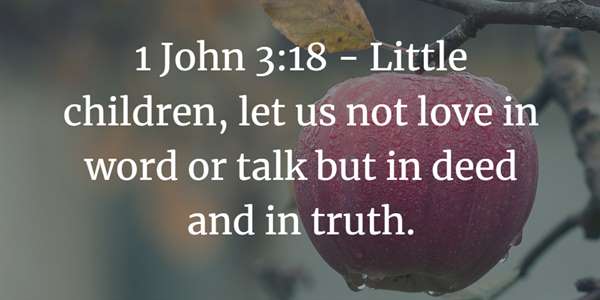
1 John 3:16-23(3:18) – April 21, 2024

            Children love stickers! I can remember as a piano teacher years ago, I always let my piano students choose stickers after their lessons. I would have all different kinds of stickers – animals, dinosaurs, flowers, cars, space ships, and hearts, among other designs. I love stickers, too! When my children were young, they used to put them all over their notebooks, too!        

            Hearts and the heart stickers I passed out before the sermon help us think about this Scripture lesson we read today. We are commanded to be loving, sure! But, the elderly apostle John has some specific words for us – we are to love, in truth and action!

            Let us start at the beginning, with love, and where it often begins. When many people think about love, love can be a concept, an idea. Love is something people can buy in a store, with flowers and candy. Many people start thinking especially of Valentine’s Day or other Hallmark holidays, with stores and card shops full of red and pink displays and hearts and roses. Sweets for the sweet, as the old saying goes!

            That is definitely not what the apostle John has in mind, here in his letter to scattered believers in Christ. Let’s get right into it: John hits us all with a one-two punch. He says in chapter 3, “This is how we know what love is: Jesus Christ laid down his life for us. And we ought to lay down our lives for our brothers and sisters.”

            Wow! That is a really long way from some pretty, nice idea of hearts and flowers and Valentine’s Day cards, isn’t it? John was not playing around. He was very serious about his Lord Jesus and Jesus’s love. The amazing, sacrificial love of Jesus has been all-important to John for over fifty years at this point.  The love of Jesus is so important to John, that John gets banished to prison, in isolation on a tiny island in the Mediterranean Sea because of it.

            Let’s go back to the idea of hearts. Sure, when we see hearts on a Valentine’s Day card, that can be cute and sweet. But, it isn’t at all the idea that John is thinking of here!

When you and I really mean something, we often say we put our heart into it. “That’s how we indicate something is really important. That’s how we show that we are really committed, really involved, really connected. Right? Put your heart into it. When we really mean it, our hearts are in it. When they aren’t, when we are half-hearted or worse, then nothing happens. Or nothing of significance anyway.” [1]

            I suspect the apostle John thought about the love of Jesus a lot. I also suspect he really put his heart into communicating the message of the love of Jesus, too!

We are celebrating Shepherd Sunday this fourth week of Easter, with our Scripture readings this week focusing on the Shepherd. Our Gospel reading is from John 10, where Jesus portrays Himself as the Good Shepherd. The psalm for this Sunday is that wonderful psalm describing the Lord as our loving Shepherd – caring for all of the sheep. (even the sheep you and I don’t particularly like)

            As we consider the Shepherd theme, the Gospel of John tells us the Shepherd lays down His life for the sheep. Here in 1 John 3, the elderly John tells us more about that sacrificial love: “This is how we know what love is: Jesus Christ laid down his life for us. And we ought to lay down our lives for our brothers and sisters.”   

            The next verse is important, as well! “If anyone has material possessions and sees a brother or sister in need but has no pity on them, how can the love of God be in that person?” This cautionary word from John is another one-two punch, for sure, and it really hits home! I can tell you that I feel it deep down in my soul. I wonder if you do, too?

“If we have all we need and see another person who has nothing but do not share what we have, we cannot say we love God.  Love is not what we feel, but what we do.  God wants us to love each other with actions.” [2] God insists that we love one another not only with our words, but with our deeds – our actions – and to put our whole hearts into it, too!

            Things do not always go smoothly or lovingly, however. Some people are just half-hearted, or even less. “The problem is, we have learned to guard our feelings; we have learned to change the channel when the pictures of the hungry children appear. We have learned to turn the page when the paper is full of need and want and brokenness. “Nothing to do with me,” we think to ourselves. We have shut off our emotions; we have closed our bowels, says John.” [3]

            Who remembers several years ago, when our Church Council got together after a Council meeting and packed some disaster response kits for people affected by flooding downstate, here in Illinois? That was loving in word and deed! That was loving each other with actions! Helping others, full of need and want and brokenness, no matter what.

            Certainly, John is asking us – all of us – to do something! Actions big or small, it doesn’t matter. Spend your money wisely, where it makes a difference. Get involved! Write or call your town or state representative when you feel strongly about a local issue. What about hunger, poverty, and need? Our church supports our local food pantry, and the Salvation Army’s outreach to the homeless community in the Forest Preserves. Be sure you support these outreaches, too!

Each of us can make a difference, one person at a time, one prayer at a time, one action at a time.  John wants each of us to put our heart into it! Love truly, in action and in truth. Alleluia, amen!   

@chaplaineliza

(Suggestion: visit me at my other blogs: matterofprayer: A Year of Everyday Prayers. and  A Year of Being Kind . Thanks!


[1] https://www.umcdiscipleship.org/worship-planning/how-shall-we-live/fourth-sunday-of-easter-year-b-lectionary-planning-notes/fourth-sunday-of-easter-year-b-preaching-notes

[2] http://worshipingwithchildren.blogspot.com/2015/03/year-b-fourth-sunday-of-easter-april-26.html

[3] https://www.umcdiscipleship.org/worship-planning/how-shall-we-live/fourth-sunday-of-easter-year-b-lectionary-planning-notes/fourth-sunday-of-easter-year-b-preaching-notes

Unknown's avatar

We All Are Witnesses!

“We All Are Witnesses!”

Luke 24:48 – April 14, 2024 

Have you ever been confused by the number of hurried, jumbled nature of things happening at once? And the speed at which these things happen? This experience is more common than we might think. Just think of the passing of time, where it’s New Year’s, you and I turn around, and it’s already Easter! Or, before we know it, the school year is over!

However hurried and jumbled these past months have been, it pales in comparison with our Gospel reading today. The end of the Passion Week must have been momentous and confusing for the followers of the Rabbi Jesus. Some confusing and jumbled things were happening very quickly. From the big festival entrance on Palm Sunday to the Passover Dinner of Maundy Thursday evening, to the arrest, trial and Crucifixion on Good Friday.

Events happening in short succession from morning until night. Everything happening one thing after another. This was compounded by the followers of Jesus scattering, running away, frightened by the very real, very legal, very official things happening to Jesus on Thursday night and Friday during the day.

   Let’s fast-forward to that Sunday morning, the first day of the week. The disciples still must have been frightened to death of the Jewish and Roman authorities. I suspect they needed to talk about the happenings of the past few days, too. We can see that from our scripture passage.

We pick up the narrative right after the events of the Road to Emmaus. To fill everyone in, two followers of Jesus got on the road to Emmaus that Sunday. As they walked, they talked. Debriefed. Tried to figure things out, as best as they could. And what circumstances they needed to figure out! A Stranger began to walk with them on the way, and unbeknownst to them, it was the risen Jesus, incognito. He shared with them a summary of all that He had come to earth to do. Of His ministry, His message, and His purpose. And still, they did not know it was Jesus.

Not until dinner that evening in Emmaus, the risen Jesus was revealed when He blessed and broke the bread. And then—Jesus disappeared! The other two at the dinner table did not waste any time! They ran back to Jerusalem, to the Upper Room, to tell what they had seen. Yes, they were witnesses. Eye witnesses, verifying everything that had happened that day.

Our Gospel reading for today picks up the story at this point. All of the followers of Jesus are gathered together in the Upper Room, and are talking about the story of the road to Emmaus. Do they believe? Or, don’t they? Are a few skeptical? Or doubtful? Are some still frightened?

Let’s transition to today. Here and now. I can hear some people today, scoffing at the idea of some guy rising from the dead. And then, miraculously traveling alongside of two other guys? Good as new—in fact, even better? No way! Not a chance. The other two must have been hallucinating. Or dreaming. Or maybe, seeing a ghost. They can’t believe. Or, won’t believe.

As we start the Gospel reading, the risen Jesus suddenly appears to the group in the locked Upper Room. What does He say? “Peace be with you.” A common greeting of the time. He’s also calming their hearts, their spirits, their anxieties, their emotions. “Peace be with you.”

How does the risen Jesus immediately respond to the disciples?  “Don’t be frightened! It is I, myself.” He emphasizes His identification. “I, myself!” It’s not anyone else, but Jesus! He lets them know that He is solid and corporeal, not a ghost. Not a spirit. And, Jesus doesn’t criticize His followers for being afraid! For feeling uncertain, doubful and anxious!

I wonder whether you have ever had a kind and patient teacher, or instructor, or coach. When you were afraid, uncertain, or anxious, did this kind and patient person get angry with you? Or, upset? Or, did this person continue to be open and willing to help you? Generous with time and welcoming to your attempts? Well, that is Jesus, all over. To a T.

Jesus tells the disciples, first. They are to proclaim what they have seen and heard. They are to be witnesses to the power of the resurrection. They are to tell how the risen Jesus has made a difference in their lives! And boy, that was a big difference!

When we read the book of Acts, that is exactly what we see. The disciples being witnesses of what they have seen and heard, witnesses of the power of the resurrection. Time after time, no matter what, the disciples tell others about how Jesus lived, preached, did miracles, and rose from the dead. Then, how all that has made an earth-shaking difference in their lives.

This is the message that Jesus told the disciples to start to carry, when John was a very young man. Some decades later, we see the aged John still carrying the message Jesus told him to, the message of sacrifice, hope, and resurrection. John is still being a witness, all those decades later, at the close of the first century! Dear friends, our Lord Jesus gave specific instructions to His friends, to go and be witnesses. He gives those same instructions to us. We are to be witnesses of the power of the resurrection.

Can you think of someone who was a witness to the power of God, in your life? Someone who immediately comes to mind for me is Miss Rose. I met her more than thirty years ago, when my older two children were very small. She was a witness to the power of God, and to God’s love. She communicated God’s love to everyone she ever met, just about! A little lady, a dynamo for God, she would tell everyone about God and how much God loved them.

I met her again, some years ago when I was a chaplain intern at the Presbyterian Homes. She was a resident there. I was so happy to see her. Miss Rose and her joy in the Lord bubbled over and communicated to everyone she met there, too. Even though she was in severe, chronic pain, Miss Rose witnessed to the power of the resurrection, asking people she met, “Do you know Jesus? Can I tell you about Him, and what He’s done in my life? Can I tell you my story?”

Each of us has an opportunity to be a witness, to communicate the Good News about the risen Jesus and the power of the resurrection. We can communicate by words, by a smile, by being kind, through our actions, through our generosity.

Think about someone who impacted your life, who communicated the Good News to you. There’s a great example for you! Just like Miss Rose is a marvelous example for me, to be a witness despite pain and suffering, even through difficulty in my life. I can still communicate God’s love, just like the aged Apostle John did, too, decades after the Resurrection. He was even in prison when he wrote his letters, on a little island in the Mediterranean Sea. That didn’t make any difference. John still told his story, how the risen Jesus made a difference in his life.

What is important is that we get out there and start being a witness, telling people about the power of God, and about how much the risen Jesus has changed our lives. Can you be a witness? It’s as simple as telling your story. Can you tell the story of Jesus and His love? Jesus loves you. Jesus loves me. Jesus loves all of us.  Be witnesses. Alleluia, Amen.

@chaplaineliza

(Suggestion: visit me at my other blogs: matterofprayer: A Year of Everyday Prayers. and  A Year of Being Kind . Thanks!

Unknown's avatar

Are We Doubters, Too?

“Are We Doubters, Too?”

John 20:19-31 (20:29) – April 7, 2024

            Seeing is believing! Or . . . is it?

            I wonder what things come to mind when I mention the phrase, “Seeing is believing”? Or even, “I won’t believe it until I see it!” Sometimes, people can be really doubtful, even really skeptical about things. I can just imagine several people I know folding their arms across their chests and saying, “Unless you show me . . . “

            In the gospel account we read today, from John 20, the disciple Thomas had just that reaction. After the Resurrection, the first time Jesus came to the disciples, Thomas was not there. We’re not told why, simply that he wasn’t there. Maybe he was scared, maybe he was away for the day, or out of town. Maybe he was sick. We just aren’t told why he wasn’t there.

            The ‘why’ is not the important part. The fact that Thomas wasn’t present the first time is. Thomas had doubts. Sincere doubts. Truth to tell, the other disciples’ story was a little farfetched. I mean, how many people have you known who came back from the dead, and walked through walls into a locked room?

            I wonder. I wonder if Thomas’ reaction strikes a chord with anyone here today. How many of us today are like Thomas? Doubting that Jesus has risen indeed from the dead? Or, completely missing Jesus, and doubting that Jesus is even here at all, today?

            Let’s think some more about Thomas and his reaction. Thomas not only doubted, he wanted concrete proof. Tangible proof, proof he could touch and feel and handle. Thomas wanted to put his hands in the nail marks on Jesus’ hands. That’s pretty concrete. But – what about you and me? Do we want concrete proof that God is working in our lives right now? Do we want concrete proof that Jesus rose from the dead and is present with us, today?

            The second time the risen Jesus appeared to the disciples, it was also in a locked room. And, this time, Thomas was present. Let’s paint the picture. The disciples are huddled together in the Upper Room, still frightened of the Jewish leaders. It’s only been a little over a week since their Rabbi Jesus had died on the cross, after all! I’d imagine they would be shaking in their shoes! Then, the risen Jesus suddenly appears in the midst of them all, Thomas included. What do you think would be going through Thomas’s mind right about now? His Rabbi, his Lord, back from the dead, right in front of him!

            Let’s go further as we imagine Thomas’s face, and imagine what he is thinking and feeling as the risen Lord Jesus invites Thomas to touch Him. Then, we look around at the faces of the other disciples and try to figure out what they are thinking and feeling, too! The commentator Carolyn Brown says that she suspects the disciples “are glad Thomas asked his question because they really wanted to know the same thing but were afraid to ask.  It does take courage to ask some questions and Thomas had it.” [1]

            I think that “doubting Thomas” is not the most accurate nickname for this earnest disciple. Perhaps, maybe, just maybe, we ought to think of Thomas as courageous Thomas. Because, it takes real courage to ask out loud some of those questions Thomas wanted the answers to. After all, he was a real “show-me!” kind of guy, and not in a mean way, either. A healthy skepticism is just that – healthy and curious.

            I wonder whether our doubts and fears about Jesus and the Resurrection can be as easily taken care of, as Thomas’s? What if our problem is less doubt, and more fear? Fear of being misunderstood by others, fear of looking foolish, fear of falling flat on our face? Perhaps, some kind of nebulous fear that you and I do not even understand, but we know is deep down inside of us?

            Let us return to Thomas. When he sees our risen Lord Jesus in the flesh – the resurrected body – he suddenly believes that everything the disciples were telling him about the resurrected Jesus is true! And, “he makes the climactic confession of John’s Gospel, addressing Jesus as, ‘My Lord and my God!’” When Thomas saw Jesus with his own eyes, that was enough for him. Enough to make the declaration of divinity directly to our risen Lord! Remember the confession made in the first verse of John chapter 1: “In the beginning was the Word, and the Word was with God, and the Word was God.” [2]

            Sure, some healthy curiosity is just that – curiosity. And, some people are naturally skeptical. We know God can handle that! After all, that is the way God constructed many people. Our Lord Jesus is not surprised by any of this. He won’t get mad, or storm out, all upset. No! He was warm and accepting of Thomas and his “show-me” attitude, and even answered him right back! And, what did Thomas do? What did Thomas say to Jesus? “My Lord and my God!”

            As commentator David Lose tells us, Thomas offers those same readers a model for faithful response to an encounter with Jesus – belief, belief that leads to confession. All through the Gospel of John we see a variety of responses to Jesus. The confusion of Nicodemus the religious teacher, the trust of the Samaritan women, the stubborn fidelity of the man born blind, the disdain of Pilate, the denial of Peter. [3] John saves the best for last: he shows us the radical, bold confession of Thomas, sure and certain at last.

            Have there been long moments in your life where you have doubted God’s presence? Have you ever felt lost and alone, almost like the way the disciples felt right after the Crucifixion? We do not need to fear or be alone, because Jesus has promised never to leave us nor forsake us. We can embrace our flickering faith with the same words of Thomas: “My Lord and my God!”          

So, the Gospel of John helps us to believe, too. This Gospel was not only written to bear witness so long ago, in the first century, months and years after Jesus was raised from the dead. This Gospel was also written for the many generations which have come to believe in Jesus Christ throughout the centuries. That includes us, too.

Even though today we may have doubts, and fears, and unbelief, and wonder whether, and why, or even why not, Jesus comes to us in our doubts and fears and unbelief. Our Lord comes to us with reassurance and open arms and says “Do not doubt, but believe!” And our faithful, bold response to Jesus? “My Lord and my God!” Alleluia, amen!

@chaplaineliza

(Suggestion: visit me at my other blogs: matterofprayer: A Year of Everyday Prayers. and  A Year of Being Kind . Thanks!


[1] http://worshipingwithchildren.blogspot.com/2015/02/year-b-second-sunday-of-easter-april-12.html

[2] https://www.workingpreacher.org/dear-working-preacher/its-not-about-thomas  

[3] Ibid.