Unknown's avatar

Wisdom from Above!

“Wisdom from Above!”

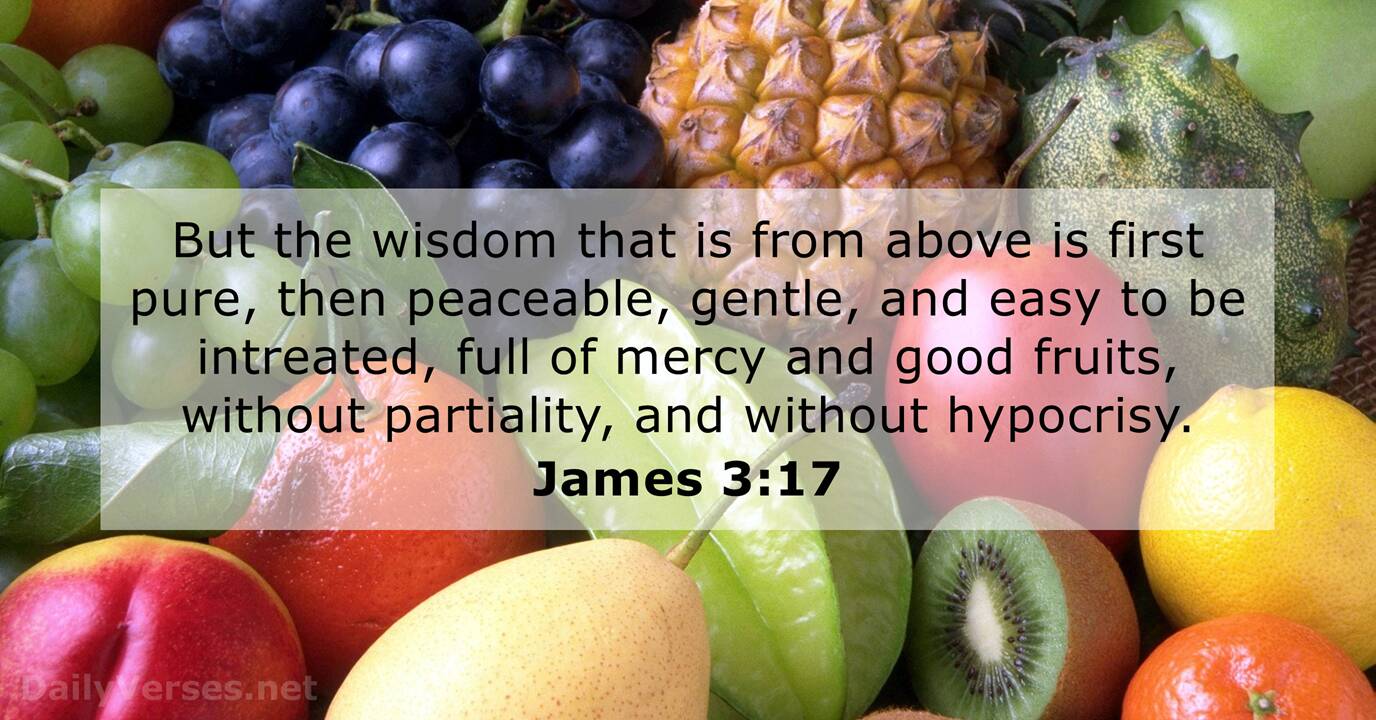
James 3:13-4:3 (3:17) – September 22, 2024

            I wonder if you can think of people who are called the best at something? The greatest athlete in a sport? The smartest student at your school? The best chef or best writer or best driver or best of anything? Just imagine how much bitter jealousy that comment can promote. Or, how much selfishness and blind ambition all this empty striving and competition leads to!

Worldly “wisdom” is anything but wise, according to our letter writer James. I am sure you recognize these jealous, covetous people. They regularly moan and kvetch and sometimes outright quarrel about what they have or about what they don’t have. James tells us about these dissatisfied, disgruntled people in our Scripture reading today.  

            Just listen to his description: “If in your heart you are jealous, bitter, and selfish, don’t sin against the truth by boasting of your wisdom. 15 Such wisdom does not come down from heaven; it belongs to the world, it is unspiritual and demonic. 16 Where there is jealousy and selfishness, there is also disorder and every kind of evil.”  

This kind of worldly striving, dog-eat-dog attitude is definitely not what James has in mind for us, as believers in Christ. He shines the spotlight on how believers ought to live. Listen! “13 Are there any of you who are wise and understanding? You are to prove it by your good life, by your good deeds performed with humility and wisdom.”

Can there be a sharper contrast between the dissatisfied, selfish, boastful worldly “wisdom” and the Godly, humble, beneficial wisdom and way of life that James talks about here? Not likely. Remember, in this practical letter, this how-to manual, James advises his friends on how to live in a way pleasing to God.

            It’s true that this fancy, flashy excitement can be attractive, even seductive, on the surface! But, all that is just for show, simply surface, an inch deep, and nothing more than worldly dissatisfaction, boastfulness and jealously. But, let’s be truthful – which of us is not tempted, sometimes, by the alluring or bright and shiny trappings of the way of worldly “wisdom?” Which of us doesn’t fall in step with others who might be jealous, or bitter, or selfish – sometimes? Most important, which of us leaves the simple, quiet, godly life of contentment for the flashy, glitzy (and shallow) excitement that so soon fades?

            Let’s consider the worldly, flawed way of thinking and being, for a moment. Carolyn Brown, retired Children’s Ministry Director, has written a prayer for this reading. Listen, if you would, and see whether these words from Ms. Brown do not resonate in our hearts.

Dear God, we want to look amazing.  

We want great clothes, cool shoes, a great haircut. We want our homes filled with our stuff.

We want all the best people to be our friends. We want to be the first, the best, the most, the greatest. So we grab and hold and demand. We even kick and punch to get what we want.

Forgive us.

Teach us to let go, to open our hands and hearts to others. Teach us to be content with what we have and to share it.

Teach us to think as much about what OTHERS want as what WE want. Teach us to be as loving as Jesus. Amen. [1]

            This prayer penetrates straight to the heart, let me tell you! I want to ask God for forgiveness, and to help me live in a loving way, like Jesus. I hope you do, too.

            This prayer makes me think of the Jewish High Holidays, which are quickly approaching. During the month before Rosh Hashanah and Yom Kippur, faithful Jews prepare for these holidays by examining their hearts. They meditate and pray, and ask forgiveness of God, of others, and of themselves for the sins and shortcomings of the past year.

            We also have a weekly time of confession and prayer at the beginning of each worship service. Thank God we receive the assurance of pardon each Sunday from our loving Lord! Yet, we keep on sinning. We still need to keep confessing our sins and shortcomings, and receive that assurance of pardon and forgiveness. Is it any wonder that we have this very practical how-to manual of how to live the Christian life by our letter-writer James, in the New Testament?  

            James assures his readers of Godly wisdom, because he describes its results. “Believers need to submit to the wise rule of God through the Spirit of God, a rule which purifies from within.” [2] The practical consequences of this wise rule of God are easy to observe. People who live God’s way are peaceable, considerate, gentle and non-combative! Does this sound very worldly to you? Certainly not selfish or jealous or bitter!

            What I wonder: how is the life of Jesus any mirror to our personal lives? Jesus is certainly recorded as merciful and loving. That is displayed over and over again in the Gospel record! When I think of our Lord Jesus during that three-year period of time in Palestine, I cannot think of anyone more sincere, honest or peaceable. More real and yet penetrating to the heart. I would love to have just a fraction of that Godly attitude and lifestyle as part of mine!

What – practically – can we take away from this reading today? Can we concentrate on living like Jesus? Living the Jesus way is peaceable, considerate, gentle and non-combative. Jesus is sincere, honest, and real. Can we make a commitment to live like Jesus?

This is the how-to of living a life pleasing to God, being filled with the presence of God. “[You and I] are works in process. This isn’t about completion and the satisfaction of a job well done; it is about a journey of discovery and transformation. But peace [gentleness, mercy, and lovingkindness] can be our companions in the journey to keep our feet on the path.” [3]

            Practical James would wholeheartedly agree! Keep on keeping on. Live in God’s way, in the wonderful, honest presence of Jesus. It’s a sure-fire way to have God draw near to each one of us. Alleluia, amen.

@chaplaineliza

(Suggestion: visit me at my other blogs: matterofprayer: A Year of Everyday Prayers. #PursuePEACE – and  A Year of Being Kind . Thanks!


[1] http://worshipingwithchildren.blogspot.com/2012/08/year-b-proper-20-25th-sunday-in_30.html

Worshiping with Children

[2] http://www.lectionarystudies.com/sunday25bee.html  

[3]  https://www.umcdiscipleship.org/worship-planning/doers-of-the-word/seventeenth-sunday-after-pentecost-year-b-lectionary-planning-notes

Unknown's avatar

What God Sees

“What God Sees”

1 Samuel 16:1-13 (16:7) – March 19, 2023

            What does a successful leader look like? Good looking? Adept on his or her feet? Expert at talking or perhaps explaining things? How about good at getting things done?

            What does God see in such a person? How does God view a leader and determine the measure of a man, of a woman? How does God see how they are best suited for – or for what?   

            Today’s Scripture reading comes from the Hebrew Scriptures, from the book of 1 Samuel. We meet an older Samuel, judge and prophet of Israel. But what about the deeper meaning of this narrative from the Hebrew Scriptures?

For that, we need to go back a few chapters in 1 Samuel. At first, Samuel and the people of Israel were very glad that Saul was their king. He was tall and broad-shouldered, and pleasing in appearance. Saul looked like a successful leader! He was the very image of what people thought a king ought to be. Everyone said so!

            But, after some time, Saul’s true nature—on the inside—became evident. He was not all he appeared to be on the outside. Saul made some very unwise choices, acted foolishly, and God finally rejected him as the king of Israel. So, yes. By today’s Scripture reading, Samuel had anointed King Saul some years before, and that had not turned out well at all.

            How do you see a successful leader? What kinds of features do you look for? What kinds of features does God look for?

             We know that the prophet Samuel was grieving that he had anointed Saul as king. For that matter, even though the Bible does not say specifically, we can guess that Samuel was also grieving for the nation of Israel, since the nation had such an unfortunate person as king. Plus, we do know that Samuel was frankly afraid of King Saul by this point!

Listen to the conversation between Samuel and God: “The Lord said to Samuel, “How long will you mourn for Saul, since I have rejected him as king over Israel? Fill your horn with oil and be on your way; I am sending you to Jesse of Bethlehem. I have chosen one of his sons to be king.” 2 But Samuel said, “How can I go? If Saul hears about it, he will kill me.”

God is the one to suggest taking a heifer with Samuel and to invite Jesse (David’s father) and his sons to the sacrifice. Yes – this was a legitimate reason for Samuel to go to Bethlehem. And, Jesse had some big, strapping sons for Samuel to look over. We know what Samuel decided! And, we can see what God thinks of Jesse’s elder sons. Lo and behold, the older sons of Jesse are not chosen to be God’s anointed one, the new king of Israel,   

Have you ever been undecided about something really important, and then God swept in and helped you with your choice? Samuel started to think that his first impressions were perfectly fine. But, no! Samuel has “a lot of unlearning to be done from the previous experience of anointing a king and Samuel needs to mourn the old way/king for a time, but God encourages him to move on to what God is calling him into now.” [1]

God had a definite list of features that God’s idea of a king was supposed to have, and Samuel realized that his checklist and God’s list just were not jiving. Not connecting. Can we be upfront and honest with God? Can you and I admit we have quite a different checklist for a successful leader? Even, for a king for the nation God loved.

            Another lesson this Scripture reading has for us is “the same as we see in the biblical texts over and over. The world has a pecking order: elder son over youngest, Pharaohs over slaves, the sons of priests over an outsider. God pays no attention to that order.” [2] That worldly plan or idea just does not follow God’s plan.

            Remember what God told Samuel: “But the Lord said to Samuel, “Do not consider his appearance or his height, for I have rejected him. The Lord does not look at the things people look at. People look at the outward appearance, but the Lord looks at the heart.”

What is important to God? What kinds of attitudes and ways of thinking are pleasing to the Lord? Are we “looking” but not really “seeing” as God sees?

            All of Jesse’s older sons were presented to the prophet Samuel, but God was silent. Samuel needed to ask whether Jesse had any more sons. “Yes, I do. But, he’s the youngest. He’s out watching the sheep,” said Jesse. Sure enough, God chose David, the youngest of eight brothers. God sees differently from human beings.

 This bible reading from 1 Samuel is a great source of encouragement for children and young people, who feel left out and left behind by the big and powerful. We see that God finds possibilities in the most unexpected places and through the most unlikely persons. We see the Lord lift up Jesse’s youngest son David to be the anointed king of Israel. In a similar way, God can lift up the marginalized, the downtrodden and the rejected ones today to a place of prominence. God can, and God does just that.

Many people are still fooled by appearances. What kinds of possibilities are there in your life and heart today? What does God see in you, and in me? Are we a person after God’s own heart? Be comforted and encouraged that God does not see us as the world sees, but God sees past all that. God sees our very hearts. Amen!


[1] https://www.churchofscotland.org.uk/worship/weekly-worship/monthly/march-2023/19-march-4th-sunday-in-lent

[2] https://www.workingpreacher.org/commentaries/narrative-lectionary/call-of-david/commentary-on-1-samuel-161-13-psalm-5110-14-2

@chaplaineliza

(Suggestion: visit me at my other blogs: matterofprayer: A Year of Everyday Prayers. #PursuePEACE – and  A Year of Being Kind . Thanks!

Unknown's avatar

Blessed Are We

“Blessed Are We”

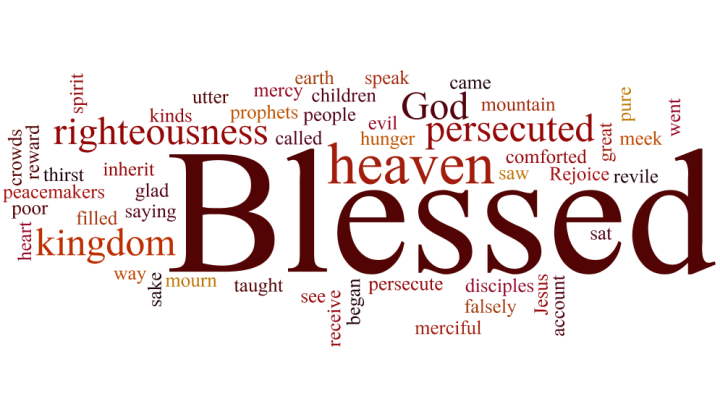
Matt 5 beatitudes, word cloud

Matthew 5:1-12 – February 2, 2020

This Thursday afternoon, my husband and I are taking a short trip to St. Louis to see our daughter. Before we leave the house, we are going to print out some maps on our computer. Lots of journeys begin with a road map. There are signs to follow and road maps we can consult, just in case. We have landmarks we know along the way. I wonder, when you are on a journey, do you have a road map to follow?

In the previous Gospel reading from Matthew chapter 4, our Lord Jesus gives a summary statement of the message He wants to get across to everyone. “Repent, for the kingdom of heaven is at hand!” That message is—in brief—a headline for the whole of the next three chapters of the Gospel of Matthew, the Sermon on the Mount. These three chapters tell the world what God wants them to do, how to act, even what to say.

Today, Eileen read to us the first twelve verses of Matthew 5. These verses have a particular name: the Beatitudes. In these statements, our Lord Jesus tells us about His followers’ road through life. In other words, Jesus gives us a road map which will guide us to the kingdom of heaven. (In other parts of the Gospels, this is identified as the kingdom, or the reign, of God.)

This is great! Isn’t it? We have a road map to heaven! If we follow the signs and landmarks that Jesus describes for us here in the Beatitudes, we will make it to heaven, for sure! Won’t we? Or, will we? How easy is it to follow the signs and landmarks that Jesus tells us about?

Hold on just a minute. Following Jesus is more than just a pleasant walk in the park. Let’s take a look at who benefits from being selfish, who gets the lion’s share of attention, and how the faulty, selfish world wants people to act.

In case you and I haven’t noticed, there is a huge difference between what God wants and what the selfish, self-centered world wants. This is the first detour we are going to take from the road God means for all Christians to take.

Let’s look at a topsy-turvy, cynical, worldly view of the Beatitudes. In today’s faulty, selfish world, things are good for the rich, they can buy whatever they want. It’s good for the strong, they can take whatever they want. They will also make the team. Things are good for the winners, they get all the prizes. It’s good for the smart, and the smart-alecks. They get straight A’s, go to the best colleges, and get great jobs. It’s good for the beautiful. They will get their pictures in magazines, on social media, and get to be in movies. Things are good for the important people. They get to make all the plans and all the decisions. [1]

But, is that the way God wants people to live? Is that what Jesus tells us here, in the Beatitudes? Is that how God wants us to live? If you and I live in that selfish, self-centered kind of a way I just described, will we be traveling on the road to the kingdom of heaven?

We know the selfish, self-centered world rewards the powerful, the wealthy, the attractive, the ones who push others out of the way and trample the weak and poor and sick ones.

Now that we have figured out the topsy-turvy, twisted detour way of looking at the Beatitudes, let’s look at a second detour some might take when they consider the Beatitudes.

Sometimes, certain people think that only super-holy people can possibly follow God’s way to heaven. You know, only real saints of God. People like Mother Teresa, or St. Francis of Assisi, or St. Augustine, or Pastor Dietrich Bonhoeffer. The rest of us cannot possibly measure up to such a high standard. I am sorry, but you and I are only going through the motions. Some say we are much too weak and sinful to ever be able to follow God’s high and lofty recommendations in the Beatitudes.

Now, this detour around the Beatitudes is a bit closer to the true road map that God marks out for us, but still not quite on target. God wants all of us—each one of us—to have an opportunity to walk more closely with the Lord, and to follow God in each of our individual journeys through life in this selfish, self-centered world

But, wait! Does that mean that you and I need to follow each of these items on the road map of the Beatitudes, to the letter? We have already seen how selfish, self-centered people often live, disregarding all of God’s recommendations. How instead would Jesus want us to fit into His world and His kingdom?

Jesus says that in His kingdom, it’s good for those who know they do not know everything. They belong in God’s world. It’s good for those who are terribly sad. They will be comforted. It’s good for those who obey God. They will be in charge, according to God’s way. It’s good for those who don’t get justice now. Sooner or later, they WILL get it—God says so. It’s good for those who forgive and care about others. God forgives and cares about them. It’s good for those who are pure in heart. They will see God. It’s good for the peacemakers. They will be praised as God’s own children. It’s good for those who are hurt because they stand up for God’s ways. They will be called heroes and heroines. It’s even good for you and me when people come after us in anger because we follow Jesus. We will be rewarded by God in heaven. [2]

Some people will scoff. How do any of Jesus’s suggestions work properly? If I do any of that stuff, I’ll be laughed out of my workplace! People will taunt me and ignore me, or even worse. Well, I think that is just the point. Our Lord Jesus said these things might happen. In fact, Jesus tells His followers, point blank, that these kinds of things will undoubtably happen. And, Jesus also tells His followers which people are His precious ones, His dear sisters and brothers.

There is a kicker—a high point in this section of Jesus’s sermon. When you and I follow the road map Jesus shows to us, He calls us blessed. This is our Lord’s description of every single Christian. In each Beatitude, everyone who follows God is declared blessed.

Are you mourning for a loved one right now? Jesus said you are truly His sister, His brother. Are you poor, and especially poor in spirit? Jesus says you are really on the road to heaven. Are you meek and humble? Then, the world will be in your hands—in this world or the next. And what about those who work for peace in our neighborhoods, our cities, our country? What a wonderful thing to be called God’s children—God’s daughters and sons. And, God promises to abundantly bless us as we journey with Jesus.

This road map of blessing, this road map to the Christian life, shows us a God who delights to create, bless and redeem. May we always remember that we—all of us—have been abundantly blessed with the Beatitudes, for now, and for always.


[1] http://worshipingwithchildren.blogspot.com/2014/01/year-fourth-sunday-after-epiphany.html

Worshiping with Children, Epiphany 4, Including children in the congregation’s worship, using the Revised Common Lectionary, Carolyn C. Brown, 2014.

[2] http://worshipingwithchildren.blogspot.com/2014/01/year-fourth-sunday-after-epiphany.html

Worshiping with Children, Epiphany 4, Including children in the congregation’s worship, using the Revised Common Lectionary, Carolyn C. Brown, 2014.

@chaplaineliza

(Suggestion: visit me at my regular blog for 2020: matterofprayer: A Year of Everyday Prayers. #PursuePEACE – and my other blog,  A Year of Being Kind . Thanks!