Unknown's avatar

What about the Tongue?

“What about the Tongue?”
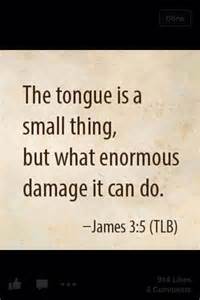
James 3:1-12 (3:1-12) – September 15, 2024

How many of us can remember that old playground saying, “Sticks and stones may break my bones, but names can never hurt me!” children and young people may put on a brave face when they are teased, hurt and picked on. Children and young people can be particularly mean, teasing each other, with left-handed compliments, and even downright insults. But, what insight does this Bible reading from James give us about this very problem?

Let’s hear again these serious words from James. “Just think how large a forest can be set on fire by a tiny flame! And the tongue is like a fire. It is a world of wrong, occupying its place in our bodies and spreading evil through our whole being. It sets on fire the entire course of our existence with the fire that comes to it from hell itself. We humans are able to tame and have tamed all other creatures—wild animals and birds, reptiles and fish. But no one has ever been able to tame the tongue. It is evil and uncontrollable, full of deadly poison.”

Such a little part of the body – the tongue! And yet, despite the playground saying, the tongue can really hurt. “When people are called nasty, dirty names they know what the name caller thinks of them – and that hurts. Those people can be strong, not believe the name caller, and work to prove they are better than the name caller claims. But, it still hurts.” [1]

Names can cause pain, internally. The hurt feelings can smart and fester for a long time. And sometimes, people remember mean words, nasty words or harsh words years after they heard them. Sometimes even decades later. Words can come back to haunt us – either words we have said, or words we have heard. Internalized. Taken to heart.         

Who hasn’t been on the receiving end of a nasty argument, or mean, angry words? Sometimes, words can even change the way we think about ourselves.

Our letter-writer James would whole-heartedly agree. Remember, in this letter the apostle James writes a manual of Christian living. A how-to book on how to live a life pleasing to God.

The big problem with mean, hasty or thoughtless words is that they cannot be unsaid. Once the words have been said out loud – or, sometimes worse, printed electronically in social media – the mean or hasty or thoughtless words are out there in public, whether texts, or tweets or TikTok. These various kinds of words cannot be taken back. And, James cautions all of us on the danger of a tongue that just flaps in the wind! Or, as James says, burns like a forest fire or is fast acting as deadly poison!

Commentator Rev. Dr. Derek Weber thinks further about mean, nasty name-calling and the destructive nature of words. “In our normal catalog of sins, gossip is somewhere far down the list. We are much more concerned about other kinds of misbehavior. James would have us reconsider our hierarchy [of sins] and raise our awareness of the power of words to bring harm to the body of Christ.” [2]  

In Yiddish folklore, there is a story about a woman who would gossip and make false accusations about her neighbors. She never understood the implications of her words until the wise rabbi of her village decided to demonstrate it to her. He told her to get a feather pillow, cut the top off, and run around town with it. As she did that, the feathers flew away and fluttered all around the town. The wise rabbi then told her to collect all of the feathers that flew away and put them back in the pillow. She just couldn’t. It was an impossible task, she told him. “Maybe now you will understand,” he explained, “for you see, your words are like those feathers. Once they get out, it’s impossible to put them all back in.”

Our letter-writer James would so much agree! “As God’s children we are to be careful how we use the power of words. We are called to bless rather than harm, to seek justice and peace for all rather than revenge or harm.” [3] And, I do not want any of us to think that God is just a frowning or disapproving Supreme Being in the sky, ready to hurl thunder bolts at anyone who sins and lets their tongue run on and is a name caller and a gossip.

No, God is serious about sin, that is true! However, we can think of God our Heavenly Parent sort of like a well-loved elder who you and I love and cherish so much, who we do not want to disappoint, who we very much want to do our very best for!

Let’s flip this around, and look at our words from a positive light. Recall how you felt when someone said good, positive things to you or about you. How did you feel, deep down inside? Just think hard about the positive, beneficial impact of these words! James tells us we can certainly bless one another, just as much as we let slip mean or hateful words!

How can we build up each other with our words? What kind of effect would positive affirmations, sincere compliments and just plain being kind have on our daily interactions? I mean all of our interactions, it doesn’t matter with who. Family, friends, acquaintances, even people you meet on the street. Even people who don’t look like us, or speak our language, or wear familiar clothes. Maybe, especially different folks!

I offer the following challenge: find ways of blessing others through kind words, affirmations, and positive reinforcement. Look for everyday opportunities! Try it for the next week, and then the week after that. This is as much a challenge for me as it is for you! Please, find ways of blessing others. [4]  Remember, in this letter the apostle James writes a manual of Christian living. A how-to book on how to live a life pleasing to God. James encourages us to bless each other.

Please, consider turning to your neighbor, to the person in the next pew, and saying, “God bless you!” “God be with you!” Do it, right now. Please. That’s the way to live pleasing to God.

Finally, how would Jesus speak? Would Jesus say kind, helpful, encouraging, positive words? Would Jesus bless people? Do that. And, God will be so pleased!

@chaplaineliza

(Suggestion: visit me at my other blogs: matterofprayer: A Year of Everyday Prayers. #PursuePEACE – and  A Year of Being Kind . Thanks!


[1] http://worshipingwithchildren.blogspot.com/2012/08/year-b-proper-19-24th-sunday-in.html

[2] https://www.umcdiscipleship.org/worship-planning/doers-of-the-word/sixteenth-sunday-after-pentecost-year-b-lectionary-planning-notes/sixteenth-sunday-after-pentecost-year-b-preaching-notes

[3] https://www.stewardshipoflife.org/2012/09/the-gratitude-attitude/

[4] Ibid.

Unknown's avatar

Taming the Tongue

“Taming the Tongue”

James 3:1-12 (3:8) – September 12, 2021

            Who remembers the schoolyard saying “Sticks and stones may break my bones, but words can never hurt me!” There’s a problem with that saying. We all know that words can hurt. And sometimes, people remember mean words, nasty words or harsh words years after they heard them. Sometimes even decades later. Words can come back to haunt us – either words we have said, or words we have heard. Internalized. Taken to heart.

            Our letter-writer James would whole-heartedly agree. Remember, in this letter the apostle James writes a manual of Christian living. A how-to book on how to live a life pleasing to God. This is the point in the letter where he talks about the tongue, and how powerful it is. James begins by comparing the small tongue to other small but powerful items. “When we put bits into the mouths of horses to make them obey us, we can turn the whole animal. Or take ships as an example. Although they are so large and are driven by strong winds, they are steered by a very small rudder wherever the pilot wants to go.” James does want to help us behave in a way pleasing to God. However, the tongue gets in the way of that, big time!      

            I am sure you and I know this, from long experience. Who hasn’t been on the receiving end of a nasty argument, or angry words? We can use our tongues for positive words and kind comments, or for negative, hurtful sniping. This use of the tongue causes all kinds of bitter feelings and sometimes can escalate arguments and even cause fighting.   

            Who hasn’t experienced this negative use of the tongue? It’s no wonder that many people hesitate to jump in the middle of quarreling, arguing people. And, bullies? Gossips? Those who misdirect or misrepresent themselves or others? People who use particularly nasty or hurtful speech? Not positive ways to win friends or influence people.

Our commentator Dr. Derek Weber tells us that James wants to help us tame the tongue. It’s true that many Christians don’t take this recommendation of James all that seriously. However, “we’ve all experienced the sting of the tongue as we were growing up, and even as adults. We all know what it is to bear the brunt of rumors or misrepresentations or words spoken in anger. And just as likely we know what it is to watch our words bring pain to another, intentional or not. How can we get worshipers to take this text seriously?” [1]

I remember when I went to the circus with my children, when they were small. Watching the wild animals and their circus acts was truly amazing! Lions, tigers, other large animals – the oohs and ahhs coming from the audience were real, let me tell you! As often is said in YouTube videos and on reality television, “do not try this at home!” Wild animals are dangerous! It is so similar with the tongue! Trying to tame the tongue is often as difficult as trying to tame wild animals! (That’s why James uses this example in verse 7.)

We have talked about how dangerous the tongue is. Yet – is gossip THAT bad? Surely, a little gossip can’t hurt. Just letting people know the whole story. Just filling in the gaps. Surely, gossip isn’t as bad as murder, or stealing, or lying, is it? Is it? But, what would James say?

Instead of spreading gossip about people, how could we turn that around? How can you and I spread a good report about people? Sometimes, about the same people we gossiped about? Instead of saying something cutting or annoying, how can we say positive things? Have good, helpful words come out of our mouths? That would be kind, be caring, and even be forgiving!

I know it takes some time to correct bad habits. Perhaps our sometimes-bad, sometimes-mean, sometimes-thoughtless words are habits that many people need lots of help with.

Let’s face it, some do not want to start correcting negative words, malicious gossip, and rude comments. I can just hear some say, “Pastor, don’t we have bigger fish to fry? More serious sins to be concerned with?” Ahh, yes. But, a little thing like the tongue can be poisonous, hurtful, even mistakenly cruel and thoughtlessly punishing.                                                                                                                                                                                                                                                                                                                                       

I do not want this sermon to be all negative! So, “let’s talk about the good we can do with our words. Let’s talk about what it means to bless. The internet is full of lists of ways to praise a child [or young person], for example – the words we can use for encouragement and for building up.”[2]  How did you feel, deep down inside, when you recall how you felt when someone said good, positive things to you or about you? Just think hard about the impact of these words! What kind of words were they? How were the words said to you? A compliment, a kind, caring word, an encouraging comment – all these are positive uses of the tongue! We then understand how powerful words are!

Speak positive, kind, encouraging words. (Think those caring, kind thoughts about others, too!) Just like with toothpaste, after you squeeze it out, it is impossible to put all the toothpaste back in the tube. Just like our hurtful or thoughtless words. Once they’ve come out of our mouths, they’re so hard to take back. That is why we need to be super careful about how we use our words.[3]

With God’s help, we can tame our tongues. With God’s help, we can speak kind, helpful, encouraging words. Words that build up, rather than tear down. Positive words, instead of negative snipes or hurtful jabs. What would James say? More important, what would Jesus do?

Remember, in this letter the apostle James writes a manual of Christian living. A how-to book on how to live a life pleasing to God.

How would Jesus speak? Would Jesus speak kind, helpful, encouraging, positive words? Do that. And, God will be so pleased!

@chaplaineliza

(Suggestion: visit me at my other blogs: matterofprayer: A Year of Everyday Prayers. #PursuePEACE – and  A Year of Being Kind . Thanks!


[1] https://www.umcdiscipleship.org/worship-planning/doers-of-the-word/sixteenth-sunday-after-pentecost-year-b-lectionary-planning-notes

[2] https://www.umcdiscipleship.org/worship-planning/doers-of-the-word/sixteenth-sunday-after-pentecost-year-b-lectionary-planning-notes/sixteenth-sunday-after-pentecost-year-b-preaching-notes

[3] https://www.umcdiscipleship.org/worship-planning/doers-of-the-word/sixteenth-sunday-after-pentecost-year-b-lectionary-planning-notes/sixteenth-sunday-after-pentecost-year-b-youth-lessons

Unknown's avatar

Anger and Insults

Matthew 5:21-26 – February 12, 2017

matt-5-22-words

“Anger and Insults”

Have you ever met someone who flew off the handle about the least little thing? I mean, got angry at the drop of a hat? People get angry about all kinds of things. Big things, little things, serious things, even funny things. Like, getting cut off in traffic, or getting passed over for that promotion. Or what about when your shoelace snaps as you’re late for an appointment? What about other people, like when they spill juice all over the kitchen floor? Or when someone does something stupid and thoughtless at work? Doesn’t that just make your blood boil? Sometimes?

Anger happens to all of us, to all different kinds of people. Adults, teenagers, and children, not just once, or twice, but many more times than that. In our Gospel reading today, Jesus has some pointed words for anger and insults. Serious, too.

Let’s start where Jesus starts: the Law of Moses, and specifically, the big ten, or the Ten Commandments found in Exodus 20. That is one place Jesus refers to here in Matthew 5:21. “You have heard that it was said to those of ancient times, ‘You shall not murder’; and ‘whoever murders shall be liable to judgment.’”

I am certain the people Jesus was talking to knew what the Law of Moses had to say about murder. Except—the Law of Moses did not say anything about getting angry. (Not in any of the 613 laws found in the Hebrew Scriptures.) What does Jesus say about getting angry?

Matthew 5:22—”But I say to you that if you are angry with a brother or sister, you will be liable to judgment; and if you insult a brother or sister, you will be liable to the council; and if you say, ‘You fool,’ you will be liable to the hell of fire.”

Whoa! Those words are extremely serious! Jesus takes murder, on one hand, and compares it with anger. What is more, He says they are just as bad as each other!

If we take Jesus’s words as Gospel truth, we are in a sorry state. Everyone gets angry, sometimes. What are we to do?

Dr. Scott Hoezee has a paraphrase that packs a punch: “You haven’t stabbed anyone through the chest or shoved someone to his death off a cliff?  Good for you, but when in your anger you told Harold last week to go take a flying leap, in God’s eyes the ‘Do not murder’ command snapped quite cleanly in two in your life.” [1]

Jesus took the Law of Moses, from the Ten Commandments, and went beyond it. Far beyond it! He did not merely repeat the Law, like any of the scribes and teachers of that day did. Jesus transcended the Law of Moses.

How radical is that? I’ve said it before, and will say it again. Jesus was indeed a radical. He was subversive, never saying or doing what the established religious folks expected. Here, in this passage, Jesus was talking about the inside job, about how people felt on the inside—and how that translated to their outward actions.  

How did we start our service today? After the opening hymn, we had our children’s time, and I started talking about anger. Then—we had a prayer of confession. We confessed our anger, and asked God to forgive us when we get angry.

Let’s go one step further, and turn to another of the commentators, Karen Georgia Thompson: “The comparison is clear. Murder is serious and so is anger. There is a need in this first-century church to look at relationships and how individuals treat each other. There is a value to life and how we value the lives of others.” [2] Over and over again, Jesus talks about relationships, and how we are to act and speak in relationships. Here, Jesus goes one step further and even tells us how we are to think, in a way that will be pleasing to God.

Remember, relationships are more than one-dimensional. Sure, there are relationships on a horizontal level, between individuals, and even between groups of people. But Jesus is talking about the vertical relationship, too. The relationship between me and God, each individual and God. And, our joint relationship between all of us as a congregation and God. It’s quite a sobering thing, when we consider Jesus’s words in this light.

Eugene Peterson translates verse 22 as “Carelessly call a brother ‘idiot!’ and you just might find yourself hauled into court. Thoughtlessly yell ‘stupid!’ at a sister and you are on the brink of hellfire.” So, our angry words and thoughts towards others do great harm to our insides.

Jesus is serious when He refers to calling someone “stupid.” “He uses a term that calls into question the other person’s morality–it might be the equivalent of calling someone “a dirty rat,” someone you don’t trust for a second.” Another way of looking at it? Jesus is decrying our belittling of people’s mental powers and our belittling of their moral status. “Let your anger get the best of you in simmering grudge-bearing,” Jesus says, “and sooner or later you’ll start to denounce the people around you as stupid and immoral–as not worthy of your time.” [3]

That is not the kind of relationship Jesus wants us to have! Not with our neighbors, not with those in the church. Not with those in our community, and not with those on the other side of the state line, or the country’s border, or the ocean. What did Jesus say? Quoting from the Message again: “If you enter your place of worship and, about to make an offering, you suddenly remember a grudge a friend has against you, abandon your offering, leave immediately, go to this friend and make things right. Then and only then, come back and work things out with God.”

We have been shocked, and warned. We are all scared down to our shoes by the words of Jesus. What is our next step? What does Jesus say? Jesus gives us some really valuable advice. Action steps, if you will. Jesus does say not to wait too long to do this! We can name the problem that makes us angry and figure out something to do about it.  The Gospel of Matthew says, “be reconciled” with the person who made you angry. That means work it out with them. Figure out how to solve the problem, or the quarrel, or the bad feelings between you. That is not easy. Frequently it helps to get advice or help from other people. [4]

I have known people who hold grudges for years, even decades. On the block where I grew up, two neighbors had a huge fight with each other. One of the neighbors was a sour old man who lived alone. He built a grudge fence, eight feet high, so he would not have to see his neighbor’s yard—less than six feet from his house. The grudge fence stood until he died.

This Gospel reading reaches right out of the Bible and shakes us up. We can even be interrupted in church. If we remember a grudge in the middle of a worship service, Jesus tells us to go, and make it right. Apologize, if we need to. (And, Jesus will help us.)

Right relationships come from the heart. Jesus doesn’t say this until later in the Gospel, but now is a great time to remember: Love God, and love your neighbor as yourself. Which neighbor? The neighbor we are angry at. The family member we called “idiot.” Say we are sorry. Apologize. Then, God will truly be pleased with us, and with our worship.

Alleluia, amen!

[1] http://cep.calvinseminary.edu/sermon-starters/epiphany-6a/?type=the_lectionary_gospel February 06, 2017 The Lectionary Gospel —  Matthew 5:21-37, Author: Scott Hoezee


[2] http://www.ucc.org/worship_samuel_sermon_seeds_february_12_2017  “Heartfelt,” Karen Georgia Thompson, Sermon Seeds, 2017.


[3] http://cep.calvinseminary.edu/sermon-starters/epiphany-6a/?type=the_lectionary_gospel February 06, 2017 The Lectionary Gospel —  Matthew 5:21-37, Author: Scott Hoezee

[4] http://worshipingwithchildren.blogspot.com/2014/01/year-sixth-sunday-after-epiphany-sixth.html Worshiping with Children, Epiphany 6, Including children in the congregation’s worship, using the Revised Common Lectionary, Carolyn C. Brown, 2014. 2011.

@chaplaineliza

(Suggestion: visit me at my regular blog for 2017: matterofprayer: A Year of Everyday Prayers. #PursuePEACE – and my other blog,  A Year of Being Kind . Thanks!)