Unknown's avatar

God’s Dwelling Place

“God’s Dwelling Place”

Rev 21-6 Alpha and Omega

Revelation 21:1-6 – April 24, 2016

It’s spring! It is finally spring! Bushes and trees are budding, the grass is greening up, the spring flowers are in full display. After the long, cold winter, everything finally is blooming and budding—showing signs of green, fresh, new life.

It seems like it’s been a long, long time since we have seen the last leaves fall from the trees, last year—in the autumn of the year. This past week I read several books to the four and five year old children at Kids Academy about trees. In one book, I read about what happens to trees during the winter. They certainly appear dead, from the outside. But now in spring time, life starts shifting into forward motion. Full speed ahead, with the new growing season!

Imagine the newness of spring, of exactly this time of year, with everything outside budding and blossoming and growing. See that in your mind’s eye. Now, imagine it, 100 times bigger and better. No, 1000 times bigger and better! Now we’re getting the beginnings of an idea of what the new heavens and the new earth are like. That’s a little of what Eugene Peterson meant when he wrote his translation of Revelation 21:1; “I saw Heaven and earth new-created. Gone the first Heaven, gone the first earth, gone the sea.”

Doesn’t it say somewhere that “God saw everything that he had made, and indeed, it was very good?” As the book of Genesis tells us, in the beginning, God created the heavens and the earth, and God created everything good.

God gave humanity the world and everything in it for us to enjoy. It is all a gift, everything, for us to enjoy together with God. Not only that, God wants to be in relationship with us. Can you imagine, daily strolls through beautiful gardens, in the cool of the evening? That’s just the picture that is painted for us by Genesis chapter 3.

You all know the plot line. God did have a close relationship with Adam and Eve. Then, one day, God came looking for Adam and Eve, but what happened? Sin happened. That relationship was fractured. Humanity was separated from God by sin. Now, today too, I am separated from God by my sin. We all are separated from God. Alienated from God.

When the world was created, everything was created very good. God says so, at the end of Genesis 1. Beautiful, glorious, magnificent Earth was created, and humans were placed on it to be good stewards of the Earth, and to take good care of it. But, we all know what happened. Sin happened. Not only we—us humans—were separated from God, but something catastrophic happened to the Earth, too. The world has been suffering from the catastrophe of sin, inside and out, ever since.

Another word for sin is separation. I know I sin. I displease God. And when I sin, I am separated from God. I feel it. I know I am alienated from God. I feel intense sadness, sorrow, and longing to be back in relationship with God. (And with other humans, too.)

This separation and alienation is a problem. Not only for you and for me, but for the Earth, too. The Bible is not specific on this point, but when Jesus died on the cross, the gospel of Matthew tells us that the Earth shook and the rocks were split. Somehow, the Earth knew when the Son of God died. The Earth reacted when the Creator of the heavens and the Earth died.

Thank God that Jesus, the eternal Son of God, became a human being. Just like us. Thank God that Jesus reconciled us to God, so that we don’t have to be separated from God for eternity. And, this passage from Revelation reminds us that the world is going to be renewed, reconciled to God. The Earth is going to become that fresh, new, spring green place that it once was.

Remember, the book of Revelation was written by John. This book of amazing, fantastical visions was written for our edification and to help us get ready for things to come in the future. When you read this passage, this description in Revelation 21, what is your reaction? Do you think this description is pie in the sky? Is it way, way far-fetched? Or, is it a blessed promise of things to come?

Let’s read more from Eugene Peterson’s translation. Starting with verse 3: I heard a voice thunder from the Throne: “Look! Look! God has moved into the neighborhood, making his home with men and women! They’re his people, he’s their God. He’ll wipe every tear from their eyes. Death is gone for good—tears gone, crying gone, pain gone—all the first order of things gone.”

That doesn’t sound like this crazy, messed-up world, at all. Does it? Especially the part with God moving into the neighborhood!

How would you like God—the Lord God Almighty, who created the heavens and the earth—to live in your neighborhood? On your block? Across the street, or maybe even living right next door?  For some, it’s a scary, daunting thought.

Some bible scholars say that cities—like Chicago—are scary! Sometimes, they are. Dark, dreary, dangerous places, where sin, evil, violence and alienation reign, and keep the good Christian folk huddling inside their homes and buildings. However, that is not the case here. John tells his readers that the New Jerusalem is a bright, shining city! The city of God, where God dwells. That’s God settling down, getting comfy in our very own neighborhood!

The commentator Dana Ferguson describes urban settings and cities in a fascinating way: she talks of cities being places of cooperation, interdependence and welcome. (See Feasting on the Word Year C, Vol. 2). Let’s go with that description, and think like that. What a positive, encouraging way to think of the Heavenly City, the New Jerusalem.

Yes, this bible passage provides a vision of the future, of where we’re going. These descriptive words tell how wonderful it will be. Not only a bright, shining city, but also a welcoming snapshot of what God has promised to us. And, just think. That’s where God is settling down. As Peterson translated, “Look! Look! God has moved into the neighborhood, making his home with men and women!”

Theologian Frederich Buechner gave a telling response: “What does it mean to be ‘with God’? To say that a person is ‘with it’ is slang for saying that whether he’s playing an electric guitar or just watching the clouds roll by, he’s so caught up in what he’s doing and so totally himself while he’s doing it that there’s none of him left over to be doing anything else . . . In other words, to live Eternal Life in the full and final sense is to be with God as Christ is with him, and with each other as Christ is with us.” [1] [italics mine]

Let’s enlarge that vision to include all of Earth. Have you ever thought of caring for the Earth as caring for God’s creation? We just celebrated Earth Day on Friday. Earth Day is a day of responsibility and caring for this wonderful world. And, it serves as a tangible reminder of God’s unconditional love, extended toward all humanity.

We can celebrate God’s love, God’s presence with us, and the gift of God’s creation.

Sometimes, I hear language like, “Jesus lives in my heart.” Or, “My heart, Christ’s home.” Is it, really? How welcome is Jesus Christ in my heart? Am I generous and kind with my heart and my attitude, or does Jesus feel unwelcome when He knocks at the door of our hearts? Great question! An intriguing thing to think about. Sometimes, a serious thing to think about.

I know, I know. We aren’t there yet. The new heavens and the new earth are not here, yet.  However—what are we going to do with these Bible words in this in-between time? How can these words from Scripture impact our lives, today?

We can take these words as hopeful, encouraging words: “Look! Look! God has moved into the neighborhood, making his home with men and women!”  We can celebrate God’s presence right by our sides, today. Now, in the in-between time, and at the time of the new creation, too.

Alleluia, amen!

(Thanks to Kathryn M. Matthews and her online commentary, Sermon Seeds, http://www.ucc.org/worship_samuel_sermon_seeds_april_24_2016 Several of the ideas in this sermon were used in Kathryn’s article.)

[1] Wishful Thinking: A Theological ABC by Frederick Buechner, Harper & Row, 1973, 21-23.

@chaplaineliza

(Suggestion: visit me at my daily blog for 2015: matterofprayer: A Year of Everyday Prayers. and my other blog,  A Year of Being Kind .  Thanks!)
 

Unknown's avatar

Well Pleased

“Well Pleased”

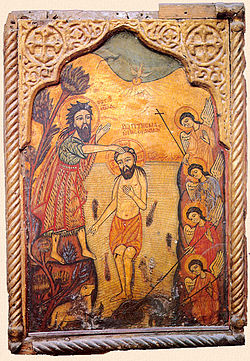
Baptism of Jesus Coptic icon

Baptism of Jesus
Coptic icon

Luke 3:22 – January 10, 2016

It’s a joyful day indeed when we celebrate a baptism in church.

We follow the command of our Lord and Savior Jesus Christ, showing to all an outward sign of an inward change. Here in this church, we often celebrate infant baptism, showing the sign of God’s grace to all who are present. The congregation has an important part, too. They promise to teach the little one the ways of God, and to help the family bring up the child in a manner pleasing to God. Truly, a joyful, grace-filled sign and sacrament!

Well, that’s today, here and now, a long time after the first century. That’s one common understanding we now have of baptism.

Our Gospel reading today features John the Baptist, baptizing people in the wilderness. John was a prophet of God. He was set apart for a special purpose, to give out a special message from God. Here John the Baptist preaches to the nation of Israel, before our Lord Jesus has even started His ministry.

This message ought to be familiar to most of us. We heard some of John’s prophetic message read as our Gospel lesson only a month ago. Doom and gloom! He identifies everyone in the crowd as part of the brood of vipers—as sinners! Exactly what John the Baptist has been saying to the people of Israel for some time.

Another way of looking at John’s message is: “You are dirty, inside and out! Come get clean, both symbolically and physically!” Through God’s grace, John offers the people the opportunity to be obedient and to clean up, to show God and to show others that they repent and turn from their sinful, wicked behavior, speech and thinking. Many people respond. It’s a mini-revival going on at the River Jordan. Amen! Hallelujah!

Let’s pull back for a moment, and consider the larger situation.

At that time, the nation of Israel was an occupied country. Under the boot of the Roman Empire, the people of Israel were oppressed and subjugated. Many people in Israel were looking for the promised Messiah, the Anointed One of God, who would be a Savior for Israel. We can see from our Gospel reading today. Verse 15: “The people were waiting expectantly and were all wondering in their hearts if John might possibly be the Messiah.”

John does not mince words. He does not pull punches. John identifies his listeners as a brood of vipers, as sinful and separated from God.

Just think about identity today. How do people identify themselves? In an excellent commentary on this Gospel passage, David Lose says many of the traditional elements of a person’s identity have been diminished. Think about it. The majority of people today change jobs and careers frequently. The majority of people live in multiple places and different residences rather than growing up and living for their whole lives in a single community. He comments, “fewer families remain intact – there is a craving to figure out just who we are.” [1]

John tells the people of Israel straight out, ““I baptize you with water. But one who is more powerful than I will come, the straps of whose sandals I am not worthy to untie. He will baptize you with the Holy Spirit and fire.” John the Baptist responds with a clear message: he offers the people baptism to remedy that flawed, sinful, separated identity. They can identify themselves with God, and be identified as God’s beloved children.

And then—and then—Jesus shows up. Jesus is about to begin His public ministry. But before that happens, He comes to the River Jordan to listen to His cousin John the Baptist. And, to get baptized.

Lo and behold, the companion Gospel accounts of Matthew and Mark tell us that John is surprised to see Jesus there. But Luke’s account makes Jesus’s appearance natural. The next right thing that happens. Verse 21 says, “When all the people were being baptized, Jesus was baptized too.” At first, John is the star actor, the one doing the main action of baptizing. Jesus is the next one baptized, along with many others. However, what happens next?

The spotlight shifts in the following sentence. Dr. Luke turns his focus on Jesus. “As [Jesus] was praying, heaven was opened 22 and the Holy Spirit descended on Him in bodily form like a dove.”

Can you see this on a movie screen? We open to a wide shot of the River Jordan. Large crowd of people on the river bank, and a number lined up in the water, waiting their turn. John the Baptist in a rough woven tunic with a leather belt around his waist. John is doing his thing—baptizing people who have repented of their sin. And—Jesus is one of them.

The camera pans in to a close-up shot on Jesus. Next in line. John slowly takes Jesus, baptizes Him. We are not sure whether John dunks Jesus in the water, or whether he pours water over Jesus’s head. (I prefer the idea and the image of pouring the water.) Regardless, everyone gets pretty wet. Next thing we all know, the heavens open wide.

Can you see it? The bright light from heaven? Perhaps sound effects, too? Heavenly music? Maybe even a low rumble of thunder? Dr. Luke paints a show-stopper of a scene. He tells us the Holy Spirit appears as a dove, descending on Jesus. The capper of the scene is the voice of God. Quoting from Luke’s account: “A voice came from heaven: ‘You are my Son, whom I love; with You I am well pleased.’”

Just in case anyone was not sure, God’s own voice tells us the identity of Jesus.

Jesus is God’s own beloved Son. Not only that, but God is well pleased with Him, too. Plus, the Holy Spirit as a dove is a visible and physical sign of the presence of God.

Here in this act of baptism, we find out about identity. As the commentator says, “The voice from heaven is addressed to Jesus in the first person: “You are my Son, the beloved; with you I am well pleased.” Baptism teaches us who we are – God’s beloved children – and confers upon us the promise of God’s unconditional regard.“ [2]

God not only proclaimed Jesus’s identity, on the banks of the Jordan River, God also proclaims our identity. We belong to God. It is not our doing, but God’s, instead.

Did you hear? Do you understand? No matter what happens, or how often we fall short, we cannot erase or eradicate God’s love. We love God because God first loved us. God has given us that sign, that seal of baptism, sealed by the Holy Spirit.

It does not matter whether we have been brought to baptism as a baby or a child, or have come as a young person or an adult. Perhaps there are people here who have not been baptized yet. God calls for all to be baptized. God calls for all of us to remember our baptism, as well.

God’s arms are open wide. God’s grace is abundant, for you and for me. God’s grace is poured out freely upon us in baptism. We are cleansed to do God’s gracious work in the world. Can you hear God’s voice talking to you? Telling others about you? “This is my beloved child. With you, child, I am well pleased.”

Alleluia, amen.

[1] Preaching a More Meaningful Baptism – David Lose, https://www.workingpreacher.org/craft.aspx?post=1624 .

[2] Ibid.

@chaplaineliza

Suggestion: visit me at my sometimes-blog: matterofprayer: A Year of Everyday Prayers. and my other blog,  A Year of Being Kind .  Thanks!

Unknown's avatar

One Who Brings Peace

“One Who Brings Peace”

Micah 5-5 He will be our peace

Micah 5:5 – December 20, 2015

Peace. Peace is the subject today. Today we light the Advent candle of peace. Here, inside the church, it seems like peace is a realize-able actuality. But—not on the outside. Not out in the cold, cruel world. Peace, peace, is the cry! Here in the 21st century, we have wars and the rumors of war. Fighting, skirmishes, various attacks of various kinds. Will anyone hear our cry for peace? Will anyone—anywhere—heed our cry?

In biblical times, there was always some tribe or country beating up on another tribe or country. Always somebody marching off to war. To enlarge territory, or to gain political advantage, or to right some wrong. So seldom did the nation of Israel have true peace! Much of this book of the prophet Micah deals with war, conflict and fighting. Except for right here.

Our Gospel reading from Luke tells of the pregnant Virgin Mary going to visit her older cousin Elizabeth, who prophecies that Mary has within her the baby Jesus, the Son of God. Usually, the Scripture readings are chosen with great care. Chosen with an eye to common themes. So, what is in common, here? The prophecy of a strong leader to come, from our Old Testament text, and the prophecy of the birth of the Messiah, from our Gospel reading.

Here we are at the fourth Sunday of Advent. We have had Advent for a long time. Since the last week of November. I can just hear the children saying, “When is Christmas finally going to get here?” Some schools have already gotten out for the winter holidays. I know some local churches are featuring a Christmas cantata today, or a Christmas pageant in worship.

Yet here we all are. The last Sunday of Advent. Isn’t Christmas here yet? Isn’t it time for angels and shepherds, Mary and Joseph and the Baby in a manger? Can’t we hurry things along?

As we look at the prophecy in Micah, we can see that the prophet is certainly not thinking about warm and fuzzy Christmas carols. Not about the lion lying down with the lamb, about God reaching down and bringing peace on earth, good will towards all people. Or, is he? What is Micah saying in our reading today?

Yes, a strong leader will rise up. Who do you think Micah’s contemporaries thought the prophet was talking about? I was fascinated to read in one commentary that most people would connect this strong leader to King David. But, wait! David had been dead for two hundred years, by the time that Micah wrote his prophecy. How could the Jewish people think “David” when they heard prophetic words like this?

Because—because of the prophecy of David’s prophet Nathan from 2 Samuel 7. A direct descendant of David would be king. God had promised King David that exact thing. So, who else could this strong leader be but a direct descendant of the great King David?

All well and good! Except, it gets more complicated, fast. Micah mentions “out of you [Bethlehem] will come one who will be ruler over Israel, whose origins are from of old, from ancient times.”

Now, I can understand a strong leader. A ruler, a mighty King. A descendant of King David. I can even understand the prophecy of a baby, from Luke, chapter one. The descendant of David needs to be born. Elizabeth prophecying and praising God that the mother of the Messiah to come was coming to see her. Okay, I’ve got that.

I am so indebted to John C. Holbert’s article on this Scripture reading. [1] I was aware of some of this material from the book of Micah, but by no means all. And never in so much depth!

Micah’s prophecy foretells a strong leader, yes. A descendant of David is presumed. (Micah doesn’t specifically say so.) Adding two and two and two together, from the prophecies of the Hebrew Scriptures, people have ascertained that this prophecy also refers to the Messiah. And then—Micah adds the part about the ruler “whose origins are from of old, from ancient times.” This part definitely needs more explanation.

These phrases are a challenge to translate from Hebrew. The best that anyone can figure is that there are several meanings for these words. “Origins” can also be translated “coming forth” of old! Dr. Holbert says that God put this word ‘olam, or “ancient times,” “into human minds in such a way that they may know a bit of what has happened in the past, and a tiny portion of what may come, but just enough to teach them that they in fact know precious little about either past or future in the end. There the word appears to mean something like a very long time or deep in the past and far into the future, not quite eternity but as much as any puny human mind may conceive.”

Talk about not being able to understand Scripture. These couple of phrases blow me away. I feel small when I read this. Really young, like a preschooler. I realize I do not know very much about God or about the Bible, at all. Period. God surely can flatten me, humble me with a phrase from the prophet Micah.

But, wait! There is more! Let’s unpack this reading, further.

Holbert continues: “Who then does Micah have in mind? This is no simple heir of David; here is someone primordial, someone from the most ancient of times yet also uniquely prepared to act decisively in the present.” In other words, Micah is talking about Someone more than human. Looking forward to the future, talking about Someone who not only is the promised Messiah to come, the promised descendant of David, but also looking back to the far distant past. To the beginning of time, even beyond the beginning.

Then, in Micah 5:3, the prophet brings up the image of a woman in labor. What is our Gospel reading from Luke for today? It’s about two pregnant women. Elizabeth prophecying about the Child Mary is carrying. The Child is the Lord. The Son of God. The next verse, Micah 5:4 speaks of the promised one who will be a shepherd. Just like King David! A powerful and godly shepherd who keeps the flock safely; “and they will live securely, for then his greatness will reach to the ends of the earth.” Again, this is Messiah language, and more!

Who is this Messiah, anyway? Descendant of David, check. Born in Bethlehem, which is David’s ancestral home. Check. But, Micah says from ancient of days? Luke calls Him the Son of God? The Lord God Almighty?

This great Shepherd will not only be concerned with the flock of Israel, but also the flock of the entire world. And—this is the most important part to me, right now. This strong leader, this Shepherd will be our peace.

This Messiah will not just be peaceful for Israel’s sake. No! Our Messiah, our Christ, from ancient of days, will act peacefully for the safety and well-being of the whole world!

Do you hear the Good News from the prophet Micah today? This Messiah was not going to act in the way that so many other Middle Eastern potentates did. Or, for that matter, like any other earthly ruler ever has. Instead, we are told in our Scripture passage today that He will feed His flock. The Messiah’s flock will have the opportunity of living secure, safe, and peacefully under Messiah’s mighty protection. I thank God that I am one of the worldwide flock.

God extends that opportunity to everyone, so that we all can have the security and care of the Messiah, the Good Shepherd, the Babe of Bethlehem, the ruling King. Praise God for God’s wonderful gift of protection and care.

[1] http://www.patheos.com/Progressive-Christian/Who-Is-This-Peaceful-One-John-C-Holbert-12-11-2015

(Many thanks and much appreciation to Dr. Holbert! Wonderful article on Micah.)

@chaplaineliza

Suggestion: visit me at my daily blog for 2015: matterofprayer: A Year of Everyday Prayers. and my other blog,  A Year of Being Kind .  Thanks!

Unknown's avatar

Generous with Our Faith

“Generous with Our Faith” – March 29, 2015

Jesus raising Lazarus John 11

John 11:25-27

Some people strive to be punctual. Even, early. My grandfather was like that. If he wasn’t fifteen minutes early for an appointment, he would consider himself late! Then, some people have a more fluid idea of time. They see a more relaxed framework of the spectrum of late- versus-early. These come down at different points on this spectrum. And then, we have Jesus.

Our Gospel reading is quite long today, from the 11th chapter of the Gospel of John. I wanted to read this whole passage in the context of this sermon. At the beginning of the reading, we have Jesus and His disciples, some distance from the town of Bethany, where His friends Mary, Martha and Lazarus lived. Let me set the scene. I will be using the awesome, modern version of the Gospel, translated by Eugene Peterson, called The Message.

1-3 A man was sick, Lazarus of Bethany, the town of Mary and her sister Martha. This was the same Mary who massaged the Lord’s feet with aromatic oils and then wiped them with her hair. It was her brother Lazarus who was sick. So the sisters sent word to Jesus, “Master, the one you love so very much is sick.”

When Jesus got the message, he said, “This sickness is not fatal. It will become an occasion to show God’s glory by glorifying God’s Son.”

5-7 Jesus loved Martha and her sister and Lazarus, but oddly, when he heard that Lazarus was sick, he stayed on where he was for two more days.


Here’s the situation in Bethany. We receive quite a lot of information here! Jesus was very close to all three siblings, to Lazarus, Mary and Martha. Lazarus became very sick! So sick, that his sisters sent an emergency message, a call for help, to Jesus. The request to Jesus has been made. A sincere request, made by the loved ones of Lazarus. I suspect we all can relate to this earnest request. We’ve made similar prayers from time to time. Any number of us have sent SOS messages to Jesus, too!

Jesus made mention of showing God’s glory through Lazarus’ sickness. Obviously, He made this comment to His disciples, and I suspect to whomever else was there, listening to Him, at the time. And, as was often the case with Jesus and some of the cryptic things He said, people just did not understand what He meant, at the time. Back to Jesus:

After the two days, Jesus said to his disciples, “Let’s go back to Judea.” They said, “Rabbi, you can’t do that. The Jews are out to kill you, and you’re going back?” 11 Jesus replied, “Our friend Lazarus has fallen asleep. I’m going to wake him up.”

12-13 The disciples said, “Master, if he’s gone to sleep, he’ll get a good rest and wake up feeling fine.” Jesus was talking about death, while his disciples thought he was talking about taking a nap.

14-15 Then Jesus became explicit: “Lazarus died. And I am glad for your sakes that I wasn’t there. You’re about to be given new grounds for believing. Now let’s go to him.”

Jesus knows. I mean, Jesus really knows the situation some miles away. His disciples are confused, and at first think Lazarus is just asleep. But, no! Is this a major complication, or what? Sure, there are miracles all over the Old and New Testaments, but miracles of healing, or of feeding large groups of people. Not of reversing death itself! And, especially, after several days!

On top of the disciples’ confusion at the words and behavior of Jesus, Jesus wants to go back to Bethany, which is a town just down the road from Jerusalem. “Jesus, You can’t go there! The Jewish leaders are going to arrest You. Probably try to kill You, too!” Jesus goes anyway.

17-20 When Jesus finally got there, he found Lazarus already four days dead. Bethany was near Jerusalem, only a couple of miles away, and many of the Jews were visiting Martha and Mary, sympathizing with them over their brother. Martha heard Jesus was coming and went out to meet him. Mary remained in the house.

We see Mary and Martha, in the house of mourning. Two very different women, mourning in two very different ways. Many of their friends and acquaintances are with them, too. Sympathizing and mourning with them, as was the custom of the time. Martha goes to meet Jesus while her sister stays put.

21-22 Martha said, “Master, if you’d been here, my brother wouldn’t have died. Even now, I know that whatever you ask God he will give you.”

23 Jesus said, “Your brother will be raised up.”

24 Martha replied, “I know that he will be raised up in the resurrection at the end of time.”

25-26 “You don’t have to wait for the End. I am, right now, Resurrection and Life. The one who believes in me, even though he or she dies, will live. And everyone who lives believing in me does not ultimately die at all. Do you believe this?”

27 “Yes, Master. All along I have believed that you are the Messiah, the Son of God who comes into the world.”

What a statement! What a testimony! Even though Martha is distraught at the death of her dear brother, she still has deep faith. As we’ve just heard, she states that her brother will be raised in the resurrection at the end of time. What does Jesus say? He does her one better.

I am the Resurrection and the Life.” Did you hear? Did everyone hear these words of faith? Words of hope? Words of new life? “The one who believes in me, even though he or she dies, will live.” And then Martha responds again, with great faith. “All along I have believed that you are the Messiah, the Son of God.”

I could preach a solid sermon on this statement of Martha’s, alone. This ringing declaration, these great words of a rock-solid faith were made at such a devastating time for Martha. On top of everything, in the middle of mourning her brother, we can see that this is not just an intellectual admission or assent for Martha, but heartfelt belief. But wait, there’s more! Much more!

28 After saying this, Martha went to her sister Mary and whispered in her ear, “The Teacher is here and is asking for you.”

29-32 The moment Mary heard that, she jumped up and ran out to him. Jesus had not yet entered the town but was still at the place where Martha had met him. When her sympathizing Jewish friends saw Mary run off, they followed her, thinking she was on her way to the tomb to weep there. Mary came to where Jesus was waiting and fell at his feet, saying, “Master, if only you had been here, my brother would not have died.”

33-34 When Jesus saw her sobbing and the Jews with her sobbing, a deep anger welled up within him. He said, “Where did you put him?”

34-35 “Master, come and see,” they said. Now Jesus wept. 36 The Jews said, “Look how deeply he loved him.”

37 Others among them said, “Well, if he loved him so much, why didn’t he do something to keep him from dying? After all, he opened the eyes of a blind man.”

We can tell, from these few scenes in the Gospel, that Martha, Mary and Lazarus had a close, intimate relationship. Mary even fell at Jesus’ feet, sobbing. Saying, “if only! If only You had been here!” The words of deep, gut-wrenching emotion are here, too. “Jesus wept.” We know that Jesus felt with Mary and Martha! We can see from this account that Jesus felt so badly and grieved with them, even though He knew what He was intending to do!

How often do we get into a situation where we have the opportunity to come alongside of someone who is devastated, a friend, a relative. Grieve alongside of them, and walk with them down that sorrowful road of mourning, loss, anger, anxiety. Grieve over the deep pain and loss in the reality of death. That’s why I think Jesus cried with Mary. And with Martha, and with the rest of the mourning people. Back to Jesus.

38-39 Then Jesus, the anger again welling up within him, arrived at the tomb. It was a simple cave in the hillside with a slab of stone laid against it. Jesus said, “Remove the stone.”

The sister of the dead man, Martha, said, “Master, by this time there’s a stench. He’s been dead four days!”

40 Jesus looked her in the eye. “Didn’t I tell you that if you believed, you would see the glory of God?” 41-42 Then, to the others, “Go ahead, take away the stone.”

Practical Martha. “Master, by this time there’s a stench. He’s been dead four days.” Wouldn’t that be something you might think of, too? I probably would have thought of it, too.

They removed the stone. Jesus raised his eyes to heaven and prayed, “Father, I’m grateful that you have listened to me. I know you always do listen, but on account of this crowd standing here I’ve spoken aloud so that they might believe that you sent me.”

43-44 Then he shouted, “Lazarus, come out!” And he came out, a cadaver, wrapped from head to toe, and with a kerchief over his face. Jesus told them, “Unwrap him and let him loose.”

45-48 That was a turnaround for many of the Jews who were with Mary. They saw what Jesus did, and believed in him.


Because of this display of resurrection power, because Lazarus was brought back to life, we see that many believed that Jesus was, indeed, the Messiah! The Son of God!

Let me ask: what do you believe? Do you think Jesus was just a great man? Did He preach great sermons, and live an exemplary life? Or, do you think Jesus was a prophet of God? A miracle-worker, like the prophets of the Old Testament, or like the Apostles? Or, the third option. Or—do you think Jesus was, indeed, the Messiah? The Son of God? As Jesus Himself said, the Resurrection and the Life?

Hear the words of Jesus! “The one who believes in Me, even though he or she dies, will live. And everyone who lives believing in Me does not ultimately die at all. Do you believe this?” Just as Jesus asked Martha so long ago, He is asking us, today, too. Can we respond with Martha, “Yes, Master. Yes, Lord. I believe.” With great faith. “All along I have believed that you are the Messiah, the Son of God.” Jesus is asking. Do we, really, believe?

Jesus was generous, giving life abundantly to Lazarus. Can we do any less in our lives? We are encouraged to be generous with our faith! To believe Jesus. To take Him at His word, and to trust in Him. Like Martha. Like Mary. We find out that we can believe Him, we can trust Jesus when times are hard, difficult, through storms and suffering. We are also happy to trust Jesus when times are happy, when everything is going our way. Whatever is happening in your life today, can you believe Jesus? Can you be generous? Believe the good news of the Gospel. Have faith! Believe Jesus!


Thanks to Eugene Peterson for his wonderful translation The Message. I read most of John chapter 11, around which I have interwoven this message. “Scripture taken from The Message. Copyright © 1993, 1994, 1995, 1996, 2000, 2001, 2002. Used by permission of NavPress Publishing Group.”

@chaplaineliza

Thanks to the kind friends at http://www.40acts.org.uk – I am using their sermon suggestions for Lent 2015. #40acts Do Lent generously!

(Suggestion: visit me at my daily blog for 2015: matterofprayer: A Year of Everyday Prayers. Thanks!)