Unknown's avatar

Who Then Can Be Saved?

“Who Then Can Be Saved?”

Mark 10:17-27 (10:26) – October 13, 2024

If we turn on the television, read a book, or listen to a podcast or talk radio, sometimes we might hear experts giving advice. These knowledgeable experts are often from well-known places. This week I am thinking about advice on how to live the “right” way. That’s sometimes thought to be a fruitful life, or a healthy life, or a spiritual life. Wouldn’t you be interested if you heard a radio program with a noted author or well-known expert in just this subject?

            That’s the case with Rabbi Jesus, today. In today’s scripture lesson, we get just a hint of what our Lord Jesus had to deal with much of the time. Can you see this situation? I love St. Ignatius and his prayer suggestion to put ourselves into the narrative. Let us imagine ourselves being there, right with our Lord Jesus the itinerant Rabbi, and His disciples.

The Rabbi Jesus was about to travel somewhere, and a number of His disciples are getting ready to accompany Him. It is significant to read what our commentator David Lose has to say about this journey. “In Mark, this is not merely “a journey” in general (per the NRSV), but rather represents the road to Jerusalem and the cross.” [1] And, repeatedly, our Gospel writer Mark tells us that Jesus has His face set to go to Jerusalem.

When, what happens? “17 As Jesus went out into the street, a man came running up, greeted him with great reverence, and asked, “Good Teacher, what must I do to get eternal life?” That is a pretty big question, isn’t it? Many people throughout the ages have wondered exactly that! The Rabbi Jesus was a widely acknowledged wise person, an expert in the interpretation of the Hebrew Scriptures, the Law of Moses and in lots of things associated with religious and spiritual life.

After all, you don’t get an expert in religion and spiritual life coming to your town just any old day.

The Rabbi Jesus is matter-of-fact, and responds (as many Rabbis would), “You know the commandments: Don’t murder, don’t commit adultery, don’t steal, don’t lie, don’t cheat, honor your father and mother.”

This is a shortened list of some of the Ten Commandments from the book of Exodus. These commands from God are revered as being the shorthand version of God’s rules for living. Now, while we have our imagining caps on, imagine we are watching this whole scene play out. Our teacher, the Rabbi Jesus, is involved in conversation with this earnest young man.

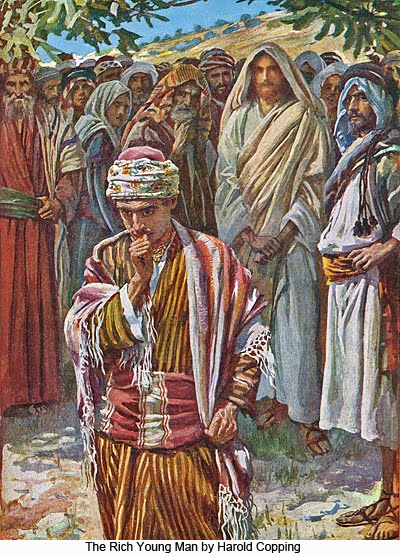
Except, something is different about this young man. He’s well-dressed, and looks to be really rich. Plus, he answers the Rabbi Jesus in all seriousness! “He said, “Teacher, I have—from my youth—kept them all!” 21 Jesus looked him hard in the eye—and loved him!”

 What do we see here? “Jesus looks at him with love (verse 21). He does not treat him as insincere or mock him as self-righteous, but rather loves him. Every interpretation we may offer must therefore take seriously Jesus’ absolute regard and unconditional love for this man.” [2]

I am still looking at this whole scene through my imagination, too. I am right there, watching everything go on. Watching the gathered crowd in the dusty afternoon in one of the towns of Palestine. And, we can see the love shining out of our Rabbi’s eyes!

But, let us get back to our rich young man who asked Rabbi Jesus this serious question. “’Jesus said, “There’s one thing left: Go sell whatever you own and give it to the poor. All your wealth will then be heavenly wealth. And come follow me.’ 22 The man’s face clouded over. This was the last thing he expected to hear, and he walked off with a heavy heart. He was holding on tight to a lot of things, and not about to let go.”

Dr. David Lose said about this point in the reading, “what Jesus really meant was that we needed to unburden ourselves of whatever might be keeping us from relying on God.” [3] Yes, the rich man had a great deal of difficulty hearing these words of Jesus.

            Let’s face it: these are difficult words for many people to hear. We love our stuff, don’t we? Or, if not most of our stuff, at least some of our stuff. I would really have difficulty giving up my computer and my car. I think I am not the only one in this room today for whom that is true. Others might have difficulty unburdening themselves of whatever might be keeping each one from God.

“Jesus knew that the only thing that could overcome the gravity of the riches of this life is a force stronger, a greater pull. Love redeems; love rescues; love wins. He knew that. He knows that. Jesus loved him even though it didn’t seem to work. The young man walked away, grieving. The burden on his heart increased, instead of lightened. He had the antidote; he had the prescription. But the medicine was too bitter for him to swallow.” [4]

Let me ask, as we still consider us being there, right next to Jesus. What would it be like to have Jesus look upon each of us with that same love? What is more, Jesus asks each of us the same question about our stuff, about following Jesus. And, what is our response to Jesus?

All of our stuff gets in the way between us and God’s kingdom. All of this clutter and distraction in our lives keeps us at a distance from God. We know what Jesus has asked us to do, just like this young man did. When you don’t do what God has asked you to do, how do you picture God responding to you? Do you imagine God looks at you—at us—with loving compassion like Jesus did in this story? What’s more, we all will see how all of our “small steps” in loving and giving combine to create a beautiful impact of compassion in God’s world.

            And, maybe, just maybe “God’s gift of salvation can actually free us to do something: to love each other, to care for God’s people and world, to share the good news…right here, right now, wherever it may be that God has placed us.” [5]  

            God willing, we can all show love, giving, and compassion, every day. Alleluia, amen.

@chaplaineliza

(Suggestion: visit me at my other blogs: matterofprayer: A Year of Everyday Prayers. #PursuePEACE – and  A Year of Being Kind . Thanks!


[1] https://www.workingpreacher.org/commentaries/revised-common-lectionary/ordinary-28-2/commentary-on-mark-1017-31-3

[2] Ibid.

[3] http://www.davidlose.net/2015/10/pentecost-20-b-curing-our-heartsickness/

[4] https://www.umcdiscipleship.org/worship-planning/walking-with-jesus/twenty-first-sunday-after-pentecost-year-b-lectionary-planning-notes/twenty-first-sunday-after-pentecost-year-b-preaching-notes

[5] http://www.davidlose.net/2015/10/pentecost-20-b-curing-our-heartsickness/
Unknown's avatar

Jesus Loved Him

“Jesus Loved Him”

Jesus and The-Rich-Young-Man, Harold Copping

Mark 10:17-27 (10:21,24) – October 14, 2018

One of my favorite movie series made recently is “The Lord of the Rings.” Huge, sweeping fantasy epic, made for the wide-screen. I realize that fantasy is not everyone’s favorite kind of movie (or book), but I absolutely loved it. The ultimate battle of Good versus Evil, with the clash of armies fighting for supremacy in the world called Middle Earth.

One supporting character in this fantasy is an ancient, twisted creature named Gollum, who had the Ring in his keeping for many years, but lost it. The Ring was magic, you see, and the Ring exerted a magical pull or craving on anyone who came near to it. Gollum spent years and years trying to get close to the Ring, and perhaps possibly steal it back. Gollum not only craved the Ring, he thought about it almost all the time, and talked to it. Called it “my Precious.”

In our Gospel reading from Mark today, we have something similar to the situation with Gollum and the Ring. But, I’ll get to that in a few minutes.

What is the centerpiece in this picture from the Gospel of Mark? A rich young man? Is this about a wealthy young person, who had everything in life he could possibly want or desire? Some preachers make use of this bible reading to criticize wealthy people for being stingy. Even more preachers use this as an example of good stewardship, and how Christians are to be generous with the money they have. This sermon is not going to focus on either of those things. Let’s take a closer look at what is actually happening here.

A rich young man comes to Jesus, and asks how he might go to heaven—that is, inherit eternal life. This is not an odd question, for a rabbi. Not out of left field, at all. Rabbis got this and similar questions tossed to them on a regular basis.

Jesus took the young man directly back to his religious training in the synagogue. Jesus mentioned several of the Ten Commandments—all commandments that refer to a person’s relationship with others.19 You know the commandments: ‘You shall not murder, you shall not commit adultery, you shall not steal, you shall not give false testimony, you shall not defraud, honor your father and mother.’”

The young man seems to be very earnest and sincere.20 ‘Teacher,’ he declared, ’all these I have kept since I was a boy.’”

“We have this rich man (Matthew describes him also as young) coming to Jesus, actually, kneeling in front of him, asking “What must I do to inherit eternal life?” How often do you get rich people asking you that kind of question? Not much, I suspect. But here’s a live one.” [1]

All of these commands—all of these rules and prescriptions and social morés for behavior this young man has followed since he was a boy. Reading between the lines, I suspect this young man felt empty on the inside. He felt there was something missing in his relationship with God. Thus, prompting the question “What must I do to inherit eternal life?”

The response of Jesus? 21 “One thing you lack,” he said. “Go, sell everything you have and give to the poor, and you will have treasure in heaven. Then come, follow me.” 22 At this the man’s face fell. He went away sad, because he had great wealth.”

It is at this point some preachers say, “Aha!” This young man had too much wealth! Shaking their fingers at their congregations, some advise their congregations to divest themselves of their wealth, and a few preachers even mention how blessed it is to give it all away to others.

Well, yes. At first glance, we all can see that is kind of what Jesus is saying. But as with many things Jesus says in the Gospels, we can read deeper than the surface communication, and get so much more.

It may be that Jesus saw that this man was trapped in his riches, that it had become an idol that needed to be cast away. On top of that, as many have pointed out, what is the man supposed to do after he impoverishes himself?” [2]

Yes, riches and wealth can be a huge obstacle in anyone’s relationship with God. A rich person’s money might be on their mind too much. How are they investing the money? What kind of money manager do they have? How much are they paying in taxes? What if the stock market takes a big hit? And what about making more money? What then?

All of these persistent questions and random thoughts—and many more besides—can preoccupy someone’s mind. They can get in the way when you or I are thinking about having a close relationship with God. Why? Because, our skewed relationship with money or wealth is more important than a relationship with God.

To expand on what Dr. Vander Zee just said was that the relationship with riches had become an idol. It was getting in between the rich young man and God. Isn’t that what idols do? But, let’s go one step further. We are talking idols, what might be all-important to many people. Do you know people who have a real focus on their house? I mean, take care of their home impeccably, even are constantly boasting about it? Is their house an idol to them, maybe?

What about people who put their job first? Work extra-long hours, neglect their spouse and family, but are always available for work-related activities? We can say their job is their idol, even what they would sacrifice much of their life for.

Remember Gollum? I mentioned him a few minutes ago. A sad, twisted creature, so set on the magic Ring. He even called it “my Precious!” Is there anything extra-special in your life, so special you might be tempted to call it “my Precious?” Anything that consumes your mind and heart?

I believe that is something Jesus was so concerned about, with this rich young man. “We all have something ‘precious’ to which we cling. It’s the thing that separates us from God, from our full potential as faithful disciples. In order to see and experience the truth found in Jesus that leads to real life, the rich man has, to turn from his “precious” thing (money/possessions).” [3]

It does not matter what we lift up, what consumes almost every waking moment. Possessions, or physical fitness, or money, family, friends, or education. Any aspect of life can become too-important. Anything can become an idol, and get in between us and God.

What strikes me so much in this reading? Jesus loved this young man. He loved him. So earnest, such questions, really wanting to find out more about how to have a close, sincere relationship with God. Yet, the young man went away sorrowful, because he was not willing to set aside that idol or riches, of comfort. He was too comfortable, too complacent. Or, perhaps it was because the young man was too set in his ways, and that amount of change may be too disruptive. For whatever reason,

Jesus is calling. Jesus beckons to you, to me, to all of us. Leave behind whatever idol, whatever separates you from God. Embrace a loving, abundant relationship with Jesus, today. Jesus loved this young man, despite his faults and flaws. He loves each of us in exactly the same way, without strings, without conditions. Praise God! His arms are open to welcome each of us.

Alleluia, amen.

[1] http://cep.calvinseminary.edu/sermon-starters/proper-23b/?type=the_lectionary_gospel

The Center for Excellence in Preaching, resources from Calvin Theological Seminary: Comments & Observations, Textual Points, illustration ideas, 2015. Author: Leonard Vander Zee

[2] Ibid.

[3] http://www.stewardshipoflife.org/2015/10/who-can-be-saved/

“Who Can Be Saved?” Sharron R. Blezard, Stewardship of Life, 2015.

@chaplaineliza

(Suggestion: visit me at my regular blog for 2018: matterofprayer: A Year of Everyday Prayers. #PursuePEACE – and my other blog,  A Year of Being Kind . Thanks!