Unknown's avatar

Flight into Egypt

“Flight into Egypt”

Matthew 2:13-23– December 28, 2025

            From time to time, I enjoy listening to radio serials. I suspect you all know the kind I’m thinking of. Old time radio shows like “Those Were the Days” broadcasts feature classic radio shows from the 1930’s, 40’s and 50’s. Periodically, I tune in to the show, and sometimes get caught up in an exciting, suspenseful adventure serial. Each installment usually ends with a cliffhanger, and the next installment of the serial begins: “When last we left our story . . . “

            Here, in our lectionary reading from the Gospel of Matthew, we have just such an installment. We come into the story right smack dab in the middle of things, with loose ends left hanging all over the place. It is not a pleasant story. The topic of this sermon is not pleasant, either—I’m telling you right now, up front.

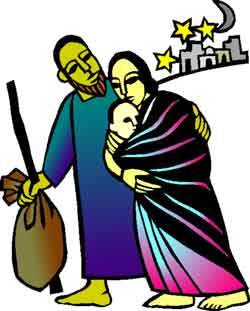
            We are breaking into the Gospel account at one of the really gripping, gut-wrenching parts, but I’d like to zoom in on this particular scene. We look at Joseph, in Bethlehem, with his fiancée Mary and newborn baby Jesus. Joseph gets an emergency communique from an angel, in a dream. The angel says, “Get up, take the child and his mother and escape to Egypt. Stay there until I tell you, for Herod is going to search for the child to kill him.”

What would you do if you had to flee from danger, immediately? Be on the run at very short notice? Can you imagine you and your family traveling on an emergency basis, with the added complication of transporting a very young child?

            It may not be physical harm threatened against you or your family. However, there are many other traumatic or life-shattering things that can up-end our lives. “When you are plunged underwater by news you can scarcely comprehend, let alone respond to, how do you take your next breath? When all your visions of a joyous tomorrow are spoken out of existence by whispered words of tragedy or denial, how do you put one foot in front of another on your way into the void?” [1]

            I cannot even imagine what went through Joseph’s mind at that moment. From all accounts of King Herod and his life and reign, he was a tyrant. Looking at writings from contemporary authors of that period, Herod was cruel and bloodthirsty. He was also two-faced, as we can see from a few verses before our lectionary reading today, from his response to the Magi. He sent the Magi to Bethlehem, and requested that they come back after they find this “King of the Jews,” because Herod wished to “worship” this King as well. I have a pretty good idea of exactly what Herod wished to do to the baby Jesus from what follows.

            The Holy Family fled Bethlehem in a hurry. We know that. They fled across a distance, across boundaries, racial lines and cultural spaces. They encountered ethnic differences and language barriers, too, as they made their flight into Egypt.           

            Father James Martin wrote in a recent social media post, “It’s not surprising that in 1952, Pope Pius XII wrote: “The émigré Holy Family of Nazareth, fleeing into Egypt, is the archetype of every refugee family. Jesus, Mary and Joseph, living in exile in Egypt to escape the fury of an evil king, are, for all times and all places, the models and protectors of every migrant, alien and refugee of whatever kind who, whether compelled by fear of persecution or by want, is forced to leave his native land, his beloved parents and relatives, his close friends, to seek a foreign soil.” [2]

            I live in a suburb of Chicago, with the months-long Operation Midway Blitz occurring right here in Chicago and surrounding area. I have been praying with and for the clergy who go regularly to the federal facility in Broadview, on what has been named Faithful Fridays. I mourn with so many because of the injustice. Yes, I take the words of Jesus in Matthew 25 quite seriously. I regularly consider: what would Jesus do?

            Let us go back to the Holy Family fleeing to Egypt, in fear of King Herod and his military goons. But – I want to check in with you all as I am preaching. I know very well that these issues I am talking about are difficult for many people, traumatic for some, and even so upsetting that certain dear ones cannot even sit here and listen any longer. And – that is absolutely okay, to excuse yourself or leave the room or the sanctuary. Please, take this as an invitation for us all to tend to each other’s well-being.

            As we consider the Holy Family on the run, I would like to remind us all of countless families on the move for all kinds of reasons. Of course, some in danger for their lives! And, some on the move because of catastrophic natural disasters, or wars, or widespread extreme poverty. Sometimes, fleeing your safe, familiar town and place where you grew up is the only painful option left after heart breaking and gut-wrenching trials and traumas.

            I would like to highlight something important from Fr. Martin: “the Greek word that Matthew’s Gospel uses is a key: it’s ‘pheuge,’ to flee, one of the ancient roots of the word “refugee.” When we think of refugees, migrants and internally displaced peoples today, we are invited to remember the Holy Family, the ‘archetype,’ as Pope Pius XII said, of ‘every refugee family.’ And we should treat them accordingly.” [3]

            As we reflect upon the situation of the Holy Family as refugees, in the first century, we need to seriously consider the heartbreaking situations of so many refugees today. We are confronted with the serious question: what does God ask of us? If we look to the Bible, to both the clear commands from Micah 6:8 and from Matthew 25, consider these ringing words of Rev. Sharon Blezzard, Lutheran pastor, It does not matter whether we are considering refugees, strangers, aliens, migrants or immigrants. All are human beings, all created by God.

“We can be God’s presence to others in the midst of their suffering, and we can work to alleviate suffering, injustice, and pain in the world. Encourage [all of us] to find their voice and place of power to make a difference through small steps grounded in faithful community and fervent prayer.” [4]

            May it be so! Alleluia, amen.

@chaplaineliza

(Suggestion: visit me at my other blogs: matterofprayer: A Year of Everyday Prayers. #PursuePEACE – and  A Year of Being Kind . Thanks!


[1] https://www.umcdiscipleship.org/worship-planning/toda-la-tierra-espera/first-sunday-after-christmas-day-year-a-lectionary-planning-notes/first-sunday-after-christmas-day-year-a-preaching-notes

[2] https://x.com/JamesMartinSJ/status/2005287734017950134

[3] https://x.com/JamesMartinSJ/status/2005287734017950134

[4] https://www.stewardshipoflife.org/2013/12/refugees-all/

Unknown's avatar

Compassion with Our Welcome

“Compassion with Our Welcome”

Deut 10-19 words

Deuteronomy 10:18-19 – August 20, 2017

The world today is a divided place, even here in the United States. There are so any divisions in society happening recently. Arguments, inflamed rhetoric, serious disagreements—and this is just between family members and acquaintances. Then, to escalate matters even further, many people of sincere beliefs and good conscience are finding themselves on opposite sides of serious matters, like immigration, the movement of people groups, and the safe passage of refugees and migrants.

What are we to make of such things?  More importantly, what does the Lord tell us in the Bible that we are to do about immigrants, refugees and migrants? More on this important topic, a little later in the sermon.

I also want to tell you all about the Family Peace Fest yesterday outside of the Civic Center. Frankly, I was nervous and anxious about this event. Or, more specifically, about the potential weather on the day of the Family Peace Fest.

However, God took care of all of my fears and anxiety. Yesterday was a gorgeous day, the weather couldn’t have been better, and this turned out to be a wonderful event at the Civic Center at Harrer Park on Dempster! We not only raised up peace, hope and harmony in Morton Grove and the surrounding neighborhoods, but we showed everyone who attended that our multi-ethnic, multi-cultural community could gather together, laugh, learn, and enjoy each other’s company. We also showed the Chicago area and the world that this diverse community lifts up peace as one of our most prized values.

We continue with our summer sermon series on compassion. This week, we are considering a reading from Deuteronomy, the fifth book of the Hebrew scriptures. Here we are looking closely at some words of Moses to the large number of Jewish people, at the end of forty years of wandering in the Sinai desert and wilderness.

Moses also said a great many things that make a great deal of sense, especially from our Hebrew scripture reading today. From Deuteronomy 10: “Hey, people, what is it God wants from you? Just this: your reverence, your faithfulness, your love, your dedication, and for you to obey the commandments. They’re for your own good.”

Moses gave the Jewish tribes a whole lot of instructions, rules, and commands. Let’s take a close look at his commands for this people. They had strict duties and responsibilities to God and to other people. What was it Moses said again? Just this: God wants our reverence, our faithfulness, our love, our dedication, and for us to obey the commandments.

Right here is a summary statement of all of the laws, rules and commands Moses gave in Deuteronomy, the second giving of the Law. We’ve talked a few months ago about summary statements Jesus gave in the Gospels for what God wants from us, above all. Well, here is a brief summary from Moses about the exact same thing. What God wants, above all.

Going on, in our Scripture: “All the sky and all the stars belong to God, the earth and everything in it, and listen: God chose you—your people, your ancestors and your children—you! Do not cut yourself off from God; soften your heart. God is above all, but concerned for those who have nothing, caring for those who are stranded and alone, providing for them.”

What is this? Moses is now departing from a simple summary statement of what God wants from us into specific waters: Moses says God is concerned for “those who have nothing, caring for those who are stranded and alone, providing for them.”

Can you imagine some of the situations that may cause people to leave their homeland and go to a new place? We can just imagine some of the positive things. Economic opportunities, or better living conditions. Then, there are negative situations. Wars and conflict, perhaps famine or drought, earthquakes, fires, and other catastrophic events. These situations might come out of nowhere and knock people off their feet and destroy their homes.

Sometimes little is left except to migrate, to become refugees or immigrants, sometimes traveling a long, long way.

I saw a meme on the computer a few days ago. It said: “Your car is German, your vodka is Russian, your pizza is Italian. Your kebab is Turkish, your democracy is Greek, your coffee is Brazilian. Your tea is Tamil, your shirt is Indian, your oil is from Saudi Arabia. Your electronics are Chinese, your numbers are Arabic, your letters are Latin. And you complain that your neighbor is an immigrant?” [1]

As many memes do, this one uses ironic statements to get the point across. My blogging friend (and Registered Nurse) Marilyn Gardiner wrote a post just a few days ago about this very thing. Let’s hear what she has to say about this meme in her own words.

“While the meme is about things, I began to think about all the people in my life who are immigrants. As I made the list, I started to laugh. It’s unlikely I could function without them.

My doctor is from Jamaica, my surgeon is from Greece, my hairdresser is from Albania.

“I occasionally get my nails done by a woman from Vietnam; I buy fruit from a man from Albania. The advisory board members on a project that I am responsible for at work are from Syria, Iran, Algeria, Pakistan, Ethiopia, Iraq, and the Azores. A consultant who also works with the project is from Somalia. “My colleagues are from Portugal, the Azores, Brazil, Haiti, and Malawi – and that’s only a few of them.

“Daily I say hello to hotel employees from Guatemala, Haiti, and Egypt. The restaurant next to my work that sells excellent falafel and shwarma is owned by Iraqis. My friends at church are from Bulgaria, Greece, Romania, Ukraine, Russia, Kazakhstan, and Lebanon. Other regular friends in my life are from Pakistan, Israel, and Iran.

“What’s more, my maternal grandfather who died many years ago is from Poland….

“Every one of these people contribute positively to their communities and to the workforce, a fact that validates what studies have shown – that immigration has a positive effect on both economic growth and productivity.” [2]

Marilyn was a missionary kid, now living in Boston. She grew up in Pakistan, going to boarding school for years in the mountains away from her parents. So, she knows well the feelings of displacement, of not being home (wherever “home” is).

Turning back to our Scripture for the morning: “God is above all, but concerned for those who have nothing, caring for those who are stranded and alone, providing for them. You, too, remember when you were immigrants, strangers in Egypt—let that memory stir compassion in you for the strangers among you.”

All of us (even Native Americans, way far back) come from somewhere else. Even if you or I were born locally, our parents, grandparents, or ancestors further back hailed from somewhere else. At some point, we or our parents or our ancestors were alone, lonely, stranded, displaced, and missing “home,” wherever their “home” was.

Here in Deuteronomy, God gives a direct command: love the immigrant, the stranger, the migrant, the refugee. Have compassion for them. Love them. Care for them. (We were once immigrants, too.) Can it be any more direct?

Let us finish this reading: “Worship only God; hang on tightly to God; praise God; know that everything wonderful you have seen, God has done.”

What wonderful words from our God. Everything wonderful that we see every day? God is the author of it. God deserves our worship and praise, every day. We are urged here to hang on tightly to God!

God hangs on tightly to all people God has created. What is more, we know the Lord cares deeply for people who are the least powerful—especially women, children, and immigrants, as our Bible reading says. Can you imagine some reasons God shows extra care for them? Who are some immigrants and refugees you know of today? People in your life, or people you’ve heard of? What are some ways we can show compassion to immigrants in our lives and our community? What comes to your mind?

We showed love, caring and compassion for all people in our community yesterday, raising up peace at Harrer Park outside of the Civic Center, at the Family Peace Fest.

How can we show compassion? Be creative! Take an action step. One genuine smile, one kind word, one loving action. These actions, taken together, can change the world, one smile at a time.

Our friendship and compassion to immigrants, strangers, refugees and migrants is such a gift. Best of all? We will be doing what God commands. Hear what God is saying to the church.

[1] https://communicatingacrossboundariesblog.com/2017/08/07/who-are-the-immigrants-in-your-life/

[2] https://communicatingacrossboundariesblog.com/2017/08/07/who-are-the-immigrants-in-your-life/

(A heartfelt thank you to Marilyn Gardiner and her wonderful blog “Communicating Across the Boundaries of Faith & Culture.” Thanks for your permission to make an extended quote from your blog in this week’s sermon.

Another heartfelt thank you to An Illustrated Compassion: Learning to Love Like God. Many of these sermon ideas and thoughts came directly from this series.  I appreciate this intergenerational curriculum, which is the basis for my summer sermon series on compassion. This curriculum comes from Illustrated Children’s Ministry. Thanks so much for such great ideas!)

@chaplaineliza

(Suggestion: visit me at my regular blog for 2017: matterofprayer: A Year of Everyday Prayers. #PursuePEACE – and my other blog,  A Year of Being Kind . Thanks!)