Unknown's avatar

Loving Neighbors in the Strangest Places

“Loving Neighbors in the Strangest Places”
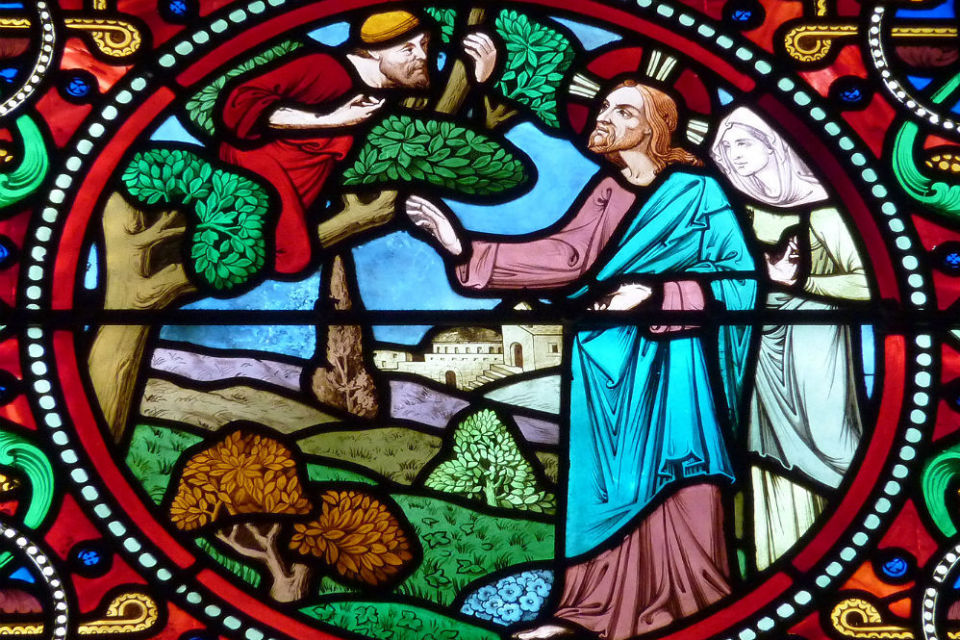
Luke 19:1-10 (19:5) – July 13, 2025

I have rubbed elbows with all kinds of people! I grew up in Chicago in a half-and-half, working-class and middle-class neighborhood. I lived in (and worshiped in) two racially mixed areas of Chicago for some years. I’ve had a number of jobs before I went to seminary at 40 years old, in diverse industries, including the ramp, a huge warehouse, and an order fulfillment center. So, when I hear the Rabbi Jesus getting some guff from the crowd for hanging out with the riff-raff and “sinners,” that surely gets my attention!   

I think today’s Scripture reading is particularly fascinating since it shows someone who was definitely not well liked in his neighborhood. In fact, no one wanted to call him “friend” or neighbor. Zaccheus was a chief tax-collector for the Roman occupation. Yes, he was Jewish, and yes, he was working for the hated occupying foreign forces. And as if that were not enough to get him disliked by his Jewish neighbors, Zaccheus was officially delegated by the Roman government to collect their taxes for them.

The Roman government was not very particular about how they got their tax money – as long as they got it. So, the local tax collectors could be as demanding or dishonest as they wanted to be, all for the purpose of getting money for the Romans. And, if these tax collectors squeezed a little extra money out of their fellow Jews, the Romans did not care. As long as enough money came into the Roman treasury. That was all the occupying force cared about.

I would imagine that Zaccheus was a pretty lonely man. Until – the Rabbi Jesus came to town. This was several years after Jesus had started to preach, teach and do miracles, so I suspect by this time Jesus had quite a following, and quite the reputation! Let’s pick up right in the middle of the narrative: “3Zaccheus wanted to see who Jesus was, but because he was short he could not see over the crowd. So he ran ahead and climbed a sycamore-fig tree to see him, since Jesus was coming that way. When Jesus reached the spot, he looked up and said to him, “Zacchaeus, come down immediately. I must stay at your house today.” So he came down at once and welcomed him gladly.”

We read next that the crowd started to grumble, because the Rabbi Jesus saw and spoke with Zaccheus, truly engaged with him, and even said “I must stay at your house today.”  

Can you imagine, being the shortest guy in your high school! Plus, being one of the least popular persons in the town of Jericho! Both of those things must have been painful subjects for Zaccheus. I just imagine that he lived an isolated existence, wanting, hoping that someone would see him, notice him and validate him. This emotional response is only human!

We are currently observing a summer sermon series highlighting the person of Fred Rogers, of Mister Rogers’ Neighborhood. Have you ever thought of someone who is meek and gentle as being a strong individual? Someone who is so strong and confident themselves that they do not care what other people think? I think that is exactly the kind of person Fred Rogers was. Plus, Fred Rogers thought everyone was deserving of attention and respect, no matter what! And, that deep emotions were important things.

Of the many lessons Rogers gently gifted his audience, a chief one was that all emotions are valid, even the sad and angry ones. They need acceptance from friends and family and, often, expression – so long as it’s not violent. Sigmund Freud called this ‘sublimation,’ the channeling of destructive impulses into socially acceptable actions. It was a pillar of Rogers-ism, and [Rogers] often referred to dialogue about emotions and feelings as ‘important talk.’” [1]  

The Rabbi Jesus obviously thought that emotions were important – even the emotions of someone hated like Zaccheus. Sure, Zaccheus was seen as a hated tax collector by his Jewish neighbors! But, Zaccheus’s feelings were valid, too! Our Lord Jesus went out of His way to single Zaccheus out, see him, notice him, validate him. And, Jesus invited Himself over for dinner!

Salvation came to Zaccheus’s house that day. Jesus followed him home, and broke bread with him at a lonely table. Salvation comes to all of us when Jesus joins us, has fellowship with us. Even when people do not feel worthy, for whatever reason, to have Jesus join them – it doesn’t matter. Salvation is solidarity, hospitality, and yes, ministry.

Our commentator Karoline Lewis relates a modern (and true) narrative, taken from the column of David Brooks, long time New York Times columnist. Brooks tells the story of Kathy Fletcher and David Simpson. “They have a son named Santi, who went to Washington, D.C. public schools. Santi had a friend who sometimes went to school hungry. So, Santi invited him to occasionally eat and sleep at his house.”

“That friend had a friend and that friend had a friend, and now when you go to dinner at Kathy and David’s house on Thursday night there might be 15 to 20 teenagers crammed around the table, and later there will be groups of them crashing in the basement or in the few small bedrooms upstairs.”

The kids who show up at Kathy and David’s have endured the ordeals of modern poverty: homelessness, hunger, abuse, sexual assault. Almost all have seen death firsthand — to a sibling, friend or parent.”

“It’s anomalous for them to have a bed at home. One 21-year-old woman came to dinner last week and said this was the first time she’d been around a family table since she was 11… Poverty up close is so much more intricate and unpredictable than the picture of poverty you get from the grand national debates.”

“I started going to dinner there about two years ago,” writes Brooks, “hungry for something beyond food. Each meal we go around the table, and everybody has to say something nobody else knows about them. Each meal we demonstrate our commitment to care for one another. I took my daughter once and on the way out she said, ‘That’s the warmest place I can ever imagine.’”

The problems facing this country,” says Brooks, “are deeper than the labor participation rate and ISIS. It’s a crisis of solidarity, a crisis of segmentation, spiritual degradation, and [lack of] intimacy.”

“The kids call Kathy and David ‘Momma’ and ‘Dad,’ are unfailingly polite, clear the dishes, turn toward one another’s love like plants toward the sun and burst with big glowing personalities. The gift of Kathy and David is the gift of a complete intolerance of social distance,” insists Brooks. [2]

At church, we speak ‘salvation speech.’ This is speech that sees the other, that regards the overlooked. We speak speech that brings together, and unites across barriers and boundaries, classes and cultures. Speech that creates community and family for everyone. Speech that gives life and says that salvation is here and now, in this world as well as the next. [3]

Jesus said, “Today, salvation has come to this house.” It is salvation to a house, any house. It’s to a neighborhood, each and every neighborhood. This place where Zaccheus lives is where Fred Rogers would welcome, and be welcomed, too.

What would Jesus do? What would Fred Rogers do? Go. Do that.

(A big thank you to the online resources for Mr. Rogers Day – the Sunday nearest March 20th, Fred Rogers’ birthday. These resources come from the Presbyterian Church (USA). https://www.pcusastore.com/Content/Site119/Basics/13792MrRogersIG_00000154465.pdf )

@chaplaineliza

(Suggestion: visit me at my other blogs: matterofprayer: A Year of Everyday Prayers. #PursuePEACE – and  A Year of Being Kind . Thanks!


[1] https://www.cnn.com/2018/06/08/health/mister-rogers-go-ask-your-dad/index.html

[2] David Brooks, “The Power of a Dinner Table,” The New York Times, October, 18 2016, http://www.nytimes.com/2016/10/18/opinion/the-power-of-a-dinner-table.html

[3] https://www.workingpreacher.org/dear-working-preacher/salvation-today

Unknown's avatar

Love in Their Hearts!

“Love in Their Hearts!”

2 Corinthians 8:7-15 (8:7) – June 30, 2024 

Remember children on the playground, or maybe your friends or relatives’ children, divvying up some playthings, or some sports equipment, or some dress-up clothes? And then, getting into arguments about how someone had more, or another kid had the best one, or somebody was being overlooked? “Nobody pays any attention to me!” was the cry! “They’re cheating!” was another. “It’s not fair!” was the ultimate complaint.

Things have been that way for thousands and thousands of years. Human nature has not changed one bit. It does not matter whether we are talking about children or adults. We don’t always get what we want. We can’t sit wherever we want to. “He gets more than I do!” “Why is it her turn first?” And it always comes back to, “It’s not fair!”

Except, the apostle Paul is talking about being generous to each other here. In this letter to his friends and former church members in Corinth, Paul congratulates the friends in Corinth for their generosity! He is not able to say this to every group of believers he writes to, that’s for sure! The Corinthians go out of their way to give of themselves! As Paul says, “You are so rich in all you have: in faith, speech, and knowledge, in your eagerness to help and in your love for us. And so we want you to be generous also in this service of love.”

A little background here. Some years had passed since the Resurrection and the start of the Church, and the Church in Jerusalem and the surrounding area was very persecuted by the ruling authorities. These believers were – frankly – in poverty, because of the maltreatment by soldiers, by the government, and by their fellow citizens. The believers in the far-away city of Corinth had taken up an offering for the poverty-stricken believers in Jerusalem and the surrounding area, and the apostle Paul was really commending them for their generosity!

Paul’s kind words to his fellow believers make me think about us, today. Christians in Jerusalem are very much like people in dire poverty, today. Christians in Corinth are very much like those living in comfort, today. Just think about the believers in Corinth sending money to the struggling believers in Jerusalem. How does this church send money to people in poverty, today?

How about the Maine Township Food Pantry? Does that feed people in poverty? How about providing paper goods for those who have very little money? I know I have said this before, and it needs to be said again and again. You cannot buy disposable diapers with food stamps. You cannot get feminine products – sanitary pads or tampons – with SNAP cards. These are essential products that young families need.

Let’s look back at what Paul said here. This church in far-away Corinth collected money for their fellow believers whom they have likely never met. This offering binds the two churches – the two communities – together! “To use Paul’s language, this collection shows the believers’ indebtedness to one another and ultimately to the God who is working among them.” [1]

Which draws us to the high point of this reading today: “You know the grace of our Lord Jesus Christ; rich as he was, he made himself poor for your sake, in order to make you rich by means of his poverty.” Time after time in these letters, Paul reminds his friends about our Lord Jesus became human, becoming one of us frail creatures. And in our reading today, we see Jesus made Himself ultimately poor for OUR sake. For US.

What an astounding thing to think about! Jesus voluntarily made Himself poor. He took on poverty in this world so that you and I might become spiritually rich. That is so marvelous and astounding, that I almost cannot comprehend it. Plus, Paul then adds to his friends in Corinth that they need to finish the job that they started. Paul acknowledges that they are blessed with much. He says, “since you have plenty at this time, it is only fair that you should help those who are in need. Then, when you are in need and they have plenty, they will help you.”

I want to go back to hungry people, today. I am especially thinking about hungry children. I think all of us here know about children (and grandchildren) who are hungry enough to eat a horse, regularly! There are many families here in this community who do not have enough to feed their hungry children. Many families only get two meals a day, and sometimes even only one meal a day. That is all the food that the family can afford.

When children are hungry, they cannot pay attention in school or to their schoolwork. That is why reduced cost and free lunches are so necessary! Except, what about when weekends come? Or, school is on vacation? And, there are no extra lunches to be had? That is where the Backpack Project comes in. Backpacks are distributed by teachers and social workers at schools to families in great financial need. Quietly, without any fuss or fanfare, and with dignity. This is surely a way to provide for those in need, who do not have enough.

Paul shows us a way to let abundant grace be seen in these believers’ lives and announced to the church as a whole. Besides, giving to the church in Jerusalem is something the Corinthian believers are already doing. “Paul wants us to give, but he wants our hearts in it too, not that the value of our giving is measured by the depth of our desire to give, but that grace is at work in us, evidently at work in us, when our desires match our actions. Paul commended them for their giving, but also for their wanting to give.” And he is encouraging them to keep both the giving and the desire to give going to the utmost. [2]

Can we as believers do the same, today? Give abundantly, with grace?  

The apostle Paul tells us we – you and I – we are all one in the body of Christ. This reading tells us we all share as one in the body of Christ. Yes, it’s an ideal. Yes, we freely admit it. “Yet we strive for it anytime we open our hearts. And whether we have more than enough or whether we are lacking, we find help and hope in the body, hope in the relationship within the community of faith to whom we have opened our hearts.” [3]

            Paul calls each of us to generosity! Be generous with what we have, always. Open your heart and open yourselves to others, and we will all share as one in the body of Christ.

Alleluia, amen.

@chaplaineliza

(Suggestion: visit me at my other blogs: matterofprayer: A Year of Everyday Prayers. and  A Year of Being Kind . Thanks!


[1] https://www.churchofscotland.org.uk/worship/weekly-worship/monthly/2024-june/sunday-30-june-2024-sixth-sunday-after-pentecost-year-b

[2] https://www.workingpreacher.org/commentaries/revised-common-lectionary/ordinary-13-2/commentary-on-2-corinthians-87-15.

[3] https://www.umcdiscipleship.org/worship-planning/open-your-heart/sixth-sunday-after-pentecost-year-b-lectionary-planning-notes/sixth-sunday-after-pentecost-year-b-preaching-notes

Unknown's avatar

Through God’s Strength!

“Through God’s Strength!” – September 19, 2020

Philippians 4:12-20 (4:12-14)

When people have food, shelter, employment, and money, it’s easy to be content and happy. Isn’t it? Or, is it easy to be poor, hungry, unemployed and homeless? What would the apostle Paul’s answer to that question be?

This is our last sermon from Philippians. We are looking again at the apostle Paul, in prison, in a really awful situation. Shackled to a Roman soldier, 24 hours a day, with no privacy, in a cold, dank, drafty stone cell.

For the past eight weeks, we have considered Paul and his words to his friends from Philippi. He wrote this thank-you letter to the Philippians congregation, and it was one of the most joy-filled letters we have, included in the New Testament.

Do you know how much it means for a friend to send a message, an email, a card or letter, especially when you are downhearted and close to giving up hope? That is what Paul’s former congregation in Philippi did. They showed “a love and concern that led them to help Paul. The most significant gifts often cost us very little—sometimes nothing, except a few moments to say a friendly word or the make a telephone call or send an email, the stamp to post a letter or a card. What matters is that someone has been remembered with affection and concern.” [1]

Paul says he knows what it’s like to be poor, and he knows what it’s like to have abundance, in verse 12. I know there are many in the United States who may consider themselves to be poor, but I wonder whether you realize quite what Paul was talking about here.

We could drill down to find out more about economic, educational and societal poverty worldwide. For example, according to the United Nations latest report on poverty in 2019, 23 percent of the world population – that’s 1.3 billion people – lived in abject poverty worldwide. Just to give you an idea of how little money we are talking about, that is living on approximately $1 a day, or less.

Paul did not mean just economic poverty. He also was talking about poverty of spirit, poverty of emotional wherewithal, poverty of humility and ability to persevere.

We all know something about that. Who has not felt the pinch of poverty of spirit in the past six months? In the past six months, who has not had their emotions shredded raw, like raw vegetables on a kitchen grater? Never mind about humility, who has felt their ability to persevere stretched very, very thin? I know I have. And, I suspect I am not the only one, by far.

 Paul could have been in despair, being in prison, charged with a capital crime. He was facing possible death. Yet, he wrote one of the most joy-filled letters in the New Testament. What was his secret? How did Paul keep his chin up?

He tells us, right here. In today’s Scripture reading, Paul says, “I have learned the secret of being content in any and every situation, whether well fed or hungry, whether living in plenty or in want. 13 I can do all this through him who gives me strength.”

Yeah, right, Paul! Easy for you to say!

As one of my favorite commentators J. Vernon McGee says, “Many of us think that if things are going right and if we are in the right place, then we will be contented. That means that we depend on the circumstances of life for our contentment….But Paul had learned to be content regardless of his state. There were times when he had nothing, and he was content. There were times when God had given him an abundance, and he had learned how to abound.” [2]

Paul “is able to meet the circumstances of life head-on in the strength of Christ. Paul does not depend on his own strength or ability, rather he relies on the sustaining help of Jesus.” [3] Our Lord Jesus will sustain us with his strength. Alleluia!

Paul does not share his dire circumstances in order to twist the arms of his friends to send him more money. No! He thanks his Philippian friends for both their financial gift as well as their messenger, Epaphroditus, and this letter is so, so much more than just a simple thank-you card. Paul also communicates the fact that – over his years of serving the Lord – he has learned to be content, no matter what. Either contentment with hunger, as Jesus did in the wilderness, or “contentment with abundance, without being caught up with the desire for more. He has learned to rejoice in the lean times and does not feel compelled to change his circumstances. He leaves that to God.” [4]

This sounds like it flies in the face of everything we might hear from those television evangelists who preach the health, wealth and prosperity Gospel. But, isn’t it consistent with what many people in the Bible – both the Hebrew Scriptures and the New Testament – experience on a daily basis? Paul tells us right here that it is not the outer trappings of wealth and plenty, or the circumstances of life that count to God. No, it is the internal attitude, the Godly mindset, the inside job that truly counts.

Praise God that our internal attitude is what God finds truly valuable. May we all, like Paul, be filled to overflowing, well-supplied with the strength of Christ Jesus our Lord.   


[1] Hooker, Morna D., “The Letter to the Philippians,” The New Interpreters Bible Commentary, Vol. XI (Abingdon, Nashville, TN: 2000), 548.

[2] McGee, J. Vernon, Thru the Bible, Vol. V (Thomas Nelson Publishers: Nashville, 1983), 326.

[3]  “The Power that Christ Gives,” Rev. Bryan Findlayson, Lectionary Bible Studies and Sermons, Pumpkin Cottage Ministry Resources   http://www.lectionarystudies.com/sunday28aee.html

[4] From the series: To Live Is Christ: A Study of the Book of Philippians

https://bible.org/seriespage/13-give-and-take-phil-410-20

@chaplaineliza

(Suggestion: visit me at my regular blog for 2020: matterofprayer: A Year of Everyday Prayers. #PursuePEACE – and my other blog,  A Year of Being Kind . Thanks!