Unknown's avatar

Gratitude Is—!

“Gratitude Is—!”

Philippians 4:4-7 (4:6) – November 19, 2023

            It’s that thankful time of the year, and this service is one way we all gather to say “thank You” to God. We say thanks for all sorts of good things. Wonderful gifts. Exciting opportunities. We gladly come before God and mention how thankful each of us is—to God.

One of my favorite biblical websites (and, I fully consider her a bible commentator) is “Worshipping with Children,” written by Carolyn Brown. This is what she had to say about Thanksgiving: “One of my favourite times with the children was the year we learned how to say “Thank you” in many languages from our congregation, and ended by using those words for our prayer together.” [1]

I know I taught my children how to say “thank you” when they received gifts, and compliments, and lots of other things. It’s a common thing, for grown-ups, parents, and grandparents to instruct children in these considerate, valuable, and grateful words.

            But, gratitude? Yes, almost everyone knows they are supposed to be thankful at Thanksgiving-time. But, grateful? That is not quite thankful – or is it?  

            Our New Testament Scripture reading for this Sunday is directed toward a group of people – of believers in God. Similarly, the Psalm reading is meant for a group of people, as are our hymns today, too. Isn’t it easier for us to be thankful – jointly? And, to be grateful – together?

            Sometimes being a part of a special group of people is helpful for joining together and agreeing to be in one accord with one another. Especially in terms of encouragement and hope, any group of people makes it easier to show signs of gratitude and thankfulness. Like, in the example of the group of people the apostle Paul addresses through this thank-you note. 

            We all know that being grateful and thankful is not just a head thing, not just something we decide to do one fine day. No, being grateful and thankful is not just an intellectual belief we endorse to be true. Instead, our gratitude and thankfulness ought to be a well-worn habit, a way of living. Most important, our gratitude and thankfulness should be visible, shown in what we do and say, shown in the choices we make and the priorities we set.

            Who remembers thank-you notes? I know I just mentioned thank-you notes written for gifts received (especially written by our children), but this is on a much larger scale. If you like to think so, each of us can be saying “thank you” to God, each and every day. In the same way, each of us has many reasons to be grateful to God each and every day, too.

            We are in a worship service right now. Worship is supposed to be a grateful and thankful time, for sure! What kinds of prayers are grateful and thankful? What about the group that is us, our congregation? “What prayers can we offer that might tap into the sense of interconnectedness and belonging? How can we celebrate the community that we are and the community that we are becoming? Let there be space for saying thank you to one another and to God.” [2]

When Paul wrote this particular letter, he wrote it from prison in Rome. He had been sent to the emperor’s court on a capital charge. He was on trial for his life. And yet—the apostle Paul writes this joyful, thankful, gratitude-filled letter.

Let us count off difficulties and challenges that Paul faced: not only the upcoming trial—for his life, but on top of that, Paul considered himself to be responsible for the churches he had planted on his missionary trips in Asia Minor and throughout Greece. Such heavy burdens on Paul. Yet, here in chapter 4 we see him writing almost blithely to the Philippian believers. He not only writes a thank-you note for a financial gift the Philippian believers sent to him, but Paul also is full of praise, thanksgiving and gratitude to God!

When we look at the people who were on the receiving end of this correspondence, few of them were living comfortable lives. One of the commentaries I consulted said, “Many were poor, many were slaves and few of them would have known the meaning of security. In marked contrast, those of us who live in comparative wealth and luxury today are frequently those who are most worried and anxious.” [3] Isn’t that a true description of us, today?

Sometimes there IS stuff to worry about! A lot of times, people (yes, even Christians) worry about all kinds of stuff! Aren’t we tempted to be worried and anxious when finances are a challenge or the car is giving big problems? Or, how about when we or one of our loved ones is unemployed? Or, in the hospital or dealing with a chronic illness? What about in an accident, or even in jail? Some would say it is natural, even part of the human condition to be worried.

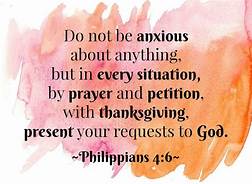
Here is camaraderie, teamwork, and togetherness at work. And, the togetherness, the sense of interconnectedness and belonging of the Christian life is what Paul recommends to us in verses 2 and 3. All of Paul’s commands dovetail into his urging to pray—with gratitude and thanksgiving. “Do not be anxious about anything, but in every situation, by prayer and petition, with thanksgiving, present your requests to God.”   

All too often, our prayers are just a ‘shopping list’ we bring to God, without thanksgiving and seasoned with anxiety and fear. We are urged to be grateful, to count our blessings.

            I encourage all of us – and I am preaching to myself as much as to anyone else – to strive to make it a habit. A way of living, to be thankful and grateful. Not just for this week, for Thanksgiving, but for the rest of the year, too. For always. Let us encourage each other to tap into this praiseworthy sense of interconnectedness and belonging! And celebrate the community that we are and the community that we are becoming!

Be like Paul. Don’t be filled with worry, but instead, be filled with gratitude and thanksgiving! Not just on Thanksgiving, but every day!

@chaplaineliza

(Suggestion: visit me at my other blogs: matterofprayer: A Year of Everyday Prayers. #PursuePEACE – and  A Year of Being Kind . Thanks!

(I would like to express my great appreciation for the observations and commentary from the web page www,umcdiscipleship.org for their brief series on gratitude. I used several quotes and ideas from their useful resources. Thanks so much!)


[1] http://worshipingwithchildren.blogspot.com/2013/09/year-c-thanksgiving-day-october-14-2013.html

[2] https://www.umcdiscipleship.org/worship-planning/our-hymn-of-grateful-praise/twenty-fifth-sunday-after-pentecost-year-a-lectionary-planning-notes

[3] Hooker, Morna D., The New Interpreter’s Bible Commentary (Vol. 12,The Letter to the Philippians), (Nashville, TN: Abingdon Press, 2000), 547-48.

Unknown's avatar

Anxious About Anything?

Anxious About Anything?

Phil 4-6 don't worry

Philippians 4:4-9 (4:6) – September 2, 2018 – from Dave Ivaska’s book Be Not Afraid

Worry. Anxiety. Fear. These are natural emotions, and so common to our human experience! When we are on edge, lonely, filled with anxious thoughts—our minds can play funny games. Some people can think frightening or isolating thoughts. We often talk—or think—ourselves into things that cannot be true. Sometimes we talk—or think—ourselves out of things that are absolutely true. [1]

The Apostle Paul understood about worry, anxiety and fear. When he wrote this letter to the believers in the city of Philippi, he was imprisoned in Rome. Prison in the first century was not at all like the functional, barred jail cells we might think of today, when we consider American prisons. Whether in prison today or 2000 years ago, being in prison must be an awful thing. I have never been in prison. I’ve never been arrested. Several of my friends and acquaintances have, though, and I understand it can be a very frightening experience indeed.

Except, the Apostle Paul was not your normal prisoner. He was a Roman citizen. What’s more, in his first imprisonment, he was allowed to remain confined in a private apartment, although chained and shackled to a Roman soldier as guard. Paul mentions his chains and being confined in this letter to the Philippians.

This scary predicament of Paul’s would probably cause most people a great deal of fear and anxiety. Wouldn’t you be afraid, to be chained and shackled to a Roman soldier? They were no joke military men. Not playing. Not even close. And, it was worth the soldiers’ lives, being responsible for a prisoner and keeping him under close custody. Like I said, serious business.

So, what on earth did Paul mean when he said “Do not be anxious!”

Probably few people here have been arrested or put in prison. However, everyone here knows what it’s like to be anxious and fearful. Let’s take finances. How many here have wondered if their money would last until the next paycheck? What about grocery bills? What about unexpected car repairs? Or, house repairs, like a plumber or washing machine repair?

Let’s talk about health, or lack of it. If not for you, then a loved one. Any broken bones or sudden falls? What about an emergency operation? Or a routine procedure suddenly made much more complicated by the unexpected? What about loved ones with recurring mental health issues? Doesn’t that put a great deal of additional stress on the whole family?

Speaking about our families, what about our loved ones? What if something happens in one of their lives? Fights can get particularly nasty, turning into long-held grudges. What about children or grandchildren? Will they be able to go to school? Go to college? Get a job? Avoid drugs and alcohol, and keep to the straight and narrow?

Paul has an answer to growing anxiety, fear and worry: he says to pray! Listen to verse 6: “Do not be anxious about anything, but in every situation, by prayer and petition, with thanksgiving, present your requests to God.”

Wait a minute, Paul! That sounds an awful lot like the tricks Jesus used to pull, when He told His disciples to do something that was next to impossible. How on earth are we supposed to keep that fear, worry and anxiety away? I have heard an old expression: “Worry about nothing; pray about everything.” But, how does that work, exactly?

Some might think they need to do everything themselves, with no assistance. Sort of like a big home improvement project. A huge do-it-yourself project. What’s more, if those same people go to YouTube and look online, they will see handy handymen and handywomen doing amazing things to their homes, all by themselves. But, it very rarely works that way in real life.

If you go to the home improvement mega-stores, you’ll find lots of helpful employees, ready to give advice about all kinds of improvement activities. Except—you don’t need to do it all alone. In fact, there are helpful people to come alongside you and give encouragement and moral support, and even assistance.

Commentator Alyce McKenzie writes, “There are other things that I might be able to do but that it would be so much better to have someone else do. We had a bad storm in our area a few weeks ago. The result is that lots of houses in our neighborhood have to have their roofs redone. Could I do this? It is humanly possible, I suppose, but we are hiring a roofing company that knows what they are doing.” [2]

The apostle Paul could have done this prayer thing all on his own. Except—he had some good friends present with him while he was in captivity in Rome. Dr. Luke was one of Paul’s faithful companions. I suspect they prayed together regularly; Aristarchus was another friend, and probably Tychicus, too. Plus, Paul also mentions a number of others in Rome who came to faith in Jesus Christ. One or two, or perhaps even more of these unknown friends came to see Paul, and to pray with him, for the many months while he awaited his trial.

Alas, along with Dr. McKenzie, I am afraid I might not have the faith. I might be anxious and fearful anyway. As she said, I can psyche myself up in other areas of life. But I need God to bring peace to my soul.” [3]

Just like Dr. McKenzie, I wish Paul had reversed the order of this verse and written it like this instead: “In everything by prayer and supplication with thanksgiving let your requests be made known to God and then you will receive the gift of not worrying about anything.”

Oh, it is so difficult for me to train my heart and not worry or be anxious about things. Things that go bump in the night. Things that are scary, or irritating, or anxiety-producing. Things that can even frighten us to death. Our attitude is often exactly the opposite of the way Paul encourages us to be. Paul wants us to hear: “’Live without anxiety because God cares for you.’ In Philippians 4…the peace of God that comes through prayer counters anxiety because it ‘guards believers’ thoughts and hearts in Christ.’” [4]

The people of Philippi would have understood what it was like to have a guard watching over their thoughts and hearts. There was a Roman garrison in Philippi, so this was a familiar image to them. The Philippians could rejoice—just as we rejoice—because prayer can guard our hearts and minds. Each moment of each day, “in every situation, by prayer and petition, with thanksgiving,” we can present our requests to God. And, we can help each other, support and encourage each other, as we pray.

Requests, joys, concerns, whatever is on our hearts, God wants us to bring these prayers to the throne of grace. “This is the peace of God Paul proposes as an alternative to anxiety. The Philippians are not called to imitate the peace of Christ, but to accept the gift of that peace being offered to them by the Grace of God, accessed through the habit of prayer.” [5]

Verse 4:7 is almost a benediction: “And the peace of God, which transcends all understanding, will guard your hearts and your minds in Christ Jesus.”

Hear the words of the apostle Paul today: the gift of God’s peace is offered to all of us, despite fear and worry. We all can live without anxiety, because God cares deeply for each one of us today. Yes, now, and forever. Amen!

[1] Ivaska, David, Be Not Afraid (Downers Grove, Illinois: InterVarsity Press, 2000), 123.

[2] http://www.patheos.com/progressive-christian/lets-do-this-alyce-mckenzie-10-06-2014.html

“Let’s Do This!” Alyce M McKenzie, Edgy Exegesis, 2014

[3] Ibid.

[4] Ibid.

[5] Ibid.

@chaplaineliza

(Suggestion: visit me at my regular blog for 2018: matterofprayer: A Year of Everyday Prayers. #PursuePEACE – and my other blog,  A Year of Being Kind . Thanks!)