Unknown's avatar

Moses in a Basket

“Moses in a Basket”

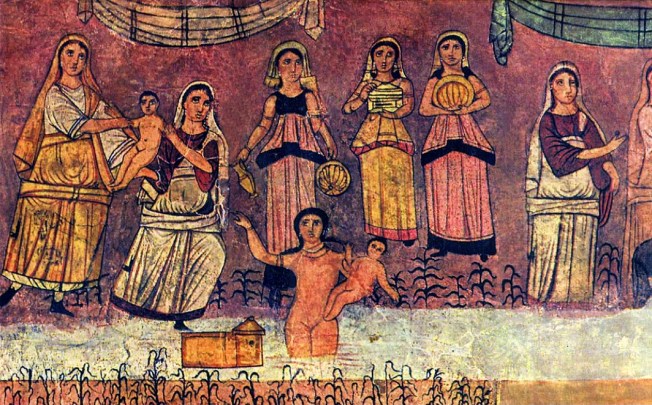
Exod 2 Pharaoh's daughter and Moses in the Dura-Europos synagogue fresco, c. AD 244

Exodus 1:15-2:6 – July 7, 2019

On social media, one sure way to get loads of “likes” and “shares” is to post the photo of a cute baby. So many people love seeing photos of little babies looking adorable. And when photos of crying or unhappy babies are posted, many people pour out their sad, shocked, and comforting emotions in their responses online.

Is it much different in our Scripture reading today from Exodus? As we hear about the infants born to the Israelite women in Egypt so long ago, I suspect many in our congregation are sad and shocked, and wish to comfort those women and families involved.

And yet—this narrative about infants from Exodus has a much starker, darker impact, as we read it over again in the clear light of day. With the typical economy of words that Hebrew often employs, our narrative opens with: “Then a new king, to whom Joseph meant nothing, came to power in Egypt.” In other words, a number of generations had passed, and as commentator Karla Suomala suggests “the new king didn’t remember Joseph’s role in keeping the Egyptians alive during a time of famine or simply chose to ignore this piece of history. It seems to be more willful than a simple act of forgetting.” [1]

The people of Israel, resident aliens living in Egypt for several hundred years, have become extremely numerous. So numerous, in fact, that the new Pharaoh and other racist Egyptian leaders feared the people of Israel would be guilty of insurrection or an alliance with a foreign nation. The Egyptians ruthlessly worked them even harder, but they continued to multiply and grow as a sub-people group within the nation.

I give a trigger warning, since this sermon is going to speak of some horrible events.

Further compounding [Pharaoh’s] false statement, is a clear strategy to create an “enemy within” and to stir up fear of the foreign or immigrant other. The Pharaoh then wastes no time in putting a plan together to deal with this dangerous element in their midst.” [2] Pharaoh and the other leaders became so fearful and anxious that they come up with a nefarious scheme—killing all the Jewish boy babies, from that point onward.

We take a side trip to consider women in healthcare, specifically working as midwives. This work as midwives outside the home has been an accepted thing for certain women to do for millenia. The two women we look at come at the beginning of Exodus, in the middle of this narrative about the Israelite—or, Hebrew boy children.

These women were diligent in their work. We even know the names of these midwives—Shiprah and Puah. The biblical writer honors them by recording their names for posterity. Plus, they were God-fearing women, who understood their work was important in God’s eyes.

As we know, Pharaoh’s evil plan was to command the Hebrew midwives to kill all baby boys, to commit male infanticide, yet allow the baby girls to live. This is a slow yet sure way of eradicating Egypt’s problem population. What do we think about such horrendous acts of cruelty? No, even worse, acts of murder? What would you consider doing, if you had been in the place of these Hebrew midwives?

The midwives Shiprah and Pual were civil servants; they worked for the Egyptian government, and so the all-powerful Pharaoh was their ultimate boss. However, Pharaoh and his cronies did not have much power. Pharaoh needed to meet with the Israelite midwives in a huge turnover in power. Imagine, we are faced with the question: where—with whom—does true power reside?

Apparently, Pharaoh is not aware of this power differential. What is more, Pharaoh tries to deputize these Hebrew midwives to do his dirty work for him. He does not want to get his hands (or the hands of his fellow Egyptian leaders) bloody.

The midwives are honorable and God-fearing, and most probably cannot even consider killing the newborn infants they assist bringing into the world. However, when Pharaoh asks them why they are not killing the baby boys, “the midwives respond by playing to his own stereotypes about immigrants and their breeding habits. “Because the Hebrew women are not like the Egyptian women; for they are vigorous and give birth before the midwife comes to them,” they say.” [3]

Here we see that racist stereotypes are sadly perpetuated from generation to generation. Has this frightening, common, xenophobic mindset changed today? I think not.

The Pharaoh clearly sees that he won’t be able to convince the Israelites to kill their own children. So, he and other racist, xenophobic Egyptian leaders turn to the Egyptian population, telling them to throw the Jewish baby boys into the Nile River. This is where we pick up with the story of Moses. His mother gave birth to Moses in secret, hid him for three months, and then finally did put him in the Nile River—in a floating, waterproof basket.

We follow Miriam, Moses’s older sister, watching from the riverbank, as Pharaoh’s daughter finds the floating basket. Pharaoh’s daughter is charmed with the darling baby who she correctly identifies as a Jewish baby, spies Miriam nearby, and asks whether Miriam can find a wet nurse for this baby she decides on the spot to adopt. Thus, the adopted Moses is suckled by his own mom—and even paid to nurse her own child. Such are the amazing incidents that happen in God’s providence.

One fascinating insight about the male Pharaoh and the female midwives: one of the most striking points of this section is the fact that the text names the midwives. Why do we need to know the names of these two women, Shiphrah and Puah, who never appear again in the story? Names are very important in the Book of Exodus. Moses’s sister Miriam is named, too, further on in the book.

Who remains nameless? Pharaoh. Pharaoh is unnamed. Pharaoh’s royal family members are unnamed. Pharaoh’s officers are unnamed. Pharaoh’s royal advisors are unnamed. Every Egyptian in the book of Exodus remains nameless. All public figures in Egypt take great efforts at self-promotion and control. [4] But when God steps in and raises up the women in this story, we need to sit up and take notice.

A final act of defiance to the Pharaoh’s authority and will comes from his own daughter. Moses will grow up under the protection of the princess even before he is officially adopted. [5] Sure, we can see the patriarchal mindset and attitude shown in the Bible remains deeply entrenched, through the centuries. However, in God’s providence and outworking in these connected situations, we can see defiance and subversion of Pharaohs’ commands, even from within his own house at the hands of his own daughter.

God be praised. Yes, there is continuing horror, despair, death and destruction. But, God’s purposes shine through all the darkness. Moses rose to prominence, to lead his people out of Egypt. And, God’s purposes continue to shine through.

That is something to truly celebrate. Alleluia, amen.

@chaplaineliza

(Suggestion: visit me at my regular blog for 2019: matterofprayer: A Year of Everyday Prayers. #PursuePEACE – and my other blog,  A Year of Being Kind . Thanks!

This entry was tagged angry, arrogant, coat of many colors, dysfunctional, favorite, Genesis 37, God’s purposes, hurt feelings, Joseph, praise God, reconcile, sibling rivalry.


[1] http://www.workingpreacher.org/preaching.aspx?commentary_id=3380

Commentary, Karla Suomala, Preaching This Week, WorkingPreacher.org, 2017.

[2] Ibid.

[3] http://www.workingpreacher.org/preaching.aspx?commentary_id=3380

Commentary, Karla Suomala, Preaching This Week, WorkingPreacher.org, 2017.

[4] https://juniaproject.com/midwives-vs-pharaoh-exodus-question-of-power/

[5] http://www.workingpreacher.org/preaching.aspx?commentary_id=972

Commentary, Exodus 1:8-2:10, Amy Merrill Willis, Preaching This Week, WorkingPreacher.org, 2011.

Unknown's avatar

Compassion and Babies

Exodus 1:15-21(1:20) – June 18, 2017

Exod 1 Pharaoh and the Midwives, Golden Haggadah, Catalonia, early 14th century, British Library,

“Compassion and Babies”

Who doesn’t love babies? Babies are sure to put smiles on the faces of many, many people, all over the world. Chubby little hands and feet, delicate ears, nose and mouth. They are adorable when they smile and yawn, and little angels when they are asleep.

I realize there are some people who are not wild about babies, but these are in the minority. Could we focus on one particular person who did not like babies at all? Our Scripture reading today from Exodus tells us a good deal about him. Starting at verse 8, “Then a new king, to whom Joseph meant nothing, came to power in Egypt. “Look,” he said to his people, “the Israelites have become far too numerous for us.”

Joseph and his brothers had been dead for many years—perhaps centuries. This king of Egypt did not remember anything of the marvelous things that Joseph did and the wonderful miracle he helped bring about, assisting all of Egypt and the regions surrounding to survive a great famine that lasted seven years. No, as far as the Pharaoh was concerned, he had forgotten all that history in the mists of a far-off past.

The King of Egypt had grown afraid of the numerous descendants of Jacob, who were growing more numerous and prolific all the time.14 The Egyptians made their lives bitter with harsh labor in brick and mortar and with all kinds of work in the fields; in all their harsh labor the Egyptians worked them ruthlessly.” In other words, the Egyptians were using these newcomers to their land as servants, even as slaves.

But, this hard labor—forced labor—was not enough. Pharaoh and many other Egyptians continued to be intimidated by the Israelites. When enough was enough, the Pharaoh called the two midwives to him, the ones who helped the Israelite women to give birth, and gave them a terrible command. He commanded genocide.15 The king of Egypt said to the Hebrew midwives, whose names were Shiphrah and Puah, 16 “When you are helping the Hebrew women during childbirth on the delivery stool, if you see that the baby is a boy, kill him; but if it is a girl, let her live.”

I suspect everyone here can guess what the midwives’ reaction is to this terrible command. Horror, shock, and revulsion, followed by refusal and resolve.

According to Dr. Brueggemann, “This narrative plunges [us] into a world of danger, brutality and desperation. It is a world into which a settled congregation does not easily go.” [1] Sure, this Scripture reading from Exodus is definitely not warm and fuzzy.  Many congregations regularly romanticize the Bible, and thus ignore the difficult parts, the ominous conflicts, the slavery, wars, death and destruction.

Imagine, so many powerless little babies, just born into this world. Remember the children’s sermon? Remember how certain people today are powerless, too? Similar to our activity during children’s time, here is a story in the book of Exodus about babies in danger who needed help. The babies couldn’t help themselves, and others—the midwives—came along to be sure they were safe.

Continuing from Exodus, “The midwives answered to God, not the king, and so they let the boy babies live, too. The king called for them, and when they came, he asked them, “Why have you done this? Why have you let the boys live?” The midwives said, “Oh, king! Hebrew women are so strong—they give birth on their own, before we can even arrive!”

These courageous women defied the direct orders of the Pharaoh. “They feared God more than they feared the new king, and for that reason they refused to participate in the state-authorized killing.” [2] What is more, they give a wonderful reason for not carrying out Pharaoh’s horrible plan: they say that the Hebrew women give birth too quickly! These women are filled with vigor and a liberated power for life, and for life-bearing, too. [3]

The Hebrew women were not the delicate flowers that many Egyptian women supposedly were. Instead, the midwives appeal to what appears to be Pharaoh’s own prejudicial sense of the relationship between physical difference and ethnicity. They insist that “the Hebrew women are not like the Egyptian women; for they are vigorous and give birth before the midwife comes to them” (Exodus 1:19).

The Hebrew word here for “vigorous” shares the root of the word “life.” The midwives deceive Pharaoh, and at the same time use language that also winks at the reader: the Hebrew women are full of life. [4] Their identity as God’s people resists death. Death is what Pharaoh demands to bring into their powerless lives—but it does not work. The midwives, Shiphrah and Puah, not only defy the King of Egypt, they also show compassion to the Israelite boy babies and their families, as well. Their community grew and became even stronger, and God was pleased with the midwives; their disobedience to the King was faithfulness to God.

According to the king, as Pharaoh, he was mighty, wily and powerful; on the other hand, the boy babies of the Israelites had no power, and neither did their parents.

Do we know what “powerless” means?  It’s to need help from others because we cannot help ourselves. Who else might be powerless? I mean, with less power in our world, or our own lives, or in their lives. Who are some people you can think of that don’t have much power in our world today? How can we help these people? Are there ways we all could show compassion and kindness to them?

This week offers us a story of humankind’s inhumanity to one another, and it is a story that gets played out in every generation. Why are we human beings unable to end our hunger for finding a group to be bullied or ostracized, be it on the playground at our local elementary school, in our neighborhood, or in the land that God promised to the Jews all those generations ago? [5]

It is the same old, same old story. One group of people come to consider themselves superior to another. Perhaps they think they are superior because of their appearance, or because they enjoy a more satisfying lifestyle, or they practice a particular religious faith. Maybe they feel they are superior because they have interpreted the Bible in such a way that they have come to believe God supports their views and lifestyle, and God condemns the views and lifestyles of those who differ from them. [6]

Who in our community enjoys favor and who is scapegoated? How does our church address these problems? Do we speak out? If not, why? Who stands to gain and who stands to lose from speaking out or keeping quiet? Can you put your own story into the story of the Hebrew people suffering under the abuses at the hands of the Egyptians? [7]

Thank God for these midwives, for Shiphrah and Puah. They stepped up, they came alongside of the Hebrew women, and they showed kindness and compassion.

How can we act today with kindness and compassion? How can we come alongside of someone in our neighborhood who is being bullied, ostracized, or even abused?

God willing, we can, and we will! Amen.


(A heartfelt thank you to An Illustrated Compassion: Learning to Love Like God. Many sermon ideas and thoughts came directly from this series.  I appreciate this intergenerational curriculum, which is the basis for my summer sermon series on compassion. This curriculum comes from Illustrated Children’s Ministry. Thanks so much for such great ideas!)

[1] Brueggemann, Walter, Exodus, The new Interpreter’s Bible: general articles & introduction, commentary, & reflections for each book of the Bible, Vol. 1 (Nashville: Abingdon Press, 1994), 696.

[2] Ibid, 695.

[3] Ibid, 696.

[4] http://www.workingpreacher.org/preaching.aspx?commentary_id=2169  Commentary, Cameron B.R. Howard, Preaching This Week, WorkingPreacher.org, 2014.

[5] https://www.umcdiscipleship.org/worship/lectionary-calendar/eleventh-sunday-after-pentecost4#notes1

[6] Ibid.

[7] Ibid.