Unknown's avatar

Peace, from Generation to Generation

“Peace, from Generation to Generation”
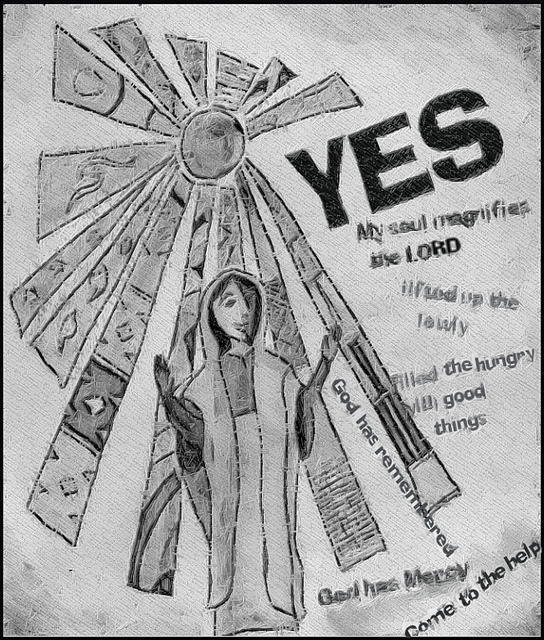
Luke 1:44-56 (1:50) – December 8, 2024

People have been writing songs about the Virgin Mary for centuries. Songs of praise, songs of worship, songs honoring God, and lifting up Mary for saying “yes” to God. Christmas carols might be the first thing that come to mind—but I am also thinking of music from centuries past. From the familiar first part of Handel’s Messiah, to the various settings of the Magnificat, with lyrics from the first chapter of Luke—our Gospel reading for this morning.

            Some Protestants might not be as familiar with the Virgin Mary as many Catholics and Orthodox Christians are. Mary is held in extremely high esteem in many denominations and faith traditions throughout the world, and for excellent reasons. I honor her greatly.

If we look at our modern world today, the situation here in our country, we have a great deal of uncertainty, and very little peace. Does our world today have some strong similarities to the world that Mary inhabited? I wonder, and I would say yes.

Mary sings about the mighty work of God. Yes, personally, in her life. But also in the lives of all the people in the world. “What will this work of God look like?  Something revolutionary is about to happen. God will turn the world upside down. The rich and the powerful will be brought low, and those living on the margins will be raised up. This isn’t a vision that fits very well with a Christian world that values success and power.[1]

For, that is definitely what a large portion of the so-called “Christian world” values today. At least, here in this country, and among a large number of people who claim to follow Christian values and practices religiously. Even if certain Christian denominations do not say it outright, the “Health, Wealth and Happiness Gospel” is a high priority in many people’s lives today.

Let us take a look at what Mary’s situation consisted of. Did you know that Mary—an unwed teenager from an oppressed people-group in an occupied country under crushing Roman rule—was also a radical? A subversive? Was plotting to overthrow the existing oppressive government and replace it with the rule of God?

            What surprising, even shocking things to say about the sweet, innocent Virgin Mary! Everyone associates her with travel to Bethlehem while nine months pregnant, and needing to deliver the infant Jesus in a stable, because there was no room for them in the inn.

That Mary? Radical? Subversive? Absolutely, yes.

Think about the modern Christmas season from another direction. Contrast Mary’s situation with today. Is there any place we can go where we are not bombarded with commercial messages shouting for us to “Buy, buy, buy!” and reminding us of big sales, and markdowns, and half-price! Not to mention all the pressure to be “merry and bright” all the time. Even when going to yet another event or concert or dinner or celebration is the last thing you want to do!

Let us reflect on the first chapter of Luke, on Mary’s song. The last thing on Mary’s mind was commercialism. “Mary’s song, often called the Magnificat, is a welcome contrast to the hyped-up speed of the commercialism that is too often the dominant theme in our culture during the Advent season. Her lyrics are an invitation to approach Christmas with a slower, more contemplative pace.” [2] Is it possible to slow down the frenetic pace of the holidays, to get off the commercial merry-go-round, and instead sit still and worship the coming Messiah?

Sure, the wonderful classical settings of the Magnificat were often sung in a foreign language, like Latin. Or, in text from the King James version of the Bible, full of “thee’s” and “thou’s” and all manner of archaic words. Listen to the first part of her Magnificat, as translated in the modern version by Eugene Peterson, “The Message.” 

“I’m bursting with God-news; I’m dancing the song of my Savior God. God took one good look at me, and look what happened—I’m the most fortunate woman on earth! What God has done for me will never be forgotten, the God whose very name is holy, set apart from all others. His mercy flows in wave after wave on those who are in awe before Him.”

 One well-known depiction of the Virgin Mary is one that is meek, docile, sweet, and not raising a fuss at all. But, wait a moment. Do we realize what Mary is going to sing next? How revolutionary were many of the statements in her song?

             “Even more importantly, Mary’s song is an overture to the Gospel of Luke as a whole. Mary’s lyrics set the tone for Jesus’s radical and controversial ministry that is to come:

You have shown strength with your arm;

You have scattered the proud in the thoughts of their hearts.

You have brought down the powerful from their thrones, and lifted up the lowly;

You have filled the hungry with good things, and sent the rich away empty.

“In contrast, the Christmas season leaves too many still hungry, and too many even further in debt.” [3]

            Do you hear what radical things Mary is saying? If these lyrics of her song were more well-known, would our understanding of Mary be changed? Here Mary is advocating social change, rescuing victims—neglected women, forgotten elders and children, abused strangers and refugees—from being trodden underfoot, even ground under the heel of bragging, bluffing tyrants and braggarts. Turning all society as it was in her day—and ours—upside down.

            What subversive idea is our revolutionary Mary advocating now? Feeding the starving? Giving the poor a banquet? Turning the unfeeling, callous rich people out into the cold? Yes, these radical words are the words found in Luke chapter 1, before we rush on to the narrative of the birth of the Baby in Bethlehem from Luke 2. 

Just looking at this Magnificat, we can see how subversive it was for the infant Messiah to be born to the Virgin Mary. And, we can begin to realize how radical it is for us to say, “O come, let us adore Him, Christ the Lord!” For Jesus truly will bring peace on earth, and He will truly turn the world upside down, just as Mary sang two thousand years ago.

But, this is still only the second Sunday of Advent. We still wait for the baby Jesus to be born in Bethlehem. We still hold our collective breath with all the rest of creation as we wait—and wait. And with Mary, we can rejoice in the promise of the coming Messiah.

Are we overwhelmed with the superficial, commercial glitz and bling of the holidays? Or, are we focused on what really matters – on the coming of our Messiah, our Lord, in God’s peace and wholeness? Let us focus on Jesus, today. Alleluia, amen.

@chaplaineliza

(Suggestion: visit me at my other blogs: matterofprayer: A Year of Everyday Prayers. #PursuePEACE – and  A Year of Being Kind . Thanks!


[1] http://www.bobcornwall.com/2015/12/blessed-are-you-among-women-lectionary.html

[2] http://www.patheos.com/blogs/carlgregg/2011/12/magnificat-learning-to-sing-mary%E2%80%99s-song-a-progressive-christian-lectionary-commentary-on-luke-146-55/

[3] http://www.patheos.com/blogs/carlgregg/2011/12/magnificat-learning-to-sing-mary%E2%80%99s-song-a-progressive-christian-lectionary-commentary-on-luke-146-55/

“Magnificat! Learning to Sing Mary’s Song,” Carl Gregg, Patheos, 2011.

Unknown's avatar

Joyful, We Adore Thee

“Joyful, We Adore Thee”

Matthew 2:1-12 (2:10) – January 8, 2023            

I love my Christmas tree ornaments. I have many that are very special to me! Quite a number came from my mother, and hung for years on her Christmas tree. A few came from both of my grandmothers. My ornaments are special to me for where and when I got them.            

One ornament I got a few years ago was made by my son Peter. He is skilled at the art of paper folding called origami; he folded this exquisite three-dimensional star. I think of this as my Epiphany star; it is very precious to me. I wonder whether the marvelous star the Magi followed was anything like this star? Bright, multi-colored, shiny from a long distance?             The 2nd chapter of Matthew tells us about these Magi, or wise men from the East. They traveled a long way, following this bright and shining star to Jerusalem. These Magi asked King Herod, “Where is the one who has been born king of the Jews? We saw his star when it rose and have come to worship him.”           

The wise men dearly want to find the child born King of the Jews! But, where are they going? They themselves are not sure! They follow the star towards Jerusalem, but that town is where their books and ancient writings leave them all puzzled. “Where is the one who has been born king of the Jews?”            

We might think of three foreign kings, traveling around Palestine. But, this is most probably a misguided way of thinking. The whole mythology of “We Three Kings of Orient Are” embroidered the simple words found in Matthew chapter 2 into a fanciful tapestry involving three noble kings in rich robes, knocking at the door of the palace in Jerusalem.             

They were not kings, but instead “magi” from Persia. Wise people who studied the stars. Plus, these Persian astronomers (or, astrologers, since they put a great deal of stock in the movements of the stars, planets and other heavenly bodies) included both men and women. There may have been women in the group who followed the special star to Palestine!            

So, these wise men – or, wise people – were not quite sure where they were going. Simply that they were following a sign, a portent in the heavens. A special star that seemed to lead them onward, westward leading, still proceeding.            

Are you – am I – sure of where we are going? We have a good deal more revelation from God, more information from the Bible to guide us. But, do we know where we are being led? What is our path? Where does the Christmas star direct each of us to go, today?            

When the Magi arrived at the palace in Jerusalem, King Herod immediately asked the chief priests and Temple scribes to search the Scriptures and find some direction he could give to these foreign visitors. Herod “asked them where the Messiah was to be born. ‘In Bethlehem in Judea,’ they replied, ‘for this is what the prophet has written.’”           

I find it fascinating that the chief priests and scribes (who wer  e also avidly studying the Scriptures themselves) did not “see” that special star. They did not “get” the message that this brilliant sign in the heavens was a particularly marvelous star. Whatever that brilliant star was had to be huge and visible from a long way away! But, only these foreigners saw something different in the sky and decided to follow it!            

The shining star that the Magi followed is surely a sign from God showing the birth of the Messiah, the newborn King of the Jews, as the Magi said.            

We know one often-repeated symbol for God is light. Since we can’t make a picture of light, we use things that make light like a star, sun, candle, or lamp. I have a lovely origami star ornament here. We can reflect upon the many reasons, the many signs of light that are talked about in the Bible, including the Star of wonder, Star of light. Just think of the Advent wreath and Christmas candle lighting services and note that we light those candles to remind ourselves that God the light is with us.  What’s more, think of the candles here on the chancel. We light the candles every week to remind us of the Light of the World, the Light that shines in the darkness, the magnificent Star in the sky the Magi followed.            

Turning back to our Scripture reading, “After the Magi had heard the king, they went on their way, and the star they had seen when it rose went ahead of them until it stopped over the place where the child was. 10 When they saw the star, they were overjoyed. 11 On coming to the house, they saw the child with his mother Mary, and they bowed down and worshiped him. Then they opened their treasures and presented him with gifts of gold, frankincense and myrrh.”            

The wise people who followed that star found what they were searching for. And, they worshiped, and were overjoyed. Are you – am I – sure of where we are going? Are we following that star, too? We have a good deal more revelation from God, more information to guide us. But, do we know where we are being led? What is our path? What does the Christmas star direct each of us to do, today?            

I ask all of us to consider these words from Howard Thurman, progressive theologian who wrote this poem: The Work of Christmas.

When the song of the angels is stilled, When the star in the sky is gone, When the kings and princes are home, When the shepherds are back with their flock,  The work of Christmas begins: To find the lost, To heal the broken, To feed the hungry, To release the prisoner, To rebuild the nations, To bring peace among others, To make music in the heart. 

            Let us take these words to heart, and go and do them. Alleluia, amen.

@chaplaineliza

(Suggestion: visit me at my other blogs: matterofprayer: A Year of Everyday Prayers. #PursuePEACE – and  A Year of Being Kind . Thanks!

Unknown's avatar

One Who Brings Peace

“One Who Brings Peace”

Micah 5-5 He will be our peace

Micah 5:5 – December 20, 2015

Peace. Peace is the subject today. Today we light the Advent candle of peace. Here, inside the church, it seems like peace is a realize-able actuality. But—not on the outside. Not out in the cold, cruel world. Peace, peace, is the cry! Here in the 21st century, we have wars and the rumors of war. Fighting, skirmishes, various attacks of various kinds. Will anyone hear our cry for peace? Will anyone—anywhere—heed our cry?

In biblical times, there was always some tribe or country beating up on another tribe or country. Always somebody marching off to war. To enlarge territory, or to gain political advantage, or to right some wrong. So seldom did the nation of Israel have true peace! Much of this book of the prophet Micah deals with war, conflict and fighting. Except for right here.

Our Gospel reading from Luke tells of the pregnant Virgin Mary going to visit her older cousin Elizabeth, who prophecies that Mary has within her the baby Jesus, the Son of God. Usually, the Scripture readings are chosen with great care. Chosen with an eye to common themes. So, what is in common, here? The prophecy of a strong leader to come, from our Old Testament text, and the prophecy of the birth of the Messiah, from our Gospel reading.

Here we are at the fourth Sunday of Advent. We have had Advent for a long time. Since the last week of November. I can just hear the children saying, “When is Christmas finally going to get here?” Some schools have already gotten out for the winter holidays. I know some local churches are featuring a Christmas cantata today, or a Christmas pageant in worship.

Yet here we all are. The last Sunday of Advent. Isn’t Christmas here yet? Isn’t it time for angels and shepherds, Mary and Joseph and the Baby in a manger? Can’t we hurry things along?

As we look at the prophecy in Micah, we can see that the prophet is certainly not thinking about warm and fuzzy Christmas carols. Not about the lion lying down with the lamb, about God reaching down and bringing peace on earth, good will towards all people. Or, is he? What is Micah saying in our reading today?

Yes, a strong leader will rise up. Who do you think Micah’s contemporaries thought the prophet was talking about? I was fascinated to read in one commentary that most people would connect this strong leader to King David. But, wait! David had been dead for two hundred years, by the time that Micah wrote his prophecy. How could the Jewish people think “David” when they heard prophetic words like this?

Because—because of the prophecy of David’s prophet Nathan from 2 Samuel 7. A direct descendant of David would be king. God had promised King David that exact thing. So, who else could this strong leader be but a direct descendant of the great King David?

All well and good! Except, it gets more complicated, fast. Micah mentions “out of you [Bethlehem] will come one who will be ruler over Israel, whose origins are from of old, from ancient times.”

Now, I can understand a strong leader. A ruler, a mighty King. A descendant of King David. I can even understand the prophecy of a baby, from Luke, chapter one. The descendant of David needs to be born. Elizabeth prophecying and praising God that the mother of the Messiah to come was coming to see her. Okay, I’ve got that.

I am so indebted to John C. Holbert’s article on this Scripture reading. [1] I was aware of some of this material from the book of Micah, but by no means all. And never in so much depth!

Micah’s prophecy foretells a strong leader, yes. A descendant of David is presumed. (Micah doesn’t specifically say so.) Adding two and two and two together, from the prophecies of the Hebrew Scriptures, people have ascertained that this prophecy also refers to the Messiah. And then—Micah adds the part about the ruler “whose origins are from of old, from ancient times.” This part definitely needs more explanation.

These phrases are a challenge to translate from Hebrew. The best that anyone can figure is that there are several meanings for these words. “Origins” can also be translated “coming forth” of old! Dr. Holbert says that God put this word ‘olam, or “ancient times,” “into human minds in such a way that they may know a bit of what has happened in the past, and a tiny portion of what may come, but just enough to teach them that they in fact know precious little about either past or future in the end. There the word appears to mean something like a very long time or deep in the past and far into the future, not quite eternity but as much as any puny human mind may conceive.”

Talk about not being able to understand Scripture. These couple of phrases blow me away. I feel small when I read this. Really young, like a preschooler. I realize I do not know very much about God or about the Bible, at all. Period. God surely can flatten me, humble me with a phrase from the prophet Micah.

But, wait! There is more! Let’s unpack this reading, further.

Holbert continues: “Who then does Micah have in mind? This is no simple heir of David; here is someone primordial, someone from the most ancient of times yet also uniquely prepared to act decisively in the present.” In other words, Micah is talking about Someone more than human. Looking forward to the future, talking about Someone who not only is the promised Messiah to come, the promised descendant of David, but also looking back to the far distant past. To the beginning of time, even beyond the beginning.

Then, in Micah 5:3, the prophet brings up the image of a woman in labor. What is our Gospel reading from Luke for today? It’s about two pregnant women. Elizabeth prophecying about the Child Mary is carrying. The Child is the Lord. The Son of God. The next verse, Micah 5:4 speaks of the promised one who will be a shepherd. Just like King David! A powerful and godly shepherd who keeps the flock safely; “and they will live securely, for then his greatness will reach to the ends of the earth.” Again, this is Messiah language, and more!

Who is this Messiah, anyway? Descendant of David, check. Born in Bethlehem, which is David’s ancestral home. Check. But, Micah says from ancient of days? Luke calls Him the Son of God? The Lord God Almighty?

This great Shepherd will not only be concerned with the flock of Israel, but also the flock of the entire world. And—this is the most important part to me, right now. This strong leader, this Shepherd will be our peace.

This Messiah will not just be peaceful for Israel’s sake. No! Our Messiah, our Christ, from ancient of days, will act peacefully for the safety and well-being of the whole world!

Do you hear the Good News from the prophet Micah today? This Messiah was not going to act in the way that so many other Middle Eastern potentates did. Or, for that matter, like any other earthly ruler ever has. Instead, we are told in our Scripture passage today that He will feed His flock. The Messiah’s flock will have the opportunity of living secure, safe, and peacefully under Messiah’s mighty protection. I thank God that I am one of the worldwide flock.

God extends that opportunity to everyone, so that we all can have the security and care of the Messiah, the Good Shepherd, the Babe of Bethlehem, the ruling King. Praise God for God’s wonderful gift of protection and care.

[1] http://www.patheos.com/Progressive-Christian/Who-Is-This-Peaceful-One-John-C-Holbert-12-11-2015

(Many thanks and much appreciation to Dr. Holbert! Wonderful article on Micah.)

@chaplaineliza

Suggestion: visit me at my daily blog for 2015: matterofprayer: A Year of Everyday Prayers. and my other blog,  A Year of Being Kind .  Thanks!