Unknown's avatar

Peace! Be Still!

“Peace! Be Still!”

Mark 4:35=41 (4:39) – June 23, 2024

            Have you ever slept in a tent while a huge thunderstorm crackled and poured overhead? The blustery wind, rain and loud thunder seem right on top of you. I know firsthand; I spent several summers in high school at a Girl Scout camp, sleeping in a platform tent every night.

            Except, in our Gospel reading, Jesus and the disciples did not even have the cover of a tent. They were out in a boat on the Sea of Galilee, in the middle of a fierce storm.  Our Gospel writer Mark tells us “Suddenly a strong wind blew up, and the waves began to spill over into the boat, so that it was about to fill with water.”

            Can you relate? Has this ever happened to you? Maybe it’s an actual storm, blowing in all of a sudden out of a clear blue sky, complete with the skies turning black and the heavens opening up with pelting rain. Except, sometimes it can be a figurative story. Something horrible comes up suddenly, upon you or upon a dear member of your family. What about a sudden car accident? Or, perhaps a house fire in the middle of the night, or emergency hospitalization, out of a clear blue sky?

            These kinds of sudden, serious storms can blow up in anyone’s life, and they can overwhelm any of us with their intensity and traumatic effects.

            Let us look at this reading again. “Jesus was in the stern, sleeping on a cushion. The disciples woke him and said to him, “Teacher, don’t you care if we drown?”

            Fear can absolutely paralyze people! I can see these guys, scared out of their sandals, on this tiny boat. Rain pelting down, the wind and the waves threatening to swamp the boat, far from shore. Some of these guys are used to sailing and used to sudden squalls on the Sea of Galilee. But, a portion of the disciples are not fishermen, and are not familiar with boats or with seafaring. And what about Jesus? He is sleeping, for heaven’s sake, through the storm, the pitching of the boat back and forth, the pelting rain coming down.

            As one of my commentators says, “This is it. They’re going down. Life’s over! Jesus doesn’t seem to care. I’m not sure what they’re expecting of him—probably they just wanted him to show a bit of concern about their plight.” [1]

            What about those sudden storms that blow into our lives, today? Catastrophic accidents, emergency hospitalizations, or the very abrupt closing of a company. (That recently happened to one of my relatives, and it’s throwing a monkey wrench into everyone’s lives! Everyone who works there, and their families, too.)

            This storm that blew up on the Sea of Galilee must have been some storm, though! Even these seasoned fishermen, familiar with the water, were certain that death was near! “They must have exhausted all their other usual options and now that panic has set in all they have left is to turn to the one who is sleeping on the cushion — seemingly oblivious to the violent wind and driving rain.” [2] What is their cry? “Teacher, don’t You care if we drown?”

            Stories from recent church history can be distressing and catastrophic. Stories about weathering storms from church history can be helpful, and empowering, too. Take, for example, the true story about Anna B.

About 100 years ago, Anna B. was a faithful member of a dying church. The building was run-down, the congregation could not afford to pay a minister. Without a minister, people stopped attending Sunday services. Except – Anna B. kept coming to the church. She opened the doors on Sunday morning, week after week. She lit the candles and provided a place for prayer. She filed the necessary papers to maintain the church as a legal entity. These simple acts of faithfulness and diligence kept the congregation going for several years. Eventually, rebirth happened, and it was in great part because of Anna B. [3]

            That is the true story of Anna B., who was instrumental in faith and revitalization when that church was going through a series of storms in the life of that struggling congregation.

            Anna B.’s history takes place over several years. The sudden storms that come into our lives can blow up abruptly. What does Jesus do in this specific situation? “Jesus rebukes the wind and tells the sea to simmer down; the first word (“Peace!” in the NRSV) is a verb meaning be silent; the second (“Be still!” in the NRSV) means literally be muzzled.” [4]  Just as suddenly, the sea calms and the wind is stilled – muzzled! And, the disciples are left dumbstruck. Jaws hanging open, they murmur, “Who is this?”

            Just as the power and miracle-working capability of Jesus became clearer to the disciples, it can become clearer to us, today. No matter what our personal storm is, no matter how fearful and anxious you and I are because of our personal circumstances, our Lord Jesus has the miraculous power to calm the storms in our lives, too.  

            This Gospel reading is a powerful reminder about the power of God, as displayed through our Lord Jesus. Except, I know from sad experience that miracles do not happen the way people expect sometimes. Even many times. Like Rev. Janet Hunt, I am also not certain how so many deal with lives devastated by all sorts of storms, actual and figurative, storms that threaten from outside and from within. “Even so, perhaps we are changed if we allow ourselves, even as the disciples did, to simply stand still in awe when in the presence of such power which muzzles the worst that can threaten us. Which is all the time, if we are paying attention. Indeed, perhaps it is so that [we] do walk away re-empowered to hold fast in the storm if [we are] able to trust that somehow our benevolent God holds us all. Even in the storms. Especially in the storms.” [5]

Jesus calls on each of us to have faith, even in the midst of the raging storms of our lives. We can believe, we can have faith that Jesus will be right by our sides, through any difficulty. And, Jesus can say “Peace, be still!” to the storms in each of our hearts, too. Alleluia, amen.

@chaplaineliza

(Suggestion: visit me at my other blogs: matterofprayer: A Year of Everyday Prayers. and  A Year of Being Kind . Thanks!


[1] https://www.bobcornwall.com/2015/06/sleeping-through-storm-lectionary.html

[2] http://words.dancingwiththeword.com/2015/06/power-over-storm.html

[3] Beaumont, Susan, How to Lead When You Don’t Know Where You’re Going, (London: Rowman & Littlefield, 2019), 99.

[4] https://www.workingpreacher.org/commentaries/revised-common-lectionary/ordinary-12-2/commentary-on-mark-435-41
[5]

Unknown's avatar

In the Middle of Fear

“In the Middle of Fear”

Isa 43-2 redeemed

Isaiah 43:1-3, 10-13 (43:2) – July 15, 2018 – from Dave Ivaska’s book Be Not Afraid

If you were ever in the middle of a fearsome, hair-raising experience, you might be able to relate to my sermon today. Even if you have not been personally involved in a terrifying experience like being trapped in a dangerous house fire or caught in the middle of a raging storm in deep water while on a small boat, you probably know someone who has. Or, at least heard first-person accounts of those terrifying experiences.

What does the prophet say in this morning’s scripture reading? It is really difficult to hear what anyone is saying when you or I are in the middle of a fearful predicament. Even if the words are really important, or even if they come from a particularly significant person.

We might have the words coming at us, but we are still in the horrible situation of being in the middle of a devastating fire, or a terrifying flood, or other traumatic experience. We still have situations as if we are lost in deep water, or caught up in the middle of fear-inducing flames. What will we do? How will we cope? Will the wild flames overwhelm us? Will the raging waters close over our heads? Dear Lord, answer me! Gracious God, help!

Take the nation of Judah, who the prophet of God is talking to. The nation has been conquered. The best and brightest of the people of Judah have been captured and taken captive, far away in Babylon. “By outward circumstances, the people of Judah had [good] reason to be afraid of Babylon’s army and exile. God points them past the present circumstances to both this command and promise.” [1]

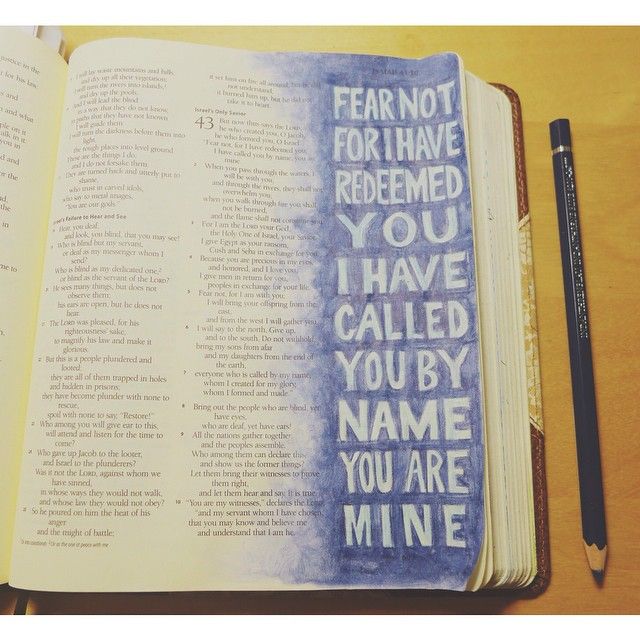
Did you hear? These verses have good news! They have within them both a command and a promise. These words are a proclamation, from the Lord, no less! “But now, this is what the Lord says—God who created you, Jacob, He who formed you, Israel: “Do not fear, for I have redeemed you.”
In the paragraphs just before our reading today, in Isaiah 42, God is called not only the creator of the heavens and the earth, but also creator of all the people on the earth. God is the “source of breath and life for humankind (42:5). Now God reveals the divine self strictly in relationship to God’s chosen ones. The God who speaks the new word of freedom, life, return, and redemption is “the creator-of-you, Jacob,” “the shaper-of-you, Israel” (verse 1). This is the transcendent God whose word created all that is good (Genesis 1).” [2]

So, God not only created the heavens and the earth, and is the creator of all that is vast and unending in this universe, but God is also the Lord of the small and the personal. The prophet proclaims God as the Lord of all, of that which is large and small, the creatures and people of this world, too.

Israel was—and is a country with desert regions and vast wilderness places. Israel was—and is also a country where sudden storms come up, and flash floods suddenly happen. That can be extremely scary, to be caught in a sudden flash flood where the water starts to rise all around you without any warning. We hear on the news today about flash floods that overwhelm people and stall out their vehicles. And sometimes, those individuals even die.

What fear! What anxiety! And, what threatening troubles!

What can we do, in the face of all of this difficulty and challenge? The prophet gives us the answer. God has redeemed us.

But—what does “redeemed” mean, anyway? Isn’t that a religious word? We certainly hear it in religious contexts. According to the dictionary, “redeem” means to buy back, to recover, as by a mortgage or pledge.

So, we are kept captive by our fear and anxiety. The nation of Israel is similarly kept captive by their fear and anxiety, too. Here in the United States, in the 21st century, we do not have debtors’ prisons any longer. However, centuries ago, when people became bankrupt and could not pay their debts, they were often either were thrown into prison or made slaves until the debt was paid.

God does not magically erase all difficulty. “God does not manipulate the created order and introduce entirely new categories: fireless existence. Rather, God redeems what God has made, and redemption involves an exchange within the created realm. A price is paid in order to set things back the way they were.” [3]
This act of redemption is not the end of things. No, the Lord does not stop there. As the prophet says in today’s reading, “I have summoned you by name; you are mine.” God speaks our name. That is what the prophet says!

In this act of speaking their name, God takes ownership. The Lord God claims Israel as God’s own and sets them free. “In these verses God speaks to God’s people not like a king on a throne pronouncing an edict, but like a lover whose heart is bursting, who has waited an eternity just to say their name. In this act of speaking their name, You are mine” means also “I have ransomed you” (43:1) [or, redeemed you]. Maker, lover, and redeemer, God will pay any price and overcome every obstacle to be reunited with God’s own. [4]

We can take heart. We can claim these precious verses as our own, as we go through fiery trials. God has called us by name, too. The Lord says “You are mine.”

Bible study teacher David Guzik states plainly “God twice owns His people. God has right of ownership both as Creator and Redeemer. God’s ownership is personal, because He says I have called you by your name. His ownership is certain, because He seals it by saying You are mine.” [5]

We have the Lord’s assurance that we are God’s creation, we are redeemed, and we have been called by God’s name. What is more, we have been bought with a price, with the precious blood of our Savior.

Knowing we belong to God is a wonderful response to fear and anxiety. So, “Be Not Afraid!” No matter the trial or difficulty, God will be with us. The Lord is right by our side. We have God’s word on it, from right here in Isaiah 43.

Alleluia, amen.

[1] https://www.blueletterbible.org/comm/guzik_david/studyguide2017-isa/isa-43.cfm

Study Guide for Isaiah 43 by David Guzik – Blue Letter Bible

[2] http://www.workingpreacher.org/preaching.aspx?commentary_id=494

Commentary, Isaiah 43:1-7  Anathea Portier-Young, Preaching This Week, WorkingPreacher.org, 2010.

[3] Seitz, Christopher R., The Book of Isaiah 40-66, New Interpreters Bible Commentary, Vol. 6 (Nashville, TN: Abingdon Press, 2001), 381.

[4] http://www.workingpreacher.org/preaching.aspx?commentary_id=494

Commentary, Isaiah 43:1-7  Anathea Portier-Young, Preaching This Week, WorkingPreacher.org, 2010.

[5] https://www.blueletterbible.org/comm/guzik_david/studyguide2017-isa/isa-43.cfm

Study Guide for Isaiah 43 by David Guzik – Blue Letter Bible

@chaplaineliza

(Suggestion: visit me at my regular blog for 2018: matterofprayer: A Year of Everyday Prayers. #PursuePEACE – and my other blog,  A Year of Being Kind . Thanks!)

Unknown's avatar

Our Stronghold, Our Peace

“Our Stronghold, Our Peace”

God, stronghold for the oppressed

March 9, 2016 – Psalm 37:39-40

Most everyone is afraid, at one time or another. And, there are some really powerful things in this world to be afraid of! Worry, anxiety, fear. Those are all things that threaten to take away any peace and serenity in our lives.

One of the enemy’s most powerful weapons that he uses against us?  Worry, anxiety, fear can overwhelm us with a thick shadow of darkness, threatening our every move and decision. Not only the huge things, but also the little things. The personal things. I know we, here at St. Luke’s Church, have a good deal to be concerned about. Things just happen.

Just when I think I’m going in a definite direction, with a specific goal in mind, things can happen. These things can just be accidental, minor bumps along the way. Or, sometimes the situations or accidents can be catastrophic, life-changing. Maybe even life-ending.

Take our psalm for the evening. A psalm of King David, David wrote about evildoers, and about the evil people seem to routinely do. Yes, there’s lots to worry about! Yes, there’s lots for us to be anxious about! Look at all the evil in the world!

No matter what kinds of things happen in our lives—and good things happen as well as bad!! —the psalm we read today is talking about the evil things that happen. Evil things complicate our lives. Make our lives messy, even confront us with dangers. Things to worry about, endlessly.

What can we do when we get into an anxious predicament like this? What if the evil, worrisome things complicate our lives beyond all imagination? It is then that we feel separate from others. What’s more, we can feel separated from God, too. Any peace we had is hopelessly gone. Worry, anxiety and fear take its place.

I have known people who do not face evil, trials, and tribulations very well. I usually didn’t ask at the time, but I think one of the reasons might have been because they were not sure whether God was really in their lives. I know for a fact that several of my acquaintances do not really care about God, and don’t want much to do with Him at all. They are totally separated from God.

There are several ways to face evil; this way is not the wisest way, to my way of thinking.

The psalmist, King David, certainly had cause to be anxious. He had been up against real evil, many times. He had been in a real mess over and over, and he had come through it repeatedly. What’s more, David knew God had been at his side all the way. And, David knew that the evildoers would get their comeuppance, sooner or later.

Remember what David said in the first two verses of this psalm: “Do not fret because of those who are evil or be envious of those who do wrong; for like the grass they will soon wither, like green plants they will soon die away.” This theme runs through this psalm, all the way through. David tells us not to worry! Yes, the evildoers might be prospering right now. Yes, the evildoers might have lots of money, and property, and power, and control. The evildoers might be doing awful things to people. But, that is not the end of the story!

Some scoffers might say, what about things that are even worse than we can imagine? Things like violence, war, rape, bombing. Why do godless people seem to get away with all these horrendous acts?

Marjorie Nelson, a Quaker nurse served with a Friends medical team in Vietnam in the late 1960’s. She is a pacifist. This is part of her story. “Our project was located six miles from My Lai [the site of a massacre by U.S. military forces]. We treated at least one survivor from that massacre. Vietnamese friends told me not only of that event but of five similar incidents perpetrated by American or Korean troops in our province alone. I saw children injured by NLF rockets which exploded near their orphanage. I treated patients in our rehabilitation center who had extremities blown off by land mines planted by both sides in that conflict. Do I under-estimate the power and influence of evil? I think not.” [1]

Some scoffers consider Christians to be naïve and easily manipulated. I don’t think so. I don’t think Marjorie, that Quaker nurse and pacifist, was naïve. Yes, we are aware of the evil that people do. Sometimes, horrible things, so awful we cannot even imagine how horrific. But we are not naïve. We have sin within ourselves, too. Plus, God’s message is to love our enemies, and be kind to them. Even when we are our own worst enemies.

David finishes the psalm with the verse “The salvation of the righteous comes from the Lord; God is their stronghold in time of trouble.”

A stronghold is not only a refuge, a place of safety, but a stronghold is also for our salvation, for offensive purposes, too! We can see that God is not only a safe place for us to hide, but also God is also a strong place to keep us free. No matter the situation, God is there for us.

God is our salvation–and we can come to the Lord at any time. We have not only the ability to come to God, but we have the privilege, too! What an opportunity. And what a thing to celebrate–we can echo the psalmist’s words, “Trust in the Lord and do good; dwell in the land and enjoy safe pasture. Take delight in the Lord, and God will give you the desires of your heart.”


[I’d like to thank Catherine Whitmire and her excellent collection of thoughts on peace found in Practicing Peace (Sorin Books: United States of America, 2007). ]

[1] Whitmire, Catherine, Practicing Peace (Sorin Books: United States of America, 2007), 126.

@chaplaineliza

Suggestion: visit me at my daily blog: matterofprayer: A Year of Everyday Prayers– where I am doing a Lenten journey.  #PursuePEACE – And my other blog,  A Year of Being Kind -Thanks!