Unknown's avatar

God Prepares a Table!

“God Prepares a Table!”
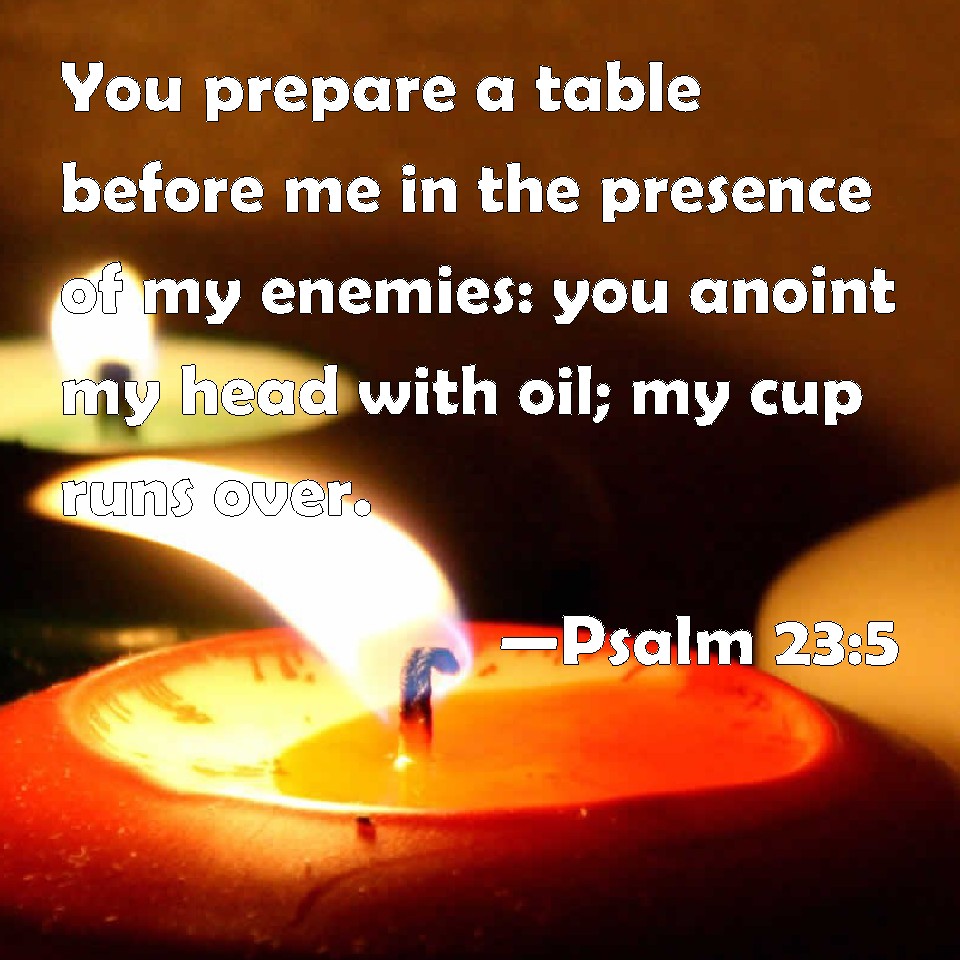
Psalm 23:5 – September 3, 2023

            I am fascinated by a painting I’ve encountered a number of times, of Jesus the Good Shepherd. This is the very first picture we have of Jesus, painted around 250 CE. It is found in the catacombs in Rome, those narrow, twisting underground tunnels. The walls are filled floor to ceiling with graves that have been dug – as tombs. Just imagine walking quietly through these twisting tunnels with a small oil lamp!

As you continue imagining, see yourself going to find fellow Christian friends who are gathering to worship by a designated grave. You need to be cautious as you listen for the clank of Roman soldiers’ armor, as you glide quietly along. Given this, it is easy to imagine why someone painted a picture of Jesus as a strong young shepherd on the ceiling of the catacomb! Jesus certainly can take care of us, as this Psalm says. [1]

Our Scripture reading today comes from the book of Psalms, and is one of the most familiar and beloved readings in the whole Bible, in either the Hebrew Scriptures or the New Testament. Countless people have turned to Psalm 23 for peace, for reassurance, in times of anxiety or struggle, and even in times of great joy. This psalm is a psalm for the ages, and has been read for centuries by believers, skeptics, and atheists alike.

            This very familiar psalm begins with the view of the Good Shepherd, taking loving care of His sheep. We hear about how the sheep depend upon the Shepherd to guide them and guard them as they roam in a flock. The sheep depend upon the Shepherd’s watchfulness and protection as they travel through dark and dangerous places. Yet, a change comes in verse five. We see the Shepherd change into a generous Host.  

            You and I know the familiar possessions many people own to show off their wealth and status. The huge, expensive, and showy house, sometimes with a large fence around it or now, in a gated community. Or, the luxury automobile, with all the bells and whistles, and a price tag I can’t even image. Except, those are signs of wealth and prestige here in the Western world, here in a culture we are familiar with.

            The traditional culture of the Middle East is very different, when it comes to displays of wealth and prosperity. “When you want the community to know that you have acquired wealth, you do not buy an expensive car or a large house. Rather, you host meals with three times as much food on the table as the numerous guests can eat.” [2]

            Such radical hospitality and generosity goes way overboard, in the eyes of many in our Western culture! But, this is the cultural way that traditional Middle Eastern people-groups show great wealth and prominence. The psalmist’s imagery goes even further. In Middle Eastern culture, men do not prepare food. Instead, women prepare the food for a banquet, and that does not mean setting a table with individual place settings and elaborate china.

Eating is carried out by tearing off a small piece of flat bread and using it to lift food from the common dish to the mouth. Each bite starts with a fresh piece of bread. There is nothing to do to ‘set the table’ except perhaps ‘spread the rugs’ (as referenced in Isa 21:5). As regards the food, servants and women prepare it. The master of the house provides the food, he does not prepare it.” [3] Several times in the Hebrew Scriptures, verses explicitly say that female involvement is instrumental for the spreading the table and serving of food.

Yet, here in verse 23:5 the psalm clearly says “You prepare a table before me in the presence of my enemies.” Here in one of our most beloved Bible passages, our God is portrayed as a nurturing, even mothering God! “Here too, what counts is that God is provides and protects. How surprising that the table spread in the presence of enemies! It is hard to relax and be fed in their presence. Yet God invites us to the table, come what may and come who may.” [4] You and I may be surprised at some of the visitors surrounding God’s welcoming table. And, for this Scripture to highlight God acting as a woman, doing traditional feminine tasks in preparing the table, is fully in keeping with numerous Scriptural references.

One of the many hymns written about Psalm 23 comes from the wonderful hymn writer Isaac Watts. “My Shepherd Will Supply My Need” is a touching reflection of the great care and nurture God takes on each of our accounts, in each of our lives.  You will note how Watts mirrors the shift in the Psalmist’s speech (from third person to second person in verse 4 and back to third person in verse 6) as he moves from the first to the second stanza.

“Much of Watts’ hymn text reflects the Psalmist speaking to the Lord. Changing the voice to second person highlights the prayerfulness of this Psalm, thereby emphasizing the more intimate relational aspect between God and God’s children.“ [5]

            As this comforting, relational psalm reminds us about the table prepared for us, the Apostle Paul references this table in 1 Corinthians 10 when mentioning Communion. Are you tired and worn, eager to come to the table of the Lord? What is more, God, our generous Host, invites us to come and partake of the abundant heavenly food and drink.

As we come together to celebrate the Lord’s Supper, we look forward to that marvelous banquet spread for all of us. For each of us. So, come. The Lord has prepared this table. Amen, alleluia.

@chaplaineliza

(Suggestion: visit me at my other blogs: matterofprayer: A Year of Everyday Prayers. #PursuePEACE – and  A Year of Being Kind . Thanks!

(I would like to express my great appreciation for Ken Bailey’s marvelous examination of all of the mentions of the Good Shepherd throughout the Bible in The Good Shepherd, the commentary published by IVP Academic in 2014. I got several excellent ideas and quotes for this sermon from this excellent book.)


[1] http://worshipingwithchildren.blogspot.com/2015/03/year-b-fourth-sunday-of-easter-april-26.html

[2] Bailey, Kenneth E., The Good Shepherd (InterVarsity Academic, Downers Grove, IL: 2014), 55-56.

[3] Ibid.

[4] https://www.workingpreacher.org/commentaries/revised-common-lectionary/ordinary-28/commentary-on-psalm-23-16

[5] https://www.workingpreacher.org/commentaries/revised-common-lectionary/fourth-sunday-of-easter-3/commentary-on-psalm-23-9

Unknown's avatar

“Held Close to God!

“Held Close to God!”

Hosea 11:1-4 – July 30, 2023

            Do you know a family who has a complicated relationship with each other? Some couples and some families have some problems that they deal with on a continuing basis. And how! I see all kinds of things in couples and families right now, in my job as hospice chaplain.

            The prophet Hosea had all kinds of problems in his relationship with his wife and family, too. I don’t know if you know much about the prophet Hosea, but he followed some specific directions from the Lord for his marriage and choice of wife. The Lord told him to marry a prostitute (who would later leave her husband). And, the Lord told Hosea to love her, cherish her and treat her really well (as all spouses ought to treat each other). This was even though – or perhaps because of – her past and future occupation.

Hosea tells a series of stories in this short book – true-life stories, from his own life. The tie-in or connection comes from a very similar story, about the nation of Israel. This true-life story “is that when God’s people were slaves in Egypt hundreds of years before this, God had freed them and led them through the wilderness to a new Promised Land.

“While they were in the wilderness God taught them what it meant to be God’s people. God gave them the 10 Commandments and taught them how to live together and how to love God. It was kind of like teaching a baby to walk. Unfortunately, when they got to the Promised Land the people forgot what God had taught them. They lied. They cheated. They stole from each other. They even worshiped other gods. God loved them too much to let it go on.” [1]

The prophet Hosea was a fascinating story-teller, and he had lots of people in the nation of Israel on the edge of their seats as he told his many-part story from God over a number of years. Hosea has moved on to relating several metaphors or parables. Like this one, here at the beginning of chapter 11.

Remember how I started this sermon? Talking about mixed-up, complicated relationships? That’s what Hosea relates at the beginning of chapter 11. Remember how the people of Israel were slaves in Egypt centuries before this time! Listen again to the words of Hosea: “When Israel was a child, I loved him, and I called my son out of Egypt. But as the saying goes, “The more they were called, the more they rebelled.”They never stopped offering incense and sacrifices to the idols of Baal.”

This child Hosea talks about? This child isn’t just one person. “The child is all God’s people – and they had been really, really rebellious for a very long time. God is about to let them be conquered and taken prisoners to Assyria. It is sort of like God was giving all the people a big “time out.” That’s the secret! “Child” is really all God’s people.” [2]

But first, before mentioning the punishment from the Lord, Hosea gets very tender. Listen to verses 3 and 4. “I took Israel by the arm and taught them to walk. But they would not admit that I was the one who had healed them. I led them with kindness and with love, not with ropes. I held them close to me;I bent down to feed them.”

In this summer sermon series, “Re-Imaging God,” we are looking at a number of Scripture readings which show the nurturing side of God. Or, a loving, mothering kind of God!

While it is much more common for Scripture to show our God as a heavenly Father, especially from the many descriptions our Lord Jesus gives to us while He was here on the earth, the imagery here is very feminine! Can you imagine a mother, teaching her little one how to walk, feeding them, and picking them up when they are hurt or injured? And, what about “leading them with kindness and love?” Our loving heavenly Parent cradling the small child Israel close. All such nurturing, caring activities. Here, Hosea gives his readers a warm, loving word-picture of our Lord. Such tender compassion shown!

Who remembers reading children’s picture books? I am thinking of several picture books I read to my small children many times. These books are about a parent who loves their child very, very much, no matter what! These books – “Runaway Bunny” by Margaret Wise Brown and “Mama, Do You Love Me” and “Papa Do You Love Me,” both by Barbara Joosse –  are wonderful expressions of the nurturing, embracing love we as human parents can show.

Hosea tells us a similar story! He insists that God loves all of the nation of Israel as much or even more than a human parent! Even when the people of Israel go their own way, stubbornly refuse to follow their God, and instead follow foreign idols, and other ungodly attractions.   Our God still loves the nation of Israel! And, our God still loves us, even when we go astray!

I can remember my small children not wanting to come home after a long playtime at the playground in the park. I would call them, and every once in a while, they would try to run away and hide, and refuse to come home. Did I walk away, and leave them there at the park? Of course not! I still loved them, even though they were disobedient. I still continued to love them, as they grew, no matter what.

We need to share a word of caution, however. In some families, relationships are definitely imperfect. Some parents feel the angry rebellion of their children. Some teachers face opposition from their students. And, some mentors want to give up on their charges. Plus, some children have parents who are distant, uncaring, or even hurtful. If that is your experience of your parents or grandparents, I am sad and sorry, and have great compassion for you. [3]

            But, there is Good News! In fact, the Greatest News of all!

Our God will never be distant, or uncaring, and especially not hurtful! Even if human relationships are like that sometimes, our relationship with our Heavenly Parent stands the test of time. The persevering love, caring and nurture of our Lord is rock solid and true. We can trust the faithfulness of God in this story that Hosea tells us. Remember, our God is always faithful, always loving, and always has arms outstretched to embrace us. No matter what.  

@chaplaineliza

(Suggestion: visit me at my other blogs: matterofprayer: A Year of Everyday Prayers. #PursuePEACE – and  A Year of Being Kind . Thanks!


[1] http://worshipingwithchildren.blogspot.com/2016/06/year-c-proper-13-18th-sunday-in.html

[2] Ibid.

[3] https://www.umcdiscipleship.org/worship-planning/prophet-margins/eighth-sunday-after-pentecost-year-c-lectionary-planning-notes