Unknown's avatar

Sacrifice of Praise

“Sacrifice of Praise”
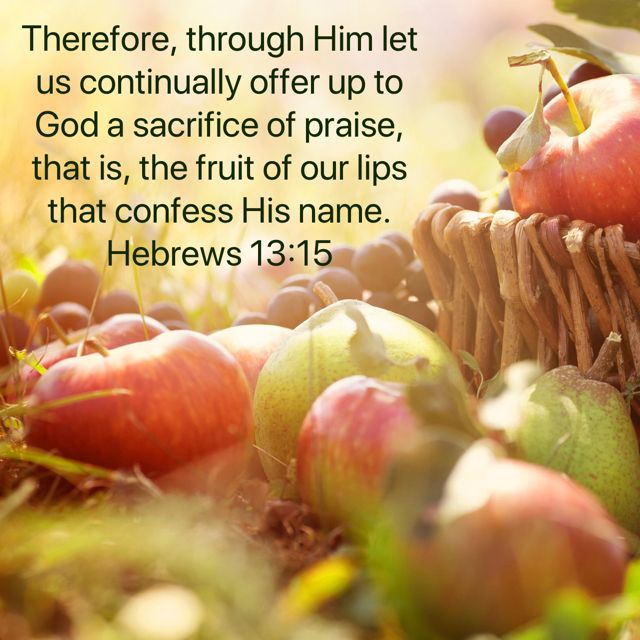
Hebrews 13:5-8, 15-16 (13:15) – August 31, 2025

            Have you ever known anyone who was really proper? Always every hair in place, always did the socially acceptable thing, and never put a toe out of line? Imagine a stern teacher, keeping order in the classroom by a mere look and a slow stare. Someone with high standards. Thinking about satisfying this kind of person makes me anxious, and nervous. I always need to be on my best behavior, minding my p’s and q’s. Just being around someone like this puts me on edge.

            But, what about putting God into the conversation? I know we are probably stretching our imaginations, but it is hard to imagine God wearing a wrinkled shirt, or with a sloppy haircut, or having a dirty face. For that matter, isn’t God perfect? Isn’t God prim and proper, always doing the right thing, never stepping out of line? Doesn’t God have incredibly high standards? Don’t we need to be on our best behavior with God, minding our p’s and q’s? Doesn’t that sum up many people’s conception of God?

Our Scripture reading today can sound like a list of rules. Do this! And, do that! And, don’t do this other thing! I can just imagine several stern Heavenly angels frowning, shaking their fingers at me if I step out of line!

However, the letter to the Hebrews was written to a bunch of scattered Jews who believed in Jesus as their Messiah, scattered in small groups throughout Asia Minor. What we know as Turkey, today. They had been chased out of Palestine by the Jewish and Roman authorities. Many of these scattered Hebrews were refugees. Migrants. People chased out of the land of their birth by an oppressive government that was out to imprison them, if not kill them, because they claimed Jesus as Lord and Messiah. So similar to migrants throughout history who come to other countries seeking asylum, because the place where they were born is very dangerous.

That is the background of the small congregations receiving this letter. This letter was copied and sent from place to place, a breath of fresh air, sound biblical teaching coming to these small groups of believers in Jesus.

Let us turn to our reading today, from Hebrews 13. At the beginning of the reading, the writer of this letter talked about sacrifice—the sacrifice for sin, which was one major way the Jews came before God in worship. In the time of the Jewish temple, it was common for Jews to bring animal offerings to God to make up for sins, to cover their sins and the sins of their loved ones, under the old covenant. One first-century Jewish idea of God was distant, angry, and even vengeful. God had incredibly high standards. God was someone to be placated. Even today, many people have that kind of view of God—a scary view. Not the view of God as loving, caring, and kind, at all.

However, we are going to flip that idea of a distant, angry, scary God. Many, many people are in fear for their religious beliefs. Governments throughout history have been cruel, indeed. Is the fear, anger and disturbance of the powerful governments today much different from the fear, anger and disturbance of the powerful people of Jesus’ day? I think not.

If we consider the wider picture today, around the world, countless followers of Christ are being actively and bitterly persecuted. It’s happening right now, in dozens of countries, officially sanctioned by their governments. Just as it was in the first century, for the small scattered congregations of Jesus followers.  

True, these scattered Hebrews in small groups have good reason to be afraid! On edge! Ready to run again. However, at the heart of this letter is a Kingdom ethic that turns worldly values upside down. Much like my summer sermon series of three years ago, when I preached on the Beatitudes, the first section of our Lord Jesus’s Sermon on the Mount from Matthew 5. That summer we looked at the Topsy Turvy Teachings of Jesus, talking about our service to others, loving mercy and kindness, and even being glad when we are persecuted, for Christ’s sake

Here, today, we can see the practical teachings in Hebrews chapter 13 as teachings of God’s Kingdom, a topsy turvy teaching which tells us that “greatness is revealed through serving others, worship is expressed in doing good, and righteousness is rooted in trusting God and acting with love. This radical re-ordering of values calls believers to live in a way that reflects the grace, justice and compassion of Christ.” [1] Truly, a topsy turvy way of living, then and now.

Instead of “pie in the sky” theological platitudes, this reading today talks about practical ways of living – and acting. These are practical ways to love others, just as Jesus told us to do. When Meier’s Bakery was donating many baked goods to our church, up until just a few years ago, we would donate those baked goods in turn to a local YMCA, for their men’s residence, which had many low-income residents. And then when we needed to stop that during the COVID shutdown, I quickly found another mission that was very grateful to receive those baked goods.

I’ve spoken about this worthy mission outreach before. A Just Harvest, which is located a block from the Howard Street El station, serves a hot meal to 200 to 250 low-income people every day, 365 days a year. This Christian group with their radical hospitality has boots on the ground. They truly welcome the stranger and reach out. They truly experience Christ’s constancy and amazing grace on a regular basis. In their daily ministry and outreach, they also rely on the Lord, as do the people in poverty they serve.[2]

            As we imitate these friends in welcoming the stranger, can there be a better way for any of us to be freed from fear, and become free to serve and praise and really live for God?

            And finally, as our instructions from Hebrews tell us, we can expand our vision of worship. Not just worship at 10:00 on Sunday morning! No, “True worship, the writer says, includes not just praise on our lips, but generosity and good works. I remind everyone: we are not doing these good works to get on God’s good side! No, the point of our good works is in response to what Jesus has done for us. Just as the whole book of Hebrews tells us!

Our freely given good works, generosity and radical welcome to all are “sacrifices pleasing to God.” It’s a complete picture of faith—one that blends word and deed, praise and practice, belief and behaviour.” [3]

            Yes, we truly bring God our sacrifice of praise! And, with boots on the ground, we can truly welcome the stranger and reach out in radical hospitality. And, we truly experience Christ’s constancy and amazing grace on a regular basis. What a way to live, the Jesus way.

Alleluia, amen.

@chaplaineliza

(Suggestion: visit me at my other blogs: matterofprayer: A Year of Everyday Prayers. #PursuePEACE – and  A Year of Being Kind . Thanks!


[1] https://www.churchofscotland.org.uk/worship/weekly-worship/weekly-worship-2025-august/31-august-twelfth-sunday-after-pentecost-year-c
[2] https://www.stewardshipoflife.org/2016/08/to-be-continued/

[3] https://www.churchofscotland.org.uk/worship/weekly-worship/weekly-worship-2025-august/31-august-twelfth-sunday-after-pentecost-year-c

Unknown's avatar

Go to Work for God!

“Go to Work for God!”

James 1:17-25 (1:19-20) – September 1, 2024

This is Labor Day weekend, all across the nation, a weekend to picnic, to barbeque, to go to the beach or pool one last time, or a weekend to get out into nature. This is the unofficial end of summer, and the beginning of our fall schedule. Even the college football season started this weekend! You know it’s got to be fall when football begins and baseball winds down.

But, it’s also Labor Day weekend – commemorating “when labor activists pushed for a federal holiday to recognize the many contributions workers have made to America’s strength, prosperity, and well-being. The first Labor Day holiday was celebrated on Tuesday, September 5, 1882, in New York City. By 1894, 23 more states had adopted the holiday, and on June 28, 1894, President Grover Cleveland signed a law making the first Monday in September of each year a national holiday.” [1]

            What does the history of our holiday of Labor Day have to do with this Bible reading from the first chapter of the letter of James? Just this: “God is at work for the health of this world God loves so much.” [2]     

            We know this letter is from the apostle James, but who on earth is he writing to? He says who, several verses back, and in fact throughout the letter. He is writing to his fellow believers in Christ, those who are dispersed, who are scattered far and wide. James refers to these fellow believers as “beloved” and “brothers,” so you can tell that he has a relationship with them. In other words, James is not just writing to some stranger in another city.

            I don’t know about you, but when I’m communicating with someone I know, it’s a lot easier for me to be open and to come straight out with important stuff I need to say.  I think it’s the same with the apostle James, especially since I’m familiar with this letter and its contents. He must have known some of these people pretty well, because he talks straight. He doesn’t pull his punches. And, what he’s communicating here in chapter 1 is pretty significant.

Remember how James began this passage? “Every generous act of giving…comes from above.” That means every generous act of giving. Not some generous acts, not only Christian acts of giving (whatever those might be). But ALL generous acts of giving. Period. No matter WHO does them. They all come from above – that is, from God, or Godly impulses. All that we do that is good comes from God, which is an amazing statement. [3]

            We all can do God’s work, all the time. Not just on Sunday.

            A natural follow-up to Godly giving and Godly working is Godly listening. James says, “19 Remember this, my dear friends! Everyone must be quick to listen, but slow to speak and slow to become angry. 20 Human anger does not achieve God’s righteous purpose.” Not only are we to listen well, what does James say next? Don’t get angry!

            James has the following advice in the following verses: “So get rid of every filthy habit and all wicked conduct. Submit to God and accept the word that he plants in your hearts, which is able to save you.” My goodness! What is James doing here, writing a heavenly advice column? It certainly sounds like it. And, heavenly advice it is, too.  

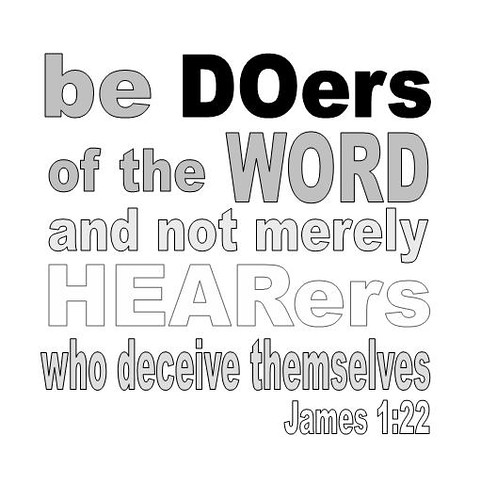
            James even gets down to specifics. Avoid these behaviors! Don’t be slow to listen! Don’t be quick to anger! Plus, promote these behaviors! Instead, be quick to listen! Be slow to speak! And most important, be “eager to care for those most vulnerable. All of these things are within our reach.” As commentator Dr. David Lose says, “What parent doesn’t want to be slower to anger with his or her children? What friend doesn’t want to be a better listener? Aren’t all of us in a position to offer help and support to those in need?” [4] James here is encouraging all of us not just to think the faith, but to do it.

            Here, James is dealing with the Law. God’s rule book. James is a faithful Jewish follower of God, and as such is thoroughly steeped in the Mosaic Law code, or God’s rule book. Moreover, he has a pragmatic way of looking at the new way of living that comes from following his Messiah Jesus. Again, don’t just think the faith or hear the faith. Instead, do it!

            I return time and again to Carolyn Brown, retired Director of Children’s Ministry and commentator on the nuts and bolts of the Bible. She breaks things down to simple, straight forward truths. She says of this reading, “At the beginning of the school year children are learning the rules for their new classes, teams and clubs.  The rules tell them who they are and how they act in each situation.  Knowing that is important to them.” [5] 

            Just so with James. God’s rule book is important to him, too! Plus, following the way of God, following these acts of giving, acts of mercy, or advocacy, or support, or friendship are available to any of us. All of us, all the time. This manual for Christian living is NOT just something we do on Sundays, not just when we are in church or thinking heavenly thoughts. We can go to work for God anytime. All the time. Anywhere. Everywhere.  

            Dr. David Lose suggests that we try something for this coming week. Each of us consider this challenge. “write down one place [you] will be in the coming week where God could use [you] to listen, to be patient, or to care for those in need.” [6]  We are hereby all commissioned as God’s co-workers and partners. We all can continue to help make this world a more trustworthy, safe and healthy place, to work for God on this Labor Day, and every day. Alleluia, amen!

@chaplaineliza

(Suggestion: visit me at my other blogs: matterofprayer: A Year of Everyday Prayers. and  A Year of Being Kind . Thanks!


[1] https://www.dol.gov/general/laborday/history

[2] https://www.workingpreacher.org/dear-working-preacher/ordinary-saints

[3] Ibid.

[4] Ibid.

[5] http://worshipingwithchildren.blogspot.com/2015/08/year-b-proper-17-22nd-sunday-in.html

[6] https://www.workingpreacher.org/dear-working-preacher/ordinary-saints

Unknown's avatar

Our Debt? Love One Another

“Our Debt? Love One Another”

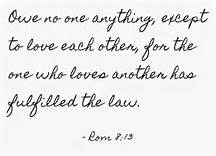
Rom 13-8 love one another, script

Romans 13:8-11 (13:8) – September 24, 2017

I am very pleased to announce that a big anniversary is coming up at the end of October. It is not just a big anniversary, it is a huge anniversary. October 31, 1517. This year, on All Hallow’s Eve, we celebrate the 500th anniversary of Martin Luther and his posting of the 95 Theses, or grievances against the hierarchy of the Catholic Church, on the chapel door at Wittenberg University, in Germany.

Many people do not even know anything about this event. Some people really could not care less. However, I care very much. I was baptized and confirmed a Lutheran and spent two years studying Luther’s Small Catechism in confirmation preparation. I was a history and theology nerd throughout high school, learning as much as I could about the Reformation of the 1500’s, and Martin Luther in particular. I was not your typical teenager.

Today, I want to finish up our short series on the book of Romans, our Epistle readings from the Revised Common Lectionary that we have focused on for the past weeks. The Apostle Paul was also one of Martin Luther’s favorite biblical authors.

The Apostle Paul gets a bad rap from some people. True, he was a Pharisee of the Pharisees. He came from impeccable bloodlines, from the tribe of Benjamin, trained at the secular college in the city of Tarsus in Asia Minor, and mentored by the renowned rabbi Gamaliel. He was puffed up about his ancestry and about his superior schooling.

Can you imagine the high-and-mighty Pharisee Saul-that-was, suddenly transformed into lowly Paul, a follower of the Messiah Jesus? Losing all that prestige, losing his position on the Sanhedrin, and also his position as an up-and-coming leader of the religious Jews. After all that, after such a come-down, Paul is not only following Jesus, but he is using his substantial rhetorical skills at persuading anyone who comes by that they ought to follow Jesus, too! That’s the situation right here, in the letter to the Roman church. We are in the middle of the practical section of the letter, where Paul gives advice and commands for his readers to listen to, and heed.

When it comes to the Hebrew Scriptures and the commands listed there, we recall the Big Ten, the Commandments given by God on Mount Sinai to Moses. The Ten Commandments were the ultimate in the commands given to the people of Israel. Even though there were more than six hundred various laws in the Law Code of Moses as written down by various biblical scholars and religious lawyers in centuries following, the Big Ten commands led the list.

Here, in our reading today, Paul lists four of these commandments, the chief commands that refer to our relationships with each other. Do not commit adultery, do not murder, do not steal, and do not covet. As a former Pharisee, I suspect Paul had learned them when very young. Repeating them was something the devout followers of the Law of Moses did on a regular basis.

Paul could have given us a repetition of the Commandments and left it at that.

But, no. Paul wanted to go beyond just a rote repetition of the Law of Moses, of the Commandments—even the Ten Commandments that the Lord God gave on Mount Sinai. What he says in this reading today is nothing short of amazing, especially coming from a former Pharisee. Listen again to verse 8: “Let no debt remain outstanding, except the continuing debt to love one another, for whoever loves others has fulfilled the law.” Full stop. Period.

And, again in verse 10, just in case anyone was not clear about what Paul was saying: “Love does no harm to a neighbor. Therefore, love is the fulfillment of the law.”

Going back to our discussion about the Reformation of the 1500’s, one of the great confessions of the Protestant Church is the Heidelberg Catechism, completed in 1562. Perhaps some of you are familiar with the first question at the beginning: “What is your only comfort, in life and in death?” The response: “That I belong—body and soul, in life and in death—not to myself but to my faithful Savior, Jesus Christ, who at the cost of His own blood has fully paid for all my sins and has completely freed me from the dominion of the devil; that He protects me so well that without the will of my Father in heaven not a hair can fall from my head.”

This Catechism was written in uncertain times, when religious wars were causing upheaval over large parts of Europe. Yet, the writers of this document have the sure certainty that Jesus Christ is, indeed, our faithful Savior, protecting us from ultimate, eternal separation from God our Heavenly Father.

Look more closely at this Catechism, which talks of human redemption, God the Father, Son and Spirit, the sacraments, prayer, and the Ten Commandments.

The section on the eighth commandment, “You shall not steal,” went right to my heart. Question 111 says: “What does God require of you in this commandment?” The response: “That I work for the good of my neighbor wherever I can and may, deal with him/her as I would have others deal with me, and do my work well so that I may be able to help the poor in their need.” What was it that Paul just said in Romans 13:10? ““Love does no harm to a neighbor. Therefore, love is the fulfillment of the law.”

Okay, love one another. But, what does that look like? How do we go about loving each other? The Rev. Dr. Alan Brehm preached on this reading from Romans, several years ago. He said, “loving your neighbor means, “if your neighbor is hungry, feed him.” It means “if your neighbor is thirsty, give her something to drink.” If there are people who are sick or hurting or suffering or alone in the world, visit them. It’s not rocket science! But it’s not easy.” [1]

The problem is, with us fallible people who sin from time to time, we forget. We fall back into old patterns, familiar but not-so-good habits. It’s all very well for Paul and the other Apostles to tell us, “love one another.” Martin Luther would be the first to tell us of his struggles with this very thing! How do we go against the grain and “love one another?” I mean, love all others? No matter who they are? I think we just heard from Dr. Brehm.

As Dr. Brehm tells us, our sinful, fallible selves are “always in the mode of “what’s in it for me?” But that’s not the kind of love the Bible teaches us. The kind of love that Jesus modeled for us and that the Apostles taught us to practice is a kind of love that simply gives to another person—without any wish to get anything in return.” [2]

The Apostle Paul gives us a big challenge today, and also a big blessing. God wants us to love one another! The Lord is so pleased when we try to love each other. As we try to love more and more, we draw closer and closer to God, and to each other. No matter who they are.

I know—from experience!—how difficult this can be. Some of us are stubborn. Some of us are afraid. Loving one another can be a really, really hard challenge. I want all of us to help each other. We can all think of one or two people we encounter on a regular basis who are difficult for us to love. I invite you all to write their names on a piece of paper. We will collect the names and the ushers will bring them forward for us all to pray over. We can ask God’s forgiveness for not loving them, and ask Jesus for His help to love one another as He loved us.

The last question in the Heidelberg Catechism is, “What is the meaning of the little word ‘Amen?’” The answer: “Amen means: this shall truly and certainly be. For my prayer is much more certainly heard by God than I am persuaded in my heart that I desire such things from Him.” We can all say, “Alleluia, amen” to that earnest, heartfelt prayer to God.

[1] http://thewakingdreamer.blogspot.com/2011/09/charity-never-fails-rom.html

A sermon preached by Rev. Dr. Alan Brehm on 9/4/11 at First Presbyterian Church, Dickinson, TX and at A Community of the Servant-Savior Presbyterian Church, Houston, TX.

[2]  Ibid.

@chaplaineliza

(Suggestion: visit me at my regular blog for 2017: matterofprayer: A Year of Everyday Prayers. #PursuePEACE – and my other blog,  A Year of Being Kind . Thanks!)

Unknown's avatar

New Life Reality

“New Life Reality”

Acts 2-42 teaching, fellowship, breaking of bread, prayers

Acts 2:42-47 – June 7, 2015

Have you ever looked through a photo album, or a scrap book? Showing memorable photos, distinctive times to remember. Hitting the high points of a person’s life, or of a family’s experiences. Or, if not the most wonderful times, at least the most significant times.

That’s what we are going to be looking at, in this summer sermon series. We are going to focus on the book of Acts, and see what vignettes Dr. Luke has for us, in this photo album of the Early Church. We’re starting with the Day of Pentecost, and its immediate aftermath. Right after Peter’s sermon, and the great big revival meeting there in the city of Jerusalem.

When last we left our intrepid heroes—I mean, the disciples—their revival meeting had a tremendous response! The report given here at the end of Acts 2 is that three thousand people came to belief in Jesus as their Messiah, who died on the cross, buried, and risen from the dead. Just as prophesied by the Hebrew Scriptures.

Now what? Sure, this extremely large group of people had their “come to Jesus” moment. The Holy Spirit blew through all of their lives. I do not at all wish to diminish this glorious experience. Dr. Luke records this marvelous “Kodak moment” in each of these individuals’ separate lives. Yes, God reached down, and touched each one.

But, in all seriousness, I repeat—now what? Where do they go from here? The group of believers in the Messiah Yeshua—or, Jesus Christ—went from a couple of dozen to 3000 people. All in one morning!

Wait just a moment: imagine a huge group of people, milling about. Think of a large location, like a high school auditorium, or a large gymnasium, or a festival at the lakefront. Now, imagine yourself plunked down in the middle of that huge crowd. We have a huge group of people who just came to a saving belief in Jesus as their Messiah. Now what? Is there any larger purpose? Any master plan?

Acts doesn’t tell us exactly who came up with this plan, but our passage today does tell us what they did. It’s a systematic listing. Four simple, straight-forward steps.

Verse 42 tells us the new believers “devoted themselves to the apostles’ teaching, and fellowship, to the breaking of bread, and the prayers.” Four simple steps are the spiritual glue that binds this miscellaneous group—diverse believers from all over creation—together as one cohesive whole.

First, the central activity: they “devoted themselves to the apostles’ teaching.” I suspect many of these 3000 people, these new believers, had only heard of Jesus of Nazareth. Some had never heard Jesus’ teachings directly, never mind about seeing His miracles! Why was this aspect so important? Because if these new believers started traipsing after their own ideas, they might go off into flights of fancy. The wild blue yonder. They needed to be grounded in solid teaching, directly from the men and women who learned from Jesus for three years. His disciples, and followers. Then they would know for sure what Jesus did—or did—not teach!

Has anyone here ever watched a plastic television preacher? Or listened to a sketchy evangelist on the radio or on a podcast? How about someone who was preaching the “health, wealth and happiness gospel?” Jesus wants us all to be healthy, wealthy and happy! Look at Job, after the Lord gave him everything back! Look at King David and King Solomon! Fabulously wealthy! All of them had favor with God, and you can, too! Just send the evangelist lots of money, and then you’ll be blessed! Just make sure you walk the straight and narrow, otherwise the Lord will smite you with sickness and poverty! Are you sick? Are your loved ones poor? Then, you’re not sending the preacher enough money! And, you don’t have enough faith!

Hold it! What I just said? False. Not true, at all.

Not the health, wealth and happiness gospel, not sending some huckster preacher or evangelist money in order to get health and prosperity. This is skillful twisting of Scripture passages, and is NOT GOOD AT ALL. This is exactly why it was so important that these new believers had ready access to the apostles, and paid such close attention to the disciples’ teaching. To prevent this kind of false teaching from getting started. It was true in the first century, and is just as true today, too!

Second on the Acts 2 list, fellowship. That means hanging out together! Eating meals together, visiting each others’ homes, going places together. This is closely followed by number three, breaking bread together. In other words, eating together! How many here just hang out together, occasionally? Visit, and be friends together?

Our friends from Love Sharing Congregation, do exactly that! If you come here early on a Sunday morning, before most people from St. Luke’s Church come into the building, you’ll find Love Sharing Congregation meeting together for early worship, and fellowship. They meet together, eat together, and hang out together. Then, again, every Sunday after 12 noon. They meet for worship service, and then eat a meal together. Be together, some more.

What a wonderful way to live out the activities the book of Acts recommends.

Fourth on the list we have “the prayers” mentioned. Not just general, private times of prayer, although the life of Jesus certainly models this for us, if anyone examines His life closely. “The prayers” probably refers to set times of prayer at the Temple. Gathering together regularly for prayer and worship was and is considered to be an important way to join together with others, horizontally, as well as joining with God, vertically.

These four things are activities that this group of brand new believers were involved in, from the get-go, from the very start. And, guess what? Their group continued to grow, and grow some more! Let’s take a special look at verses 46 and 47: “Day by day, as they spent much time together in the temple, they broke bread at home and ate their food with glad and generous hearts, 47 praising God and having the goodwill of all the people. And day by day the Lord added to their number those who were being saved.” This is what their new life together looked like! And, people noticed. They wanted to find out more.

I wonder whether the new believers might have been onto something?

On an online bulletin board, I read earlier this week about a church in Minnesota. This post was written a few years ago. I can’t tell you what the pastor’s name was, since he or she did not leave it. However, the pastor wrote about this awesome example of togetherness: communal living, spending time together, eating together, and hanging out together.

“The most profound example of communal living I see in our world is the work being done in homeless shelters. We often take our Sr. and Jr. High kids to a shelter and bring an evening meal for the shelter’s staff and residents. Individually, we cannot feed them because of the great need but, when we work together and plan together, we have more than enough to provide a good meal for the 70 or 80 residents of the shelter.

“In our church, it has become a badge of honor to insure that we can provided the best food for these folk and we now go to the shelter once a month. The point we make with our church members is that the residents of the shelter deserve our best, so we strive to provide it. Our youth like the work because it is a direct way to put their budding theology to work.”

You all see? Life together. Fellowship. Being friends. Eating and drinking together. Worshipping and praying together. Did I mention being comfortable together? This is “doing church,” at its best. Of course, we are all humans, and disagreements occur. Disappointments happen. But, this passage shows us a snapshot of what our life as a church can be!

Something to shoot for. Something to hope for. Something all of us can strive for. Wouldn’t it be marvelous if people in Morton Grove—Niles—Glenview—Park Ridge—Des Plaines—noticed what was going on here at St. Luke’s Church? The new church in Acts 2 reported “having the goodwill of all the people. And day by day the Lord added to their number those who were being saved.” This is what their new life together looked like! People noticed. They wanted to find out more.

Let’s celebrate the power of the Holy Spirit! We have that same power here. Nothing is impossible for the Spirit of God. This is a wonderful reminder of what church is all about.

Can I hear an “amen?” Alleluia, amen!

summer sermon series

@chaplaineliza

(Suggestion: visit me at my daily blog for 2015: matterofprayer: A Year of Everyday Prayers. and my other blog,  A Year of Being Kind .  Thanks!)