Unknown's avatar

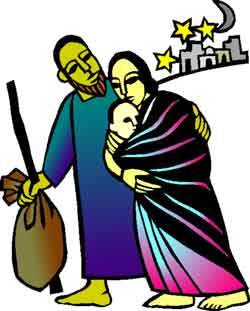
Flight into Egypt

“Flight into Egypt”

Matthew 2:13-23– December 28, 2025

            From time to time, I enjoy listening to radio serials. I suspect you all know the kind I’m thinking of. Old time radio shows like “Those Were the Days” broadcasts feature classic radio shows from the 1930’s, 40’s and 50’s. Periodically, I tune in to the show, and sometimes get caught up in an exciting, suspenseful adventure serial. Each installment usually ends with a cliffhanger, and the next installment of the serial begins: “When last we left our story . . . “

            Here, in our lectionary reading from the Gospel of Matthew, we have just such an installment. We come into the story right smack dab in the middle of things, with loose ends left hanging all over the place. It is not a pleasant story. The topic of this sermon is not pleasant, either—I’m telling you right now, up front.

            We are breaking into the Gospel account at one of the really gripping, gut-wrenching parts, but I’d like to zoom in on this particular scene. We look at Joseph, in Bethlehem, with his fiancée Mary and newborn baby Jesus. Joseph gets an emergency communique from an angel, in a dream. The angel says, “Get up, take the child and his mother and escape to Egypt. Stay there until I tell you, for Herod is going to search for the child to kill him.”

What would you do if you had to flee from danger, immediately? Be on the run at very short notice? Can you imagine you and your family traveling on an emergency basis, with the added complication of transporting a very young child?

            It may not be physical harm threatened against you or your family. However, there are many other traumatic or life-shattering things that can up-end our lives. “When you are plunged underwater by news you can scarcely comprehend, let alone respond to, how do you take your next breath? When all your visions of a joyous tomorrow are spoken out of existence by whispered words of tragedy or denial, how do you put one foot in front of another on your way into the void?” [1]

            I cannot even imagine what went through Joseph’s mind at that moment. From all accounts of King Herod and his life and reign, he was a tyrant. Looking at writings from contemporary authors of that period, Herod was cruel and bloodthirsty. He was also two-faced, as we can see from a few verses before our lectionary reading today, from his response to the Magi. He sent the Magi to Bethlehem, and requested that they come back after they find this “King of the Jews,” because Herod wished to “worship” this King as well. I have a pretty good idea of exactly what Herod wished to do to the baby Jesus from what follows.

            The Holy Family fled Bethlehem in a hurry. We know that. They fled across a distance, across boundaries, racial lines and cultural spaces. They encountered ethnic differences and language barriers, too, as they made their flight into Egypt.           

            Father James Martin wrote in a recent social media post, “It’s not surprising that in 1952, Pope Pius XII wrote: “The émigré Holy Family of Nazareth, fleeing into Egypt, is the archetype of every refugee family. Jesus, Mary and Joseph, living in exile in Egypt to escape the fury of an evil king, are, for all times and all places, the models and protectors of every migrant, alien and refugee of whatever kind who, whether compelled by fear of persecution or by want, is forced to leave his native land, his beloved parents and relatives, his close friends, to seek a foreign soil.” [2]

            I live in a suburb of Chicago, with the months-long Operation Midway Blitz occurring right here in Chicago and surrounding area. I have been praying with and for the clergy who go regularly to the federal facility in Broadview, on what has been named Faithful Fridays. I mourn with so many because of the injustice. Yes, I take the words of Jesus in Matthew 25 quite seriously. I regularly consider: what would Jesus do?

            Let us go back to the Holy Family fleeing to Egypt, in fear of King Herod and his military goons. But – I want to check in with you all as I am preaching. I know very well that these issues I am talking about are difficult for many people, traumatic for some, and even so upsetting that certain dear ones cannot even sit here and listen any longer. And – that is absolutely okay, to excuse yourself or leave the room or the sanctuary. Please, take this as an invitation for us all to tend to each other’s well-being.

            As we consider the Holy Family on the run, I would like to remind us all of countless families on the move for all kinds of reasons. Of course, some in danger for their lives! And, some on the move because of catastrophic natural disasters, or wars, or widespread extreme poverty. Sometimes, fleeing your safe, familiar town and place where you grew up is the only painful option left after heart breaking and gut-wrenching trials and traumas.

            I would like to highlight something important from Fr. Martin: “the Greek word that Matthew’s Gospel uses is a key: it’s ‘pheuge,’ to flee, one of the ancient roots of the word “refugee.” When we think of refugees, migrants and internally displaced peoples today, we are invited to remember the Holy Family, the ‘archetype,’ as Pope Pius XII said, of ‘every refugee family.’ And we should treat them accordingly.” [3]

            As we reflect upon the situation of the Holy Family as refugees, in the first century, we need to seriously consider the heartbreaking situations of so many refugees today. We are confronted with the serious question: what does God ask of us? If we look to the Bible, to both the clear commands from Micah 6:8 and from Matthew 25, consider these ringing words of Rev. Sharon Blezzard, Lutheran pastor, It does not matter whether we are considering refugees, strangers, aliens, migrants or immigrants. All are human beings, all created by God.

“We can be God’s presence to others in the midst of their suffering, and we can work to alleviate suffering, injustice, and pain in the world. Encourage [all of us] to find their voice and place of power to make a difference through small steps grounded in faithful community and fervent prayer.” [4]

            May it be so! Alleluia, amen.

@chaplaineliza

(Suggestion: visit me at my other blogs: matterofprayer: A Year of Everyday Prayers. #PursuePEACE – and  A Year of Being Kind . Thanks!


[1] https://www.umcdiscipleship.org/worship-planning/toda-la-tierra-espera/first-sunday-after-christmas-day-year-a-lectionary-planning-notes/first-sunday-after-christmas-day-year-a-preaching-notes

[2] https://x.com/JamesMartinSJ/status/2005287734017950134

[3] https://x.com/JamesMartinSJ/status/2005287734017950134

[4] https://www.stewardshipoflife.org/2013/12/refugees-all/

Unknown's avatar

Goodness and Mercy!

“Goodness and Mercy!”

Psalm 23 (23:5-6) – May 11, 2025

If you have been listening to the news at all this past week, you probably have heard: there is a new pope! Pope Leo XIV.

With the pageantry and voting by the Papal Conclave, during this last week the world has had many news stories and op-eds about the process of choosing a pope. As the Papal Conclave met, on Thursday the first North American pope was chosen, the former Robert Prevost, now Pope Leo XIV. And, not only is there a new pope, but he was born on the south side of Chicago! A real home town boy, indeed.  

As we think about this recent selection of the head of the worldwide Catholic church, several general descriptions of a representative Pope, the leader of the church, come to my mind. Some popes can be described as more this way than others, but Pope Leo sounds like he may indeed be an example of all of these.

The pope is seen as a bridge, connecting the disparate countries and regions of the Catholic church, and a bridge reaching out to other faith communities around the world. Also, a champion of the poor, the hungry, the migrant and immigrant, the least of these. And, most importantly for us today, the Pope can be seen as a Shepherd among shepherds. The Chief Shepherd for the Catholic church, caring for his sheep.

Does that sound familiar? Our Scripture reading today is Psalm 23. This reading goes along with Shepherd Sunday. Like the other Scripture readings today, it reminds us that God is our Chief heavenly Shepherd. We highlight this gorgeous expression of trust in God, written by King David several thousand years ago. Countless people over the centuries have found comfort in grief, solace and encouragement in sorrow, in these words and reflections.

As we consider the reflections of King David, thinking back to his time shepherding his father’s sheep, this psalm displays “comfort and reassurance of God’s caring presence with us throughout life, whether we’re in the ‘green pastures’ of verse 2 or the ‘darkest valley’ of verse 4. That’s definitely the narrative that the psalmist intended to describe and celebrate and from which, millions of us have taken comfort for generations past.” [1]

One of my favorite commentators Carolyn Brown reminds us that “it is important to recognize that the Good Shepherd is a metaphor and children have a hard time with metaphors.  Studies show that most children do not develop the brain skill of transference that is necessary to understand metaphors until they are into adolescence.  But, the Bible and our worship is filled with metaphors.  I suspect that we help the children claim them when we carefully explore the details of a few key ones, expecting them to become familiar with the concrete part of the metaphor and some of the spiritual realities it embodies, but not fully making the connection until later.  The Good Shepherd is definitely one of those key metaphors. 

“Dr. Maria Montessori reports that while working in a children’s hospital she found that when she told sick children stories about the Good Shepherd using small wooden figures, they almost all grabbed the figure and held onto it “for keeps.”  So the Good Shepherd made sense to them in some way.” [2]

That is all very well, to talk about the Shepherd psalm as literature and as a metaphor. But, can I personalize this scripture reading, and get some meaning out of it for me? Where am I in this psalm? Can I see myself in this scripture passage?

Yes, I certainly can, and I hope you can, too.

I can recognize myself throughout. David compares himself to a sheep, here, and the Lord God is the Good Shepherd. So, when I look at this psalm, I find I have no problem seeing myself as a sheep, too. If you imagine with me here, we can all identify as sheep in the flock that Jesus our Good Shepherd herds and leads.

This Sunday is the fourth Sunday after Easter, which many faith traditions in the Christian church celebrate as “Good Shepherd Sunday.” This is the Sunday where we particularly highlight our Good Shepherd, our true and eternal shepherd Jesus.

When we consider the Latin word for shepherd, we come upon the word “pastor.” Catholics worldwide are rejoicing that they again have what they term as a “universal pastor here on earth in Pope Leo.” [3] From all accounts, as the former Father Robert Prevost served in Peru for several decades, he was a pastor and shepherd for the local churches among the rural parishes he served. He highlights social justice. He has a heart for the poor, the underserved, the migrant and immigrant, and the stranger among us – just as our Lord Jesus told us to do, in Matthew 25.  

In Psalm 23, the Good Shepherd knows the difficulties and the dangers of the land, as well as the easy places, the pleasant, sheltered places. That’s true, in our case, too. God knows where each of us has been, and where each of us is going. God knows our every step, and our every misstep, too. God goes ahead of us, to look over the terrain, and check out any adverse conditions. There are no surprises to God.

            So, is it any wonder that this psalm ends with the marvelous words “Surely goodness and mercy shall follow me all the days of my life, and I will dwell in the house of the Lord forever.” God knows where we have been, and God knows where each of us is going. And, God is right by our sides all the way, no matter what.

            Good, devout people of faith all over the world are praying today with hope and thanksgiving for this new church leader, Pope Leo XIV. We can join our prayers with theirs as we come to God on this Shepherd Sunday, remembering our Good Shepherd, our Lord Jesus. That is truly good news for all of us! Alleluia, amen.

@chaplaineliza

(Suggestion: visit me at my other blogs: matterofprayer: A Year of Everyday Prayers. #PursuePEACE – and  A Year of Being Kind . Thanks!


[1] https://www.churchofscotland.org.uk/worship/weekly-worship/monthly/2025-may/sunday-11-may-2025-fourth-sunday-of-easter-year-c

[2] http://worshipingwithchildren.blogspot.com/2015/03/year-b-fourth-sunday-of-easter-april-26.html

[3] https://nypost.com/2025/05/10/world-news/cardinal-dolan-reveals-how-future-pope-leo-xiv-impressed-him-at-the-conclave-and-predicts-what-kind-of-pontiff-he-will-be/