

“Peace, from Generation to Generation”
Luke 1:44-56 (1:50) – December 8, 2024
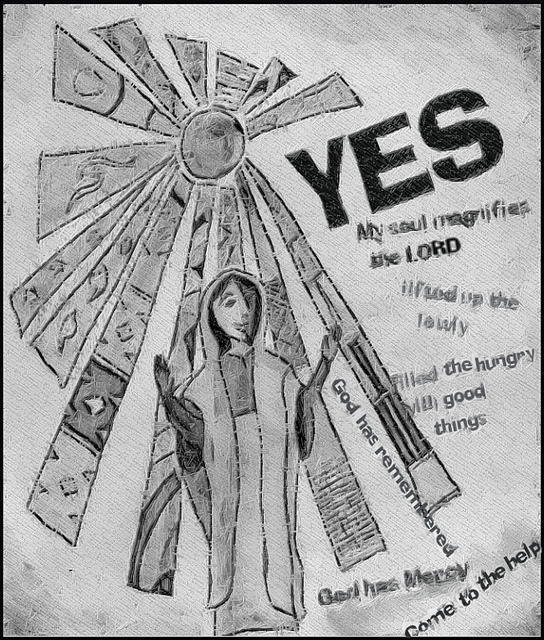
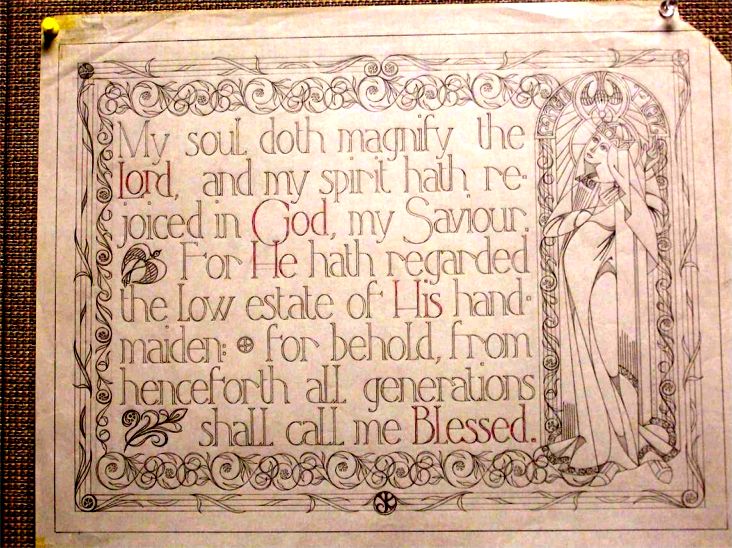
People have been writing songs about the Virgin Mary for centuries. Songs of praise, songs of worship, songs honoring God, and lifting up Mary for saying “yes” to God. Christmas carols might be the first thing that come to mind—but I am also thinking of music from centuries past. From the familiar first part of Handel’s Messiah, to the various settings of the Magnificat, with lyrics from the first chapter of Luke—our Gospel reading for this morning.
Some Protestants might not be as familiar with the Virgin Mary as many Catholics and Orthodox Christians are. Mary is held in extremely high esteem in many denominations and faith traditions throughout the world, and for excellent reasons. I honor her greatly.
If we look at our modern world today, the situation here in our country, we have a great deal of uncertainty, and very little peace. Does our world today have some strong similarities to the world that Mary inhabited? I wonder, and I would say yes.
Mary sings about the mighty work of God. Yes, personally, in her life. But also in the lives of all the people in the world. “What will this work of God look like? Something revolutionary is about to happen. God will turn the world upside down. The rich and the powerful will be brought low, and those living on the margins will be raised up. This isn’t a vision that fits very well with a Christian world that values success and power.” [1]
For, that is definitely what a large portion of the so-called “Christian world” values today. At least, here in this country, and among a large number of people who claim to follow Christian values and practices religiously. Even if certain Christian denominations do not say it outright, the “Health, Wealth and Happiness Gospel” is a high priority in many people’s lives today.
Let us take a look at what Mary’s situation consisted of. Did you know that Mary—an unwed teenager from an oppressed people-group in an occupied country under crushing Roman rule—was also a radical? A subversive? Was plotting to overthrow the existing oppressive government and replace it with the rule of God?
What surprising, even shocking things to say about the sweet, innocent Virgin Mary! Everyone associates her with travel to Bethlehem while nine months pregnant, and needing to deliver the infant Jesus in a stable, because there was no room for them in the inn.
That Mary? Radical? Subversive? Absolutely, yes.
Think about the modern Christmas season from another direction. Contrast Mary’s situation with today. Is there any place we can go where we are not bombarded with commercial messages shouting for us to “Buy, buy, buy!” and reminding us of big sales, and markdowns, and half-price! Not to mention all the pressure to be “merry and bright” all the time. Even when going to yet another event or concert or dinner or celebration is the last thing you want to do!
Let us reflect on the first chapter of Luke, on Mary’s song. The last thing on Mary’s mind was commercialism. “Mary’s song, often called the Magnificat, is a welcome contrast to the hyped-up speed of the commercialism that is too often the dominant theme in our culture during the Advent season. Her lyrics are an invitation to approach Christmas with a slower, more contemplative pace.” [2] Is it possible to slow down the frenetic pace of the holidays, to get off the commercial merry-go-round, and instead sit still and worship the coming Messiah?
Sure, the wonderful classical settings of the Magnificat were often sung in a foreign language, like Latin. Or, in text from the King James version of the Bible, full of “thee’s” and “thou’s” and all manner of archaic words. Listen to the first part of her Magnificat, as translated in the modern version by Eugene Peterson, “The Message.”
“I’m bursting with God-news; I’m dancing the song of my Savior God. God took one good look at me, and look what happened—I’m the most fortunate woman on earth! What God has done for me will never be forgotten, the God whose very name is holy, set apart from all others. His mercy flows in wave after wave on those who are in awe before Him.”
One well-known depiction of the Virgin Mary is one that is meek, docile, sweet, and not raising a fuss at all. But, wait a moment. Do we realize what Mary is going to sing next? How revolutionary were many of the statements in her song?
“Even more importantly, Mary’s song is an overture to the Gospel of Luke as a whole. Mary’s lyrics set the tone for Jesus’s radical and controversial ministry that is to come:
You have shown strength with your arm;
You have scattered the proud in the thoughts of their hearts.
You have brought down the powerful from their thrones, and lifted up the lowly;
You have filled the hungry with good things, and sent the rich away empty.
“In contrast, the Christmas season leaves too many still hungry, and too many even further in debt.” [3]
Do you hear what radical things Mary is saying? If these lyrics of her song were more well-known, would our understanding of Mary be changed? Here Mary is advocating social change, rescuing victims—neglected women, forgotten elders and children, abused strangers and refugees—from being trodden underfoot, even ground under the heel of bragging, bluffing tyrants and braggarts. Turning all society as it was in her day—and ours—upside down.
What subversive idea is our revolutionary Mary advocating now? Feeding the starving? Giving the poor a banquet? Turning the unfeeling, callous rich people out into the cold? Yes, these radical words are the words found in Luke chapter 1, before we rush on to the narrative of the birth of the Baby in Bethlehem from Luke 2.
Just looking at this Magnificat, we can see how subversive it was for the infant Messiah to be born to the Virgin Mary. And, we can begin to realize how radical it is for us to say, “O come, let us adore Him, Christ the Lord!” For Jesus truly will bring peace on earth, and He will truly turn the world upside down, just as Mary sang two thousand years ago.
But, this is still only the second Sunday of Advent. We still wait for the baby Jesus to be born in Bethlehem. We still hold our collective breath with all the rest of creation as we wait—and wait. And with Mary, we can rejoice in the promise of the coming Messiah.
Are we overwhelmed with the superficial, commercial glitz and bling of the holidays? Or, are we focused on what really matters – on the coming of our Messiah, our Lord, in God’s peace and wholeness? Let us focus on Jesus, today. Alleluia, amen.
(Suggestion: visit me at my other blogs: matterofprayer: A Year of Everyday Prayers. #PursuePEACE – and A Year of Being Kind . Thanks!
[1] http://www.bobcornwall.com/2015/12/blessed-are-you-among-women-lectionary.html
[2] http://www.patheos.com/blogs/carlgregg/2011/12/magnificat-learning-to-sing-mary%E2%80%99s-song-a-progressive-christian-lectionary-commentary-on-luke-146-55/
[3] http://www.patheos.com/blogs/carlgregg/2011/12/magnificat-learning-to-sing-mary%E2%80%99s-song-a-progressive-christian-lectionary-commentary-on-luke-146-55/
“Magnificat! Learning to Sing Mary’s Song,” Carl Gregg, Patheos, 2011.

 Pastor, Preacher, Pray-er