Unknown's avatar

But Now I See

John 9:1-41 (9:25) – March 26, 2017
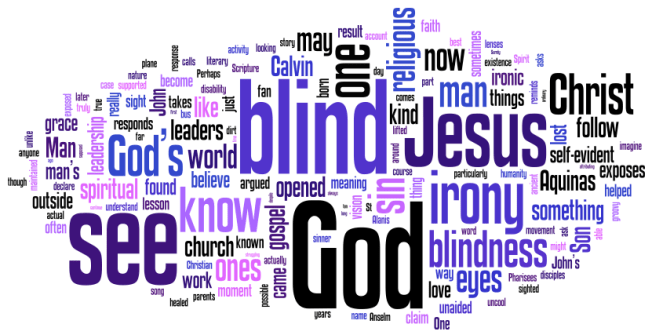
John 9 word cloud

“But Now I See”

In the first century, when Jesus walked the earth, people commonly believed a number of things that have since been proven mistaken, including something mentioned here in our Gospel passage today. When babies were born with a handicap or impediment—like born with a club foot, born with a cleft palate, or born blind—many, many people thought this was a punishment from God.

The parents were at fault. Sin was the reason the child was born that way!

In the encounter we have today in our Gospel lesson from John, Jesus deals with that kind of thinking. Let’s set the scene. “9 As Jesus was walking along, he saw a man who had been born blind. His disciples asked him, “Teacher, whose sin caused him to be born blind? Was it his own or his parents’ sin?”

In certain parts of the world today, people still think like that. Sad state of events, but that is the way it is. Some people mistakenly assign the “blame” for a “disability” or “illness.” Let’s see how Jesus responds.

Jesus answered, “His blindness has nothing to do with his sins or his parents’ sins. He is blind so that God’s power might be seen at work in him. As long as it is day, we must do the work of him who sent me; night is coming when no one can work. While I am in the world, I am the light for the world.”

Jesus rejects this blaming kind of talk! He “suggests that this man’s blindness offers the opportunity for God’s power to be revealed…. There is, in this case, physical blindness, but it’s not the only kind of blindness.  There are those who can see just fine, but live in spiritual darkness.” [1] More on that, later.

Plus, Jesus goes from talking about blindness, to God’s power, to Jesus being the light for the world. Can you follow Him in the progression of His thought? Actual, physical blindness, leading to God’s power made manifest by our Lord Jesus, who is God’s Light for the world, enlightening everyone. Back to the story.

After he said this, Jesus spat on the ground and made some mud with the spittle; he rubbed the mud on the man’s eyes and told him, “Go and wash your face in the Pool of Siloam.” (This name means “Sent.”) So the man went, washed his face, and came back seeing.

A man, born blind, made to see? This is a miracle, by anyone’s estimation! But, this is not quite a happily-ever-after story. By no means the end of our story.

13 Then they took to the Pharisees the man who had been blind. 14 The day that Jesus made the mud and cured him of his blindness was a Sabbath. 15 The Pharisees, then, asked the man again how he had received his sight. He told them, “He put some mud on my eyes; I washed my face, and now I can see.” Here is a clear statement of facts, as reported by the man who formerly was born blind.

We can tell the Pharisees believed the commonly held theological position of the day: illness and disability were God’s punishment for sin. What is more, people disagreed about whose sin was responsible for this former baby’s (now grown man’s) blindness. Most thought it was the parents. However, some thought that the newborn baby had somehow sinned! (Hard to believe, but true.)

On top of that, the Pharisees had some unkind words for this upstart Rabbi Jesus. Imagine, healing on a Sabbath! Who does He think He is?

16 Some of the Pharisees said, “The man who did this cannot be from God, for he does not obey the Sabbath law.” Others, however, said, “How could a man who is a sinner perform such miracles as these?” And there was a division among them. 17 So the Pharisees asked the man once more, “You say he cured you of your blindness—well, what do you say about him?” “He is a prophet,” the man answered. 18 The Jewish authorities, however, were not willing to believe that he had been blind and could now see, until they called his parents 19 and asked them, “Is this your son? You say that he was born blind; how is it, then, that he can now see?”

The Pharisees could not see past the noses on their faces. All they could see was healing, or work being done on the Sabbath, which was forbidden in their strict interpretation of the Law of Moses. That was huge, in their eyes. Hugely wrong!

Looking for additional people to cast blame on, the Pharisees just did not believe this guy who was formerly blind—so they called his parents!

20 His parents answered, “We know that he is our son, and we know that he was born blind. 21 But we do not know how it is that he is now able to see, nor do we know who cured him of his blindness. Ask him; he is old enough, and he can answer for himself!” 22 His parents said this because they were afraid of the Jewish authorities, who had already agreed that anyone who said he believed that Jesus was the Messiah would be expelled from the synagogue. 23 That is why his parents said, “He is old enough; ask him!”

24 A second time they called back the man who had been born blind, and said to him, “Promise before God that you will tell the truth! We know that this man who cured you is a sinner.” 25 “I do not know if he is a sinner or not,” the man replied. “One thing I do know: I was blind, and now I see.”

One of the most familiar and beloved traditional hymns is “Amazing Grace.” This hymn talks about several important things, including salvation. The hymn also talks about blindness, and the change that comes into a person’s life when they receive sight—spiritual sight. “Was blind, but now I see.” What a theological truth. What a profound insight. Jesus wasn’t blinded at all to seeing this man born blind.

It is the Pharisees who have been blind—spiritually blind—and they don’t even know it. “The religious leaders remain spiritually blind, still contending that the work of Jesus is demonic.  In their resistance to [Jesus,] their blindness – their sin – is revealed.” [2]

Is this just some nice bible story, or could it apply to us, today? Similar to the Pharisees, are we so preoccupied with our own holiness and righteousness that we are blinded? I mean, spiritually blinded to seeing signs of God’s work right here in our midst? [3]

“How does Jesus open our eyes to the things of God?  How does he reveal our blind spots so that we can let go of them and give glory to God? The good news is that there is amazing grace available to us.” [4] We can testify, along with this formerly blind man, “One thing I do know: I was blind, and now I see.”

This is something to celebrate! Jesus can open our eyes to those around us. We can be healed of our spiritual blindness and come into the light of God’s presence, and be able to testify to others of God’s light-giving and grace-giving. Praise God! Amen.

[1] http://www.bobcornwall.com/2014/03/who-is-really-blind-lectionary.html

[2] http://www.bobcornwall.com/2014/03/who-is-really-blind-lectionary.html

[3] https://www.umcdiscipleship.org/worship/lectionary-calendar/fourth-sunday-in-lent-one-great-hour-of-sharing#preaching

[4] http://www.bobcornwall.com/2014/03/who-is-really-blind-lectionary.html

@chaplaineliza

(Suggestion: visit me at my regular blog for 2017: matterofprayer: A Year of Everyday Prayers. #PursuePEACE – and my other blog,  A Year of Being Kind . Thanks!)

Unknown's avatar

Generous With Our Words

“Generous With Our Words”

Jesus cures the blind man John 9

John 9:38 – March 15, 2015

In our sermon today, we are going to consider a situation where Jesus met a man who was born blind, and healed him. Miraculously! I could preach an awesome sermon on the blind man, or on the healing. But I want us to look at the aftermath of the healing. As we consider this man, I would like you to think about his lonely, isolated, marginalized situation, too.

I want to read chapter 9, from the Gospel of John. I’ll be reading from a modern translation called “The Message,” by Eugene Peterson.

True Blindness

1-2 Walking down the street, Jesus saw a man blind from birth. His disciples asked, “Rabbi, who sinned: this man or his parents, causing him to be born blind?”

3-5 Jesus said, “You’re asking the wrong question. You’re looking for someone to blame. There is no such cause-effect here. Look instead for what God can do. We need to be energetically at work for the One who sent me here, working while the sun shines. When night falls, the workday is over. For as long as I am in the world, there is plenty of light. I am the world’s Light.”

6-7 Jesus said this and then spit in the dust, made a clay paste with the saliva, rubbed the paste on the blind man’s eyes, and said, “Go, wash at the Pool of Siloam” (Siloam means “Sent”). The man went and washed—and saw.


The Rabbi Jesus performed another miracle! And this time, He healed a man who had a dark cloud over his head. The man was born blind. He had never, ever been able to see anything. We can tell how he was isolated. Shunned. And like I just read, certain people blamed the man for being born blind. “Well, he must have done something to be born that way!” Treated in that way, we can see how he was marginalized! Other people blamed his parents. “Serves them right! Look at them, having a child born blind! Just a nuisance, a drag on them and their lives.”

Isn’t that like some people today? Isolating, shunning, marginalizing people because of some seeming disability. What kinds of negative, judgmental things are they thinking of? Whose cynical words are they paying attention to? Are they like the disciples, or the other townspeople, listening to their own preconceived, sometimes faulty judgments?

Let’s hear what happens next, in our reading today.

Soon the town was buzzing. His relatives and those who year after year had seen him as a blind man begging were saying, “Why, isn’t this the man we knew, who sat here and begged?”

Others said, “It’s him all right!” But others objected, “It’s not the same man at all. It just looks like him.” He kept saying, “It’s me, the very one.”

10 They said, “How did your eyes get opened?”

11 “A man named Jesus made a paste and rubbed it on my eyes and told me, ‘Go to the pool of Siloam and wash.’ I did what he said. When I washed, I saw.”

12 “So where is he?” “I don’t know.”

We can hear the disbelief of everyone in the town. The townspeople were arguing! Some said this guy was the blind man. Others said he couldn’t be. He, himself, kept on saying, “Yes, I am! I’m the one! It’s me, the very guy!”

The former blind man’s words showed he was fully aware of what it was like, what happened, and what it’s like now. He knew very well how he had regained his sight! And after the healing, Jesus was nowhere to be found. Let’s continue. See what happens next!

13-15 They marched the man to the Pharisees. This day when Jesus made the paste and healed his blindness was the Sabbath. The Pharisees grilled him again on how he had come to see. He said, “He put a clay paste on my eyes, and I washed, and now I see.”

16 Some of the Pharisees said, “Obviously, this man can’t be from God. He doesn’t keep the Sabbath.”

Others countered, “How can a bad man do miraculous, God-revealing things like this?” There was a split in their ranks.

                We see the Pharisees as official, religious people of the town. They were the ‘judges’ or ‘experts’ for all things religious, in their day. They ruled on proper behavior and correct rule-keeping, as far as everyone’s daily lives were concerned. The Pharisees were meticulous in following the Mosaic Law code! You had better believe they made sure that everyone else followed the law code just as closely as they did, or else everyone would hear about it!

We know the blind man had been begging outside the Temple for years. However, the religious leaders had paid so little attention to him! Now that he had sight, they did not recognize him when he was not in his usual place, begging. The Pharisees had never even noticed him, a person, except to toss a few coins in his cup. This blind guy was totally marginalized, even shunned. Jesus on the other hand, saw him and paid attention to him.  He treated the man as a real, worthwhile person. In response to his need, Jesus healed him. And was promptly criticized.

17 The Pharisees came back at the blind man, “You’re the expert. He opened your eyes. What do you say about him?”

He said, “He is a prophet.”

18-19 The Jews didn’t believe it, didn’t believe the man was blind to begin with. So they called the parents of the man now bright-eyed with sight. They asked them, “Is this your son, the one you say was born blind? So how is it that he now sees?”

20-23 His parents said, “We know he is our son, and we know he was born blind. But we don’t know how he came to see—haven’t a clue about who opened his eyes. Why don’t you ask him? He’s a grown man and can speak for himself.” (His parents were talking like this because they were intimidated by the Jewish leaders, who had already decided that anyone who took a stand that this was the Messiah would be kicked out of the meeting place. That’s why his parents said, “Ask him. He’s a grown man.”)

In this specific case of the formerly-blind man, the Pharisees carefully investigated this guy. They brought questioning words, and made cynical, unbelieving comments. Plus, we can see how the super-religious people intimidated the townspeople, not to mention the blind man’s parents. The leaders badgered them into saying that this healing Rabbi Jesus was definitely not the Messiah. The townspeople listened to their own fears. They didn’t want to be ostracized, too!

The judgmental attitude of the religious leaders was aided by their skeptical, angry words, capped by. “This man can’t heal on the Sabbath! This man can’t possibly be from God!” The Pharisees were blinded by their meticulous rule-keeping. They were hindered from seeing the marvels of God and God’s miraculous working. But, back to the reading.

24 The Pharisees called the man back a second time—the man who had been blind—and told him, “Give credit to God. We know this man is an impostor.”

25 He replied, “I know nothing about that one way or the other. But I know one thing for sure: I was blind . . . now I see.”

26 They said, “What did he do to you? How did he open your eyes?”

27 “I’ve told you over and over and you haven’t listened. Why do you want to hear it again? Are you so eager to become his disciples?”

28-29 With that they jumped all over him. “You might be a disciple of that man, but we’re disciples of Moses. We know for sure that God spoke to Moses, but we have no idea where this man even comes from.”

30-33 The man replied, “This is amazing! You claim to know nothing about him, but the fact is, he opened my eyes! It’s well known that God isn’t at the beck and call of sinners, but listens carefully to anyone who lives in reverence and does his will. That someone opened the eyes of a man born blind has never been heard of—ever. If this man didn’t come from God, he wouldn’t be able to do anything.”

34 They said, “You’re nothing but dirt! How dare you take that tone with us!” Then they threw him out in the street.

35 Jesus heard that they had thrown him out, and went and found him. He asked him, “Do you believe in the Son of Man?”

36 The man said, “Point him out to me, sir, so that I can believe in him.”

37 Jesus said, “You’re looking right at him. Don’t you recognize my voice?”

38 “Master, I believe,” the man said, and worshiped him.

39 Jesus then said, “I came into the world to bring everything into the clear light of day, making all the distinctions clear, so that those who have never seen will see, and those who have made a great pretense of seeing will be exposed as blind.”

40 Some Pharisees overheard him and said, “Does that mean you’re calling us blind?”

41 Jesus said, “If you were really blind, you would be blameless, but since you claim to see everything so well, you’re accountable for every fault and failure.”

In the final act of this chapter, we see the former blind man meeting Jesus. He had already mentioned the miracle-working power of the Rabbi Jesus to the Pharisees, and was thrown out on his ear for his bold statements. Then, he runs into Jesus. Remember, he had never seen Jesus before. Only heard Him. What do you know, the man addresses Jesus with believing words! The former blind man’s eyes were opened in a number of ways!

Just as the townspeople and the Pharisees were blinded by their fears, skepticism, and preconceived notions, the same thing might very well happen to us today. We can strive to be like the man born blind, who gave witness, and told the religious leaders what happened after he was healed. The man sees what Jesus has done, and gives Jesus believing words, too! Speaking up for Jesus! Can we speak up for Jesus? Or will we hide in a corner? Can we offer each other generous, positive, God-focused words? Or, will we keep quiet, be timid, duck our heads and run away? This is a challenge all of us can listen to today.

Thank God, we can offer each other encouraging words! Generous words! Positive, God-honoring words! Just like the formerly blind man. We, too, can say we believe Jesus. Praise God! Amen.


Thanks to Eugene Peterson for his wonderful translation The Message. I quoted John chapter 9, around which I have interwoven this message.

@chaplaineliza

Thanks to the kind friends at http://www.40acts.org.uk – I am using their sermon suggestions for Lent 2015. Do Lent generously!

(Suggestion: visit me at my daily blog for 2015: matterofprayer: A Year of Everyday Prayers. Thanks!)