Unknown's avatar

Flight into Egypt

“Flight into Egypt”

Matthew 2:13-23– December 28, 2025

            From time to time, I enjoy listening to radio serials. I suspect you all know the kind I’m thinking of. Old time radio shows like “Those Were the Days” broadcasts feature classic radio shows from the 1930’s, 40’s and 50’s. Periodically, I tune in to the show, and sometimes get caught up in an exciting, suspenseful adventure serial. Each installment usually ends with a cliffhanger, and the next installment of the serial begins: “When last we left our story . . . “

            Here, in our lectionary reading from the Gospel of Matthew, we have just such an installment. We come into the story right smack dab in the middle of things, with loose ends left hanging all over the place. It is not a pleasant story. The topic of this sermon is not pleasant, either—I’m telling you right now, up front.

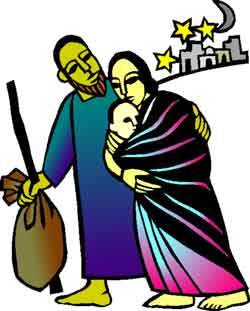
            We are breaking into the Gospel account at one of the really gripping, gut-wrenching parts, but I’d like to zoom in on this particular scene. We look at Joseph, in Bethlehem, with his fiancée Mary and newborn baby Jesus. Joseph gets an emergency communique from an angel, in a dream. The angel says, “Get up, take the child and his mother and escape to Egypt. Stay there until I tell you, for Herod is going to search for the child to kill him.”

What would you do if you had to flee from danger, immediately? Be on the run at very short notice? Can you imagine you and your family traveling on an emergency basis, with the added complication of transporting a very young child?

            It may not be physical harm threatened against you or your family. However, there are many other traumatic or life-shattering things that can up-end our lives. “When you are plunged underwater by news you can scarcely comprehend, let alone respond to, how do you take your next breath? When all your visions of a joyous tomorrow are spoken out of existence by whispered words of tragedy or denial, how do you put one foot in front of another on your way into the void?” [1]

            I cannot even imagine what went through Joseph’s mind at that moment. From all accounts of King Herod and his life and reign, he was a tyrant. Looking at writings from contemporary authors of that period, Herod was cruel and bloodthirsty. He was also two-faced, as we can see from a few verses before our lectionary reading today, from his response to the Magi. He sent the Magi to Bethlehem, and requested that they come back after they find this “King of the Jews,” because Herod wished to “worship” this King as well. I have a pretty good idea of exactly what Herod wished to do to the baby Jesus from what follows.

            The Holy Family fled Bethlehem in a hurry. We know that. They fled across a distance, across boundaries, racial lines and cultural spaces. They encountered ethnic differences and language barriers, too, as they made their flight into Egypt.           

            Father James Martin wrote in a recent social media post, “It’s not surprising that in 1952, Pope Pius XII wrote: “The émigré Holy Family of Nazareth, fleeing into Egypt, is the archetype of every refugee family. Jesus, Mary and Joseph, living in exile in Egypt to escape the fury of an evil king, are, for all times and all places, the models and protectors of every migrant, alien and refugee of whatever kind who, whether compelled by fear of persecution or by want, is forced to leave his native land, his beloved parents and relatives, his close friends, to seek a foreign soil.” [2]

            I live in a suburb of Chicago, with the months-long Operation Midway Blitz occurring right here in Chicago and surrounding area. I have been praying with and for the clergy who go regularly to the federal facility in Broadview, on what has been named Faithful Fridays. I mourn with so many because of the injustice. Yes, I take the words of Jesus in Matthew 25 quite seriously. I regularly consider: what would Jesus do?

            Let us go back to the Holy Family fleeing to Egypt, in fear of King Herod and his military goons. But – I want to check in with you all as I am preaching. I know very well that these issues I am talking about are difficult for many people, traumatic for some, and even so upsetting that certain dear ones cannot even sit here and listen any longer. And – that is absolutely okay, to excuse yourself or leave the room or the sanctuary. Please, take this as an invitation for us all to tend to each other’s well-being.

            As we consider the Holy Family on the run, I would like to remind us all of countless families on the move for all kinds of reasons. Of course, some in danger for their lives! And, some on the move because of catastrophic natural disasters, or wars, or widespread extreme poverty. Sometimes, fleeing your safe, familiar town and place where you grew up is the only painful option left after heart breaking and gut-wrenching trials and traumas.

            I would like to highlight something important from Fr. Martin: “the Greek word that Matthew’s Gospel uses is a key: it’s ‘pheuge,’ to flee, one of the ancient roots of the word “refugee.” When we think of refugees, migrants and internally displaced peoples today, we are invited to remember the Holy Family, the ‘archetype,’ as Pope Pius XII said, of ‘every refugee family.’ And we should treat them accordingly.” [3]

            As we reflect upon the situation of the Holy Family as refugees, in the first century, we need to seriously consider the heartbreaking situations of so many refugees today. We are confronted with the serious question: what does God ask of us? If we look to the Bible, to both the clear commands from Micah 6:8 and from Matthew 25, consider these ringing words of Rev. Sharon Blezzard, Lutheran pastor, It does not matter whether we are considering refugees, strangers, aliens, migrants or immigrants. All are human beings, all created by God.

“We can be God’s presence to others in the midst of their suffering, and we can work to alleviate suffering, injustice, and pain in the world. Encourage [all of us] to find their voice and place of power to make a difference through small steps grounded in faithful community and fervent prayer.” [4]

            May it be so! Alleluia, amen.

@chaplaineliza

(Suggestion: visit me at my other blogs: matterofprayer: A Year of Everyday Prayers. #PursuePEACE – and  A Year of Being Kind . Thanks!


[1] https://www.umcdiscipleship.org/worship-planning/toda-la-tierra-espera/first-sunday-after-christmas-day-year-a-lectionary-planning-notes/first-sunday-after-christmas-day-year-a-preaching-notes

[2] https://x.com/JamesMartinSJ/status/2005287734017950134
[3] https://x.com/JamesMartinSJ/status/2005287734017950134

[4] https://www.stewardshipoflife.org/2013/12/refugees-all/

Unknown's avatar

God with Us, God’s Peace

“God with Us, God’s Peace”

Matthew 1:18-25 (1:23) – December 18, 2022

            Where does your name come from? What do our first names mean? Do you know? Are you named after someone beloved or meaningful in our families? Many parents choose their children’s names carefully, and sometimes name them after someone beloved or meaningful to them or their family. Several of my older brothers and sisters have names like that. I suspect some relatives of yours do, too.

            The name Jesus had a special meaning. But before we get to that, let’s talk about this reading from the Gospel of Matthew. This is not the typical reading associated with Christmas! This is not the reading with Mary or the Magnificat, or with the angels, the shepherds, the star shining in the east, and shepherds rushing to find the Baby in Bethlehem. That is the reading from Luke chapter 2. Instead, we have today’s reading from Matthew chapter 1. This is the Nativity from Joseph’s point of view.

We can’t know much about Joseph and Mary’s marriage preparations, other than some generalities that we understand from cultural and historical studies of their area and the society of the time. But, I have some experience with people. I have learned how many people behave, frequently, on different occasions. I can tell you right now that from my observations, people have not changed much over the centuries.

            Matthew tells us that Joseph observes the Law of God. That is huge! Can you say that about yourself? Can I? Are we faithful to God’s laws? Since Matthew is a faithful Jew, this law-keeping is obviously very important to him. The very next thing we hear is that Mary is pregnant, and not by Joseph! What does that mean to Joseph, who is so faithful to the Law of Moses? Matthew does let his readers know that Joseph wants to dissolve the betrothal quietly.

How often, even today, do we make plans? Trying to fix, manage and control people, places and things? Doing our best to make sure all our ducks are in a row, making sure that everything is just right, trying to orchestrate everything, so that nothing is left to chance?

We can see that Joseph made plans, too! Yes, he cared enough for Mary – pregnant as she was – that he planned to divorce her, to break the betrothal quietly. He wanted to organize what he could of his life, while still being considerate of her. But, what happened next?

            Let’s take a closer look at Matthew’s words: “But after Joseph had considered this, an angel of the Lord appeared to him in a dream and said, “Joseph son of David, do not be afraid to take Mary home as your wife, because what is conceived in her is from the Holy Spirit.”

Sure, Joseph had lots of fear and anxiety, because of the unknown and unexpected. Because of a situation he did not plan for. The angel came to him with words of comfort and hope. Can you imagine how heartwarming this must have been for Joseph, hearing these words from an angel sent from God? Can you imagine how earthshaking it would be for an angel, a messenger sent from God, delivering words of comfort and hope to us?

            We do not know much about Joseph at all, from the biblical record. He does not get very much attention, compared to Mary. But, this appearance of the angel of the Lord is certainly dynamic! In case Joseph had second thoughts about where the baby came from, the angel’s words gave Joseph no doubt: “what is conceived in Mary is from the Holy Spirit.”

            Joseph and Mary were even told what the child’s name would be! As I said a few minutes ago, names can be meaningful. In this case, Jesus’ name means something very important. Let us hear what the angel said: “Mary will give birth to a son, and you are to give him the name Jesus, because he will save his people from their sins.”       

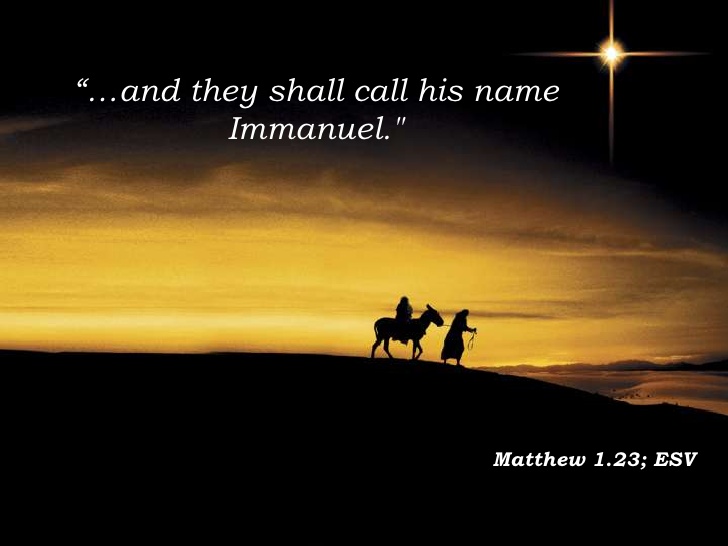
            The name “Jesus” means “the Lord saves,” revealing the birth of the Savior of the world. This statement is an angelic birth announcement of an historic nature, indeed! But, this is not all. Matthew goes on to give the words of the prophet Isaiah: “All this took place to fulfill what the Lord had said through the prophet: 23 “The virgin will conceive and give birth to a son, and they will call him Immanuel” (which means “God with us”).

            My favorite bible commentator Carolyn Brown states, “The name Joseph and Mary are to give this child is Immanuel, “God with us.”  When we want to know what God is like, we look at Jesus.  Jesus once said, “If you have seen me, you have seen God.  What I say is what God says.  What I do is what God does.” [1]  In Isaiah the name Immanuel is defined and connected to God’s promise to be with us, even right by our sides. In the gospel Joseph is instructed to name the baby both Jesus and Immanuel. God-with-us.  

            A preview of what is to come at the end of Matthew’s Gospel is also a reminder to all of us. “The last sentence in Matthew 28 and Jesus’ last words: “remember I am with you always, even to the end of the age.”  “I will be with you” is God’s promise to us always.  It was God’s promise for hundreds of years before Jesus was born, God’s promise was God-with-us when Jesus was alive, and is God’s promise to us forever. [2]

What better source for a name than a God-given name? How amazing is the prophecy from Isaiah that lets us know God will always be right by our sides!

Unexpected situations may come up, but they are not unexpected to God. Human plans may fail, but God never fails. Through it all, God is faithful in all God does, and we can count on the Lord one hundred percent. Immanuel – God with us!


[1] http://worshipingwithchildren.blogspot.com/2013/08/year-fourth-sunday-of-advent-december.html

[2] Ibid.

@chaplaineliza

(Suggestion: visit me at my other blogs: matterofprayer: A Year of Everyday Prayers. #PursuePEACE – and  A Year of Being Kind . Thanks!

Unknown's avatar

Dad’s Favorite!

“Dad’s Favorite!”

Gen 37 Jacob shown bloodstained coat - Rembrandt

Genesis 37:3-4 – June 30, 2019

“It’s not fair!” Who remembers hearing brothers, sisters, or cousins say that? “He gets more!” “I don’t have any!” “He has fancy gym shoes!” or, “She takes special classes, but what do I do? Nothing!” At its worst, sibling rivalry can tear a family apart. When brothers and sisters fight among themselves, hurt feelings and disgruntled relations often result as bickering and arguments break out. These hurt feelings can fester for years, even for decades.

But, what if the whispers and even shouts of “It’s not fair!” happen because a parent plays favorites, elevating one sibling over all the rest? Hurt feelings can become downright animosity, which can fester, simmer, and flare up repeatedly in a lifetime. This animosity can be a devastating family-destroyer.

This very sad topic is what we see, taking a closer look at Genesis 37. Jacob plays favorites with his favorite son, Joseph.

In Sunday school, children often learn about young Joseph and his coat of many colors. Or, as lyricist Tim Rice and composer Andrew Lloyd Weber referred to it in their classic musical, Joseph and the Amazing Technicolor Dreamcoat. Children get all excited by the many-colored coat. This bible story from Genesis is a great opportunity for making something colorful and memorable for a children’s craft. Often, children do learn about Joseph being his father’s favorite, but not as much about how Joseph tattled on his older brothers, and brought the tales back to his father Jacob. Being a rat like that would not help relations between siblings, either.

But, what was this coat that Jacob gave to Joseph? One of my favorite commentators, Carolyn Brown, wonders about this, too. “Depending on the translation, it was a fancy coat, a beautifully decorated coat, a coat with long sleeves (for one who does not have to work), or a coat of many colors. The Bible was written in another language centuries ago and no one knows exactly what kind of coat it was.” [1] Whatever kind of coat it was, it certainly caused trouble. 

Jacob did not have a simple marriage like those we are familiar with—like we do, in the United States today. No, Jacob had two wives, Rachel and Leah. Plus, Rachel and Leah each had a maidservant, Bilhah and Zilpah. According to the customs of several thousand years ago, Rachel—being a legitimate wife of Jacob—could claim any sons her maid bore if Jacob slept with her. The same went for Leah, being a legitimate wife of Jacob. So, Jacob ended up having four wives, essentially. And, lots of sons. That was where Jacob’s twelve sons came from: from Jacob sleeping with Rachel, Leah, Bilhah and Zilpah.

We might also be familiar with a big pack of kids, cousins, brothers and sisters, kids on the block or the playground. This was what Joseph and his brothers were—a really large family. Plus, little brother Joseph was a little big for his britches. He boasted a lot. You know the type.

After Joseph got the fancy coat from his dad, Jacob, he had a dream. “Listen to this dream I had: We were binding sheaves of grain out in the field when suddenly my sheaf rose and stood upright, while your sheaves gathered around mine and bowed down to it.” His brothers said to him, “Do you intend to reign over us? Will you actually rule us?” And they hated him all the more because of his dream and what he had said.”

Even his father Jacob and mother Rachel got sick and tired of Joseph and his arrogant boasting. Here is Joseph’s second dream: “Listen,” he said, “I had another dream, and this time the sun and moon and eleven stars were bowing down to me.” 10 When he told his father as well as his brothers, his father rebuked him and said, “What is this dream you had? Will your mother and I and your brothers actually come and bow down to the ground before you?” 11 His brothers were jealous of him, but his father kept the matter in mind.” That is, Jacob remembered the boasting dreams that Joseph had. What is more, these dreams would work out to be true in an unimaginable way. But, we are jumping years ahead to the end of the story, already.

If we take a closer look at Jacob, the dad of these twelve brothers, Jacob was no ideal father figure. He not only played favorites with one particular son, but he chose one favorite above the others among his wives and concubines. Rachel was his cherished, favorite wife, and Joseph was her older son. Benjamin was Rachel’s younger son—Jacob’s youngest son, and Rachel died of complications from his birth.

Yes, there was tumult, tragedy and trauma in the whole extended family, going all the way back to the time Jacob was working for Leah’s and Rachel’s, the two sisters’ dad—Laban. Father-in-law Laban was no prize winner where his ethics were concerned. He hoodwinked Jacob into marrying the more unattractive older sister Leah in addition to the beautiful younger sister Rachel. This whole family was messed up, from way back. So, are we surprised if sibling rivalry, hurt feelings and even outright animosity affect all twelve brothers?    

In many ways, a lot of us sympathize with the other brothers. Joseph was a boastful, arrogant pain in the backside. Plus, the brothers had a legitimate complaint against their father who was playing favorites. So many have heard this sadly familiar refrain over and over again. “It wasn’t fair that Joseph got the fancy coat and they had their old clothes. It wasn’t fair that the youngest brother was not required to work with the others and was actually sent to check up on them. Where the brothers got into trouble was when they used an unfair strategy (selling their defenseless brother [as a slave]) to get what seemed only fair for themselves.” [2]

When family members plot and plan against other members of their own family, that is definitely a sign that something is really wrong and really dysfunctional. Perhaps we have been so angry at one of our family members—or a good friend—that we might even have wanted to do something mean or hurtful to them. This seems like something a person who is far from God might want to do—complete with rubbing the hands together and an evil laugh.

Our New Testament reading today is from Romans 2. The apostle Paul lets the believers in Rome know that God judges all people the same—Jews and Gentiles alike. God does not play favorites—unlike Jacob in our sermon passage from Genesis 37.

We know how Jesus responded to people who were unkind to Him, even hated Him. He loved them—all of them. How do you think God wants us to respond when people are unkind to us, or when we don’t like other people? Would God want us to be mean and nasty, and turn our backs on them? Or, would God want us to be kind and loving, even if others are mean and bad? Remember that next time you—we—are tempted to get angry, curse, or fly off the handle.

Face it, this can be really difficult to do, say or think things that are pleasing to God while anger is twisting and roiling deep inside of each one of us.

Going all the way to the end of the story of Joseph, we know he did forgive his brothers for selling him into slavery. In retrospect, Joseph realized that God’s purposes were accomplished, and he reconciled with his brothers,

God can help us reconcile all kinds of families, and friends and acquaintances, too. God can help bring peace and repair relations. God can even bring reconciliation and love back to what some might view as hopeless situations.

Praise God, we indeed have a wonder-working God! Alleluia, amen.

[1] http://worshipingwithchildren.blogspot.com/2014/07/year-proper-14-19th-sunday-in-ordinary.html

Worshiping with Children, Including children in the congregation’s worship, using the Revised Common Lectionary, Carolyn C. Brown, 2014.

[2] Ibid.

@chaplaineliza

(Suggestion: visit me at my regular blog for 2019: matterofprayer: A Year of Everyday Prayers. #PursuePEACE – and my other blog,  A Year of Being Kind . Thanks!