Unknown's avatar

Give Thanks Every Day!

“Give Thanks Every Day!”

John 6:5-23 (6:11) – November 26, 2023

            “We gather together to ask the Lord’s blessing!”

            Those words from a beloved, traditional Thanksgiving hymn are so familiar, and so appropriate for this thankful time of the year. Our family just had a Thanksgiving celebration a few days ago, and for many who are followers of faith traditions throughout the United States, Thanksgiving was indeed a day to ask the Lord’s blessing!

            Our Scripture reading is from the Gospel of John, chapter 6. Yet, we could also read about this same miracle from the other three Gospels. This miracle is the only miracle that appears in all four Gospel accounts of the life of Christ.

            This miracle from John 6 is about providing food to a large group of people, yes, and a whole lot more. Let us set the stage. The crowds gathered around the Rabbi Jesus more and more now, because Jesus was gaining a reputation for performing miracles!

            What do you think it would be like, to stand in the crowd and actually see a miracle performed by Jesus? How would you react, or your friends or family react? Would you believe that this Rabbi could actually perform miracles? Or, would you be more skeptical?   

            Each Gospel writer tells a similar narrative. For example, here we have a waiting crowd, eager to see what this unconventional Rabbi is going to do now, and perhaps even get up close to this miracle-worker!

“Here they come, down the road toward Jesus. Can you hear their voices getting louder as they approach and taste the dust that has risen from the tramping of their feet? They are coming closer and closer and they are hungry.” [1]

But, what makes the Gospel of John’s account of this miracle different?

            Think small and simple. Jesus is found in the ordinary and everyday stuff of life. John also called the “miracles” Jesus performed “signs.” This week’s Gospel reading reminds us of John pointing to Jesus in the simple sign of bread. In these verses Jesus uses a few loaves of bread to sustain and calm hungry and fearful folk. Yes, bread says a lot about Jesus’ identity and presence, not only in the sacrament of communion but in daily life. [2]

            Getting down to the specifics of the miracle, the disciples have much discussion about how all of this huge crowd is going to be fed. In the midst of this animated discussion, the disciple Andrew brings a little boy’s lunch to Jesus. But then, he says “How will this little amount go so far among so many?

            Perhaps you and I are like the disciples. Perhaps we get caught up in the limitations, in our fears, in the worry and concern about “how much?” and “what if?” and “what now?” How on earth are we ever going to have enough? And, how can you and I explain exactly how this miracle happened?    

            That is not the important part, which was about a “who,” not a “how.” Jesus is the focus of this sign, “the meeter of needs, the worker of miracles.” The second “who” is us, or them, “the 5,000 hungry ones on the side of the mountain. Who are us too, by the way, John says with an elbow to the ribs. Get it? We are hungry for something we can’t provide for ourselves.” [3]

            Sure, we can intellectualize this miracle, and talk about the exact number fed, and whether the 5,000 were just men, or whether there were additional women and children, and how many, and where they all came from, and who exactly distributed the food. Or, we can theologize this reading, and talk about the differences between the fine points of the translation of the different readings, or how this reading from John is another metaphor for the Eucharist, the bread or manna of heaven, the communion that Jesus provided for these people in the huge crowd without a thought for the exact theological terms used for this picnic lunch.

            Then, John puts in his occasional editorial comment at the end of this narrative. Perhaps John was the only disciple who actually got the point that our Lord Jesus was making! “We know that by how he describes the event. Did you see it? It’s there in the final verse of our text. The people were hanging out in the place where it happened. The miracle place. But John doesn’t call it a miracle place. [In verse 23] He says that it is the place where they had eaten the bread after the Lord had given thanks.[4]

The first thing Jesus did when he received the little boy’s lunch was to thank God for it. He gave thanks for having the food to offer the crowd of people. Jesus gave thanks for feeding the hungry people crowded around Him. Gratitude and generosity come from a way of seeing and being in the world. [5]

            Perhaps that is our grand takeaway for today. Perhaps that is exactly why there was a miracle, a sign from God, precisely because our Lord Jesus looked up to heaven and gave thanks before He broke the bread and shared out the pieces of fish.

Think about it. That’s what John wants us to remember: that this meal, this miracle happened after gratitude was expressed. Gratitude for the abundance that didn’t look like abundance. Gratitude for the satisfaction that came out of hunger. Gratitude becomes a way of seeing and a way of being in the world. We give thanks to God for what is about to happen. We give thanks for what we might not yet see, but what we trust God will provide.” [6]

            Jesus showed us – just as much as He showed His disciples and the crowd of people – that He is able, and He will provide for us our daily bread. We can truly have thanks, truly have gratitude for all that God has done, and is continuing to do in each of our lives. Alleluia, amen.

@chaplaineliza

(Suggestion: visit me at my other blogs: matterofprayer: A Year of Everyday Prayers. #PursuePEACE – and  A Year of Being Kind . Thanks!

(I would like to express my great appreciation for the observations and commentary from the web page www,umcdiscipleship.org for their brief series on gratitude. I used several quotes and ideas from their useful resources. Thanks so much!)


[1] https://www.patheos.com/progressive-christian/mind-the-gap-alyce-mckenzie-07-20-2012

[2] https://www.stewardshipoflife.org/2012/07/bread-water-and-signs-of-god/

[3] https://www.umcdiscipleship.org/worship-planning/our-hymn-of-grateful-praise/christ-the-king-reign-of-christ-sunday-year-a-lectionary-planning-notes/christ-the-king-reign-of-christ-sunday-year-a-preaching-notes

[4] https://www.umcdiscipleship.org/worship-planning/our-hymn-of-grateful-praise/christ-the-king-reign-of-christ-sunday-year-a-lectionary-planning-notes/christ-the-king-reign-of-christ-sunday-year-a-preaching-notes

[5] https://www.umcdiscipleship.org/worship-planning/our-hymn-of-grateful-praise/christ-the-king-reign-of-christ-sunday-year-a-lectionary-planning-notes/christ-the-king-reign-of-christ-sunday-year-a-childrens-message

[6] Ibid.
Unknown's avatar

Jesus: Living Bread!

“Jesus: Living Bread!”

John 6:35, 41-51 (6:51) – August 8, 2021

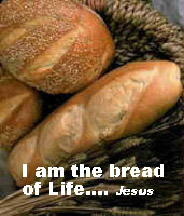
            Bread is commonplace – isn’t it? Bread – the staff of life, putting bread on the table, knowing which side your bread is buttered on, the greatest thing since sliced bread, bread and water (the bare minimum food a person needs), and of course, our daily bread.   

 Bread, in some form or other, is found in just about every kitchen, every pantry, around the world. Whether raised dough, sourdough, or flatbread – made of wheat, rye, corn, or rice, or any one of a dozen other grains found around the world – bread is the universal food among the worldwide human race.

            The Rabbi Jesus had been preaching and teaching for a great number of months. Jesus is an itinerant rabbi, but He is preaching in the local area of His hometown. Are we surprised at Jesus’s reception, among the crowd listening to Him? Frankly, I’m not. I might have been skeptical of Jesus, too, if I were in the position of many of these local townsfolk.

             The Rabbi Jesus had already become known for His miracles of healing, plus the deep nature of His sayings and teachings. Here, Jesus makes the bold statement, “I am the Bread of Life.” Jesus compares Himself to something that everyone could relate to. He’s not saying He actually is a loaf of bread! However, Jesus talks about an absolutely everyday necessity that everyone is quite familiar with. That way, people might be able to learn more about Him.

            But, there is a problem with Jesus’s statement. He was preaching to a local crowd, and the crowd wasn’t altogether on board with what Jesus was saying. John’s commentary about the crowd’s complaints: “At this the Jews there began to grumble about him because he said, “I am the bread that came down from heaven.” 42 They said, “Is this not Jesus, the son of Joseph, whose father and mother we know? How can he now say, ‘I came down from heaven’?”

Commentator David Lose said “they knew his parents and his brothers and sisters, they watched him play and learn his trade, grow up and eventually leave home. In other words, they know him, just like they know all the kids from their old neighborhood. And for this reason, you see – because he is just like them, because he is common – he can’t be all that special, and he certainly can’t be the one God sent for redemption.” [1] They knew where His parents lived. How can someone with a known name and address be considered God? From heaven?

Let’s take a deeper dive, and try to get below the surface gripes of the crowd. Sure, these hometown folks knew Jesus, but what is it that really bothers the crowd about the claims of Jesus? Could it be that Jesus’s words about bread are just a bit too ordinary? When this group of people heard the hometown boy preach, was that a little too close to home, and a bit too much like looking in the mirror?

 Sure, the Rabbi Jesus uses a common, ordinary object – bread – to let everyone see how universal their need was. Who doesn’t eat bread, every day? (Unless you are allergic to wheat or other grains, which a small percentage of the population are.) Nevertheless, Jesus wants to show how important His role is in life, and how much Jesus can supply people’s greatest wants and inner needs.

Many of this crowd has been following Jesus for some time. Many follow Him because of His wise teaching, and many more because of His miracles! Prophets of God were reliable at preaching, teaching, even doing miracles. But, this statement crosses some kind of a line.

            David Lose describes the words of Jesus as hitting a deep down nerve. He says, “when I am in need or distress, when I am hurt or afraid, I want to see a God who shows in strength and through miracle, I want to call upon a God who answers clearly and quickly, and I want to rely on a God who is there, really there, when you need him.” [2]

            Isn’t that the case? When you and I are in need or distress, in whatever way, we want to be sure of a God who is responsive, who is there for us. Not some rinky-dink fourth-string quarterback whose parents we know, whose mother and brothers and sisters still live in town, or down the road. No wonder the crowd is grumbling and griping!

            I know very well how much I trip up. I know where I fall down and miss the mark God wants me to hit. I suspect you do, too. We all know our own doubts, fears, broken promises, petty grudges, foolish betrayals. If Jesus is really like one of us – that is, a plain, ordinary, sinful human being! – then we are sunk. We all are in big trouble.

            Jesus makes a comparison between the manna of Exodus and the current bread from heaven. He says “49 Your ancestors ate the manna in the wilderness, yet they died. 50 But here is the bread that comes down from heaven, which anyone may eat and not die. 51 I am the living bread that came down from heaven. Whoever eats this bread will live forever.” Jesus is saying that He is much better than the temporary manna that lasted for just a day and no more – which makes me think of the letter to the Hebrews, which repeatedly describes Jesus as “better” than so many biblical high points.

“Jesus was common, ordinary, mortal like you and me, and yet was also uncommon, divine, the very Son of God. For where we expect God to come in might, God comes in weakness; where we look for God to come in power, God comes in vulnerability; and when we seek God in justice and righteousness – which is, after all, what we all expect form a God – we find God (or rather are found by God!) in forgiveness and mercy.” [3]

            What kind of bread are we being offered, right now? The temporary manna which passes away after a day, or the living bread that comes down from heaven? Jesus calls to each of us, offering to fill our deep hunger with the Living Bread from heaven, for eternity. You and I can say “thank you!” for this gift of love. Jesus offered bread to His friends a long time ago, in the Upper Room. And we still offer bread to one another in our church to remember and participate in Jesus’ love. Truly, a gift from God, however we slice it. Alleluia, amen!

@chaplaineliza

(Suggestion: visit me at my other blogs: matterofprayer: A Year of Everyday Prayers. #PursuePEACE – and  A Year of Being Kind . Thanks!

(Many ideas from this sermon come from this lesson from Illustrated Ministries. Thanks to Illustrated Ministries for the use of their lesson for the 11h Sunday after Pentecost from John 6, from their 2020 Summer Children’s series. Also, thanks so much to Rev. David Lose, for ideas and quotes from http://www.davidlose.net/2015/08/pentecost-11-b/  “Ordinary Things,” David Lose, …in the Meantime, 2015.)


[1] http://www.davidlose.net/2015/08/pentecost-11-b/  “Ordinary Things,” David Lose, …in the Meantime, 2015.

[2] Ibid.

[3] Ibid.