Unknown's avatar

Sacrifice of Praise

“Sacrifice of Praise”
Hebrews 13:5-8, 15-16 (13:15) – August 31, 2025

            Have you ever known anyone who was really proper? Always every hair in place, always did the socially acceptable thing, and never put a toe out of line? Imagine a stern teacher, keeping order in the classroom by a mere look and a slow stare. Someone with high standards. Thinking about satisfying this kind of person makes me anxious, and nervous. I always need to be on my best behavior, minding my p’s and q’s. Just being around someone like this puts me on edge.

            But, what about putting God into the conversation? I know we are probably stretching our imaginations, but it is hard to imagine God wearing a wrinkled shirt, or with a sloppy haircut, or having a dirty face. For that matter, isn’t God perfect? Isn’t God prim and proper, always doing the right thing, never stepping out of line? Doesn’t God have incredibly high standards? Don’t we need to be on our best behavior with God, minding our p’s and q’s? Doesn’t that sum up many people’s conception of God?

Our Scripture reading today can sound like a list of rules. Do this! And, do that! And, don’t do this other thing! I can just imagine several stern Heavenly angels frowning, shaking their fingers at me if I step out of line!

However, the letter to the Hebrews was written to a bunch of scattered Jews who believed in Jesus as their Messiah, scattered in small groups throughout Asia Minor. What we know as Turkey, today. They had been chased out of Palestine by the Jewish and Roman authorities. Many of these scattered Hebrews were refugees. Migrants. People chased out of the land of their birth by an oppressive government that was out to imprison them, if not kill them, because they claimed Jesus as Lord and Messiah. So similar to migrants throughout history who come to other countries seeking asylum, because the place where they were born is very dangerous.

That is the background of the small congregations receiving this letter. This letter was copied and sent from place to place, a breath of fresh air, sound biblical teaching coming to these small groups of believers in Jesus.

Let us turn to our reading today, from Hebrews 13. At the beginning of the reading, the writer of this letter talked about sacrifice—the sacrifice for sin, which was one major way the Jews came before God in worship. In the time of the Jewish temple, it was common for Jews to bring animal offerings to God to make up for sins, to cover their sins and the sins of their loved ones, under the old covenant. One first-century Jewish idea of God was distant, angry, and even vengeful. God had incredibly high standards. God was someone to be placated. Even today, many people have that kind of view of God—a scary view. Not the view of God as loving, caring, and kind, at all.

However, we are going to flip that idea of a distant, angry, scary God. Many, many people are in fear for their religious beliefs. Governments throughout history have been cruel, indeed. Is the fear, anger and disturbance of the powerful governments today much different from the fear, anger and disturbance of the powerful people of Jesus’ day? I think not.

If we consider the wider picture today, around the world, countless followers of Christ are being actively and bitterly persecuted. It’s happening right now, in dozens of countries, officially sanctioned by their governments. Just as it was in the first century, for the small scattered congregations of Jesus followers.  

True, these scattered Hebrews in small groups have good reason to be afraid! On edge! Ready to run again. However, at the heart of this letter is a Kingdom ethic that turns worldly values upside down. Much like my summer sermon series of three years ago, when I preached on the Beatitudes, the first section of our Lord Jesus’s Sermon on the Mount from Matthew 5. That summer we looked at the Topsy Turvy Teachings of Jesus, talking about our service to others, loving mercy and kindness, and even being glad when we are persecuted, for Christ’s sake

Here, today, we can see the practical teachings in Hebrews chapter 13 as teachings of God’s Kingdom, a topsy turvy teaching which tells us that “greatness is revealed through serving others, worship is expressed in doing good, and righteousness is rooted in trusting God and acting with love. This radical re-ordering of values calls believers to live in a way that reflects the grace, justice and compassion of Christ.” [1] Truly, a topsy turvy way of living, then and now.

Instead of “pie in the sky” theological platitudes, this reading today talks about practical ways of living – and acting. These are practical ways to love others, just as Jesus told us to do. When Meier’s Bakery was donating many baked goods to our church, up until just a few years ago, we would donate those baked goods in turn to a local YMCA, for their men’s residence, which had many low-income residents. And then when we needed to stop that during the COVID shutdown, I quickly found another mission that was very grateful to receive those baked goods.

I’ve spoken about this worthy mission outreach before. A Just Harvest, which is located a block from the Howard Street El station, serves a hot meal to 200 to 250 low-income people every day, 365 days a year. This Christian group with their radical hospitality has boots on the ground. They truly welcome the stranger and reach out. They truly experience Christ’s constancy and amazing grace on a regular basis. In their daily ministry and outreach, they also rely on the Lord, as do the people in poverty they serve.[2]

            As we imitate these friends in welcoming the stranger, can there be a better way for any of us to be freed from fear, and become free to serve and praise and really live for God?

            And finally, as our instructions from Hebrews tell us, we can expand our vision of worship. Not just worship at 10:00 on Sunday morning! No, “True worship, the writer says, includes not just praise on our lips, but generosity and good works. I remind everyone: we are not doing these good works to get on God’s good side! No, the point of our good works is in response to what Jesus has done for us. Just as the whole book of Hebrews tells us!

Our freely given good works, generosity and radical welcome to all are “sacrifices pleasing to God.” It’s a complete picture of faith—one that blends word and deed, praise and practice, belief and behaviour.” [3]

            Yes, we truly bring God our sacrifice of praise! And, with boots on the ground, we can truly welcome the stranger and reach out in radical hospitality. And, we truly experience Christ’s constancy and amazing grace on a regular basis. What a way to live, the Jesus way.

Alleluia, amen.

@chaplaineliza

(Suggestion: visit me at my other blogs: matterofprayer: A Year of Everyday Prayers. #PursuePEACE – and  A Year of Being Kind . Thanks!


[1] https://www.churchofscotland.org.uk/worship/weekly-worship/weekly-worship-2025-august/31-august-twelfth-sunday-after-pentecost-year-c

[2] https://www.stewardshipoflife.org/2016/08/to-be-continued/

[3] https://www.churchofscotland.org.uk/worship/weekly-worship/weekly-worship-2025-august/31-august-twelfth-sunday-after-pentecost-year-c
Unknown's avatar

Diverse Gifts and Abilities!

“Diverse Gifts and Abilities!”

1 Corinthians 12:1-11 (12:10) – January 19, 2025

“In the beginning, God created the heavens and the earth.” God created everything on the face of the earth. Just think of the myriads of different kinds of plants, animals, climates, languages, cultures. God made it all, and God rejoices in the countless variations and differences. What a diversity in creation! We can be amazed over and over, at the ever-renewable wonders of God’s creation, whether we look at a flower in a vase, through a microscope at a microbe, or at the photographs sent from the landing craft now exploring on the planet Mars.

When we consider our reading for today, we can also see that God made different kinds of spiritual gifts, as well. God’s plan is for human beings to live together, with one another, in community. The main purpose for these diverse gifts is for the common good. God wants us to use our gifts for one another. What an awesome opportunity! Here, God freely and openly gives us gifts—spiritual gifts—to serve one another.

Now, let’s back up. The Apostle Paul cites Jesus Christ as a starting point at the beginning of Chapter 12. He states the authority of Jesus, and even makes the statement “Jesus is Lord” a sort of litmus test for being a follower of Jesus Christ. After all, no one who is a pagan can say “Jesus is Lord” and really mean it (at least in Paul’s day, that was true). But there is a problem. The problem is us human beings.

We are fallen people. We sin. In and of ourselves, we have no standing, and are not righteous before God. As Romans 3:23 reminds us, “There is none righteous, no, not one.” But the Holy Spirit gives us a big assist here! The Holy Spirit helps us to say the words “Jesus is Lord!” It is through the power of the Holy Spirit that we exercise these gifts that God so graciously gives to us!

Let’s look at what Paul says about these spiritual gifts. There are many kinds of gifts! Yet, there is one Lord. There are diverse abilities! Yet, one Spirit. I see a definite connection here. It’s all about God, and God’s immense creativity. Just as God created the world in all of its glory, beauty and diversity, so too the Lord created people in all their wonderful diversity, with diverse gifts and abilities for us to share with one another.

I started out quoting Genesis 1:1–”in the beginning, God created the heavens and the earth.” Looking back at Genesis, we can see that diversity is definitely in God’s plan for humanity from the very beginning. The sheer creativity of God in creation is so big and so varied. Musically speaking, there are countless variations on a countless number of themes. The only way I can figure this out is that God is pleased when we use our God-given creativity in any one of a myriad of ways—inventing, designing, doing, helping, making, thinking, crafting, composing, giving. And when we use our God-given gifts and abilities, it plain feels good inside.

When we look at this chapter in 1 Corinthians, Paul stresses that the church—the group of believers in Christ he was writing to–in all of its diversity, is a community. A great, big extended family, if that helps you think about it. I know that can remind us of the whole topic of the families each of us were born into–and some people don’t want to go there–with in-laws, out-laws, black sheep, and all the rest. But biblically speaking, this is God’s family.

This reminds me of my birth family, my family of origin. I am one of six sisters and brothers. The six of us are about as diverse as anyone would want to see. Across the political spectrum, in terms of talents, abilities, interests and activities, the six of us are so different from each other. Yet, we came from the same parents, and grew up in the same household. Even within my own family, there is such a rich diversity.

With God as our Heavenly Parent, we as believers in Jesus Christ are all sisters and brothers of one another. Why? Because God’s Word says so. Paul says, several verses down in this same chapter, “For in the one Spirit we were all baptized into one body—Jews or Greek, slaves or free—and we were all made to drink of one Spirit.”

There are different services, and different activities, yet there is one Holy Spirit over all, energizing all. And this is a corollary benefit: whatever happens, whenever people use their God-given gifts and abilities, God receives praise and honor!

Tomorrow, we observe a federal holiday, where we remember and give thanks for Martin Luther King Jr. His stirring words helped to move this nation toward justice, empathy and equity. His witness called forth the best of all of us.

Sadly, in recent years, we have seen the increasing rise of hatred, separation one from another, and white supremacy. We need to go forward towards those loving, caring and equitable ideas that Martin spoke of. We have been given these gifts to show the whole world that God means for all of us to serve one another, no matter who they are, no matter where they may be.

God can break through insular, tribal loyalties! God can and does knit all of us together as one humanity, one great big extended family. Plus, tomorrow as a Day of Service is not simply a day on the calendar, but it is a day on which all of us can serve and work, pray and hope, struggle and strive to – as Martin said – bend the arc of history closer to justice, and be shaped into the people of God that God’s prophets call all of us to be. Each day. Every day.

So, we can praise God that we have been graciously given these gifts and abilities to use, for each person we meet.  What an awesome opportunity! Here, God freely and openly gives us gifts—spiritual gifts—to serve one another, for the common good. How can you take that opportunity, and use these gifts for one another’s benefit, and continue to build the Beloved Community we are told of repeatedly in the Bible? Not just tomorrow, on the MLK Day of Service, but every day? How can you best serve God’s worldwide family? How can I?

God willing, we can and we will. Alleluia, amen.

@chaplaineliza

(Suggestion: visit me at my other blogs: matterofprayer: A Year of Everyday Prayers. #PursuePEACE – and  A Year of Being Kind . Thanks!

Unknown's avatar

The Coming King

“The Coming King”

Jesus Palm Sunday - Giotto di Bonde, Entry into Jerusalem 1304-06, Fresco, Cappella Scrovegni Arena Chapel, Padua

Luke 19:35-40 – April 14, 2019

The most powerful person in the world. Ever hear that expression? I suspect it is familiar to most of us from movies, from comic books, from historical fiction. With the release of super hero blockbusters every few months, we certainly have the opportunity to see the clash of titans on the big screen, and the super hero of the movie conquering the huge threat or the big bad guy—or big bad girl. The thing is…can we imagine Jesus as the most powerful person in the world?

Our Gospel reading today from Luke 19 tells us that a huge crowd of people thought the Rabbi Jesus was a really important person, a really powerful person. He was a Miracle Worker, He preached with authority, and just to be in His presence—wow! The crowd was hailing Him as the long-awaited King, the Anointed One of God, the Messiah.  

Jesus, Himself, had been telling His disciples that He had to go to Jerusalem for some time now. Even though His friends kept telling Him that the Jewish leaders and the Sanhedrin had it in for Him and wanted to kill Him, Jesus still “determined to go to Jerusalem,” as Luke tells us back in chapter 9.

Today’s story has all the makings of a great drama. (And, the narrative of the Passion Week has been recorded a number of times in motion pictures.) As commentator Alyce McKenzie tells us, “Good stories, screenwriters tell us, have a compelling protagonist, a believable supporting cast, a series of vivid scenes, and plenty of dramatic tension.” [1] Dr. Luke’s telling of the Palm Sunday story has all that, and more.

Here we are on Palm Sunday, and the weeks of Lent are almost over. That means that our series on the Lord’s Prayer is almost over, too. What sentence are we going to look at today, with our Scripture readings of Luke’s Triumphal Entry into Jerusalem, and the Apostle Paul’s hymn of Christ’s humility? We take a closer look at “for Thine is the kingdom, the power and the glory, forever and ever, amen.”  What more glorious Scripture readings to examine!

As we think of our great Divine drama, Jesus not only is a marvelous protagonist, but we can see He displays Divine foreknowledge. “Jesus knows ahead of time where the colt will be and what the response of the owner will be to being told, “The Lord needs it.” Luke shares with the other evangelists a portrait of Jesus as a true prophet whose prophecies are fulfilled and who has access to the secret knowledge of human hearts.” [2]

The second necessary feature of a great drama is a believable supporting cast. Look at the disciples—human, and distinctive. Listen again to Luke’s story: “Go to the village ahead of you, and as you enter it, you will find a colt tied there, which no one has ever ridden. Untie it and bring it here. 31 If anyone asks you, ‘Why are you untying it?’ say, ‘The Lord needs it.’” 32 Those who were sent ahead went and found it just as he had told them. 35 They brought it to Jesus, threw their cloaks on the colt and put Jesus on it “

We notice the rest of the supporting cast here, in the next verses. “As he went along, people spread their cloaks on the road. 37 When he came near the place where the road goes down the Mount of Olives, the whole crowd of disciples began joyfully to praise God in loud voices for all the miracles they had seen: 38 “Blessed is the king who comes in the name of the Lord!” “Peace in heaven and glory in the highest!”

From time to time we have talked about putting ourselves into a Scripture reading, and viewing it from the inside. Where would you be, in our Gospel reading from Luke? Are you an excited disciple or crowd member, waving your arms and picking up a palm to welcome the Messiah Jesus into the city of Jerusalem? Or, are you one of the skeptical ones on the road, holding back, with a wait-and-see attitude?

“The people were obviously weary of the Roman occupation. They had been hearing rumors of a great teacher from Nazareth who healed the sick, fed the hungry, and made the scriptures come alive. Some of them had seen miracles first hand and had heard parables straight from Jesus’ mouth. Now, they had a deliverer; their long-awaited Messiah and Savior, King Jesus, was with them.” [3]

The third necessary element in any great drama is dramatic tension. Boy, does the Triumphal Entry have that! Even down to the antagonistic Jewish leaders who come up against the Messiah Jesus, this has drama all over the place.

It is almost too difficult for me to put myself into the narrative, I know this story all too well. Yes, I am tempted to rush right through the Palm Sunday celebration, go once-over-lightly through the several events recorded in the other Gospels during Holy Week, and cry again because of the Crucifixion this Friday night. Or, was it two thousand years ago?

Switching to the New Testament reading from Philippians, the apostle Paul has a slightly different point of view. Paul is writing from the other side of the Crucifixion, the Resurrection and Jesus’ ascension into heaven—as we know from the Apostles Creed, Jesus has taken His seat at God’s right hand in heaven.

As we start this reading to the church in Philippi, Paul tells us of Jesus, before His incarnation and birth in Bethlehem. The eternal Christ humbled Himself, emptied Himself of all Godhood, all Godly prerogatives, and became a helpless human baby. Imagine the most powerful person in the whole world, in the whole universe, even. The eternal Christ put aside the kingdom of the universe, the ultimate power and the infinite glory, to become human.

Another way of looking at this is that Jesus put aside all of that kingdom, power and glory so He could communicate better with us, so He could come along side of us and be Emmanuel, God-with-us, as we have talked about at Christmas. But, that is not the end. Oh, no! Certainly not!

We see this progression: the preincarnate Christ, in all His kingdom, power and glory. Amen! “Christ emptied himself of inherent divinity, and for his supreme obedience unto crucified death, he was exalted by God for unending glory. Philippians 2:5-11 keeps the focus Christologically and theologically tight. On Passion Sunday [today, this Sunday], Paul keeps us grounded in what God, through Christ Jesus, is doing.” [4]

We do not look at the institution of Communion on Maundy Thursday and the Crucifixion of Good Friday. We are skipping the additional drama, trauma, anguish and grief today. Paul does mention those things briefly, but he looks to the amazing ending. “God exalted him to the highest place and gave him the name that is above every name, 10 that at the name of Jesus every knee should bow, in heaven and on earth and under the earth, 11 and every tongue acknowledge that Jesus Christ is Lord, to the glory of God the Father.”

If that is not a proclamation of the last line of the Lord’s Prayer, I don’t know what is. “For Thine is the kingdom, and the power, and the glory, forever and ever, amen.” Have you bowed the knee to our ascended and exalted Jesus the Messiah? Is your tongue acknowledging Him as Lord and Savior? Yes, Jesus was crucified on our account. It was for our sins He was crucified. His arms are open. His pierced hands are extended. Come to Jesus, today.

[1] https://www.patheos.com/Progressive-Christian/Palm-Sunday-Alyce-McKenzie-03-18-2013.html

Rewriting the Palm Sunday Story: Reflections on Luke 19:28-40, Alyce McKenzie, Edgy Exegesis, 2013.

[2] https://www.patheos.com/Progressive-Christian/Palm-Sunday-Alyce-McKenzie-03-18-2013.html

Rewriting the Palm Sunday Story: Reflections on Luke 19:28-40, Alyce McKenzie, Edgy Exegesis, 2013.

[3] http://www.theafricanamericanlectionary.org/PopupLectionaryReading.asp?LRID=15           

Commentary, Zechariah 9:9-13 / Luke 19:28-40, Rodney S. Sadler, Jr., The African American Lectionary, 2008.

[4] http://www.workingpreacher.org/preaching.aspx?commentary_id=284

Commentary, Philippians 2:5-11 (Passion Sunday), C. Clifton Black, Preaching This Week, WorkingPreacher.org, 2009.

@chaplaineliza

(Suggestion: visit me at my regular blog for 2019: matterofprayer: A Year of Everyday Prayers. #PursuePEACE – and my other blog,  A Year of Being Kind . Thanks!

Unknown's avatar

Jesus is Lord of All!

Jesus is Lord of All!

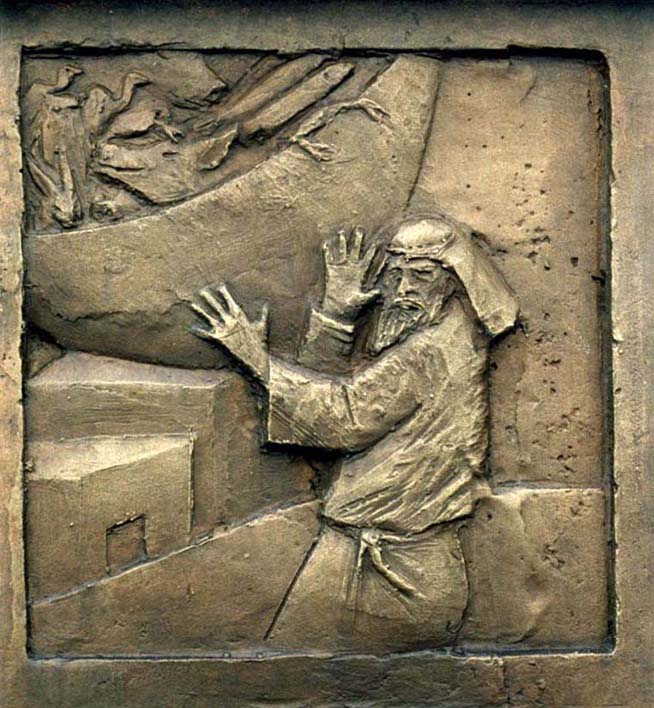
Acts 10 Peter's Vision bas relief

Acts 10:45 – August 9, 2015

Here in the church, we sometimes talk about missionaries going to far-flung places in distant parts of the earth. They navigate visible and invisible borders and boundaries. But not me! I’ve always lived here in the Chicago area. One big similarity? I served in three multi-cultural hospitals. For almost ten years, in several hospitals and extended care centers around Chicago, I worked as a chaplain. I dealt with patients, their loved ones, and health care staff—on a regular basis. Instead of going to the world, I had the world come to me, in the hospital.

What in the world does this have to do with our sermon today? I’ll tell you, in a story-telling kind of way. We start off in Caesarea, a Roman city on the coast of the Mediterranean Sea, the Roman capital of the Roman province of Judaea. Thoroughly Roman in every way, from its pagan temples, amphitheater and other architecture to the brand new deep harbor, thanks to superior Roman engineering skills.

Here we meet Cornelius, a Roman centurion, in charge of one hundred soldiers. (He’s a Gentile, by the way.) Let me tell you what Dr. Luke has to say in Acts chapter 10. I’m reading again from the excellent version translated by J.B. Phillips. “1-3 There was a man in Caesarea by the name of Cornelius, a centurion in what was called the Italian Regiment. He was a deeply religious man who reverenced God, as did all his household. He made many charitable gifts to the people and was a real man of prayer.”

Did you all catch that? Cornelius reverenced/revered God! The God who made heaven and earth. The God of the Jews. But, he was a . . . Gentile! Not a drop of Jewish blood in him.

What happens next? “About three o’clock one afternoon he saw perfectly clearly in a dream an angel of God coming into his room, saying, “Cornelius!” 4a He stared at the angel in terror, and said, “What is it, Lord?” 4b-6 The angel replied, “Your prayers and your deeds of charity have gone up to Heaven and are remembered before God. Now send men to Joppa for a man called Simon, who is also known as Peter.”

The town of Joppa was not just a mile or two down the road. No, the soldier Cornelius needed to send his servants between thirty and forty miles away in order to fetch this Simon Peter guy. Which, Cornelius did, right then and there.

Meanwhile, in Joppa—I imagine a split-screen sort of a deal here. On this side, here is the city of Caesarea. A large, Roman-style house. The camera zooms in on the centurion Cornelius, just having dispatched his men to go fetch Peter. And—on the other side of the screen, we have the camera: starting out in a long shot. We see the street scene on an afternoon in Joppa. The camera pans in, coming closer and closer to a particular building. A smaller house. Simon Peter is sitting up on the flat roof, catching some breeze off the ocean in that coastal town.

Dr. Luke continues: “9-13 Next day, while these men were still on their journey and approaching the city, Peter went up about mid-day on to the flat roof of the house to pray. He became very hungry and longed for something to eat. But while the meal was being prepared he fell into a trance and saw the heavens open and something like a great sheet descending upon the earth, let down by its four corners. In it were all kinds of animals, reptiles and birds. Then came a voice which said to him, “Get up, Peter, kill and eat!” “

In the Mosaic Law, recorded in the books of Exodus, Leviticus and Deuteronomy, the Law code has definite restrictions on what any good, kosher-keeping Jew is and is not allowed to eat. A few well-known forbidden foods are no pigs—no pork. No shrimp or other shellfish. Also, no rabbits or snakes, and no owls or birds of prey. These are just a few of the kinds of animals, fish and birds that are forbidden, for various reasons. So, let’s see what happens next!

14 Peter said, “Never, Lord! For not once in my life have I ever eaten anything common or unclean.” 15 Then the voice spoke to him a second time, “You must not call what God has cleansed common.” 16 This happened three times, and then the thing was gone, taken back into heaven.”

Wow! Amazing vision that Peter had! Talk about totally blowing Peter away. Peter had always—all of his life—kept kosher. Eaten only the things that the Mosaic Law code said he could eat. Now, out of a clear blue sky, this vision is telling him that God calls all things clean!

I want to take a little detour. Tell you a bit about my two chaplain internships, after graduating seminary. I dug right into learning about various faith traditions. I learned about widely different cultural traditions, too. This was a natural progression for me, learning more of how to accompany diverse people in crisis, critical care, trauma and end of life. It sounds rather odd, talking about my years of intensive learning and stressful internship in this way, but I very much appreciated every intense, multicultural experience I had: both in the classroom, as well as on the floors and units of the hospitals and care centers.

Let’s come back to Acts, chapter 10. “17-20 While Peter was still puzzling about the meaning of the vision which he had just seen, the men sent by Cornelius had arrived asking for the house of Simon. They were standing at the very doorway of the house calling out to enquire if Simon, surnamed Peter, were lodging there. Peter was still thinking deeply about the vision when the Spirit said to him, “Three men are here looking for you. Get up and go downstairs. Go with them without any misgivings, for I myself have sent them.”

“23b-26 On the next day Peter got up and set out with them, accompanied by some of the believers from Joppa, arriving at Caesarea on the day after that. Cornelius was expecting them and had invited together all his relations and intimate friends. As Peter entered the house Cornelius met him by falling on his knees before him and worshiping him. But Peter roused him with the words, “Stand up, I am a human being too!”

I need to interrupt, to let you know—Peter and his Jewish friends from Joppa, being good observant Jews, were forbidden by the Jewish Law code to enter the house of a Gentile. Yet—that is exactly what Peter intended to do! Let’s continue.

27-29 Then Peter went right into the house in deep conversation with Cornelius and found that a large number of people had assembled. Then he spoke to them, “You all know that it is forbidden for a man who is a Jew to associate with, or even visit, a man of another nation. But God has shown me plainly that no man must be called ‘common’ or ‘unclean’. That is why I came here when I was sent for without raising any objection.”

As for me? All three of the hospitals where I served were in the middle of multicultural areas, a crossroad of the multicultural communities of Chicago and the surrounding area. One of these hospitals has the distinction of sitting in one of the most diverse ZIP codes in the country. (The U.S. Census Bureau says so.) I never knew who was going to be in that next room I entered, or what situation I was going to encounter next.

34-43 Then Peter began to speak, “In solemn truth I can see now that God is no respecter of persons, but that in every nation the one who reverences Him and does what is right is acceptable to Him! God has sent His message to the children of Israel by giving us the good news of peace through Jesus Christ—He is the Lord of us all.” Ahh. We can see that slowly, very slowly, Peter is taking baby steps towards being open to more than just Jews.

When I served as a chaplain, I didn’t just serve Protestant Christians. I remember a Buddhist Asian family in critical care, as their loved one died just as I came in—complete silence and intense sadness greeted me as I joined them in the room. Another time, I entered the packed ICU cubicle—wall to wall with a Pentecostal Latino family, who wanted me to pray their brother (and uncle) across the River Jordan. (The crashing, palpable waves of grief struck me again and again…I vividly remember.) It wasn’t all end of life. I remember being asked to pray the Rosary with a Filipino family around their ill auntie, lying in the hospital bed. There was the situation with an older Muslim patient, and the 20-something relative wearing black hijab and very conservative dress, sitting next to the bed; she earnestly asked me to pray. Of course I did!

In fact, Peter goes on to say: “We are those witnesses, we who ate and drank with Him after he had risen from the dead! Moreover, we are the people whom He commanded to preach and bear fearless witness to the fact that He is the one appointed by God to be the judge of both the living and the dead.”

This sermon Peter preached—for it was a sermon!—had its effect. The Gentile audience heard Peter, and what happened? “44-46a While Peter was still speaking these words, the Holy Spirit fell upon all who were listening to his message. The Jewish believers who had come with Peter were absolutely amazed that the gift of the Holy Spirit was being poured out on Gentiles also; for they heard them speaking in foreign tongues and glorifying God.”

Did you hear what happened? Praise God! These Gentiles believed, and the same thing happened to them that had happened to the Jewish believers in Acts chapter 2! The gift of the Holy Spirit came upon the Gentiles, too.

Remember what Peter told his Jewish audience, at Pentecost? Acts chapter 2? Joel’s prophecy regarding the outpouring of the Holy Spirit had been fulfilled. All who call upon the name of the Lord will be saved (Joel 2:32a). At first, Peter and the rest of Jesus’ followers thought that all only meant Jews. And then, Samaritans were added.

I have Good News for you. I have Good News for us all. Jesus is the Lord of all (10:36b). All Jews and all Gentiles who believe in Him receive forgiveness of sins through His name (10:43). As the commentator Richard Carlson said, the Apostle Paul had it exactly right, “In Christ there is neither Jew nor Gentile, slave nor free, male nor female” (Galatians 3:28). In Christ, there is neither Republican nor Democrat, citizen nor undocumented visitor, gay nor straight, for all are one in Christ Jesus.

In God’s salvation plan, all now really means all.

Alleluia, amen!

@chaplaineliza

Suggestion: visit me at my daily blog for 2015: matterofprayer: A Year of Everyday Prayers. and my other blog,  A Year of Being Kind .  Thanks!