Unknown's avatar

Have Mercy on Us!

“Have Mercy on Us!”

Luke 17:11-19 (17:13) – October 12, 2025

            Ever been to the dentist, or the doctor, with a health complaint? Of course, you have! You all—we all have, at one time or another. Thank goodness, we live here, in the suburbs of Chicago. It is fairly easy to get good—or even, excellent medical and dental care, as opposed to the rural spaces in the United States, where health care is not as accessible. And, can you imagine outside of this country?

            Imagine living in the first century of the Common Era. In Jesus’ day, doctors were rare even in mid- to large-sized towns. When people had health complaints, there were some homeopathic remedies, true. And local healers, people who were good with herbs, poultices, and ointments. But for continuing problems or chronic diseases? There weren’t many options for any other kind of health care.

            Let us set the scene. Dr. Luke tells us, “Now on his way to Jerusalem, Jesus traveled along the border between Samaria and Galilee. 12 As he was going into a village, ten men who had leprosy met him.”  We have a situation with some chronically ill people. These people had skin diseases. Commonly referred to as leprosy, these skin afflictions could be anything from severe eczema to Hansen’s disease, what we now know today as leprosy. And any disfiguring skin problem, in between.chronic

            In Jesus’ day, there were priests and Levites stationed all throughout the land of Israel. These official people were not only on duty for the Sabbath day, for religious observance, but they had several other important duties under the law of Moses. Did you know that the priests and Levites could make rulings on whether a person was too disfigured, too blemished to live in close quarters with the rest of the townspeople?  True facts!

            This was an early example of a health code. The priests and Levites were among the first health inspectors! Because some of these skin diseases were contagious, and so the people who had them would contaminate others, the priests and Levites would have to exile them. Kick these former upstanding people out of town. Out of society, and isolated. Marginalized. Exiled. Called ‘unclean.’ Living far away from everyone and everything they once held dear. Ringing bells to warn others not to come near them. That was the situation for these ten lepers we read about in Luke’s Gospel today. What a lonely existence for these poor people.

            The Rabbi Jesus was on His way to Jerusalem with His disciples when he met these ten men, on the border between Galilee and Samaria. This is yet another time that our Gospel writers tell us that “Jesus is again in a border region, again crossing boundaries and wandering where he probably shouldn’t go, and again healing people with whom he has no business interacting.” [1] Commentator Dr. Davis Lose reminds us that Jesus is again doing something out of the ordinary. In fact, extraordinary!  

            Let us consider that this unconventional Rabbi Jesus is not only crossing geographical boundaries and wandering – traveling where “good, rule-keeping Jews” just don’t go. But, Jesus is also interacting with these ten lepers! These men obviously kept at a distance from all other “normal” or “regular” people, except I am certain they had heard of this miracle-working Rabbi! Can’t you just hear the anguish and the hoping-against-hope in their voices as they cry out, “Jesus, Master, have mercy upon us!”  

            Jesus’ response is simple. Straight-forward. “Go, show yourselves to the priests. I can just imagine these ten men, told by Jesus to go and show themselves to the priests in town. Except, Jesus told them to go before He had done the act of visibly healing them from their skin disease. They needed to act, they needed to start to go before they saw what had happened.

            Have you ever needed to go on faith, and start an action, go on a trip, take a step without knowing for sure that God is right there with you? And, the whole idea of a borderland, an in-between place that is neither one place or the other. Doesn’t God meet us right there, before healing is completely complete?  [2]

That’s all Jesus says to them. The verb in Greek means ‘show, or point out something to someone.’ Remember, I said the priests were the health inspectors of that day? Can you understand these ten guys, isolated, banished, marginalized. And Jesus says, “Go, show yourselves to the priests.”

            Lo and behold, “as they went”—that is, in the going—“they were cleansed.” Do you understand? These poor, lonely people believed Jesus, had faith, and were healed as a result. We are not told exactly how they discovered it, but it probably didn’t take too long.

            One ex-leper, out of the original ten—one ex-leper comes back to thank Jesus. Glorifies God! Comes to Jesus and prostrates himself at His feet. Once the Samaritan realized he’d been healed, he couldn’t help but turn back and share his joy and thanksgiving with Jesus.

            Thanksgiving is like that. When it’s genuine, it’s spontaneous—you recognize you’ve been blessed and can’t help but share your joy through thanksgiving.

“Have you ever noticed just how powerful it is not only to receive blessing but also to name it and give thanks for it? Maybe you’re at dinner with family or friends, then you lean over to another, or maybe raise your glass in a toast, and say, “This is great. This time, this meal, you all. Thank you.” And in seeing and giving thanks, the original blessing is somehow multiplied. You’ve been blessed a second time.” [3]

The Samaritan knows he’s been given a gift and can’t help turning around to say something. In doing so, he’s given a second gift: He leaves his encounter with Jesus not only healed but also blessed in his own recognition of healing, blessed at being drawn into deeper relationship with the one he thanks, blessed at hearing himself commended for having great faith.

Imagine the huge difference that must have made in his life. That’s the way thanksgiving works—in giving thanks for gifts given to us, we are blessed again. We can all say alleluia, Thanks be to God!

@chaplaineliza

(Suggestion: visit me at my other blogs: matterofprayer: A Year of Everyday Prayers. #PursuePEACE – and  A Year of Being Kind . Thanks!


[1] https://www.workingpreacher.org/dear-working-preacher/second-blessing

[2] https://www.umcdiscipleship.org/worship-planning/choosing-faith/eighteenth-sunday-after-pentecost-year-c-lectionary-planning-notes/eighteenth-sunday-after-pentecost-year-c-small-groups

[3] https://www.workingpreacher.org/dear-working-preacher/second-blessing

Unknown's avatar

Give Thanks Every Day!

“Give Thanks Every Day!”

John 6:5-23 (6:11) – November 26, 2023

            “We gather together to ask the Lord’s blessing!”

            Those words from a beloved, traditional Thanksgiving hymn are so familiar, and so appropriate for this thankful time of the year. Our family just had a Thanksgiving celebration a few days ago, and for many who are followers of faith traditions throughout the United States, Thanksgiving was indeed a day to ask the Lord’s blessing!

            Our Scripture reading is from the Gospel of John, chapter 6. Yet, we could also read about this same miracle from the other three Gospels. This miracle is the only miracle that appears in all four Gospel accounts of the life of Christ.

            This miracle from John 6 is about providing food to a large group of people, yes, and a whole lot more. Let us set the stage. The crowds gathered around the Rabbi Jesus more and more now, because Jesus was gaining a reputation for performing miracles!

            What do you think it would be like, to stand in the crowd and actually see a miracle performed by Jesus? How would you react, or your friends or family react? Would you believe that this Rabbi could actually perform miracles? Or, would you be more skeptical?   

            Each Gospel writer tells a similar narrative. For example, here we have a waiting crowd, eager to see what this unconventional Rabbi is going to do now, and perhaps even get up close to this miracle-worker!

“Here they come, down the road toward Jesus. Can you hear their voices getting louder as they approach and taste the dust that has risen from the tramping of their feet? They are coming closer and closer and they are hungry.” [1]

But, what makes the Gospel of John’s account of this miracle different?

            Think small and simple. Jesus is found in the ordinary and everyday stuff of life. John also called the “miracles” Jesus performed “signs.” This week’s Gospel reading reminds us of John pointing to Jesus in the simple sign of bread. In these verses Jesus uses a few loaves of bread to sustain and calm hungry and fearful folk. Yes, bread says a lot about Jesus’ identity and presence, not only in the sacrament of communion but in daily life. [2]

            Getting down to the specifics of the miracle, the disciples have much discussion about how all of this huge crowd is going to be fed. In the midst of this animated discussion, the disciple Andrew brings a little boy’s lunch to Jesus. But then, he says “How will this little amount go so far among so many?

            Perhaps you and I are like the disciples. Perhaps we get caught up in the limitations, in our fears, in the worry and concern about “how much?” and “what if?” and “what now?” How on earth are we ever going to have enough? And, how can you and I explain exactly how this miracle happened?    

            That is not the important part, which was about a “who,” not a “how.” Jesus is the focus of this sign, “the meeter of needs, the worker of miracles.” The second “who” is us, or them, “the 5,000 hungry ones on the side of the mountain. Who are us too, by the way, John says with an elbow to the ribs. Get it? We are hungry for something we can’t provide for ourselves.” [3]

            Sure, we can intellectualize this miracle, and talk about the exact number fed, and whether the 5,000 were just men, or whether there were additional women and children, and how many, and where they all came from, and who exactly distributed the food. Or, we can theologize this reading, and talk about the differences between the fine points of the translation of the different readings, or how this reading from John is another metaphor for the Eucharist, the bread or manna of heaven, the communion that Jesus provided for these people in the huge crowd without a thought for the exact theological terms used for this picnic lunch.

            Then, John puts in his occasional editorial comment at the end of this narrative. Perhaps John was the only disciple who actually got the point that our Lord Jesus was making! “We know that by how he describes the event. Did you see it? It’s there in the final verse of our text. The people were hanging out in the place where it happened. The miracle place. But John doesn’t call it a miracle place. [In verse 23] He says that it is the place where they had eaten the bread after the Lord had given thanks.[4]

The first thing Jesus did when he received the little boy’s lunch was to thank God for it. He gave thanks for having the food to offer the crowd of people. Jesus gave thanks for feeding the hungry people crowded around Him. Gratitude and generosity come from a way of seeing and being in the world. [5]

            Perhaps that is our grand takeaway for today. Perhaps that is exactly why there was a miracle, a sign from God, precisely because our Lord Jesus looked up to heaven and gave thanks before He broke the bread and shared out the pieces of fish.

Think about it. That’s what John wants us to remember: that this meal, this miracle happened after gratitude was expressed. Gratitude for the abundance that didn’t look like abundance. Gratitude for the satisfaction that came out of hunger. Gratitude becomes a way of seeing and a way of being in the world. We give thanks to God for what is about to happen. We give thanks for what we might not yet see, but what we trust God will provide.” [6]

            Jesus showed us – just as much as He showed His disciples and the crowd of people – that He is able, and He will provide for us our daily bread. We can truly have thanks, truly have gratitude for all that God has done, and is continuing to do in each of our lives. Alleluia, amen.

@chaplaineliza

(Suggestion: visit me at my other blogs: matterofprayer: A Year of Everyday Prayers. #PursuePEACE – and  A Year of Being Kind . Thanks!

(I would like to express my great appreciation for the observations and commentary from the web page www,umcdiscipleship.org for their brief series on gratitude. I used several quotes and ideas from their useful resources. Thanks so much!)


[1] https://www.patheos.com/progressive-christian/mind-the-gap-alyce-mckenzie-07-20-2012

[2] https://www.stewardshipoflife.org/2012/07/bread-water-and-signs-of-god/

[3] https://www.umcdiscipleship.org/worship-planning/our-hymn-of-grateful-praise/christ-the-king-reign-of-christ-sunday-year-a-lectionary-planning-notes/christ-the-king-reign-of-christ-sunday-year-a-preaching-notes

[4] https://www.umcdiscipleship.org/worship-planning/our-hymn-of-grateful-praise/christ-the-king-reign-of-christ-sunday-year-a-lectionary-planning-notes/christ-the-king-reign-of-christ-sunday-year-a-preaching-notes

[5] https://www.umcdiscipleship.org/worship-planning/our-hymn-of-grateful-praise/christ-the-king-reign-of-christ-sunday-year-a-lectionary-planning-notes/christ-the-king-reign-of-christ-sunday-year-a-childrens-message

[6] Ibid.

Unknown's avatar

Gratitude Is—!

“Gratitude Is—!”

Philippians 4:4-7 (4:6) – November 19, 2023

            It’s that thankful time of the year, and this service is one way we all gather to say “thank You” to God. We say thanks for all sorts of good things. Wonderful gifts. Exciting opportunities. We gladly come before God and mention how thankful each of us is—to God.

One of my favorite biblical websites (and, I fully consider her a bible commentator) is “Worshipping with Children,” written by Carolyn Brown. This is what she had to say about Thanksgiving: “One of my favourite times with the children was the year we learned how to say “Thank you” in many languages from our congregation, and ended by using those words for our prayer together.” [1]

I know I taught my children how to say “thank you” when they received gifts, and compliments, and lots of other things. It’s a common thing, for grown-ups, parents, and grandparents to instruct children in these considerate, valuable, and grateful words.

            But, gratitude? Yes, almost everyone knows they are supposed to be thankful at Thanksgiving-time. But, grateful? That is not quite thankful – or is it?  

            Our New Testament Scripture reading for this Sunday is directed toward a group of people – of believers in God. Similarly, the Psalm reading is meant for a group of people, as are our hymns today, too. Isn’t it easier for us to be thankful – jointly? And, to be grateful – together?

            Sometimes being a part of a special group of people is helpful for joining together and agreeing to be in one accord with one another. Especially in terms of encouragement and hope, any group of people makes it easier to show signs of gratitude and thankfulness. Like, in the example of the group of people the apostle Paul addresses through this thank-you note. 

            We all know that being grateful and thankful is not just a head thing, not just something we decide to do one fine day. No, being grateful and thankful is not just an intellectual belief we endorse to be true. Instead, our gratitude and thankfulness ought to be a well-worn habit, a way of living. Most important, our gratitude and thankfulness should be visible, shown in what we do and say, shown in the choices we make and the priorities we set.

            Who remembers thank-you notes? I know I just mentioned thank-you notes written for gifts received (especially written by our children), but this is on a much larger scale. If you like to think so, each of us can be saying “thank you” to God, each and every day. In the same way, each of us has many reasons to be grateful to God each and every day, too.

            We are in a worship service right now. Worship is supposed to be a grateful and thankful time, for sure! What kinds of prayers are grateful and thankful? What about the group that is us, our congregation? “What prayers can we offer that might tap into the sense of interconnectedness and belonging? How can we celebrate the community that we are and the community that we are becoming? Let there be space for saying thank you to one another and to God.” [2]

When Paul wrote this particular letter, he wrote it from prison in Rome. He had been sent to the emperor’s court on a capital charge. He was on trial for his life. And yet—the apostle Paul writes this joyful, thankful, gratitude-filled letter.

Let us count off difficulties and challenges that Paul faced: not only the upcoming trial—for his life, but on top of that, Paul considered himself to be responsible for the churches he had planted on his missionary trips in Asia Minor and throughout Greece. Such heavy burdens on Paul. Yet, here in chapter 4 we see him writing almost blithely to the Philippian believers. He not only writes a thank-you note for a financial gift the Philippian believers sent to him, but Paul also is full of praise, thanksgiving and gratitude to God!

When we look at the people who were on the receiving end of this correspondence, few of them were living comfortable lives. One of the commentaries I consulted said, “Many were poor, many were slaves and few of them would have known the meaning of security. In marked contrast, those of us who live in comparative wealth and luxury today are frequently those who are most worried and anxious.” [3] Isn’t that a true description of us, today?

Sometimes there IS stuff to worry about! A lot of times, people (yes, even Christians) worry about all kinds of stuff! Aren’t we tempted to be worried and anxious when finances are a challenge or the car is giving big problems? Or, how about when we or one of our loved ones is unemployed? Or, in the hospital or dealing with a chronic illness? What about in an accident, or even in jail? Some would say it is natural, even part of the human condition to be worried.

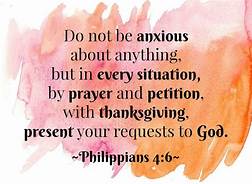
Here is camaraderie, teamwork, and togetherness at work. And, the togetherness, the sense of interconnectedness and belonging of the Christian life is what Paul recommends to us in verses 2 and 3. All of Paul’s commands dovetail into his urging to pray—with gratitude and thanksgiving. “Do not be anxious about anything, but in every situation, by prayer and petition, with thanksgiving, present your requests to God.”   

All too often, our prayers are just a ‘shopping list’ we bring to God, without thanksgiving and seasoned with anxiety and fear. We are urged to be grateful, to count our blessings.

            I encourage all of us – and I am preaching to myself as much as to anyone else – to strive to make it a habit. A way of living, to be thankful and grateful. Not just for this week, for Thanksgiving, but for the rest of the year, too. For always. Let us encourage each other to tap into this praiseworthy sense of interconnectedness and belonging! And celebrate the community that we are and the community that we are becoming!

Be like Paul. Don’t be filled with worry, but instead, be filled with gratitude and thanksgiving! Not just on Thanksgiving, but every day!

@chaplaineliza

(Suggestion: visit me at my other blogs: matterofprayer: A Year of Everyday Prayers. #PursuePEACE – and  A Year of Being Kind . Thanks!

(I would like to express my great appreciation for the observations and commentary from the web page www,umcdiscipleship.org for their brief series on gratitude. I used several quotes and ideas from their useful resources. Thanks so much!)


[1] http://worshipingwithchildren.blogspot.com/2013/09/year-c-thanksgiving-day-october-14-2013.html

[2] https://www.umcdiscipleship.org/worship-planning/our-hymn-of-grateful-praise/twenty-fifth-sunday-after-pentecost-year-a-lectionary-planning-notes

[3] Hooker, Morna D., The New Interpreter’s Bible Commentary (Vol. 12,The Letter to the Philippians), (Nashville, TN: Abingdon Press, 2000), 547-48.

Unknown's avatar

Attitude of Gratitude!

“Attitude of Gratitude!”

Psalm 100 – November 12, 2023

            Gratitude! Be grateful! Have an attitude of gratitude! But, how on earth do we do that? Great question!

With November, all of us here in the United States enter a time of thanksgiving, a season of gratitude. We can think of the Thanksgiving story, that thankful meal shared several centuries ago in New England. This was a means of showing gratitude for the harvest gathered in, and for the blessings of the bounty of nature God bestows upon those who farm the land.

I’ve lived in the Chicago area all my life. I’ve never lived in a small town, or a farming community, or had anything to do with gathering in crops. The most I’ve ever done is go to an apple orchard in the fall to pick apples – and that was just twice in my life. I know that whole communities rely on the harvest! Except – I have never been a direct part of that process.   

            What we all share, both city folks and country folks, is gratitude. Yes, we all can be thankful and grateful. Yes, we all can lift our hearts to the Holy One to say “thank you” for the bounty of nature, and we can come to God in praise for the interconnectedness of life.  

Autumn is, indeed, a thankful time of the year. But, how can each of us generate an attitude of gratitude? What does a life of gratitude look like? Or perhaps more importantly, what does a life of gratitude feel like?

            I want us to focus on our Scripture reading for today, and take special note of verse 4: “Enter God’s gates with thanksgiving and his courts with praise; give thanks to him and praise his name.” Psalm 100 is a praise psalm or song, the last in a small collection of special psalms of praise and worship. Do these verses get you in the mood of worship? Of praise? Could we see ourselves marching to our particular house of worship looking forward to meeting with God? To serve and praise and bless and be thankful to God? That is exactly what this Psalm is encouraging—no, even more strongly—is commanding us to do.

            The ancient superscription – or introduction – to this psalm simply says “a psalm of thanksgiving.” “On the one hand, there is the idea that thankfulness covers all of life; it is our way of approaching the world and the attitudes with which we choose to live. On the other hand, there is a clear indication that we are making a commitment to God in our choice to live a grateful life.” [1]

A number of verbs, or action words in this short psalm, are clear commands. In the first three verses, “Raise a shout!” “Serve!” “Come!” and “Know!” Verse four has “Enter!” “Be thankful!” and “Bless!” All of these verbs—and they are many of the chief action words in this Psalm—are instantly recognizable as an imperative, a command to anyone who spoke Hebrew!

This grateful commitment to God is quite serious if we follow these commands found in this psalm of praise. The grateful, thankful life shown to each of us in this short psalm is more than just a possibility. It becomes a blessed reality, if we follow through on the commands and promises highlighted by these few verses!

            We look to verse 4 again. We are commanded to “Enter the gates with thanksgiving!” “But what does that mean? Do we come to church with grateful hearts? Well, of course, we do. But more than that, we pass through every door with gratitude in our minds and hearts.” [2] Except, it’s more than that. Yes, we enter every door with thanksgiving and gratitude! And – plus – moreover – we can take the opportunity to incorporate this gratitude into each interaction we have throughout our day. When we enter our homes, we can be grateful for the family of which we are a part. When we go out and about, into the neighborhood or the community, we can be grateful for the abundance we all take for granted far too often. [3]

            And, what about those we encounter in our daily lives? Perhaps we haven’t even thought that far. Could it be that God would be pleased if we are grateful for each person we meet? Each one is a precious child of God, too – even the ones we sometimes struggle to get along with. Perhaps that attitude of gratitude is helpful for bridging the gap, for helping each of us be thankful for every interaction we have, every single day.

            I was so amazed to read about a senior’s daily practice in the preaching notes for this Sunday’s Scripture reading. Listen to this description: “Every morning, Amy Kawahara, ninety-four years old, opens her eyes and thanks God for another day to live. She knows she belongs to God. She reads devotion, prays, and seeks ways to share joy. She sings in the choir to make a joyful noise to the Lord. She leads a prayer group and senior exercise ministry. In every way, she worships the Lord with gladness.” [4]

            Isn’t the attitude of this senior Amy Kawahara a model attitude of gratitude to God?

            What are you thankful for, at this thankful time of year? What is each of us grateful for? There is something behind all this gratitude and thankfulness! We belong! We not only belong to God, but we belong to our church, to our fellowship of believers. “We are a part of something that is infinitely bigger than we can see. Of course, gratitude is the only proper response.” [5]

            This psalm ends with a powerful description: we have a the good God who loves each of us – all of us! Praise-filled, and thankful! May we all come into God’s loving, faithful presence with a joyful noise, giving thanks from the bottom of our hearts. Let us have an attitude of gratitude every day of the year, not only on Thanksgiving Day.    Alleluia, amen.

@chaplaineliza

(Suggestion: visit me at my other blogs: matterofprayer: A Year of Everyday Prayers. #PursuePEACE – and  A Year of Being Kind . Thanks!

(I would like to express my great appreciation for the observations and commentary from the web page www,umcdiscipleship.org for their brief series on gratitude. I used a number of quotes and ideas from their useful resources. Thanks so much!)


[1] https://www.umcdiscipleship.org/worship-planning/our-hymn-of-grateful-praise/twenty-fourth-sunday-after-pentecost-year-a-lectionary-planning-notes/twenty-fourth-sunday-after-pentecost-year-a-preaching-notes

[2] Ibid. 

[3] Ibid.

[4] https://www.umcdiscipleship.org/worship-planning/our-hymn-of-grateful-praise/twenty-fourth-sunday-after-pentecost-year-a-lectionary-planning-notes/twenty-fourth-sunday-after-pentecost-year-a-small-groups

[5] https://www.umcdiscipleship.org/worship-planning/our-hymn-of-grateful-praise/twenty-fourth-sunday-after-pentecost-year-a-lectionary-planning-notes/twenty-fourth-sunday-after-pentecost-year-a-preaching-notes

Unknown's avatar

Generosity – and Grace!

“Generosity – and Grace!”

Matthew 20:1-16 – September 24, 2023

            I often think of my four children. I sometimes remember them as younger children. I can remember very well those times when I went to school to help out in classrooms, or to chaperone on field trips. I especially remember the times when I overheard arguing and bickering in the classrooms, in the halls or on the playground between the school kids. “It’s not fair!” was one thing repeated over and over.

            Let’s see how the Rabbi Jesus begins this parable. Jesus is on His was to Jerusalem, and it will not be long before the Triumphal Entry on Palm Sunday and the Passion Week. It’s perhaps a few weeks before all those weighty events begin to happen. I am certain Jesus wanted to be certain to get some very important truths across to His disciples and to the crowds.  

            As is common with the Rabbi Jesus, when He wanted to teach some very important ideas and truths, He used parables. You and I know that using stories really helps to cement ideas into our heads! So it is with this story. That same complaint, “It’s not fair!” seems to come forth from some of the workers in this parable of Jesus. In our Gospel reading, “Jesus tells a story that reflects a completely different way of looking at things. It is a story about a vineyard owner who pays his workers on the principle of generosity, rather than on the principle of merit.” [1]

            In our parable today, Jesus tells what the kingdom of heaven is like. This is another parable in His series, in response to questions asking about what the kingdom, what heaven is like, for real! “Come on, Rabbi! Tell us! Enough with this confusing religious mumbo jumbo! Give us some straight talk about what we can expect from God!”

             Remember how the parable starts:

“Early one morning a man went out to hire some workers for his vineyard. After he had agreed to pay them the usual amount for a day’s work, he sent them off to his vineyard. About nine that morning, the man saw some other people standing in the market with nothing to do. He promised to pay them what was fair, if they would work in his vineyard. So they went. At noon and again about three in the afternoon he returned to the market. And each time he made the same agreement with others who were loafing around with nothing to do.”

            Remember, Jesus is answering a continuing question: what is the kingdom of heaven like? What will happen when we get there? In other words, another way to ask this same question is, what is God like? What can we expect from God when we get to heaven?

            I know this might be difficult, especially if you’ve been prudent with money all your life, but try and put yourself in the place of the workers who were chosen, who were sent to work at the end of the day. Imagine being a day laborer. There is no Social Security, no social safety net. Such a hard life! Imagine earning just enough to support you and your families for just one more day.

            “What we now call food insecurity is their norm, and so it’s easy to imagine their excitement when they finally get an invitation to work – they won’t earn a full day’s wage, but enough perhaps to scrape by. That excitement only multiplies when the manager unexpectedly and inexplicably pays them for a full day! I suspect that equal measures of relief, joy, and gratitude suddenly coursed through their veins as each received their payment.” [2]

            When people in the crowd or among His group of disciples continue to ask, the Rabbi Jesus is telling us that in the kingdom of heaven, God is generous! The loving, kind generosity of the owner of the vineyard is truly evident from this parable! Which brings us to the workers who were hired first, the ones who have seen all of the others, the workers hired later that day, already receive their wages for the day. Let’s hear Jesus describe the scene.

 “10 The workers who had been hired first thought they would be given more than the others. But when they were given the same, 11 they began complaining to the owner of the vineyard. 12 They said, “The ones who were hired last worked for only one hour. But you paid them the same that you did us. And we worked in the hot sun all day long!”

            Can’t you just hear these workers say, “It just isn’t fair!” Face it, their reaction ‘is almost exactly what most of us would have felt had we been in their shoes. Because what happens to them simply does not add up and so doesn’t seem fair. Never mind it’s what was contracted – if those who worked an hour received a day’s wage, then those who worked so much longer deserve more.[3] But – the owner of the vineyard is generous. Generous to everyone, no matter who, no matter what!

            Another word for this lavish, overabundant generosity is GRACE. Have you ever received grace for something you absolutely did not deserve? Many people read this parable, and say “That’s not fair!” That is exactly the point. If God were absolutely fair, none of us would be loved by God, none of us would be embraced by Jesus our Good Shepherd. No one. None. It is only by the Lord’s love, grace and mercy that any of us are welcomed into God’s family. It is all God’s grace and generosity. It is NOT about working in the vineyard, or working for salvation, at all.

                  We all have had grace extended to us here in the real world, haven’t we? – a grace period to turn in homework you did not finish or the work project you needed to finish last week. What about the landowner paying the last hired workers a whole day’s wage? And what about God forgiving us even when we don’t deserve it, or when we do things and say things that make God sad or even angry? That is grace. That is God’s generosity. God does not have to, is not obligated to forgive us and be gracious to us. But – that is exactly what God does.

      We don’t have to do more or be better in order to ensure that God loves us, because God loves each of us completely already. As Desmond Tutu puts it, “There is nothing we can do to make God love us more” and “there is nothing we can do to make God love us less.”  It is a strange kingdom indeed where there is nothing to earn.[4]

As Jesus said, this is what the kingdom of heaven is like. It’s fairness, God’s way. ”Everyone who is now last will be first, and everyone who is first will be last.” Abundant grace and generosity for all, no matter what. Thanks be to God! Alleluia, amen!

@chaplaineliza

(Suggestion: visit me at my other blogs: matterofprayer: A Year of Everyday Prayers. #PursuePEACE – and  A Year of Being Kind . Thanks!


[1] https://thewakingdreamer.blogspot.com/2011/09/nothing-to-earn-mt-201-16-1-i-have.html

[2] https://www.davidlose.net/2014/09/pentecost-15-a-love-or-justice/

[3] Ibid.

[4] https://thewakingdreamer.blogspot.com/2011/09/nothing-to-earn-mt-201-16-1-i-have.html

Unknown's avatar

Give Thanks? For What?

“Give Thanks? For What?”

Psalm 100:1-5 (100:4) – November 24, 2021 (preached at the Morton Grove Interfaith Thanksgiving Eve service, held at St. Martha of Bethany Catholic Church campus)

            What are you thankful for? I don’t know whether you or your family come up with a “gratitude” before you eat your Thanksgiving feast tomorrow. Except, it is becoming more and more common that as families and friends gather around the festive table that they go around the table and say what each one is grateful for. Sometimes, even before they begin to eat. The religious writer Diana Butler Bass calls this “the Turkey Hostage Situation.” No food until everyone comes up with a gratitude!   

            Some years we are more grateful and thankful than others. The psalm we read tonight features thankfulness as a highlight of worship. When we come into our houses of worship, we are supposed to be thankful. Grateful. Especially now, at this Thanksgiving time of the year.

I want to dig more deeply into Psalm 100, and see what else we can discover.

I love language. I loved English classes when I was in middle school and high school. Of course, I loved literature! I was – and still am – fascinated with the way language functions and is put together. This great interest in languages helped me when I went to seminary and studied biblical Hebrew and Greek, the original languages our Bible was written in.   

One helpful tip I remember when looking at the nuts and bolts of a Bible verse or paragraph is to break it down. Look at the different parts of speech: nouns, adjectives, and especially verbs. The verbs in Psalm 100 give us a great deal of insight into this psalm, or song.

Speaking of songs, this reading IS a song. This song gives us instruction of how to come into God’s presence – the how-to’s of worship. The African-American Lectionary commentary says, “The psalmist uses seven different verbs to call to the community to worship: make, serve, come, know, enter, give thanks, and bless. Although there are moments when we need to be still and quiet in the presence of the LORD, this is not one of them.” [1]

I really appreciate and enjoy those times when I worshiped in African-American congregations. Since I lead a congregation now myself, I miss those other opportunities to go, and see other congregations, and enjoy different praise structures and faith traditions in worship.

Yet, I wonder – what is it about this psalm that makes it so marvelous as a template for worship? If we go back to the verbs used in this song, this hymn of praise and worship takes on a more wonderful meaning. And institutional meaning.

True, I have attended worship in a number of different settings, over the years. In many of these, the basic outline of worship remains the same. The worshipers come together, and they know, they understand (as best as they are able) that God is the reason they gather. Then – and this is important to any worship service – they give thanks.

I remember a small, intimate worship service some years ago while I was on a retreat. About 15 people were gathered together. We did not have any of the outside trappings of a building, no special glass, no carved woodwork or stone, no music or musicians. Yet, that was a meaningful worship experience for me, and for many others in that group.

That retreat was not at Thanksgiving-time, yet we were all thankful and grateful the group of us had gathered together. Can you relate? Have you had a feeling like that, a similar experience where you and the other members of your group felt thankful about this holy experience? This worship opportunity where you felt thankful and grateful you and the other people in your group (any group – family, friends, congregation, retreat group) felt the same way? Indescribable, worshipful, beyond words, even divine.  

This psalm talks about experiences like that in worship, and says that giving thanks is an integral part of worshiping God. We can give thanks that God is our God. And, we can give thanks for all that God has given to us.

            I agree with commentator Larry Broding that thanksgiving is one of our primary attitudes of worship. “We are to be happy when we present ourselves to God. We are to be thankful when we are in [God’s] presence. Other attitudes are possible (sorrow, need, intercession, surrender, peace, etc.) but joy and thanksgiving should be our primary focus.” [2] And, this isn’t just at Thanksgiving. It’s at any time of the year.

For those among us who do not feel like gathering with family or friends at a dinner table tomorrow, I relate. Thanksgiving can be a difficult occasion, a complicated time. Know that there are friends who stand with you, or sit beside you, in your discomfort, grief or longing.

            Specifically, what about the upcoming feast tomorrow? Similar to writer Diana Butler Bass, are you and I familiar with the Turkey Hostage Situation? Are we going to hold our turkey – or whatever other kind of main course – hostage while each one around the table scrambles to come up with something they are grateful for? We are grateful for the stuff, the things of our lives! That is turning our annual day of thanks into a commodity-based occasion. [3] It is not helpful for us to twist or force “thankful” feelings and behavior in this way

            Going back to my great interest in language, I found Butler Bass’s alternative for this round-robin of “gratitude” to be a fascinating option. Instead, an alternative suggestion: Perhaps this Thanksgiving is a good time to ask some different questions regarding gratitude:

To whom or what are you grateful?
What challenges have you been grateful through?
Have you been grateful with others?
Where have you discovered gratitude within?
Has something in your life been changed by being grateful?
In
what circumstances have you experienced thankfulness?

            Any or all of these are marvelous ideas to ponder. Situations to consider. Again, this may or may not work for the group gathered around your Thanksgiving table. But, it certainly takes our minds off of the tangible, material things, the clutter of forced gratitude at Thanksgiving, and the myriad of stuff we might have randomly filling up our lives, like the stuffing inside of a turkey.

            Tonight, I hope and pray we all can “Enter God’s gates with thanksgiving and his courts with praise;” may we all “give thanks to God and praise his name.”

             I pray a blessed and thankful holiday upon us all. Amen.

@chaplaineliza

(Suggestion: visit me at my other blogs: matterofprayer: A Year of Everyday Prayers. #PursuePEACE – and  A Year of Being Kind . Thanks!


[1] http://www.theafricanamericanlectionary.org/PopupLectionaryReading.asp?LRID=98

Commentary, Psalm 100, Alfie Wines, The African American Lectionary, 2009

[2] http://www.word-sunday.com/Files/Psalms/100.html

·  “How To Prepare for Worship,”Larry Broding’s Word-Sunday.Com: A Lectionary Resource for Catholics.

[3] https://dianabutlerbass.substack.com/about

Unknown's avatar

God Gives Us Good Things

“God Gives Us Good Things!”

Deut 26-1-11 words

Deuteronomy 26:1-11 (26:11) – November 24, 2019

This season we are in right now I call the thankful time of the year. We give thanks for the harvest just brought in to the barns across the country. We give thanks for fruits and vegetables harvested from our back gardens in cities and suburbs. And, we give thanks for God’s wonderful bounty of gifts poured out upon us all, regularly.

Our Scripture reading from the book of Deuteronomy lists a thanksgiving for the harvest for the Jewish people. It’s not only a thank-you to God, but chapter 26 lists a required offering of first fruits all Jews ought to bring to God. The first fruits—or harvest—of the season we bring to God, as an expression of gratitude and thankfulness.

What is more appropriate for our reading today than this Scripture reading, especially at this thankful, grateful time of the year?

Deuteronomy 26 begins with these words: “When you have entered the land the Lord your God is giving you as an inheritance and have taken possession of it and settled in it, take some of the firstfruits of all that you produce from the soil of the land the Lord your God is giving you and put them in a basket. Then go to the place the Lord your God will choose as a dwelling for his Name.”

Talk about making an actual, physical offering of the first fruits you have gathered from your farm, or orchard, or dairy, or hen house. Whatever we have the opportunity to gather from our harvest, that is what we are to present to the Lord

Yes, showing our gratitude and thankfulness to our God is truly important. But—does this Scripture passage say more than just a duty-bound thank-you operation? Our biblical commentator certainly thinks so. “God gave the unexpected and free gift of a new life to a group of stateless persons, making of them a people with a special relationship to him and giving them a ‘land of milk and honey’ to live in.” [1]

I can understand how this presentation of first fruits was so important for the Jewish people—finally with a land of their own after centuries of having no place to call their own. Wandering and landless. Just as Moses gave one of the biblical patriarchs as an example: this reading even mentions a “wandering Aramean.”

Moreover, the manner in which the Jews are to say “thank you” to God for material and spiritual gifts is important. That is what I hear when I listen to this chapter read: it has not only the instructions for presenting the first fruits of our harvest to God, but also the underlying reason why, in the first place.

“The members of the nation are invited to respond to this divine initiative by showing their gratefulness, and to do so by returning to God part of what God has given them. But how can we give a present to the invisible God? Here is where the institution of organized worship comes in, to enable human beings to make a symbolic offering to God and in this way to express their relationship to him.” [2]

So, we are not only to give God thanks individually, but we are instructed to do so in organized worship services. This is a way to gather together and to jointly—as a worshiping body—lift our voices to the Lord in gratitude and thanksgiving.

This is not just for adults. Families can give thanks. We ought to look for opportunities to get our children and grandchildren involved, too. An excellent bible commentator I often reference, Carolyn Brown, mentions how we might possibly get our children involved in the giving of thanks. “Involving children in community services is a good way to draw a crowd and to introduce children to their community’s religious base.”  She also suggests that we “provide paper and crayons or markers for children (and older worshipers) to write poems or draw pictures of where they see God all around them.” [3] These are imaginative and creative ways to celebrate God and give God our thanks.

There are many ways we can celebrate at a joint Thanksgiving service to God. One way is to sing hymns of thanksgiving and celebration and thank God for the wonderful harvest, as we are in this service today.

Can we think of a better way to have everyone in our community gather together to give thanks for all the blessings we enjoy? Just like on this coming Wednesday, when our wider Morton Grove community will gather here in this place to give thanks.

I know that several people here in this service have attended many of the past community Thanksgiving Eve services. I would like to remind everyone that the giving of thanks is a universal expression of gratitude. We have a tremendous opportunity for everyone to gather together and give thanks, despite our variety of backgrounds and despite our religious differences.

Just as we collect an offering at the close of each service on Sunday mornings, so we will gather an offering on Wednesday night. Not only are we making a symbolic gesture of our worship through the gathering of people from diverse faith traditions and various world cultures, but we all can lift thanksgiving and gratitude together as a community, no matter when each of us separately and regularly praise and worship God.

Is there a better and more praiseworthy way for us today to give thanks to God? What is more, is there a better way for us to show God how much we care for and love God? The Jewish people have gathered for millenia, in regular praise and worship of God, and especially in thanksgiving for all God has done for them in the past.

Deuteronomy 26 tells us that each individual citizen was told to rejoice with the priests (or, in this case, Levites) and foreigners. God wishes everyone to come before the Holy One with thanksgiving, including foreigners. Just saying, but God repeated informs Israel that they are to treat the foreigners who live with them exactly the same as any citizen of Israel. God makes no distinction, and tells the people of Israel those exact words.

How wonderful to have that continuity across the ages. From the Jews, wandering in the wilderness, through the time of the Temple and what formal worship happened there, up through the times of the foundation of the Church and more recent centuries—we have always had occasion to gather together to give praise and thanks to our God.

Everything, even life itself is a gift from God above, enabling us to give thanks to God in all things. Isn’t this what the apostle Paul told us in his letter to the Philippians?  “Do not be anxious about anything, but in every situation, by prayer and petition, with thanksgiving, present your requests to God.”

[1] http://www.taize.fr/en_article167.html?date=2014-10-01

“Giving back to God what God has given us,” Commented Bible Passages from Taizé, 2014.

[2] Ibid.

[3][3] http://worshipingwithchildren.blogspot.com/2013/09/year-c-thanksgiving-day-october-14-2013.html

Worshiping with Children, Thanksgiving Day, Including children in the congregation’s worship, using the Revised Common Lectionary, Carolyn C. Brown, 2013.

@chaplaineliza

(Suggestion: visit me at my regular blog for 2019: matterofprayer: A Year of Everyday Prayers. #PursuePEACE – and my other blog,  A Year of Being Kind . Thanks!

Unknown's avatar

Were Not Ten Made Clean?

“Were Not Ten Made Clean?”

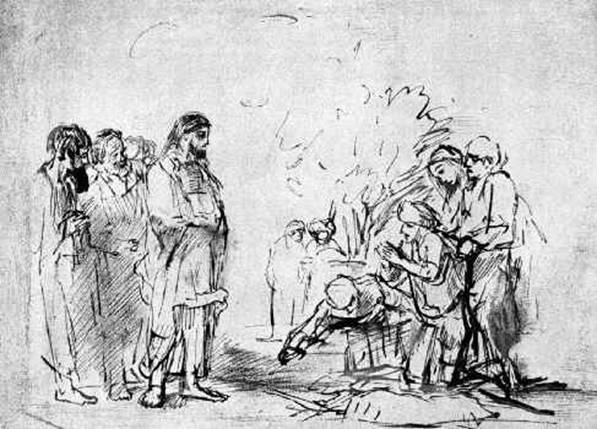
Luke 17-18 rembrandt

Luke 17:11-19 – October 13, 2019

Sometimes, I talk with people in recovery—alcoholics and addicts who are not drinking or using substances, one day at a time. I used to do this more often, when I was regularly facilitating a weekly spirituality group at an inpatient drug and alcohol rehab unit at a nearby hospital. One of the suggestions for staying clean and sober one day at a time is to keep a gratitude journal. You know, a running list of things we are grateful for.

A writer for the Hazelden/Betty Ford Clinic, Michael G., tells us “The Roman Emperor Marcus Aurelius famously said that our lives are what our thoughts make them. In other words, by simply changing the way we think and our focus, we can change our lives. Bearing this in mind, choosing gratitude can have a huge impact on your life.[1]

What on earth does a gratitude journal have to do with our Gospel reading today from Luke 17? To better understand that, we need to look at the background of the situation. Jesus and His disciples are on their way to Jerusalem. The time is growing nearer for Jesus to enter into Jerusalem on Palm Sunday—very near, now. While on the road on the border between Samaria and Galilee, Jesus is met by ten lepers—ten people with various sorts of skin deformity.

Can you see this scene? On the road at the outskirts of a town, Jesus and His disciples are walking. Perhaps, entering the town, hungry, thirsty, wanting a place to rest. When all of a sudden, ten lepers interrupt Jesus while He is on His journey. They stand some distance away, but they still make themselves heard—“Jesus, Master, have pity on us!”

Have you ever had the unexpected opportunity to meet someone special, someone important, perhaps interrupting them on their journey? That is exactly what happened.

These ten men, the men with serious skin conditions, were living a very lonely existence. They could not have any direct physical contact with any healthy or “clean” person, for fear of transmitting their skin condition or illness. Even touching a person who had leprosy or touching something they touched might be dangerous—might get someone infected.

Whenever someone developed a serious skin condition centuries ago, they had to be separated, and go live outside of their community. In the Law of Moses, the book of Leviticus devotes a whole chapter (chapter 13) to that situation, and is quite specific. ““Anyone with such a defiling disease must wear torn clothes, let their hair be unkempt, cover the lower part of their face and cry out, ‘Unclean! Unclean!’ 46 As long as they have the disease they remain unclean. They must live alone; they must live outside the camp.”

How horrible! Imagine never being able to hug your children, spouse, parents, or brothers and sisters again. Imagine never being able to enter the market or the house of worship you regularly attended, much less being banished from your home. This was life, in an ongoing and sad reality for these ten lepers. How incredibly lonely!

Especially to an observant Jew, the religious and spiritual separation must have been awful. As Dr. David Lose tells us, “That disease made them ritually unclean, which meant that they couldn’t participate in the Temple services and rituals at the center of their faith. And not able to practice their faith, these men stood on the outside of their community as well, likely feeling alone, abandoned, and desperate.” [2]             But, there is unexpected hope. I don’t know which of these lepers hears that the Rabbi Jesus is in town, but Jesus had been healing people throughout Israel and Galilee for about three years by this time. Wouldn’t you ask for healing, if you unexpected met the Rabbi Jesus?

As I considered this reading during the week, I wondered how addicts and alcoholics felt. Are they considered “Unclean!” and ostracized? Shunted aside? Ignored? Does their disease of alcoholism or addiction cause them increasingly to live alone and isolated, in poorer and poorer health?  These two situations from Luke 17 and the condition of addicts today do not line up completely, but there are some close parallels between our Gospel reading and the sad, lonely, debilitating condition of countless people who are afflicted by the disease of addiction.

I want us to begin to understand the hopeless, helpless sense of these ten lepers, ostracized and isolated, suddenly and unexpectedly getting hope for the first time in a very long time. “The Rabbi Jesus! Coming to our town? I’ve heard about Him! Isn’t He the Rabbi who heals the blind and lame? And, didn’t He raise that widow’s son from the dead? And—and—that Rabbi has healed some lepers. I know, I heard the stories. Maybe—He might heal me!”

Hoping against hope, you know what happens. Jesus does stop, and He does talk to them. He says, “Go, show yourselves to the priests.” That’s puzzling, at first hearing. But, not if you are someone living by the Law of Moses. When a person was healed from illness, they were routinely supposed to go to the Temple or to the priest and show themselves. In today’s terms, the priests were similar to physicians’ assistants in the role of certifying people’s return to good health. Jesus told the lepers to go even before they were healed. And as they were obedient and started on their way, a miracle happened. They were healed, cleansed, and their skin conditions were totally gone. Imagine how excited and delighted those former lepers were!

Here’s where the problem is: ten were healed, but how many came back with thanks to Jesus? How many were truly grateful? Yes, ten lepers left Jesus, and along the way to the priests became clean, healthy, and whole. Only one ex-leper truly recognized the incredible healing and gave thanks to the Rabbi Jesus. In giving thanks, he became what God had intended all along.

That is the answer. That is the secret to life: gratitude. “Noticing grace, seeing goodness, paying attention to healing, stopping to take in blessing, and then giving thanks for the ordinary and extraordinary graces of our life together. This is the secret to a good life and the heart of saving faith.” [3]

I started off this sermon quoting from an article on recovery. I’ll end it the same way. Michael G. says, “When I first came into recovery more than 30 years ago, my sponsor told me to buy a notebook and write down 10 things I was grateful for, and then add three things to that list every day. I stopped numbering my list when I got to 5,000 items.

Why did I write a gratitude list? Because I didn’t want to be miserable, and if being grateful was the solution, then that’s what I would do. And importantly, a grateful heart doesn’t drink. I learned very quickly that the struggle stops when gratitude begins.” [4]

I don’t often end with a challenge, but I am today. This is for me as well as for you. What practices ought we undertake, with what stories might we surround ourselves, with what rituals might we allow ourselves to be shaped, so that we might respond to God with gratitude and joy?

Dear Lord Jesus, help all of us to search for the answers to these sincere questions, and follow Your way in our daily lives, perhaps even writing a daily gratitude list.

Alleluia, amen.


[1] https://www.hazeldenbettyford.org/articles/sober-dad/gratitude-early-recovery

[2] http://www.davidlose.net/2019/10/pentecost-18-c-the-secret/

[3] Ibid.

[4] https://www.hazeldenbettyford.org/articles/sober-dad/gratitude-early-recovery

@chaplaineliza

(Suggestion: visit me at my regular blog for 2019: matterofprayer: A Year of Everyday Prayers. #PursuePEACE – and my other blog,  A Year of Being Kind . Thanks!