Unknown's avatar

Love? Jesus Says So.

“Love? Jesus Says So.”

John 13:31-35 (13:34) – May 18, 2025

            May is Mental Health Awareness Month. This month is particularly meaningful to me, since I deal with people who have mental health challenges almost all the time. Both professionally, as a hospice chaplain, and personally, since I have a number of people in my extended family who have mental health challenges.

            I have highlighted May and mental health awareness for years, as a hospice chaplain working in the Chicago community. As a friend of mine, the Rev. Kathy MacNair said many times, everyone knows someone. Every single person knows someone who is struggling with mental health issues – and sometimes, they know several someones. Or, are related to several someones. Or, perhaps you are one of these people who have mental health challenges.

            Our Lord Jesus was very familiar with mental health challenges. As we can see from all four Gospels, the Rabbi Jesus traveled from place to place, preaching, teaching and healing. Sure, some of these healings were physical healings, but some of these healings were also spiritual, mental, and I believe psychological, too. Our Lord Jesus truly healed these dear folks. His compassionate action and treatment is always truly loving, and infinitely caring.  

John chapter 13 comes from the Upper Room Discourse, that last night the Rabbi Jesus was with His disciples. Remember, this was at the Passover meal they all shared together, just before Jesus was arrested later that evening, beaten, tried, appeared before Pontius Pilate, and later the next day crucified outside the city of Jerusalem.  

            Do you understand how important and poignant these words of Jesus are? Just think back to a particularly important conversation you had with someone very meaningful in your life. Perhaps it was one of the last conversations you remember having with that loved one. Just so, our Gospel writer is aware of how important these last hours with his Lord Jesus actually were! I am certain all the disciples remembered these memorable words of Jesus with particular care.

            Let us read again the words of Jesus, from John 13: “34 A new command I give you: Love one another. As I have loved you, so you must love one another. 35 By this everyone will know that you are my disciples, if you love one another.” Shallow people comment about what they call love, thinking about valentines, candy and chocolates, and champagne toasts of undying affection. Can’t you hear them already? “Oh, how wonderful of Jesus! I love everybody already. I’m a good Christian.” Let’s take a closer look at exactly what Jesus was commanding.

            Sure, the Gospel of John mentions the disciples loving one another. But – John’s Gospel also has passages about other kinds of people, too. Nicodemus was a respected member of the Jewish religious rulers, the Sanhedrin, the religious upper class. By and large, the Jewish rulers were no friends of the Rabbi Jesus. What about the half-Jew, the Samaritan woman of chapter 4? What is more, she was also an outcast in her own town.

Did Jesus show any hesitation in His interaction with either one? Wasn’t He caring, loving and honest with each of them, just as He was with everyone else?

            Jesus was the ultimate in being open, loving and honest to everyone. No matter who, no matter where, no matter what faith tradition, social strata, ethnicity, or any other designation.  Jesus is commanding us to love in the same way. Not only towards strangers, but towards friends, as well. That can be even more difficult sometimes.

            “Here in John chapter 13, Jesus demonstrates his love for the same disciples who will fail him miserably. Jesus washes and feeds Judas who will betray him, Peter who will deny him, and all the rest who will fail to stand by him in his hour of greatest distress. The love that Jesus demonstrates is certainly not based on the merit of the recipients, and Jesus commands his disciples to love others in the same way.” [1]

            I get set back a bit when I realize the full ramifications of that boundless, amazing love of Jesus. It’s a tall order! Whoa, Lord! You don’t really expect me to be that way with people who insult me, or are mean to me, or disrespect me, do You?  I kind of think that is exactly what Jesus means. Love them. No “but, what if…?” Love all of them unconditionally.

            Which brings us back to where we started. It’s easy to love lovable people, to love babies and small children. Easier to love those in our families, and friends. But what about those we don’t even know? What about people we actively dislike? And, what about people who are scary, who we don’t understand, who are in dementia or who throw tantrums, or have addictions?

            I have permission from our friend Irene to talk about her adult daughter, who does have mental health challenges, was living at Thresholds social services for years, and who currently lives in Wisconsin. Now that the daughter is regularly taking her prescribed medication, things are stable and under control.  This dear daughter is quite helpful to Irene when she comes to visit. Thank God, this story has a happy ending, and this mother and daughter are reunited and grateful to God for all the help and support from friends, doctors and from support groups.

            That is exactly what Jesus means. Love all people. Even the scary ones, even the ones we dislike. No “but, what if…?” Love all of them, unconditionally.

            This is not just a suggestion. Jesus makes it a command. If you and I want to follow Jesus, this is one of the requirements. Some well-meaning believers say that other people may not merit Jesus’ love, for whatever reason.  Gosh, I don’t merit Jesus’ love a lot of the time! But, that makes no difference. Jesus still loves each of us, unconditionally. No matter what. Plus, Jesus commands us to love others in the same way. The same ultimate, above-and-beyond, bottomless way.

            So, whether you and I succeed or fail in our attempts to love one another this week, yet God in Jesus loves us more than we can possibly imagine. And hearing of this deep Jesus-love we are set free and sent forth, once again, to “love one another.

That is good news for all of us! Alleluia, amen!

@chaplaineliza

(Suggestion: visit me at my other blogs: matterofprayer: A Year of Everyday Prayers. #PursuePEACE – and  A Year of Being Kind . Thanks!


[1] https://www.workingpreacher.org/commentaries/revised-common-lectionary/fifth-sunday-of-easter-3/commentary-on-john-1331-35

Commentary, John 13:31-35, Elisabeth Johnson, Preaching This Week, WorkingPreacher.org, 2016.
Unknown's avatar

Gratitude Is—!

“Gratitude Is—!”

Philippians 4:4-7 (4:6) – November 19, 2023

            It’s that thankful time of the year, and this service is one way we all gather to say “thank You” to God. We say thanks for all sorts of good things. Wonderful gifts. Exciting opportunities. We gladly come before God and mention how thankful each of us is—to God.

One of my favorite biblical websites (and, I fully consider her a bible commentator) is “Worshipping with Children,” written by Carolyn Brown. This is what she had to say about Thanksgiving: “One of my favourite times with the children was the year we learned how to say “Thank you” in many languages from our congregation, and ended by using those words for our prayer together.” [1]

I know I taught my children how to say “thank you” when they received gifts, and compliments, and lots of other things. It’s a common thing, for grown-ups, parents, and grandparents to instruct children in these considerate, valuable, and grateful words.

            But, gratitude? Yes, almost everyone knows they are supposed to be thankful at Thanksgiving-time. But, grateful? That is not quite thankful – or is it?  

            Our New Testament Scripture reading for this Sunday is directed toward a group of people – of believers in God. Similarly, the Psalm reading is meant for a group of people, as are our hymns today, too. Isn’t it easier for us to be thankful – jointly? And, to be grateful – together?

            Sometimes being a part of a special group of people is helpful for joining together and agreeing to be in one accord with one another. Especially in terms of encouragement and hope, any group of people makes it easier to show signs of gratitude and thankfulness. Like, in the example of the group of people the apostle Paul addresses through this thank-you note. 

            We all know that being grateful and thankful is not just a head thing, not just something we decide to do one fine day. No, being grateful and thankful is not just an intellectual belief we endorse to be true. Instead, our gratitude and thankfulness ought to be a well-worn habit, a way of living. Most important, our gratitude and thankfulness should be visible, shown in what we do and say, shown in the choices we make and the priorities we set.

            Who remembers thank-you notes? I know I just mentioned thank-you notes written for gifts received (especially written by our children), but this is on a much larger scale. If you like to think so, each of us can be saying “thank you” to God, each and every day. In the same way, each of us has many reasons to be grateful to God each and every day, too.

            We are in a worship service right now. Worship is supposed to be a grateful and thankful time, for sure! What kinds of prayers are grateful and thankful? What about the group that is us, our congregation? “What prayers can we offer that might tap into the sense of interconnectedness and belonging? How can we celebrate the community that we are and the community that we are becoming? Let there be space for saying thank you to one another and to God.” [2]

When Paul wrote this particular letter, he wrote it from prison in Rome. He had been sent to the emperor’s court on a capital charge. He was on trial for his life. And yet—the apostle Paul writes this joyful, thankful, gratitude-filled letter.

Let us count off difficulties and challenges that Paul faced: not only the upcoming trial—for his life, but on top of that, Paul considered himself to be responsible for the churches he had planted on his missionary trips in Asia Minor and throughout Greece. Such heavy burdens on Paul. Yet, here in chapter 4 we see him writing almost blithely to the Philippian believers. He not only writes a thank-you note for a financial gift the Philippian believers sent to him, but Paul also is full of praise, thanksgiving and gratitude to God!

When we look at the people who were on the receiving end of this correspondence, few of them were living comfortable lives. One of the commentaries I consulted said, “Many were poor, many were slaves and few of them would have known the meaning of security. In marked contrast, those of us who live in comparative wealth and luxury today are frequently those who are most worried and anxious.” [3] Isn’t that a true description of us, today?

Sometimes there IS stuff to worry about! A lot of times, people (yes, even Christians) worry about all kinds of stuff! Aren’t we tempted to be worried and anxious when finances are a challenge or the car is giving big problems? Or, how about when we or one of our loved ones is unemployed? Or, in the hospital or dealing with a chronic illness? What about in an accident, or even in jail? Some would say it is natural, even part of the human condition to be worried.

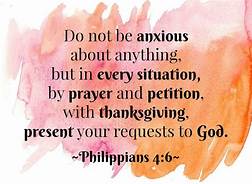
Here is camaraderie, teamwork, and togetherness at work. And, the togetherness, the sense of interconnectedness and belonging of the Christian life is what Paul recommends to us in verses 2 and 3. All of Paul’s commands dovetail into his urging to pray—with gratitude and thanksgiving. “Do not be anxious about anything, but in every situation, by prayer and petition, with thanksgiving, present your requests to God.”   

All too often, our prayers are just a ‘shopping list’ we bring to God, without thanksgiving and seasoned with anxiety and fear. We are urged to be grateful, to count our blessings.

            I encourage all of us – and I am preaching to myself as much as to anyone else – to strive to make it a habit. A way of living, to be thankful and grateful. Not just for this week, for Thanksgiving, but for the rest of the year, too. For always. Let us encourage each other to tap into this praiseworthy sense of interconnectedness and belonging! And celebrate the community that we are and the community that we are becoming!

Be like Paul. Don’t be filled with worry, but instead, be filled with gratitude and thanksgiving! Not just on Thanksgiving, but every day!

@chaplaineliza

(Suggestion: visit me at my other blogs: matterofprayer: A Year of Everyday Prayers. #PursuePEACE – and  A Year of Being Kind . Thanks!

(I would like to express my great appreciation for the observations and commentary from the web page www,umcdiscipleship.org for their brief series on gratitude. I used several quotes and ideas from their useful resources. Thanks so much!)


[1] http://worshipingwithchildren.blogspot.com/2013/09/year-c-thanksgiving-day-october-14-2013.html

[2] https://www.umcdiscipleship.org/worship-planning/our-hymn-of-grateful-praise/twenty-fifth-sunday-after-pentecost-year-a-lectionary-planning-notes

[3] Hooker, Morna D., The New Interpreter’s Bible Commentary (Vol. 12,The Letter to the Philippians), (Nashville, TN: Abingdon Press, 2000), 547-48.

Unknown's avatar

Don’t Worry—Rejoice!

“Don’t Worry—Rejoice!”

Philippians 4:4-7 (4:6) – September 13, 2020

            I love Bobby McFerrin. His way of recording acapella music is absolutely brilliant. No instruments, but just him, as he sings, whistles, and makes other kinds of sounds.

In 1988, a song was released that went straight to the top of the billboard charts. Not only in the United States, but worldwide. That quirky song “Don’t Worry, Be Happy” had no instruments, but just Bobby McFerrin singing, whistling and making other sounds with his body.  

            Today’s Scripture reading has almost exactly the same message. The apostle Paul tells his friends from Philippi, “Don’t worry—rejoice!”

            These verses from chapter 4 are where Paul gives his personal remarks and admonitions to a very special community of believers. Stand firm! Be of the same mind! Help each other! Rejoice! Be gentle! Don’t worry! And, pray!

            Of Pal’s words, what particularly strikes me at this time is “Don’t Worry—Rejoice!”  That is a tall order for anyone at any time. But, now? With all that is going on in the United States right now? Not only the COVID pandemic, but also the uncertainty, fear and anxiety with our country’s general condition. Plus, the racial tension, the problems with the weather and the wildfires, and the political uncertainty all add to the general anxiety of many in this country.

            Seriously, where does Paul get off, telling me NOT to worry? He doesn’t know what I am going through! Or, does he?

We have talked about Paul in prison, throughout this sermon series in Philippians. Imagine, awaiting his trial for a serious offence. Shackled at the wrist to a Roman soldier night and day, Paul had absolutely no privacy. What a miserable situation! Or, was it?  

            Let’s look more closely at Paul’s admonition. Or, if you like to think about it in this way, a part of Paul’s home improvement description.

Plus, some of these seem so difficult to accomplish. I can’t do this stuff that Paul tells me to! As Alyce McKenzie comments, “I would read [this admonition] and try to psyche myself up. “Let’s do this! No anxiety! Who needs it? I am a competent adult. I just need to breathe deeper, summon more faith, and I can achieve this anxiety-free life Paul talks about. Let’s do this!” [1]

            But, anxiety and fear continue to rise up and threaten to swallow us alive. Especially with so much uncertainty swirling around so many, few of us find it easy to do what Paul advises. So often, our attitude can be the exact opposite of that rejoicing and trust in God that Paul commands of us.

            Let’s think about the people Paul was writing to, in Philippi. Many of those people were probably unlikely to have comfortable lives. Most were poor, many were slaves or indentured servants. Few would have had any idea of what we know today as peace, joy and security. Yet, Paul encouraged all of them to rejoice in the Lord. [2]

            Let me tell you, Paul was hardly in the prime place to be a quality motivational speaker. From a worldly point of view, that is. Face it, we who live in comparative security, wealth and luxury today are so much more likely to be the most worried and anxious – especially with the sizeable fear and anxiety swirling around us for the past number of months.

            So, how on earth do we do it? How do we rejoice in the Lord always? And again, Paul says, rejoice!

A few years ago, commentator Alyce McKenzie went to a fitness class twice a week taught by an excellent instructor. As she says, “She is both fit and motivating. She is so pleasant that we don’t even hate her when she is making us do the tenth round of squats that are the reason getting up and down from my writing chair today is so painful.

“When we are flagging in energy in the middle of a round of chest presses or push-ups, she’ll call out “C’mon, people! You’ve got this!” I can’t deny that it has an energizing effect. Class members will call out things like “Yeah!” and “Woo-hoo!” I don’t call out anything. I’m busy trying to keep breathing, but I do feel a surge of internal confidence. “I’ve got this! I can do this!”

            Here is camaraderie, teamwork, and togetherness at work. And, the togetherness, the teamwork of the Christian life is what Paul recommends to us in verses 2 and 3. Remember? Be of the same mind! And, help each other!

            All of Paul’s commands dovetail into his urging to pray—with thanksgiving. “Do not be anxious about anything, but in every situation, by prayer and petition, with thanksgiving, present your requests to God.”   

            All too often, our prayers are just a ‘shopping list’ we bring to God, without thanksgiving and seasoned with anxiety and fear. We are urged to be grateful, to count our blessings. While the apostle Paul would express himself differently, I think Paul would appreciate the laid back, trusting attitude of Bobby McFerrin and his song “Don’t Worry, Be Happy.”   

Rejoice! Pray! Stand together in the faith!                                                                        Alleluia, amen.       


[1] https://www.patheos.com/progressive-christian/lets-do-this-alyce-mckenzie-10-06-2014.html

“Let’s Do This!” Alyce M McKenzie, Edgy Exegesis, 2014.

[2] Hooker, Morna D., “The Letter to the Philippians,” The New Interpreters Bible Commentary, Vol. XI (Abingdon, Nashville, TN: 2000), 540-41, 547.

@chaplaineliza

(Suggestion: visit me at my regular blog for 2020: matterofprayer: A Year of Everyday Prayers. #PursuePEACE – and my other blog,  A Year of Being Kind . Thanks!

Unknown's avatar

Were Not Ten Made Clean?

“Were Not Ten Made Clean?”

Luke 17-18 rembrandt

Luke 17:11-19 – October 13, 2019

Sometimes, I talk with people in recovery—alcoholics and addicts who are not drinking or using substances, one day at a time. I used to do this more often, when I was regularly facilitating a weekly spirituality group at an inpatient drug and alcohol rehab unit at a nearby hospital. One of the suggestions for staying clean and sober one day at a time is to keep a gratitude journal. You know, a running list of things we are grateful for.

A writer for the Hazelden/Betty Ford Clinic, Michael G., tells us “The Roman Emperor Marcus Aurelius famously said that our lives are what our thoughts make them. In other words, by simply changing the way we think and our focus, we can change our lives. Bearing this in mind, choosing gratitude can have a huge impact on your life.[1]

What on earth does a gratitude journal have to do with our Gospel reading today from Luke 17? To better understand that, we need to look at the background of the situation. Jesus and His disciples are on their way to Jerusalem. The time is growing nearer for Jesus to enter into Jerusalem on Palm Sunday—very near, now. While on the road on the border between Samaria and Galilee, Jesus is met by ten lepers—ten people with various sorts of skin deformity.

Can you see this scene? On the road at the outskirts of a town, Jesus and His disciples are walking. Perhaps, entering the town, hungry, thirsty, wanting a place to rest. When all of a sudden, ten lepers interrupt Jesus while He is on His journey. They stand some distance away, but they still make themselves heard—“Jesus, Master, have pity on us!”

Have you ever had the unexpected opportunity to meet someone special, someone important, perhaps interrupting them on their journey? That is exactly what happened.

These ten men, the men with serious skin conditions, were living a very lonely existence. They could not have any direct physical contact with any healthy or “clean” person, for fear of transmitting their skin condition or illness. Even touching a person who had leprosy or touching something they touched might be dangerous—might get someone infected.

Whenever someone developed a serious skin condition centuries ago, they had to be separated, and go live outside of their community. In the Law of Moses, the book of Leviticus devotes a whole chapter (chapter 13) to that situation, and is quite specific. ““Anyone with such a defiling disease must wear torn clothes, let their hair be unkempt, cover the lower part of their face and cry out, ‘Unclean! Unclean!’ 46 As long as they have the disease they remain unclean. They must live alone; they must live outside the camp.”

How horrible! Imagine never being able to hug your children, spouse, parents, or brothers and sisters again. Imagine never being able to enter the market or the house of worship you regularly attended, much less being banished from your home. This was life, in an ongoing and sad reality for these ten lepers. How incredibly lonely!

Especially to an observant Jew, the religious and spiritual separation must have been awful. As Dr. David Lose tells us, “That disease made them ritually unclean, which meant that they couldn’t participate in the Temple services and rituals at the center of their faith. And not able to practice their faith, these men stood on the outside of their community as well, likely feeling alone, abandoned, and desperate.” [2]             But, there is unexpected hope. I don’t know which of these lepers hears that the Rabbi Jesus is in town, but Jesus had been healing people throughout Israel and Galilee for about three years by this time. Wouldn’t you ask for healing, if you unexpected met the Rabbi Jesus?

As I considered this reading during the week, I wondered how addicts and alcoholics felt. Are they considered “Unclean!” and ostracized? Shunted aside? Ignored? Does their disease of alcoholism or addiction cause them increasingly to live alone and isolated, in poorer and poorer health?  These two situations from Luke 17 and the condition of addicts today do not line up completely, but there are some close parallels between our Gospel reading and the sad, lonely, debilitating condition of countless people who are afflicted by the disease of addiction.

I want us to begin to understand the hopeless, helpless sense of these ten lepers, ostracized and isolated, suddenly and unexpectedly getting hope for the first time in a very long time. “The Rabbi Jesus! Coming to our town? I’ve heard about Him! Isn’t He the Rabbi who heals the blind and lame? And, didn’t He raise that widow’s son from the dead? And—and—that Rabbi has healed some lepers. I know, I heard the stories. Maybe—He might heal me!”

Hoping against hope, you know what happens. Jesus does stop, and He does talk to them. He says, “Go, show yourselves to the priests.” That’s puzzling, at first hearing. But, not if you are someone living by the Law of Moses. When a person was healed from illness, they were routinely supposed to go to the Temple or to the priest and show themselves. In today’s terms, the priests were similar to physicians’ assistants in the role of certifying people’s return to good health. Jesus told the lepers to go even before they were healed. And as they were obedient and started on their way, a miracle happened. They were healed, cleansed, and their skin conditions were totally gone. Imagine how excited and delighted those former lepers were!

Here’s where the problem is: ten were healed, but how many came back with thanks to Jesus? How many were truly grateful? Yes, ten lepers left Jesus, and along the way to the priests became clean, healthy, and whole. Only one ex-leper truly recognized the incredible healing and gave thanks to the Rabbi Jesus. In giving thanks, he became what God had intended all along.

That is the answer. That is the secret to life: gratitude. “Noticing grace, seeing goodness, paying attention to healing, stopping to take in blessing, and then giving thanks for the ordinary and extraordinary graces of our life together. This is the secret to a good life and the heart of saving faith.” [3]

I started off this sermon quoting from an article on recovery. I’ll end it the same way. Michael G. says, “When I first came into recovery more than 30 years ago, my sponsor told me to buy a notebook and write down 10 things I was grateful for, and then add three things to that list every day. I stopped numbering my list when I got to 5,000 items.

Why did I write a gratitude list? Because I didn’t want to be miserable, and if being grateful was the solution, then that’s what I would do. And importantly, a grateful heart doesn’t drink. I learned very quickly that the struggle stops when gratitude begins.” [4]

I don’t often end with a challenge, but I am today. This is for me as well as for you. What practices ought we undertake, with what stories might we surround ourselves, with what rituals might we allow ourselves to be shaped, so that we might respond to God with gratitude and joy?

Dear Lord Jesus, help all of us to search for the answers to these sincere questions, and follow Your way in our daily lives, perhaps even writing a daily gratitude list.

Alleluia, amen.


[1] https://www.hazeldenbettyford.org/articles/sober-dad/gratitude-early-recovery

[2] http://www.davidlose.net/2019/10/pentecost-18-c-the-secret/

[3] Ibid.

[4] https://www.hazeldenbettyford.org/articles/sober-dad/gratitude-early-recovery

@chaplaineliza

(Suggestion: visit me at my regular blog for 2019: matterofprayer: A Year of Everyday Prayers. #PursuePEACE – and my other blog,  A Year of Being Kind . Thanks!

Unknown's avatar

To God Alone Be Glory

“To God Alone Be Glory”

1 Tim 1-17 immortal, invisible, words

1 Timothy 1:12-17 (1:17) – October 8, 2017

When I was young, I was a member of a Lutheran church on the northwest side of Chicago, baptized and confirmed Lutheran, and well trained in liturgical practice and classic hymnody. Later in high school and into my twenties, I spent a number of years in Evangelical churches. I memorized dozens of bible verses, learned pietistic practices, and completed an undergraduate degree in church music from a local bible college. I sang many beloved old hymns and gospel songs, including “Rock of Ages,” “Amazing Grace,” “Blessed Assurance,” and “To God Be the Glory.”

It’s this last gospel song I would like to quote: “To God be the glory—great things He hath done! So loved He the world that He gave us His Son, Who yielded His life an atonement for sin, And opened the Life-gate that all may go in.”

“To God be the glory!” Exactly the topic of my sermon today. Pastor Kevin asked me to preach on one of the “solas,” the foundations or main principles of the Protestant faith. Soli Deo Gloria is one of the “solas” or “onlies” of the Reformation. As we remember Martin Luther and his posting of the 95 Theses, or grievances against the Catholic Church on that chapel door in the town of Wittenberg in October 1517, this October 31, 2017 is the 500th anniversary of his brave act that sparked the Protestant Reformation.

“Soli Deo Gloria,” or, to God alone be glory, is one of the foundational principles that sets Protestants apart. One of the rallying cries of the Reformation, this principle meant that all glory (and honor and worship) is due to God, alone. Not God plus the saints, not God plus the Virgin Mary, not God plus the church hierarchy. God alone is worthy of our glory—and only God is to be worshipped. That was one principle that Protestants were willing to die for, and did.

Our Scripture reading today comes from 1 Timothy 1, starting at verse 12. Paul states: “I thank Christ Jesus our Lord, who has given me strength, that He considered me trustworthy, appointing me to His service.” Paul is just overflowing with thankfulness here. He is absolutely grateful to the Lord Jesus for extending His grace to Paul and designating Paul a worker for God, in the service of Jesus Christ.

Just to refresh everyone’s memories, the Apostle Paul was not always a follower of Christ. Before he had that sudden, come-to-Jesus experience on the Damascus Road, Paul was called Saul. He was a Pharisee of the Pharisees, and an up-and-coming member of the Sanhedrin—the ruling council of the Jews in Jerusalem. Saul/Paul had studied at the equivalent of the University of Tarsus, a cosmopolitan city where he grew up, in modern-day Turkey. He saw this breakaway sect of Jews following some “false Messiah” as a clear danger to the worship of the one God who made heaven and earth.

Paul tells us himself what his personal situation was—in brief—in the next verse of 1 Timothy 1: “13 Even though I was once a blasphemer and a persecutor and a violent man, I was shown mercy because I acted in ignorance and unbelief.” Sure, Saul/Paul was a fire-breathing zealot, ready to grab these “Christians” off the street and throw them in prison. As he himself states, Paul was formerly “a blasphemer and a persecutor and a violent man.”

How on earth could God use someone awful like this? A self-admitted bad guy, too! But, wait. This isn’t the end of the story. Not by a long shot. Jesus steps into the picture.

What does Paul say in the next verse? “14 The grace of our Lord was poured out on me abundantly, along with the faith and love that are in Christ Jesus.” What happened? Jesus Christ happened. God’s grace was poured out on Paul, and he had a true conversion experience. He once was blind but suddenly was given the gift of sight—spiritual sight.

Here in this letter to Timothy, the Apostle Paul gives his testimony. He tells everyone what a rotten guy he was, and how God reached down and saved him, and what’s more, put Paul into his service. In many Baptist and Evangelical churches, “the sharing of testimony was [and is] a vital practice of faith. Such sharing of stories, such narrating of God’s faithfulness in our lives was not a moment to extol the speaker’s virtues as a follower of Jesus so much as a way to name God’s acting.” [1]

Paul certainly had a different kind of past life, before coming to Christ, and he definitely remembered aspects of that life. We can see that from these two verses: “15 Here is a trustworthy saying that deserves full acceptance: Christ Jesus came into the world to save sinners—of whom I am the worst. 16 But for that very reason I was shown mercy so that in me, the worst of sinners, Christ Jesus might display His immense patience as an example for those who would believe in Him and receive eternal life.”

We can hear rumblings of several other “solas” from our Reformation in these verses, can’t we? Sola Fide—faith alone, and Sola Gratia—grace alone, and certainly Solus Christus—by Christ alone. It is at this earthshaking, deep emotional point that Paul can’t stand it any more and breaks into a glorious doxology: “17 Now to the King eternal, immortal, invisible, the only God, be honor and glory for ever and ever. Amen.”

If we are paying close attention to what he just said, it is at this point that we—all of us—ought to join Paul on our knees and lift our arms to God in praise and awe and honor and glory. Here, in brief, is the tremendous order of events that Paul wrote about at the beginning of his letter to Timothy. Saul/Paul was “the chief of sinners,” came face to face with Jesus, went into God’s service, had his life amazingly changed, and wrote a glorious doxology about it.

Look at this Protestant principle from the point of view of the 1500’s. Was it God—plus the saints, or the Virgin Mary—that caused such a life-changing experience for Paul? I think not. Was it God—plus the church hierarchy—that made Paul do a complete 180 degree turn? No, not that either. It was God alone who brought Paul to his knees. God alone, God’s grace and mercy in Paul’s life, heart and soul had a life-changing effect on Paul. Heart-changing and soul-changing, too!

Sadly, in Martin Luther’s day, many people had (in effect) contingency plans for their salvation. Or, add-ons to get to heaven. For example, they would believe in Jesus Christ and His atonement—plus prayers to the saints; or Jesus Christ and His blood shed on the cross—plus the petitions of the Virgin Mary. All of these additional things were and are blessings, and were and are embraced by people all over the world. Just not to be elevated to the point of worship.

However, Martin Luther and John Calvin and the other Reformers said that it is God alone who was to receive our worship, honor and glory. That is what bursts out of Paul here in 1 Timothy 1. “Immortal, invisible, God only wise, In light inaccessible, hid from our eyes. Most blessed, most glorious, the Ancient of Days, Almighty, victorious—Thy great name we praise.”

Which leads us to our response. Yes, we can celebrate! Yes, such a marvelous God is truly to be given all praise. Blessing and honor, glory and power be unto God and to the Lamb.

But, some of us do not readily burst into speech that might be mistaken as quotes from the King James version of the Bible. I was moved by several paragraphs of a recent book by the noted Christian author Anne Lamott. It comes from the third section of the book “Help Thanks Wow,” which is an exploration of three essential prayers that we all pray at one time or another.

“The third great prayer, Wow, is often offered with a gasp, a sharp intake of breath, when we can’t think of another way to capture the sight of shocking beauty or destruction, of a sudden unbidden insight or an unexpected flash of grace. “Wow” means we are not dulled to wonder.” [2]

Isn’t this another way of expressing Paul’s glorious doxology? It might not be as elegant, but if the Holy Spirit can take the deep, wordless groanings of our hearts and make them understood in prayer, why not the heartfelt, or exuberant, or awestruck simple “Wow!”

As the Reformers tell us, all of us are sinners, saved by God’s grace. So, all of us can say with Paul that God alone is to be worshiped—to God alone be the glory.

We can see from the life of the apostle Paul as well as from the lives of countless followers of Christ throughout the centuries, God can use anyone whom God wishes to use. Paul’s heart-stirring testimony can move us to pray, to serve, to live for God. Our Lord Jesus can take us, wherever and whomever we are, and use us. Here I am, God. Here are we. Send me. Send us.

[1] http://www.workingpreacher.org/preaching.aspx?commentary_id=3034 , September 11, 2016, Eric Barreto

[2] Help Thanks Wow, Anne Lamott, (United States of America: Riverhead Books, published by the Penguin Group, 2012) 71.

@chaplaineliza

(Suggestion: visit me at my regular blog for 2017: matterofprayer: A Year of Everyday Prayers. #PursuePEACE – and my other blog,  A Year of Being Kind . Thanks!)