Unknown's avatar

God Baking Bread!

“God Baking Bread!”

Matthew 13:33 – August 6, 2023

            Has anyone here baked bread, from scratch? I have, although it’s been a number of years since I baked white bread and wheat bread. Now, I more often bake sweet breads – banana, zucchini, apple, and other types. Homemade bread is such good bread!

            In our short Scripture passage today, we have our Lord Jesus, telling another one of His parables. This one is in chapter 13, which has a number of parables or short stories, all about the kingdom of God. These metaphors and word-pictures are meant to help Jesus’s listeners get a little bit better understanding of this huge concept Jesus taught about!

            The topics Jesus used for His parables are down to earth, from real life. For example, Jesus talks about a farmer and his field, and the weeds that grow. Typical of so many in that time, and relatable to so many of His listeners! Remember, we are looking at Bible readings that help us Re-Image God, in a nurturing, feminine way. The parable we highlight today features a woman. Yes, and something typically known as women’s work, in the home.

An unusual topic for a Rabbi to talk about! I am sure there were (and are) men who traditionally and habitually bake bread, but in Palestine as in many other rural-based cultures, but women often did many of the tasks involved with housework and home-making. Including the regular baking of bread. And, in a typical Palestinian house, a lot of bread needed to be baked each week. In the first century of the Common Era, you couldn’t run out to the local grocery store and get a loaf of bread, a dozen eggs and a gallon of milk, after all.

This parable of the yeast is one where our Lord Jesus focuses on work done by a woman. Sometimes, when the Bible mentions yeast in connection with spiritual things, yeast has a negative connotation. Not here! Jesus did something unexpected! He turned the tables on a typical understanding of yeast, or leaven. This parable is unusual and unexpected! In a matter-of-fact way, Jesus lifts up this work of baking, and the work of women, too. And without specifically naming it, Jesus compares God’s work to women’s work.

One of my favorite commentators is the Rev. Janet Hunt, a Lutheran pastor in De Kalb, a couple of dozen miles to the west of us, near Northern Illinois University. She loves to bake bread, and talks about her baking at length in her article about this particular parable. Pastor Janet’s mother used to bake bread, too. According to Pastor Janet, she was told “that our mother’s mother also baked as her mother did before her in a time and place where doing so was not an occasional practice or a hobby as it is with me, but was a necessary part of one’s weekly tasks, for bread was an everyday staple and it was not yet sold in stores.” [1]

Even today, in some rural areas and small towns, baking bread at home is much more common than it is in urban areas. The woman in this parable took a lot of flour – over a bushel of flour! She probably ground that flour with a hand-cranked little mill, too. And then, baked some bread. Jesus said that she mixed the yeast into the flour until it had leavened the whole big batch of flour! In case you are not familiar with the process of leavening, the introduction of the yeast causes a transformation of the dough.  

Before the adding of the yeast, before its mixing and incorporating into the whole batch of dough, what do we have? A big pile of flour, and some water to moisten it. Perhaps a bit of sweetener like honey, perhaps not. But, imagine the working and mixing of the flour, water and yeast! As this unnamed woman mixes and kneads the dough, the yeast gets incorporated throughout the whole. As the dough rises, the yeast does its work unseen, quietly.

The woman of Jesus’ parable “would not have had a finely tuned gas or electric oven in which to bake her bread. It would likely have been done in a clay oven over hot coals. And while she certainly could have turned her attention to other things while the bread rose or the coals came to the right temperature, baking the bread would have required her to stay nearby all day long so as to be ready for the next step. For in fact, it is possible to let bread rise too long, making the final product less appealing. And coals need to be at a certain temperature to make the baking optimal.” [2]

I hope I am making the baking of bread sound like a challenging activity, because it was, and is! Let us take a step back, and consider again this short parable of Jesus. He compares the kingdom of heaven to yeast. Could it be that our Lord is saying that “Kingdom work” takes time, energy and attention, just as the work of yeast and baking takes time, energy and attention? That it sometimes requires patience as we wait for ‘yeast’ to rise?    

Time after time, I have heard stories and read accounts of the slow or hidden or pain-staking work of the kingdom of heaven finally showing fruitfulness. Finally, good dough baking and bringing forth good, homemade bread, as we recognize the kingdom of heaven at work in our lives or in the lives of those near and dear to us! We can take common things, everyday materials, and have them transformed by God.

God loves to take things as simple as bottles of water given out for free at a farmer’s market, or boxes of cereal or feminine hygiene products brought to a local food pantry to be a part of God’s kingdom. Because, they are! Something as simple and as straight-forward as common, everyday activities or items can be used and transformed into God’s purposes – God’s work – God’s kingdom.

Remembering this parable of the yeast, we can see how God works quietly, confidently, sometimes over a long time. Today, we come before God to celebrate the Lord’s Supper, that meal of common things that our Lord Jesus transformed into a sacrament. We come to meet God in a special way at God’s table, doing what Jesus commanded us to do. As often as we eat this bread and drink this cup, we celebrate our Lord until He comes again in glory.

Doing Kingdom work as Jesus told us to do from this parable, we can bring glory to our God in common ways, using everyday things. We don’t have to be extraordinary ministers or missionaries, or God’s adventurers. As Jesus told us? We can use ordinary things, everyday items, common ways. And, this will indeed bring glory to God. Let us take these words to heart, and go and do them. Amen, alleluia!

@chaplaineliza

(Suggestion: visit me at my other blogs: matterofprayer: A Year of Everyday Prayers. #PursuePEACE – and  A Year of Being Kind . Thanks!


[1] https://dancingwiththeword.com/a-one-sentence-parable-which-opens-up-the-world/

[2] Ibid.
Unknown's avatar

Who Are You, Lord?

“Who Are You, Lord?”

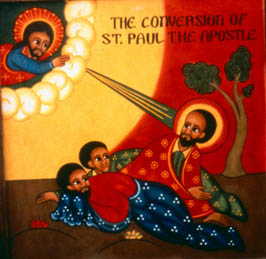
Acts 9 conversionofsaintpaul - ethiopian icon

Acts 9:1-20 – May 5, 2019

Once there was a recent college graduate named Martin. He had enrolled in a doctoral degree program at the University of Erfurt, but he went home for a few days before the class session started. On his way back, not far from the town of Erfurt, a huge thunderstorm broke over the countryside. Martin was trying his best to get to shelter when a sudden lightning bolt fell to earth. BOOM! It struck the ground immediately next to Martin—so close he could feel it singe his clothing! He was thrown to the earth with great force. Frightened almost to death—literally—Martin made the immediate, passionate vow that he would change course in his life, become a monk and devote his life to God. All this happened while Martin was traveling, on the road. A true “Road to Damascus” experience.

Has anyone here ever known someone who went through a radical transformation in an instant? Or, at least, in a relatively short time? That is what happened to Saul of Tarsus, on the road to Damascus.

But, that comes after the end of our narrative, today. What is the beginning of the story? How did Saul of Tarsus get to this point?

The wonderful commentator Bob Deffinbaugh sets a vivid scene for us. He says, “Imagine for a moment that this is the week of Saul’s arrival at Damascus. By this time Saul has gained a reputation as the ringleader of the movement to make Christianity extinct. A devout Hellenistic Jew, of the tribe of Benjamin, born in Tarsus of Cilicia, Saul did not agree with his teacher, Rabbi Gamaliel, on how the Christians should be dealt with. Rather, he sought the arrest, trial, conviction, and punishment (with imprisonment the norm and death the ideal, it would seem) of those in Jerusalem. Saul was not content to punish some and to drive the rest from the “holy city.” He did not want to merely contain Christianity or to drive it from Jerusalem; he wanted to rid the earth of Christianity and its followers. His opposition to Christ and His church took on a ‘missionary’ spirit. Saul went to other cities where he sought to arrest Christians and to bring them back to Jerusalem for punishment. Damascus, a city 150 miles to the northeast of Jerusalem, was one such city. Word was out that Saul would soon be arriving.” [1]

I don’t know about you, but if I heard of such a bloodthirsty, vengeful person coming to my home town, I might be scared to death, too. What are the followers of Jesus going to do? Ethnic hatred blended with and heightened by religious hatred is corrosive and hurtful, and greatly to be feared.

This was not just a problem in bible times. Seriously, there are many places in the world today where determined, devout people want to eradicate people who do not believe like they do. Not just run them out of town, or out of the country, but instead, put them to death. I am not just speaking about devout Hindus, or devout Muslims, but sometimes devout Jews, or devout Christians or Catholics or Orthodox Christians.

This was the situation with Saul of Tarsus! He was a religious, observant Jew, an up-and-coming rabbi, a “Hebrew of the Hebrews,” by his own account. And, he could not kill these “heretics” fast enough. He even had letters of recommendation to the heads of synagogues in Damascus, to let them know his official status as a member of the Sanhedrin, the Jewish council.

This was early in the life of the Church, only a number of months after the great Pentecost happening in Acts chapter 2. And, the followers of “The Way” (as they were called) were spreading like wildfire!

But, similar to the situation with Martin in the scene I opened this sermon with, Saul was literally knocked off his feet. A heavenly light, brighter than bright, surrounded Saul. A shocking, out-of-this-world thing happened on the road to Damascus, indeed!

Just like Moses at the burning bush, just like Martin when the lightning struck, Saul had the presence of mind to realize that this was so huge, so stupendous, this could only be a God-moment! Have you ever had a God-moment? You, or someone you know? An instant when you know beyond a shadow of a doubt that God is present? Did you get an answer to that question, “Who are You, Lord?” up close and personal?

I did. I remember it vividly. Itp was early in my first chaplain internship, right out of seminary. In Cardiac Care, I held the hand of a tiny, very elderly woman as she transitioned from this world to the next. The woman had no one—no relatives, or friends, or any one else, except for a state-appointed medical power-of-attorney. I could feel the presence of God. And, yes, God was there with us, as she died.

Saul got that answer from God in plain language. From our reading today from Acts: “Saul fell to the ground and heard a voice say to him, “Saul, Saul, why do you persecute me?” “Who are you, Lord?” Saul asked. “I am Jesus, whom you are persecuting,” He replied.

How stupendous was that response! And, how crushing! All the orthodox theological and religious scaffolding Saul had painstakingly erected throughout his education and training was tumbling around his ears, in that one moment.

Dr. Luke continues with the risen Lord Jesus’s words: “Now get up and go into the city, and you will be told what you must do.” The men traveling with Saul stood there speechless; they heard the sound but did not see anyone. Saul got up from the ground, but when he opened his eyes he could see nothing. So, they led him by the hand into Damascus. For three days Saul was blind, and did not eat or drink anything.”

“It was time for Saul to ponder what he had seen and heard. For now, he was told to proceed on to Damascus, where he would be given his next instructions.” [2] It was as if this revelation was going to come in several different pieces, or parts. Yes, his sudden conversion happened on the road to Damascus. However, Saul’s blindness allowed him the opportunity to think deeply about these events, and gave him the opportunity to wholeheartedly commit his life to the risen Lord Jesus Christ. How many of us would take something like this seriously?

Remember bloodthirsty Saul? Breathing fire and brimstone? Remember the shock and stunned reaction to the heavenly light, on the Road to Damascus? And, the follow-up question, “Who are You Lord?” Saul made a first-person testimony. We all can thank God for Saul’s—now, Paul’s—testimony and subsequent witness, too. Witness and Apostle to the world.

Remember Martin, almost struck by lightning? That was Martin Luther, and that was a true story. It really happened in 1505, and Martin’s life was forever changed, that day lightning just missed striking him. That was his Road to Damascus experience, sending Martin on the path to grapple with God’s presence and forgiveness in his personal life, and more.

It doesn’t matter whether you or I have had a Road to Damascus experience, or whether we more gradually become aware of God’s work in our lives, because there are countless ways to come close to God. These were the ways Saul (who changed his name to Paul) and Father Martin developed their relationships with the Lord Jesus Christ. The Lord Jesus has His arms open. He wants us all to struggle out of blindness, like Saul, and come into His heavenly light, the light of a loving relationship and friendship with Him.

Come to Jesus, like Saul, like Martin. Jesus has His arms open wide.

Amen, alleluia.

[1] https://bible.org/seriespage/conversion-saul-acts-91-31

“The Conversion of Saul (Acts 9:1-31),” by Robert Deffinbaugh at the Biblical Studies Foundation.

[2] https://bible.org/seriespage/conversion-saul-acts-91-31

“The Conversion of Saul (Acts 9:1-31),” by Robert Deffinbaugh at the Biblical Studies Foundation.

@chaplaineliza

(Suggestion: visit me at my regular blog for 2019: matterofprayer: A Year of Everyday Prayers. #PursuePEACE – and my other blog,  A Year of Being Kind . Thanks!