Unknown's avatar

To God Alone Be Glory

“To God Alone Be Glory”

1 Tim 1-17 immortal, invisible, words

1 Timothy 1:12-17 (1:17) – October 8, 2017

When I was young, I was a member of a Lutheran church on the northwest side of Chicago, baptized and confirmed Lutheran, and well trained in liturgical practice and classic hymnody. Later in high school and into my twenties, I spent a number of years in Evangelical churches. I memorized dozens of bible verses, learned pietistic practices, and completed an undergraduate degree in church music from a local bible college. I sang many beloved old hymns and gospel songs, including “Rock of Ages,” “Amazing Grace,” “Blessed Assurance,” and “To God Be the Glory.”

It’s this last gospel song I would like to quote: “To God be the glory—great things He hath done! So loved He the world that He gave us His Son, Who yielded His life an atonement for sin, And opened the Life-gate that all may go in.”

“To God be the glory!” Exactly the topic of my sermon today. Pastor Kevin asked me to preach on one of the “solas,” the foundations or main principles of the Protestant faith. Soli Deo Gloria is one of the “solas” or “onlies” of the Reformation. As we remember Martin Luther and his posting of the 95 Theses, or grievances against the Catholic Church on that chapel door in the town of Wittenberg in October 1517, this October 31, 2017 is the 500th anniversary of his brave act that sparked the Protestant Reformation.

“Soli Deo Gloria,” or, to God alone be glory, is one of the foundational principles that sets Protestants apart. One of the rallying cries of the Reformation, this principle meant that all glory (and honor and worship) is due to God, alone. Not God plus the saints, not God plus the Virgin Mary, not God plus the church hierarchy. God alone is worthy of our glory—and only God is to be worshipped. That was one principle that Protestants were willing to die for, and did.

Our Scripture reading today comes from 1 Timothy 1, starting at verse 12. Paul states: “I thank Christ Jesus our Lord, who has given me strength, that He considered me trustworthy, appointing me to His service.” Paul is just overflowing with thankfulness here. He is absolutely grateful to the Lord Jesus for extending His grace to Paul and designating Paul a worker for God, in the service of Jesus Christ.

Just to refresh everyone’s memories, the Apostle Paul was not always a follower of Christ. Before he had that sudden, come-to-Jesus experience on the Damascus Road, Paul was called Saul. He was a Pharisee of the Pharisees, and an up-and-coming member of the Sanhedrin—the ruling council of the Jews in Jerusalem. Saul/Paul had studied at the equivalent of the University of Tarsus, a cosmopolitan city where he grew up, in modern-day Turkey. He saw this breakaway sect of Jews following some “false Messiah” as a clear danger to the worship of the one God who made heaven and earth.

Paul tells us himself what his personal situation was—in brief—in the next verse of 1 Timothy 1: “13 Even though I was once a blasphemer and a persecutor and a violent man, I was shown mercy because I acted in ignorance and unbelief.” Sure, Saul/Paul was a fire-breathing zealot, ready to grab these “Christians” off the street and throw them in prison. As he himself states, Paul was formerly “a blasphemer and a persecutor and a violent man.”

How on earth could God use someone awful like this? A self-admitted bad guy, too! But, wait. This isn’t the end of the story. Not by a long shot. Jesus steps into the picture.

What does Paul say in the next verse? “14 The grace of our Lord was poured out on me abundantly, along with the faith and love that are in Christ Jesus.” What happened? Jesus Christ happened. God’s grace was poured out on Paul, and he had a true conversion experience. He once was blind but suddenly was given the gift of sight—spiritual sight.

Here in this letter to Timothy, the Apostle Paul gives his testimony. He tells everyone what a rotten guy he was, and how God reached down and saved him, and what’s more, put Paul into his service. In many Baptist and Evangelical churches, “the sharing of testimony was [and is] a vital practice of faith. Such sharing of stories, such narrating of God’s faithfulness in our lives was not a moment to extol the speaker’s virtues as a follower of Jesus so much as a way to name God’s acting.” [1]

Paul certainly had a different kind of past life, before coming to Christ, and he definitely remembered aspects of that life. We can see that from these two verses: “15 Here is a trustworthy saying that deserves full acceptance: Christ Jesus came into the world to save sinners—of whom I am the worst. 16 But for that very reason I was shown mercy so that in me, the worst of sinners, Christ Jesus might display His immense patience as an example for those who would believe in Him and receive eternal life.”

We can hear rumblings of several other “solas” from our Reformation in these verses, can’t we? Sola Fide—faith alone, and Sola Gratia—grace alone, and certainly Solus Christus—by Christ alone. It is at this earthshaking, deep emotional point that Paul can’t stand it any more and breaks into a glorious doxology: “17 Now to the King eternal, immortal, invisible, the only God, be honor and glory for ever and ever. Amen.”

If we are paying close attention to what he just said, it is at this point that we—all of us—ought to join Paul on our knees and lift our arms to God in praise and awe and honor and glory. Here, in brief, is the tremendous order of events that Paul wrote about at the beginning of his letter to Timothy. Saul/Paul was “the chief of sinners,” came face to face with Jesus, went into God’s service, had his life amazingly changed, and wrote a glorious doxology about it.

Look at this Protestant principle from the point of view of the 1500’s. Was it God—plus the saints, or the Virgin Mary—that caused such a life-changing experience for Paul? I think not. Was it God—plus the church hierarchy—that made Paul do a complete 180 degree turn? No, not that either. It was God alone who brought Paul to his knees. God alone, God’s grace and mercy in Paul’s life, heart and soul had a life-changing effect on Paul. Heart-changing and soul-changing, too!

Sadly, in Martin Luther’s day, many people had (in effect) contingency plans for their salvation. Or, add-ons to get to heaven. For example, they would believe in Jesus Christ and His atonement—plus prayers to the saints; or Jesus Christ and His blood shed on the cross—plus the petitions of the Virgin Mary. All of these additional things were and are blessings, and were and are embraced by people all over the world. Just not to be elevated to the point of worship.

However, Martin Luther and John Calvin and the other Reformers said that it is God alone who was to receive our worship, honor and glory. That is what bursts out of Paul here in 1 Timothy 1. “Immortal, invisible, God only wise, In light inaccessible, hid from our eyes. Most blessed, most glorious, the Ancient of Days, Almighty, victorious—Thy great name we praise.”

Which leads us to our response. Yes, we can celebrate! Yes, such a marvelous God is truly to be given all praise. Blessing and honor, glory and power be unto God and to the Lamb.

But, some of us do not readily burst into speech that might be mistaken as quotes from the King James version of the Bible. I was moved by several paragraphs of a recent book by the noted Christian author Anne Lamott. It comes from the third section of the book “Help Thanks Wow,” which is an exploration of three essential prayers that we all pray at one time or another.

“The third great prayer, Wow, is often offered with a gasp, a sharp intake of breath, when we can’t think of another way to capture the sight of shocking beauty or destruction, of a sudden unbidden insight or an unexpected flash of grace. “Wow” means we are not dulled to wonder.” [2]

Isn’t this another way of expressing Paul’s glorious doxology? It might not be as elegant, but if the Holy Spirit can take the deep, wordless groanings of our hearts and make them understood in prayer, why not the heartfelt, or exuberant, or awestruck simple “Wow!”

As the Reformers tell us, all of us are sinners, saved by God’s grace. So, all of us can say with Paul that God alone is to be worshiped—to God alone be the glory.

We can see from the life of the apostle Paul as well as from the lives of countless followers of Christ throughout the centuries, God can use anyone whom God wishes to use. Paul’s heart-stirring testimony can move us to pray, to serve, to live for God. Our Lord Jesus can take us, wherever and whomever we are, and use us. Here I am, God. Here are we. Send me. Send us.

[1] http://www.workingpreacher.org/preaching.aspx?commentary_id=3034 , September 11, 2016, Eric Barreto

[2] Help Thanks Wow, Anne Lamott, (United States of America: Riverhead Books, published by the Penguin Group, 2012) 71.

@chaplaineliza

(Suggestion: visit me at my regular blog for 2017: matterofprayer: A Year of Everyday Prayers. #PursuePEACE – and my other blog,  A Year of Being Kind . Thanks!)
Unknown's avatar

Well Pleased

“Well Pleased”

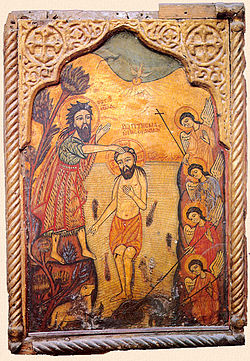
Baptism of Jesus Coptic icon

Baptism of Jesus
Coptic icon

Luke 3:22 – January 10, 2016

It’s a joyful day indeed when we celebrate a baptism in church.

We follow the command of our Lord and Savior Jesus Christ, showing to all an outward sign of an inward change. Here in this church, we often celebrate infant baptism, showing the sign of God’s grace to all who are present. The congregation has an important part, too. They promise to teach the little one the ways of God, and to help the family bring up the child in a manner pleasing to God. Truly, a joyful, grace-filled sign and sacrament!

Well, that’s today, here and now, a long time after the first century. That’s one common understanding we now have of baptism.

Our Gospel reading today features John the Baptist, baptizing people in the wilderness. John was a prophet of God. He was set apart for a special purpose, to give out a special message from God. Here John the Baptist preaches to the nation of Israel, before our Lord Jesus has even started His ministry.

This message ought to be familiar to most of us. We heard some of John’s prophetic message read as our Gospel lesson only a month ago. Doom and gloom! He identifies everyone in the crowd as part of the brood of vipers—as sinners! Exactly what John the Baptist has been saying to the people of Israel for some time.

Another way of looking at John’s message is: “You are dirty, inside and out! Come get clean, both symbolically and physically!” Through God’s grace, John offers the people the opportunity to be obedient and to clean up, to show God and to show others that they repent and turn from their sinful, wicked behavior, speech and thinking. Many people respond. It’s a mini-revival going on at the River Jordan. Amen! Hallelujah!

Let’s pull back for a moment, and consider the larger situation.

At that time, the nation of Israel was an occupied country. Under the boot of the Roman Empire, the people of Israel were oppressed and subjugated. Many people in Israel were looking for the promised Messiah, the Anointed One of God, who would be a Savior for Israel. We can see from our Gospel reading today. Verse 15: “The people were waiting expectantly and were all wondering in their hearts if John might possibly be the Messiah.”

John does not mince words. He does not pull punches. John identifies his listeners as a brood of vipers, as sinful and separated from God.

Just think about identity today. How do people identify themselves? In an excellent commentary on this Gospel passage, David Lose says many of the traditional elements of a person’s identity have been diminished. Think about it. The majority of people today change jobs and careers frequently. The majority of people live in multiple places and different residences rather than growing up and living for their whole lives in a single community. He comments, “fewer families remain intact – there is a craving to figure out just who we are.” [1]

John tells the people of Israel straight out, ““I baptize you with water. But one who is more powerful than I will come, the straps of whose sandals I am not worthy to untie. He will baptize you with the Holy Spirit and fire.” John the Baptist responds with a clear message: he offers the people baptism to remedy that flawed, sinful, separated identity. They can identify themselves with God, and be identified as God’s beloved children.

And then—and then—Jesus shows up. Jesus is about to begin His public ministry. But before that happens, He comes to the River Jordan to listen to His cousin John the Baptist. And, to get baptized.

Lo and behold, the companion Gospel accounts of Matthew and Mark tell us that John is surprised to see Jesus there. But Luke’s account makes Jesus’s appearance natural. The next right thing that happens. Verse 21 says, “When all the people were being baptized, Jesus was baptized too.” At first, John is the star actor, the one doing the main action of baptizing. Jesus is the next one baptized, along with many others. However, what happens next?

The spotlight shifts in the following sentence. Dr. Luke turns his focus on Jesus. “As [Jesus] was praying, heaven was opened 22 and the Holy Spirit descended on Him in bodily form like a dove.”

Can you see this on a movie screen? We open to a wide shot of the River Jordan. Large crowd of people on the river bank, and a number lined up in the water, waiting their turn. John the Baptist in a rough woven tunic with a leather belt around his waist. John is doing his thing—baptizing people who have repented of their sin. And—Jesus is one of them.

The camera pans in to a close-up shot on Jesus. Next in line. John slowly takes Jesus, baptizes Him. We are not sure whether John dunks Jesus in the water, or whether he pours water over Jesus’s head. (I prefer the idea and the image of pouring the water.) Regardless, everyone gets pretty wet. Next thing we all know, the heavens open wide.

Can you see it? The bright light from heaven? Perhaps sound effects, too? Heavenly music? Maybe even a low rumble of thunder? Dr. Luke paints a show-stopper of a scene. He tells us the Holy Spirit appears as a dove, descending on Jesus. The capper of the scene is the voice of God. Quoting from Luke’s account: “A voice came from heaven: ‘You are my Son, whom I love; with You I am well pleased.’”

Just in case anyone was not sure, God’s own voice tells us the identity of Jesus.

Jesus is God’s own beloved Son. Not only that, but God is well pleased with Him, too. Plus, the Holy Spirit as a dove is a visible and physical sign of the presence of God.

Here in this act of baptism, we find out about identity. As the commentator says, “The voice from heaven is addressed to Jesus in the first person: “You are my Son, the beloved; with you I am well pleased.” Baptism teaches us who we are – God’s beloved children – and confers upon us the promise of God’s unconditional regard.“ [2]

God not only proclaimed Jesus’s identity, on the banks of the Jordan River, God also proclaims our identity. We belong to God. It is not our doing, but God’s, instead.

Did you hear? Do you understand? No matter what happens, or how often we fall short, we cannot erase or eradicate God’s love. We love God because God first loved us. God has given us that sign, that seal of baptism, sealed by the Holy Spirit.

It does not matter whether we have been brought to baptism as a baby or a child, or have come as a young person or an adult. Perhaps there are people here who have not been baptized yet. God calls for all to be baptized. God calls for all of us to remember our baptism, as well.

God’s arms are open wide. God’s grace is abundant, for you and for me. God’s grace is poured out freely upon us in baptism. We are cleansed to do God’s gracious work in the world. Can you hear God’s voice talking to you? Telling others about you? “This is my beloved child. With you, child, I am well pleased.”

Alleluia, amen.

[1] Preaching a More Meaningful Baptism – David Lose, https://www.workingpreacher.org/craft.aspx?post=1624 .

[2] Ibid.

@chaplaineliza

Suggestion: visit me at my sometimes-blog: matterofprayer: A Year of Everyday Prayers. and my other blog,  A Year of Being Kind .  Thanks!

Unknown's avatar

Radical Stewardship!

“Radical Stewardship!“

Stephen stoning Acts 7

Acts 7:8-9, 57-59 – July 12, 2015

When you have a crisis or serious situation around the house, or personal matters that require some assistance, who is the first person you think of? Who is dependable, helpful, and downright handy to know? Who always seems to have the answers, provides service, and responds in a cheerful, friendly manner? Do you have someone in mind? That’s who, that’s what I think of when I think about Stephen, one of the first deacons of the Early Church.

Here we are, in the next installment of our summer sermon series from the Book of Acts, Postcards from the Early Church. I’ve mentioned this before, of how this sermon series reminds me a bit of a radio serial. “When last we left our intrepid heroes . . . “ Last week, we took a look at the first recorded church conflict, in Acts 6.

This tension and conflict revealed itself in a dispute over the care of widows. It escalated into a problem between two separate groups of believers in the early Church. Jews separated by language and by culture. One Greek-speaking group of Jews—a minority group—claimed they were being overlooked, and were being left out in the charity distribution to widows.

Remember, the twelve Apostles needed help, so they called upon the whole congregation to choose deacons, people of good standing, stature, and wisdom to serve the congregation. Among these Greek-speaking men was someone named Stephen. Like the others, he was appointed and ordained to take care of social welfare matters in the congregation.

Let’s take a closer look at Acts 6, and see what it has to say about Stephen and the other deacons. I’ll be reading from a modern translation, called The Message, translated by Eugene Peterson. “[The congregation] went ahead and chose [seven Greek-speaking men.] Praying, the apostles laid on hands and commissioned them for their task. The Word of God prospered. The number of disciples in Jerusalem increased dramatically. Not least, a great many priests submitted themselves to the faith.”

In these deacons, we have seven respected believers, people of wisdom, with Greek names. What’s more, one man was even a proselyte, a convert to Judaism. These Greek-speaking believers were good stewards of the gifts God had entrusted to them. They were also good stewards of what the congregation in Jerusalem had entrusted to them, too.

The book of Acts is not specific, but I can imagine them taking up their new duties. Going around the main part of Jerusalem and perhaps the suburbs, too. Checking up on the widows and those who could not come to services regularly. Making sure that the elderly, the young ones, and the infirm had enough to eat, and if need be, medical care. In this way, the deacons freed up the Apostles to continue in prayer, and preaching and teaching God’s Word.

Whatever they were doing must have done the job. We can see, as Dr. Luke said, the number of believers continued to grow—and grow!

What about us, here, today? Think about the things God has given you stewardship over. What gifts and talents do you have to offer the church? What can you offer to your neighbors? I’d like you to think about that, as we continue to look at Stephen.

Acts 6 lifts him up as a stand-out, as far as the new deacons are concerned. Stephen does an exceptional job. If there were Olympic-level competition in being a deacon, I suspect Stephen would be right up there, competing for a medal. He is a stellar deacon, serving the congregation! Listen to our passage from Acts: “Stephen, brimming with God’s grace and energy, was doing wonderful things among the people, unmistakable signs that God was among them.”

Remember how I opened this sermon? How I asked everyone here to think of someone who is dependable, helpful, and downright handy to know? Who always seems to have the answers, provides service, and responds in a cheerful, friendly manner? I just so happen to have someone like this in my extended family. My brother-in-law, married to my husband’s sister. Rick is one of the nicest guys you could meet. He was a volunteer fireman in his small town. Now he’s a fire inspector in his region of Michigan.

But that’s not what I wanted to highlight about Rick. Instead, he goes above and beyond when he’s asked to help. Now that my father-in-law is in his mid-eighties, my husband and I are sure glad that Rick lives only about a half hour’s drive away from Grandpa Jones. Rick is handy around the house, always keeps a cool head no matter what, and is just a swell guy to have around. Not only that, he’s an elder in his Presbyterian church, and a pillar of the community. Very much the kind of person I imagine Stephen to have been.

Back to Acts 6: “Then some men went up against Stephen trying to argue him down. But they were no match for his wisdom and spirit when he spoke.”  

It seems that Stephen is not only an outstanding deacon, excellent at serving others in the congregation, but I understand God has blessed him personally. Abundantly. He is an excellent steward of both his personal gifts, as well as God’s gifts of life and blessing for others. He must have been articulate, too. Fantastic at expressing himself, with wisdom and holy insight.

Remember, the Early Church was located in Jerusalem in these early days. Jerusalem was not friendly to the group of believers in the Risen Messiah Jesus. (I’m getting worried about what is going to happen.) Let’s read some more from Acts. “So in secret, the men bribed others to lie: ‘We heard him cursing Moses and God.’ That stirred up the people, the religious leaders, and religion scholars. They grabbed Stephen and took him before the High Council. ”

Ah. The High Council. In other words, the religiously powerful. I see them as those who block access to God. As a United Methodist commentary says, “those who use and interpret the Law in order to control access to God’s gifts. It seems that Stephen is so good at doling out ‘life abundant’ to anyone and everyone, that the religiously powerful go to unscrupulous lengths to stop him from doing what they perceive to be their job exclusively.”

Stephen continues to be a stand-out steward of the gifts God has given him. Even in his lengthy defense to the High Council—he takes almost all of Acts chapter 7 to go through the history of the nation of Israel, showing how ungrateful and stiff-necked the Jewish people are.

Just listen to the climax of Stephen’s defense: “And you continue, so bullheaded! Calluses on your hearts, flaps on your ears! Deliberately ignoring the Holy Spirit, you’re just like your ancestors. Was there ever a prophet who didn’t get the same treatment? Your ancestors killed anyone who dared talk about the coming of the Just One. And you’ve kept up the family tradition—traitors and murderers, all of you. You had God’s Law handed to you by angels—gift-wrapped!—and you squandered it!”

“At that point [the Council] went wild, a rioting mob of catcalls and whistles and invective. But Stephen, full of the Holy Spirit, hardly noticed—he only had eyes for God, whom he saw in all his glory with Jesus standing at his side. He said, ‘Oh! I see heaven open wide and the Son of Man standing at God’s side!’

57-58 “Yelling and hissing, the mob drowned him out. Now in full stampede, they dragged him out of town and pelted him with rocks. The ringleaders took off their coats and asked a young man named Saul to watch them. 59-60 As the rocks rained down, Stephen prayed, ‘Master Jesus, take my life.’ Then he knelt down, praying loud enough for everyone to hear, ‘Master, don’t blame them for this sin’—his last words. Then he died.”

As a commentator says, “Even as the council is extinguishing Stephen’s life – stone by hideous stone – he continues to dole out life and grace to them, his killers.”

Radical stewardship, indeed. He gave generously of God’s gifts of life and blessing for other believers. Such a stand-out, he was martyred for his stewardship of his gifts.

Stephen and his example of stewardship stand not only as an example for us, but for the Church Universal, and for the centuries. We can see that “The first Christian martyr comes not from those preaching the word, but from those feeding the hungry.”

This is what this church does. This church has a regular collection of food for the Maine Township Food Pantry. We feed the hungry and provide for God’s table of grace. This congregation shares food—and we share God’s gifts of life—with the hungry, with the vulnerable, with those in need. This is serving in the way that God wants us to serve.

I will adapt Paul Waddell’s words, as he writes for the Center for Christian Ethics: “Christian [stewardship] is a matter of welcoming, caring for, and befriending the stranger, the poor and needy, the homeless and destitute, the unloved and the unlikable, the weird and the strange, in gratitude to God and in imitation of Christ. For Christians, [stewardship] is not an occasional gesture but a whole way of being. It is not an interruption to our normal way of life but a habit, practice, or virtue that ought consistently to characterize our lives.”

Do you share God’s gifts of life, every day? Do we provide God’s table of grace for others, regularly? God calls each of us to be generous, each day. Be of service, one on one. Be excellent stewards—personally. God is calling, to you, and to me. Won’t you answer?

Alleluia, amen!

@chaplaineliza

(My thanks to “Radical Gratitude,” http://www.umfnw.org for several excellent ideas and quotes I used in this sermon. And, my thanks and deep appreciation for Eugene Peterson’s translation of selected verses from Acts 6 and 7;  “Scripture taken from The Message. Copyright © 1993, 1994, 1995, 1996, 2000, 2001, 2002. Used by permission of NavPress Publishing Group.”)

Suggestion: visit me at my daily blog for 2015: matterofprayer: A Year of Everyday Prayers. and my other blog,  A Year of Being Kind .  Thanks!