Unknown's avatar

Our Good Confession

“Our Good Confession”

1 Tim 6-12 good confession

1 Timothy 6:11-13 – September 29, 2019

Some people express their devotion to certain things so clearly, don’t they? Take sports teams. I am sure you know friends or acquaintances who devoutly follow a sports team in season and out. I have one particular friend who regularly wears the team jerseys (yes, he has several), plus team hats, team jackets, and team flags. All the official merchandise! Everyone knows who he supports!

I wonder, do many of us know people who express their belief or devotion to Jesus Christ with the same excited amount of fervor? Or, are people shy of expressing their belief in the Lord very loudly, lest they be considered weird or narrow-minded, or even extra judgmental?

We are looking at the letter to Timothy for the second week in a row. Here we sneak a look over Paul’s shoulder as he dictates this letter, and discover he is concerned about Timothy remembering what is really important. He tells Timothy what that is: remember when he made the good confession, when he openly told everyone he was on Team Jesus. Can you see him excitedly shouting, waving his arms and wearing his Team Jesus merchandise?

Perhaps that “Team Jesus” uniform and jersey analogy is going a bit overboard, even somewhat fanciful. However, Paul was quite sincere in reminding Timothy about the time he publicly confessed his faith in Jesus Christ. This time of baptism was an important time in any adult believer’s life, both early in the founding of the church as well as in later centuries.

I suspect we here in the United States have only an unclear idea of how much danger the first believers were in. They were outlaws, outcasts in the Roman Empire. The Roman Empire was not particularly fond of Jews, but at least Judaism was allowed. However, Christians were getting rounded up by the authorities because Christianity was a new, outlaw religion.

Did Paul realize his friends would get in trouble if they told people they were on Team Jesus? Yes, of course he did. Sadly, he knew this very well. He himself was in prison for regularly testifying to the Lord Jesus Christ.

Let’s take a closer look at the words Paul wrote to Timothy: “12 Fight the good fight of the faith. Take hold of the eternal life to which you were called when you made your good confession in the presence of many witnesses. 13 In the sight of God, who gives life to everything, and of Christ Jesus, who while testifying before Pontius Pilate made the good confession, I charge you 14 to keep this command.”

Almost everyone who became a believer in Jesus Christ at that time was converting as an adult from another kind of religion to Christianity. In other words, taking the step of a public baptism was part of confessing Jesus Christ as Lord, publicly.

In many cases, the newly-baptized person put on a fresh, white robe, signifying new life in Christ. I want to emphasize—after baptism—putting on fresh, new clothes: a brand-new Team Jesus jersey, letting everyone know that the newly-baptized person was now an openly-professing Christian.

Just so we do not mistake exactly what this confession details, let me give an illustration from the book of Acts, chapter 16. Paul, Dr. Luke and their friends were on a missionary journey to a large city in Macedonia, Philippi. Paul—as usual—was getting in trouble for preaching, teaching and casting out evil spirits. Paul and his friend Silas get thrown into prison, and God sovereignly causes an earthquake to happen. The jailer (who has been hearing all about their good confession all day and into the night) gets convicted by God, Reading from Acts 16: 29 The jailer called for lights, rushed in and fell trembling before Paul and Silas. 30 He then brought them out and asked, “Sirs, what must I do to be saved?”

31 They replied, “Believe in the Lord Jesus, and you will be saved—you and your household.” 32 Then they spoke the word of the Lord to him and to all the others in his house. 33 At that hour of the night the jailer took them and washed their wounds; then immediately he and all his household were baptized.

That was the good confession. Right there. The confession made by the Philippian jailer, even though he knew what a commitment that confession might be.

But, wait—Paul does not stop there in his letter to Timothy. He then mentions the Rabbi Jesus, who after His arrest and during His trial makes the good confession before Pontius Pilate oly a few hours before His crucifixion. Moreover, Christ Jesus made this good confession before many hostile witnesses.

A professor of the New Testament Dr. A.K.M. Adam states “In this, Timothy followed the example of Jesus before Pilate, who did not deny God in order to secure his own safety (the letter identifies Jesus’ response to Pilate also as a “good confession”).” [1] Again, the apostle Paul is not shying away from openly stating that these people believe in the Christian God.

We here in the United States might think, Paul, are you crazy? Coming right out and telling hostile people you are a Christian? Wearing your Team Jesus jersey all the time, day and night?

Yes, Paul does mean that. He is faithful, and he confesses his faith in Christ on a regular basis. He wants to encourage Timothy to do the same, to live each day for Jesus.

I think most people who knew how hard the baseball player Joe DiMaggio played would say he gave his heart and soul to the game of baseball. Late in his career, when the New York Yankees were comfortably ahead in the pennant race, Joe DiMaggio was asked why he continued to play so hard. He said, “Because there might be somebody out there who’s never seen me play.” Just so, the Christian should live every day as if someone will see him who has never seen a Christian before. [2]

So, Paul and Timothy are both wearing their Team Jesus jerseys, and maybe Team Jesus hats and jackets, too. The transformed Paul and Timothy let everyone who sees them know that they are Christians, showing love, compassion, and caring to all.

Paul even gives Timothy a run-down of all the attributes we ought to expect to show in our lives if—if we have this good confession, and before hostile witness, too! If we show this kind of sincere, persistent faithfulness, then our lives will start to show these Godly characteristics Paul mentions in verse 11. We will pursue righteousness, godliness, faith, love, endurance, and gentleness. That was the transformation that Paul told Timothy would happen. And, God does transform lives, even today!

Just like Timothy, we are encouraged to live like we mean it. Live as if someone who sees us has never seen a Christian before. Live the best life we can, for God’s glory. It’s not just with a spoken-confession, but it is also with a doing-confession. Not only show Christ by the words we say, but we show our belief by the actions we do. Yes, confess with our mouths the Lord Jesus, and also do the deeds that please God and glorify His name.

That is confessing the good confession, indeed. Alleluia, amen.

[1] http://www.workingpreacher.org/preaching.aspx?commentary_id=731

Commentary, 1 Timothy 6:6-19, A.K.M. Adam, Preaching This Week, WorkingPreacher.org, 2010.

[2] https://ministry127.com/resources/illustration/faithful-all-the-time Source: Summer of 49, David Halberstam

@chaplaineliza

(Suggestion: visit me at my regular blog for 2019: matterofprayer: A Year of Everyday Prayers. #PursuePEACE – and my other blog,  A Year of Being Kind . Thanks!
Unknown's avatar

Give Praise! Give Thanks!

“Give Praise! Give Thanks!”

Psa 100 thanksgiving, praise

Psalm 100 – November 21, 2018

Who likes to be bossed around? Does anyone?

Listen to these examples: Do this! Come here! Watch out! Stop that! Go to your room!

It is not too pleasant to be bossed around, especially by someone mean or overbearing. But, what if someone who loves you is the one doing the bossing? What if that person has your best interests at heart? Imagine you are in a kitchen and someone cries, “Watch out! That stove it hot!” Or, when you are standing by an outdoor pool, and someone yells, “Be careful! You’re right by the edge!” That changes things a whole lot, to many people.

What about Psalm 100, our scripture reading for this evening?

As is the problem with written communication, we don’t have nuances and vocal inflection. There isn’t a certain way for us to tell whether the author of Psalm 100 was grumpy, joyful, or somewhere in between. However, I would like to think of our Psalm writer being joy-filled and excited. Doesn’t this Psalm sound like it’s written by an excited person?

I want to let you know: there are some commands, some imperatives in Psalm 100. Not suggestions, not “oh, by the way, could you possibly do this?” No. No, indeed.

A number of these verbs, or action words, are clear commands. In the first three verses, “Raise a shout!” “Serve!” “Come!” and “Know!” Verse four has “Enter!” “Be thankful!” and “Bless!” All of these verbs—and they are many of the chief action words in this Psalm—would be instantly recognizable as a command to anyone who spoke Hebrew!

I don’t know about you, but when some people try to twist my arm and bark commands at me, I don’t really like it. I may begrudgingly comply with such commands, rolling my eyes, but for sure not willingly. Not with my whole heart. Not freely, in worship and praise and thankfulness and gratitude, I can tell you that!

But, what if our psalm writer did not feel grumpy or mean at all? What if his situation was 180 degrees reversed? One commentary I read said “Surely the psalmist was imagining what it might sound like when all the earth is praising the LORD at the same time. What a joyful sound, indeed, that would be!” [1]

Let me tell you a few things about this psalm, in general. Psalm 100 is the last in a small collection of special psalms of praise and worship. Do these verses get you in the mood of worship? Of praise? Could we see ourselves marching to our particular house of worship looking forward to meeting with God? To serve and praise and bless and be thankful to God? That is exactly what this Psalm is encouraging—no, even more strongly—is commanding us to do.

I love the exuberance of children. They can be so uninhibited! So filled with joy and happiness and excitement that it just boils over. Sometimes, children just overflow with joy like fountains, bubbling up all over the place. This exuberance also reminds me of the worship styles and especially the musical expressions I have seen in African-American church services. I think this psalmist was expressing an intense feeling of worship very much like that contemporary praise. “One can almost hear the outbreak of jubilation described in this summons to praise in Psalm 100. This psalm calls the entire community to lift praises to God.” [2]

I’d like to tell you something about me. I love music. I studied music theory and composition as my undergraduate major some years ago, I love finding out interesting and historical things about music, too.

Around the middle of the 1500’s, John Calvin the Protestant reformer said that any music performed in the church had to be sung. No instruments, and no glorious sounds other than voices. That meant a number of the Reformed churches could not play any of the marvelous organ, instrumental, or choral music of composers like the Lutheran Johann Sebastian Bach, who came a little later.

John Calvin said only singing psalms set in verses, was right and proper for church worship. After all, the Psalms were the song book of the Bible. Very early after Calvin made that declaration, a clergyman named John Kethe turned this Psalm, Psalm 100, into verse. It was set to a hymn tune known—of course—as “Old Hundredth.” Let me read Psalm 100, in rhyme:

All people that on earth do dwell,

Sing to the Lord with cheerful voice,

Him serve with mirth, His praise forthtell;

Come ye before Him and rejoice.

Stanza 2:

The Lord, ye know, is God indeed;

Without our aid He did us make.

We are His flock, He doth us feed,

And for His sheep He doth us take.

Stanza 3:

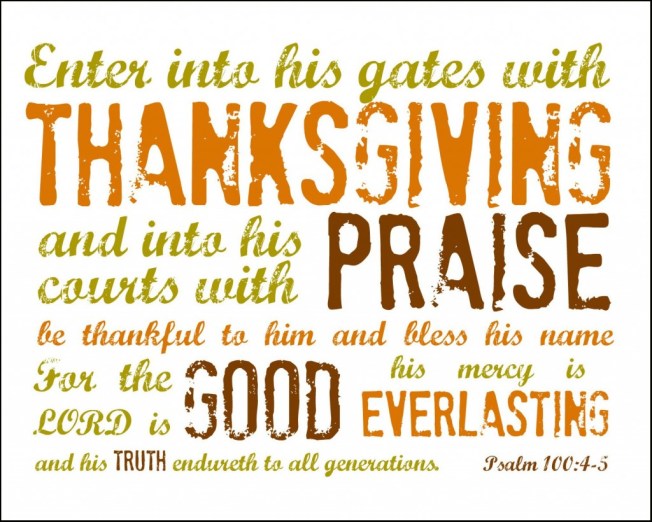
Oh, enter, then, His gates with praise,

Approach with joy His courts unto;

Praise, laud, and bless His name always.

For it is seemly so to do.

Stanza 4:

For why? The Lord, our God, is good;

His mercy is forever sure.

His truth at all times firmly stood

And shall from age to age endure.

.

This psalm text was written in the late 1500’s, and immediately was a big hit. Psalm 100 soon appeared in a hymn book, or psalter, and was regularly sung in church services. What I did not know before a few days ago was that this setting of Psalm 100 was in the hymn book brought across the Atlantic Ocean a few years later.

The church music professor Dr. Hawn said, “This is probably the oldest continuously sung congregational song in North America. When the first British explorers arrived in Jamestown Island on May 14, 1607, to establish the Virginia colony on the banks of the James River near Chesapeake Bay, they undoubtedly brought with them a Psalter, a collection of metrical psalms.” [3]

Just imagine: the earliest English colonists sang this hymn, using the words of clergyman William Kethe, the same words that congregations sing today, four and a half centuries later.

Dr. Hawn reminds us, “the important thing to remember is that William Kethe’s text ties us with the earliest settlers in the American colonies over 400 years ago. It was not long before a Psalter was published in the American colonies: The Bay Psalm Book (1640) was the first book published in North America.” [4]

What a marvelous chain of events, and connections. We can follow the verses of this Psalm across the ocean, into hymn books, and ultimately read it tonight in this service.

That’s all well and good, you might say. History is nice, but we need to dust off the cobwebs and come back into the modern age. Enough of these historical words like “doth,”  “unto,” “forthtell” and “seemly.” All right. I’ll ask some questions. Modern-day questions. These can be thought-questions, and you don’t need to answer them right away, or even out loud.

What is your attitude towards worship of God? Or, is that just for other people? Do you willingly and joyfully come into God’s presence? Or, is going to your house of worship more of a chore, where you are just reluctantly going through the motions? Penetrating thought-questions, for us all.

I pray that the Holy One might speak to hearts as needed.

How do I see this Psalm? I’m glad you asked! I come from the Christian faith tradition, and God has called to me from that understanding. What is more, the way my mind best understands God is through the lens of Reformers like Martin Luther and John Calvin. Calvin’s Reformed tradition especially treasures Psalm 100.

This Psalm’s essence might well be contained in the first question and answer of a respected historical teaching tool for young people, the Westminster Shorter Confession.

Question: What is the chief end of humankind?

Answer: The chief end of humankind is to glorify God and enjoy God forever. [5]

This is a way of abbreviating this Psalm, in a nutshell. But it does not matter how we abbreviate it, or turn it into verse, or read and meditate on it, or sing it from the rooftops. God wants to know our attitude towards worship, and is hoping our attitude is excited! Joyful! Praise-filled! May we all come into God’s presence with a joyful noise, giving thanks from the bottom of our hearts every day of the year, not only on Thanksgiving Day.

Alleluia, amen.

[1] http://www.theafricanamericanlectionary.org/PopupLectionaryReading.asp?LRID=98

Commentary, Psalm 100, Alfie Wines, The African American Lectionary, 2009.

[2] Ibid.

[3] https://www.umcdiscipleship.org/resources/history-of-hymns-all-people-that-on-earth-do-dwell

http://www.umcdiscipleship.org/resources/history-of-hymns-all-people-that-on-earth-do-dwell

History of Hymns: “All People that on Earth Do Dwell”. by C. Michael Hawn

[4] Ibid.

[5] McCann, Jr., J. Clinton, The Book of Psalms, New Interpreters Bible Commentary, Vol. 4 (Nashville, TN: Abingdon Press, 1996), 1080.

@chaplaineliza

(Suggestion: visit me at my regular blog for 2018: matterofprayer: A Year of Everyday Prayers. #PursuePEACE – and my other blog,  A Year of Being Kind . Thanks!