Unknown's avatar

God Prepares a Table!

“God Prepares a Table!”

Psalm 23:5 – September 3, 2023

            I am fascinated by a painting I’ve encountered a number of times, of Jesus the Good Shepherd. This is the very first picture we have of Jesus, painted around 250 CE. It is found in the catacombs in Rome, those narrow, twisting underground tunnels. The walls are filled floor to ceiling with graves that have been dug – as tombs. Just imagine walking quietly through these twisting tunnels with a small oil lamp!

As you continue imagining, see yourself going to find fellow Christian friends who are gathering to worship by a designated grave. You need to be cautious as you listen for the clank of Roman soldiers’ armor, as you glide quietly along. Given this, it is easy to imagine why someone painted a picture of Jesus as a strong young shepherd on the ceiling of the catacomb! Jesus certainly can take care of us, as this Psalm says. [1]

Our Scripture reading today comes from the book of Psalms, and is one of the most familiar and beloved readings in the whole Bible, in either the Hebrew Scriptures or the New Testament. Countless people have turned to Psalm 23 for peace, for reassurance, in times of anxiety or struggle, and even in times of great joy. This psalm is a psalm for the ages, and has been read for centuries by believers, skeptics, and atheists alike.

            This very familiar psalm begins with the view of the Good Shepherd, taking loving care of His sheep. We hear about how the sheep depend upon the Shepherd to guide them and guard them as they roam in a flock. The sheep depend upon the Shepherd’s watchfulness and protection as they travel through dark and dangerous places. Yet, a change comes in verse five. We see the Shepherd change into a generous Host.  

            You and I know the familiar possessions many people own to show off their wealth and status. The huge, expensive, and showy house, sometimes with a large fence around it or now, in a gated community. Or, the luxury automobile, with all the bells and whistles, and a price tag I can’t even image. Except, those are signs of wealth and prestige here in the Western world, here in a culture we are familiar with.

            The traditional culture of the Middle East is very different, when it comes to displays of wealth and prosperity. “When you want the community to know that you have acquired wealth, you do not buy an expensive car or a large house. Rather, you host meals with three times as much food on the table as the numerous guests can eat.” [2]

            Such radical hospitality and generosity goes way overboard, in the eyes of many in our Western culture! But, this is the cultural way that traditional Middle Eastern people-groups show great wealth and prominence. The psalmist’s imagery goes even further. In Middle Eastern culture, men do not prepare food. Instead, women prepare the food for a banquet, and that does not mean setting a table with individual place settings and elaborate china.

Eating is carried out by tearing off a small piece of flat bread and using it to lift food from the common dish to the mouth. Each bite starts with a fresh piece of bread. There is nothing to do to ‘set the table’ except perhaps ‘spread the rugs’ (as referenced in Isa 21:5). As regards the food, servants and women prepare it. The master of the house provides the food, he does not prepare it.” [3] Several times in the Hebrew Scriptures, verses explicitly say that female involvement is instrumental for the spreading the table and serving of food.

Yet, here in verse 23:5 the psalm clearly says “You prepare a table before me in the presence of my enemies.” Here in one of our most beloved Bible passages, our God is portrayed as a nurturing, even mothering God! “Here too, what counts is that God is provides and protects. How surprising that the table spread in the presence of enemies! It is hard to relax and be fed in their presence. Yet God invites us to the table, come what may and come who may.” [4] You and I may be surprised at some of the visitors surrounding God’s welcoming table. And, for this Scripture to highlight God acting as a woman, doing traditional feminine tasks in preparing the table, is fully in keeping with numerous Scriptural references.

One of the many hymns written about Psalm 23 comes from the wonderful hymn writer Isaac Watts. “My Shepherd Will Supply My Need” is a touching reflection of the great care and nurture God takes on each of our accounts, in each of our lives.  You will note how Watts mirrors the shift in the Psalmist’s speech (from third person to second person in verse 4 and back to third person in verse 6) as he moves from the first to the second stanza.

“Much of Watts’ hymn text reflects the Psalmist speaking to the Lord. Changing the voice to second person highlights the prayerfulness of this Psalm, thereby emphasizing the more intimate relational aspect between God and God’s children.“ [5]

            As this comforting, relational psalm reminds us about the table prepared for us, the Apostle Paul references this table in 1 Corinthians 10 when mentioning Communion. Are you tired and worn, eager to come to the table of the Lord? What is more, God, our generous Host, invites us to come and partake of the abundant heavenly food and drink.

As we come together to celebrate the Lord’s Supper, we look forward to that marvelous banquet spread for all of us. For each of us. So, come. The Lord has prepared this table. Amen, alleluia.

@chaplaineliza

(Suggestion: visit me at my other blogs: matterofprayer: A Year of Everyday Prayers. #PursuePEACE – and  A Year of Being Kind . Thanks!

(I would like to express my great appreciation for Ken Bailey’s marvelous examination of all of the mentions of the Good Shepherd throughout the Bible in The Good Shepherd, the commentary published by IVP Academic in 2014. I got several excellent ideas and quotes for this sermon from this excellent book.)


[1] http://worshipingwithchildren.blogspot.com/2015/03/year-b-fourth-sunday-of-easter-april-26.html

[2] Bailey, Kenneth E., The Good Shepherd (InterVarsity Academic, Downers Grove, IL: 2014), 55-56.

[3] Ibid.

[4] https://www.workingpreacher.org/commentaries/revised-common-lectionary/ordinary-28/commentary-on-psalm-23-16

[5] https://www.workingpreacher.org/commentaries/revised-common-lectionary/fourth-sunday-of-easter-3/commentary-on-psalm-23-9

Unknown's avatar

Caring for You!

“Caring for You!”

1 Thessalonians 2:6-10 – August 27, 2023

            Anyone here familiar with any religious leaders who are puffed up? Proud beyond measure? Strutting their stuff? I mean, lording it over their congregations and everyone else? Some preachers and evangelists can be like that. Don’t bother the extra special holy person!

It doesn’t seem like those puffed-up preachers or evangelists care about anyone! Not any common, ordinary folk from their congregations, anyway.

That kind of self-centered, self-satisfied attitude is the problem with certain people, and this is not exclusive to preachers or evangelists. Lots of people can have really skewed priorities and end up ignoring people who hurt, or those who are sad or depressed, or people who grieve all manner of losses. Or even worse, these blinded, entitled people are aware of those who cry out for help, but simply shut the door in their faces.

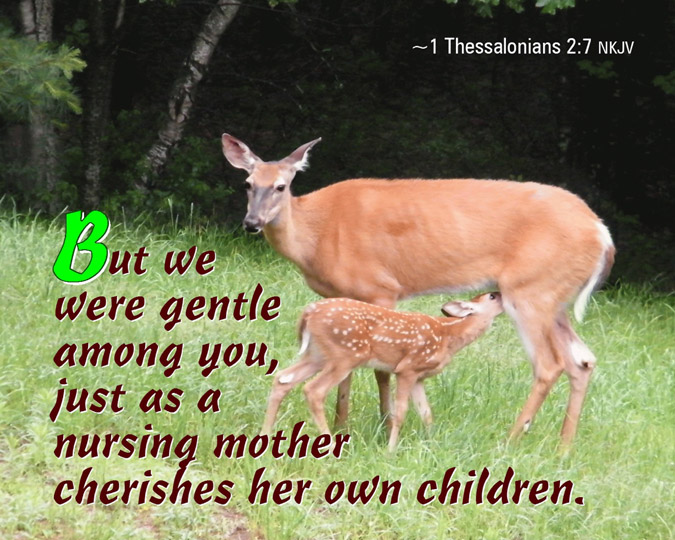
            I’d like us to focus on several verses from this reading today. They come from the apostle Paul’s letter to the believers in Thessalonica. Starting at verse 6: “We were not looking for praise from people, not from you or anyone else, even though as apostles of Christ we could have asserted our authority. Instead, we were like young children among you. Just as a nursing mother cares for her children, so we cared for you. Because we loved you so much, we were delighted to share with you not only the gospel of God but our lives as well.”

            What does Paul make a point of saying here? Paul and his friends did not want to be treated like something super special! They were not hungry for praise, or seeking strokes and adulation from their fellow believers in town. Certainly, Paul and his friends were in what is known today as a teacher or mentor position among their friends, but not high on a pedestal. And especially not puffed up.

Paul points out, “We proved to be gentle among you.” Like young children!

 “This is another example of positive and gracious leadership. Paul was not a like a dictator to the Thessalonians. Instead, he chooses one of the most tender images in all of nature, a nursing mother. Some of us here may be inclined toward “tough love.” We might say, ‘my way or the highway.’” [1] But, not Paul! He purposely meant to come alongside his Thessalonian friends gently, and he demonstrated that his co-workers were, too.

            This nurturing, maternal reading is not common within the apostle Paul’s letters, since he was more likely to use strong, masculine word-pictures or metaphors. However, using these words of maternal love and affection here show us the loving heart of Paul, and how much he cared for these believers. And not only that, Paul and his friends were ready and eager to share all that they had with the Thessalonians.

Commentator F.F. Bruce makes the connection that “No other attitude would befit the preachers of a gospel which proclaimed as Lord and Savior one who ‘emptied himself’ (Phil 2:7) for the enrichment of others.” [2]  We can see our Lord Jesus showing the ultimate in loving, caring affection in Philippians 2, as He emptied Himself of all Godly prerogatives and attitudes, and set all his Godhood aside. Our Lord Jesus became a human being so He could communicate on the same level, and more easily and directly with us fellow human beings.

            Similar to what Paul just said in this letter to the Thessalonians, Jesus did not throw His weight around! No, Jesus was not on a pedestal or puffing up His chest because He was so high and mighty. Can you possibly imagine Jesus doing things like that? Absolutely not!

            Just so, Paul imitates his Lord Jesus by showing that he and his companions are not hungry for praise, or seeking strokes and adulation from their fellow believers in Thessalonica.

Paul specifically says he and his friends tenderly care for their Thessalonian friends in the church. The Greek word he uses here is thalpo, “to warm, cherish, nourish.” How nurturing is that! This is the same word used in the Greek translation of the Hebrew Scriptures for a Scripture reading we examined earlier this summer: Deuteronomy 22:6, where mother birds cover her young or her eggs with their feathers. 

That is not all! This Greek word thalpo, “to warm, cherish, nourish,” is used again by the apostle Paul in Ephesians 5:29. Here he describes our risen Lord Jesus Christ and His care for the church universal. How wonderful that the Lord Jesus Christ continues the same caring, nurturing activity He regularly displayed during His time here on Earth as a human being. Commentator F.F. Bruce adds, Paul’s words “’For her own children’ would stress the personal involvement and concern. A mother who is nursing her children does not and cannot turn the care of her child over to someone else. She feeds, loves, and protects her child.” [3]

Helping people to grow in the Lord, as with growing children, takes time and requires patience, just as much today as 2000 years ago. Sometimes it causes pain and grief, and priorities need to be set in our relationships. We don’t raise children overnight, You and I can’t raise them without growing pains for both parent and child alike. [4]

            If we recognize our deep need for nurture, protection and caring from all that would harm us, we can also watch out for one another! Jesus urges us to nurture, protect, and care for one another, too. As our loving, caring Lord Jesus always does for us. Without fail.

            Praise God, God has been loving, caring and full of nurture for us all. God is our nurturing Parent, and that’s a blessed fact. Alleluia, amen. 

@chaplaineliza

(Suggestion: visit me at my other blogs: matterofprayer: A Year of Everyday Prayers. #PursuePEACE – and  A Year of Being Kind . Thanks!

(I would like to thank the website www.bible.org for their commentary and bible study on today’s New Testament reading, https://bible.org/seriespage/4-compelling-example-ministry-1-thess-21-12. I got several excellent ideas and quotes for this sermon from this excellent article.)


[1] https://studyandobey.com/inductive-bible-study/thessalonians-studies/1thessalonians2-1-9/

[2] https://bible.org/seriespage/4-compelling-example-ministry-1-thess-21-12

[3] Ibid.

[4] Ibid.

Unknown's avatar

Searching Until Found!

“Searching Until Found!”

Luke 15:8-10 – August 20, 2023

            Can anyone relate to this scenario? You are using a pen – perhaps it’s your favorite pen – and you put it down. Just for a moment! And when you go back to write something down, you can’t find that pen! Or perhaps you are using a tool, and something distracts you. Or, the phone rings. And when you go back to pick up that tool, it’s gone!

            Can you relate to the woman in our parable? She just had that silver coin just five minutes ago! Where did it go? Did she accidentally drop it on the floor? Did it slip down between the table and the wall? Where, oh, where did that coin go?

            The unnamed woman in our parable is featured in a series of three parables in Luke chapter 15: the chapter of the Lost Things. We see the lost sheep, the lost coin and the lost son. The Rabbi Jesus takes the unusual tack to highlight a woman in one of His parables. Unusual, and so relatable! Yet, here we see that is exactly what Jesus does!

            Think about the Good Shepherd. Exactly what Jesus calls Himself in the Gospel of John. Today’s reading is from chapter 15 of the Gospel of Luke. But, so much the same Shepherd metaphor! As Jesus tells the first parable, He is describing a Good Shepherd who diligently searches for the one lost sheep, until that sheep is found! Then, the Shepherd – the Good Shepherd – calls together his friends and neighbors and says, “Rejoice! Rejoice with me!”

            In the third parable, we have the extended parable of the Lost Son, also known as the Prodigal Son. Running off to the far country, going far astray, getting hopelessly lost until he hits bottom and comes to himself. And, we also see the Loving Father, watching and waiting for his son to return. When the son is still far off, the father runs down the main street of town to meet his boy, publicly welcoming his lost son home.

Can you hear him calling, “rejoice with me! My child was lost, and now is found!”

            Let’s focus on this second parable, which features a woman, keeping house. It’s probably a small house, and this woman is not well-to-do. She loses one out of her ten coins, and this is a lot of money – to her! Actually, in the original language, Greek, the coin is worth one days’ wage. We see a woman who is bound and determined to find that coin! She takes the initiative and searches high and low for that coin until she finds it.

            Let me read the verse again: “Doesn’t she light a lamp, sweep the house and search carefully until she finds it? And when she finds it, she calls her friends and neighbors together and says, ‘Rejoice with me; I have found my lost coin.’”  

            The lost coin was a passive participant in this whole operation. As commentator Stephen Cole says, “the only reason it was found is that the woman initiated a diligent search for it.” [1] What is more, in our case, God took the initiative. The Lord has great love and compassion, indeed. There was and is no way that we can take the initiative in saving ourselves. As the apostle Paul says in Romans 5:8, “God demonstrates His own love toward us, in that while we were yet sinners, Christ died for us.” God launched the search for each of us!  

            One of my favorite commentators, Dr. Daivd Lose, tells about his son Jack, years ago at an amusement park in Minnesota. His son was small, four years old. Right by David’s side all the time – until he wasn’t. David frantically looked for his son Jack all over the place, and recruited the security guards. Thankfully, three minutes after Jack’s description was called in, one of the guards found him at the next ride in the park.

            David Lose said, “I was just relieved and, even more, joyful. My son, who had been lost, was found. Safe and sound. Back with me. It was pure joy. And that’s how God feels anytime anyone is drawn back into relationship with God, or chooses life, or lives into his or her potential, or helps out another, and in all these ways is found. Joy. Pure joy.” [2]

            In these parables, Jesus highlights three representations of God. Jesus says that the woman did not give up until she found that missing coin. It’s the same with the lost sheep. The Good Shepherd goes after every lost sheep, no matter what the weather is like. No matter whether it’s a dark and stormy night or the middle of a scorching hot day with the sun beating down. We will all be found and brought safely into the Shepherd’s care, into God’s care.

            Just as our woman from the parable says, ‘Rejoice with me; I have found my lost coin.’ So we can rejoice as the Rabbi Jesus tells us! “10 In the same way, I tell you, there is rejoicing in the presence of the angels of God over one sinner who repents.”

We know it is not because we were seeking God and actively trying our hardest to earn our salvation. In the parable, you and I are found by the woman, by the shepherd, by the loving Father because God sought after each of us. God kept diligently seeking, as the woman did by sweeping and searching all night long, until she found that coin she valued so, so much!

            Some in Jesus’s audience were Pharisees, scribes and other Jewish leaders. They just didn’t get the blessed fact that God is primarily about love, rather than rules. God wants to be about joy, not filled with anger or fear or impatience. God wants abundant joy for all of us! [3] God wants to rejoice, with all of the angels in heaven, because of each of us precious ones!

More than that, “when you think how ordinary were the persons representing God – a shepherd who stands at the very bottom of the socio-economic ladder in first-century Palestine, a woman with only ten silver coins to her name – you realize that maybe these aren’t just metaphors, but rather that they are reminders that God often works through ordinary people to do the extraordinary work of helping to find someone.” [4]

Each one of us once was lost, and now is found. Praise God! Jesus welcomes you, and He welcomes me, too. We can all rejoice with that very Good News. Alleluia, amen.

@chaplaineliza

(Suggestion: visit me at my other blogs: matterofprayer: A Year of Everyday Prayers. #PursuePEACE – and  A Year of Being Kind . Thanks!


[1] https://bible.org/seriespage/lesson-71-god%E2%80%99s-lost-and-found-luke-151-10

[2] https://www.davidlose.net/2016/09/pentecost-17-c-joy/

[3] Ibid.

[4] Ibid.

Unknown's avatar

Gathered under God’s Wings!

“Gathered under God’s Wings!”

Matthew 23:37-39 – August 13, 2023

            Growing up in Chicago, I never had the opportunity to see chickens. I mean, live chickens, in a barnyard or roosting in a henhouse. Lately, I still have never gotten up close and personal with a chicken. I may have read the story of “The Little Red Hen” to my young children, years ago, but haven’t had too much more contact with chickens than that.  

            I am certain that this image of a hen and her chicks was much more familiar to the people the Rabbi Jesus spoke to. It was much more common to have chickens in your yard, or at least down the street, in the first century. Remember the reading? Here’s the verse we are focusing on, where Jesus refers to Jerusalem: “I have often wanted to gather your people, as a hen gathers her chicks under her wings. But you wouldn’t let me.”

Our Lord Jesus made this serious and sad statement, when He was warning Jerusalem and the people of Israel. This lovely word-picture is so touching and tender! A mother hen fluffs herself up and gathers her chicks under her wings, keeping them safe and warm. Protecting them from harm, too. Jesus often used familiar images and common metaphors in His teaching and preaching. Except – one thing stood out about this particular image Jesus used.

“Jesus, let us note, employs a feminine image for himself and, to the degree that we confess Jesus reveals the essential character and disposition of the One who sent him, also for God.” [1] Those were not my words. Instead, they are the words of a well-respected Bible commentator, Dr. David Lose. (One of my favorite commentators, I may add!) It is not often that the Bible uses feminine or maternal images to describe God, but here is one of them!

I know I have been preaching this summer sermon series about Re-Imaging God for two months now. Many of the examples and Scripture references I’ve been using come from the Hebrew Scriptures. Yet, right here we have an important one, used by our Lord Jesus! At a critical time in His ministry, too. Jesus was in Jerusalem, during the Passion Week, face to face with the Jewish leaders and members of the Sanhedrin. And, what does He do here? Jesus compares Himself to a mother hen, wanting to gather her chicks protectively under her wings.

Just as I have done during this sermon series, David Lose makes the very good point that “if Jesus can describe himself and God as a mother hen, can we not also employ a variety of images to describe God? Scripture, after all, is replete with a variety of images for God, both male and female.” [2] I must say, that most of the images and metaphors used for God in the Bible are masculine and male. However, this week we highlight this important maternal image, given by our Lord Jesus at a critical time of His work here on earth. Shortly before the Passion and Crucifixion.

Which brings us to the following question: who was Jesus talking to? Yes, the Jewish leaders were listening to Him, but in this reading, Jesus addresses Jerusalem. That’s the historic capital of the land of Israel. We see Jesus saying that He has been reaching out to Jerusalem, and the Jewish people, and they have not listened. They have not heard the invitation of Jesus.

We turn to the next question: where do you and I come in? Sure, it breaks my heart to see Jesus offering His powerful, protective love to those He was sent to serve and to save. Yes, that is the people of Israel, but couldn’t it be us, too? Jesus has His arms open wide to us. Are we not hearing? Not listening to Jesus? Or even worse, just like the Jewish people, are we rejecting His love and caring, where He offers to be like a protective mother hen with her chicks?

As the Rev. Janet Hunt says, we are, indeed, “that brood of chicks who are scattered, distracted, unable, somehow, to comprehend the very real danger which is threatening. Jesus’ lament over Jerusalem is also over you and me and this world which all too often still refuses the gifts Jesus would so freely give.” [3] 

This loving image, this metaphor for Jesus is so perfect for all of us, today. Can you see how Jesus as a mother hen would comfort the one who grieves? What about the weary ones who are fearful or anxious? What about protecting the safety for those in the care of Jesus? What about those gathered under His protective love, today?

Today’s Gospel reading does not give instruction, or commands. It does not prescribe something for the followers of Jesus to do or to say. Instead, this reading is descriptive. This description of the loving, caring mother hen – Jesus! – has His wings open wide to us all!

As Pastor Janet says, “we do not hear directly that we are to be or do anything as a result of Jesus’ words today. And yet, how might the world be changed if all of us” stopped to think of the consequences, both for those who wage war and those who suffer as a result. Or, for those who struggle to contain or direct our frustration, our anger and take it out on innocent ones. [4]

            Yes, these words were written almost 2000 years ago, but they resonate so deeply within. I don’t know about other people’s understanding, but these words and this image of the Lord Jesus speaks directly to the heart. Going to some deep, elemental place within, inviting you and me to turn to the One who would draw us close, our Lord Jesus.

If we recognize our deep need for nurture, protection and caring from all that would harm us, we can also watch out for one another! Jesus urges us to nurture, protect, and care for one another, too. As our loving, caring Lord Jesus always does for us. Without fail.

Join me in bringing thanks to our Lord for the loving, everlasting care and nurture of Jesus.  Praise God! Alleluia, amen.

@chaplaineliza

(Suggestion: visit me at my other blogs: matterofprayer: A Year of Everyday Prayers. #PursuePEACE – and  A Year of Being Kind . Thanks!

(I would like to thank the Rev. Janet Hunt for her commentary on today’s Gospel reading, https://dancingwiththeword.com/mining-the-metaphor-jesus-as-a-mother-hen/. I got several excellent ideas and phrases for this sermon from this excellent article.)


[1] https://www.workingpreacher.org/dear-working-preacher/re-imagining-god

[2] Ibid.

[3] https://dancingwiththeword.com/mining-the-metaphor-jesus-as-a-mother-hen/

[4] Ibid.

Unknown's avatar

God Baking Bread!

“God Baking Bread!”

Matthew 13:33 – August 6, 2023

            Has anyone here baked bread, from scratch? I have, although it’s been a number of years since I baked white bread and wheat bread. Now, I more often bake sweet breads – banana, zucchini, apple, and other types. Homemade bread is such good bread!

            In our short Scripture passage today, we have our Lord Jesus, telling another one of His parables. This one is in chapter 13, which has a number of parables or short stories, all about the kingdom of God. These metaphors and word-pictures are meant to help Jesus’s listeners get a little bit better understanding of this huge concept Jesus taught about!

            The topics Jesus used for His parables are down to earth, from real life. For example, Jesus talks about a farmer and his field, and the weeds that grow. Typical of so many in that time, and relatable to so many of His listeners! Remember, we are looking at Bible readings that help us Re-Image God, in a nurturing, feminine way. The parable we highlight today features a woman. Yes, and something typically known as women’s work, in the home.

An unusual topic for a Rabbi to talk about! I am sure there were (and are) men who traditionally and habitually bake bread, but in Palestine as in many other rural-based cultures, but women often did many of the tasks involved with housework and home-making. Including the regular baking of bread. And, in a typical Palestinian house, a lot of bread needed to be baked each week. In the first century of the Common Era, you couldn’t run out to the local grocery store and get a loaf of bread, a dozen eggs and a gallon of milk, after all.

This parable of the yeast is one where our Lord Jesus focuses on work done by a woman. Sometimes, when the Bible mentions yeast in connection with spiritual things, yeast has a negative connotation. Not here! Jesus did something unexpected! He turned the tables on a typical understanding of yeast, or leaven. This parable is unusual and unexpected! In a matter-of-fact way, Jesus lifts up this work of baking, and the work of women, too. And without specifically naming it, Jesus compares God’s work to women’s work.

One of my favorite commentators is the Rev. Janet Hunt, a Lutheran pastor in De Kalb, a couple of dozen miles to the west of us, near Northern Illinois University. She loves to bake bread, and talks about her baking at length in her article about this particular parable. Pastor Janet’s mother used to bake bread, too. According to Pastor Janet, she was told “that our mother’s mother also baked as her mother did before her in a time and place where doing so was not an occasional practice or a hobby as it is with me, but was a necessary part of one’s weekly tasks, for bread was an everyday staple and it was not yet sold in stores.” [1]

Even today, in some rural areas and small towns, baking bread at home is much more common than it is in urban areas. The woman in this parable took a lot of flour – over a bushel of flour! She probably ground that flour with a hand-cranked little mill, too. And then, baked some bread. Jesus said that she mixed the yeast into the flour until it had leavened the whole big batch of flour! In case you are not familiar with the process of leavening, the introduction of the yeast causes a transformation of the dough.  

Before the adding of the yeast, before its mixing and incorporating into the whole batch of dough, what do we have? A big pile of flour, and some water to moisten it. Perhaps a bit of sweetener like honey, perhaps not. But, imagine the working and mixing of the flour, water and yeast! As this unnamed woman mixes and kneads the dough, the yeast gets incorporated throughout the whole. As the dough rises, the yeast does its work unseen, quietly.

The woman of Jesus’ parable “would not have had a finely tuned gas or electric oven in which to bake her bread. It would likely have been done in a clay oven over hot coals. And while she certainly could have turned her attention to other things while the bread rose or the coals came to the right temperature, baking the bread would have required her to stay nearby all day long so as to be ready for the next step. For in fact, it is possible to let bread rise too long, making the final product less appealing. And coals need to be at a certain temperature to make the baking optimal.” [2]

I hope I am making the baking of bread sound like a challenging activity, because it was, and is! Let us take a step back, and consider again this short parable of Jesus. He compares the kingdom of heaven to yeast. Could it be that our Lord is saying that “Kingdom work” takes time, energy and attention, just as the work of yeast and baking takes time, energy and attention? That it sometimes requires patience as we wait for ‘yeast’ to rise?    

Time after time, I have heard stories and read accounts of the slow or hidden or pain-staking work of the kingdom of heaven finally showing fruitfulness. Finally, good dough baking and bringing forth good, homemade bread, as we recognize the kingdom of heaven at work in our lives or in the lives of those near and dear to us! We can take common things, everyday materials, and have them transformed by God.

God loves to take things as simple as bottles of water given out for free at a farmer’s market, or boxes of cereal or feminine hygiene products brought to a local food pantry to be a part of God’s kingdom. Because, they are! Something as simple and as straight-forward as common, everyday activities or items can be used and transformed into God’s purposes – God’s work – God’s kingdom.

Remembering this parable of the yeast, we can see how God works quietly, confidently, sometimes over a long time. Today, we come before God to celebrate the Lord’s Supper, that meal of common things that our Lord Jesus transformed into a sacrament. We come to meet God in a special way at God’s table, doing what Jesus commanded us to do. As often as we eat this bread and drink this cup, we celebrate our Lord until He comes again in glory.

Doing Kingdom work as Jesus told us to do from this parable, we can bring glory to our God in common ways, using everyday things. We don’t have to be extraordinary ministers or missionaries, or God’s adventurers. As Jesus told us? We can use ordinary things, everyday items, common ways. And, this will indeed bring glory to God. Let us take these words to heart, and go and do them. Amen, alleluia!

@chaplaineliza

(Suggestion: visit me at my other blogs: matterofprayer: A Year of Everyday Prayers. #PursuePEACE – and  A Year of Being Kind . Thanks!


[1] https://dancingwiththeword.com/a-one-sentence-parable-which-opens-up-the-world/

[2] Ibid.

Unknown's avatar

“Held Close to God!

“Held Close to God!”

Hosea 11:1-4 – July 30, 2023

            Do you know a family who has a complicated relationship with each other? Some couples and some families have some problems that they deal with on a continuing basis. And how! I see all kinds of things in couples and families right now, in my job as hospice chaplain.

            The prophet Hosea had all kinds of problems in his relationship with his wife and family, too. I don’t know if you know much about the prophet Hosea, but he followed some specific directions from the Lord for his marriage and choice of wife. The Lord told him to marry a prostitute (who would later leave her husband). And, the Lord told Hosea to love her, cherish her and treat her really well (as all spouses ought to treat each other). This was even though – or perhaps because of – her past and future occupation.

Hosea tells a series of stories in this short book – true-life stories, from his own life. The tie-in or connection comes from a very similar story, about the nation of Israel. This true-life story “is that when God’s people were slaves in Egypt hundreds of years before this, God had freed them and led them through the wilderness to a new Promised Land.

“While they were in the wilderness God taught them what it meant to be God’s people. God gave them the 10 Commandments and taught them how to live together and how to love God. It was kind of like teaching a baby to walk. Unfortunately, when they got to the Promised Land the people forgot what God had taught them. They lied. They cheated. They stole from each other. They even worshiped other gods. God loved them too much to let it go on.” [1]

The prophet Hosea was a fascinating story-teller, and he had lots of people in the nation of Israel on the edge of their seats as he told his many-part story from God over a number of years. Hosea has moved on to relating several metaphors or parables. Like this one, here at the beginning of chapter 11.

Remember how I started this sermon? Talking about mixed-up, complicated relationships? That’s what Hosea relates at the beginning of chapter 11. Remember how the people of Israel were slaves in Egypt centuries before this time! Listen again to the words of Hosea: “When Israel was a child, I loved him, and I called my son out of Egypt. But as the saying goes, “The more they were called, the more they rebelled.”They never stopped offering incense and sacrifices to the idols of Baal.”

This child Hosea talks about? This child isn’t just one person. “The child is all God’s people – and they had been really, really rebellious for a very long time. God is about to let them be conquered and taken prisoners to Assyria. It is sort of like God was giving all the people a big “time out.” That’s the secret! “Child” is really all God’s people.” [2]

But first, before mentioning the punishment from the Lord, Hosea gets very tender. Listen to verses 3 and 4. “I took Israel by the arm and taught them to walk. But they would not admit that I was the one who had healed them. I led them with kindness and with love, not with ropes. I held them close to me;I bent down to feed them.”

In this summer sermon series, “Re-Imaging God,” we are looking at a number of Scripture readings which show the nurturing side of God. Or, a loving, mothering kind of God!

While it is much more common for Scripture to show our God as a heavenly Father, especially from the many descriptions our Lord Jesus gives to us while He was here on the earth, the imagery here is very feminine! Can you imagine a mother, teaching her little one how to walk, feeding them, and picking them up when they are hurt or injured? And, what about “leading them with kindness and love?” Our loving heavenly Parent cradling the small child Israel close. All such nurturing, caring activities. Here, Hosea gives his readers a warm, loving word-picture of our Lord. Such tender compassion shown!

Who remembers reading children’s picture books? I am thinking of several picture books I read to my small children many times. These books are about a parent who loves their child very, very much, no matter what! These books – “Runaway Bunny” by Margaret Wise Brown and “Mama, Do You Love Me” and “Papa Do You Love Me,” both by Barbara Joosse –  are wonderful expressions of the nurturing, embracing love we as human parents can show.

Hosea tells us a similar story! He insists that God loves all of the nation of Israel as much or even more than a human parent! Even when the people of Israel go their own way, stubbornly refuse to follow their God, and instead follow foreign idols, and other ungodly attractions.   Our God still loves the nation of Israel! And, our God still loves us, even when we go astray!

I can remember my small children not wanting to come home after a long playtime at the playground in the park. I would call them, and every once in a while, they would try to run away and hide, and refuse to come home. Did I walk away, and leave them there at the park? Of course not! I still loved them, even though they were disobedient. I still continued to love them, as they grew, no matter what.

We need to share a word of caution, however. In some families, relationships are definitely imperfect. Some parents feel the angry rebellion of their children. Some teachers face opposition from their students. And, some mentors want to give up on their charges. Plus, some children have parents who are distant, uncaring, or even hurtful. If that is your experience of your parents or grandparents, I am sad and sorry, and have great compassion for you. [3]

            But, there is Good News! In fact, the Greatest News of all!

Our God will never be distant, or uncaring, and especially not hurtful! Even if human relationships are like that sometimes, our relationship with our Heavenly Parent stands the test of time. The persevering love, caring and nurture of our Lord is rock solid and true. We can trust the faithfulness of God in this story that Hosea tells us. Remember, our God is always faithful, always loving, and always has arms outstretched to embrace us. No matter what.  

@chaplaineliza

(Suggestion: visit me at my other blogs: matterofprayer: A Year of Everyday Prayers. #PursuePEACE – and  A Year of Being Kind . Thanks!


[1] http://worshipingwithchildren.blogspot.com/2016/06/year-c-proper-13-18th-sunday-in.html

[2] Ibid.

[3] https://www.umcdiscipleship.org/worship-planning/prophet-margins/eighth-sunday-after-pentecost-year-c-lectionary-planning-notes

Unknown's avatar

God Comforts Us!

“God Comforts Us!”

Isaiah 66:12-14 – July 16, 2023

            Many people I’ve talked with are interested when I talk about puppies. Or, kittens. Or young bunnies, or chicks or ducklings. When we see them at a pet store, or at the zoo, or on television or documentaries, a common reaction is, “Awww!” and “How darling!” Can you imagine watching a mama cat or dog, washing her little ones, or making sure that they are safe and warm, cuddled up and safe next to their mama.

            So similar to what the prophet says about the nation of Israel, here in Isaiah 66! Listen again to these verses: “12 For this is what the Lord says: “I will extend peace to her like a river, and the wealth of nations like a flooding stream; you will nurse and be carried on her arm and dandled on her knees. 13 As a mother comforts her child, so will I comfort you; and you will be comforted over Jerusalem.”

            The prophet Isaiah wrote at a time of great upheaval in both the kingdom of Israel and the sister kingdom of Judah. The kingdom of Israel had been conquered by the Assyrians a few decades before, in 722 BCE. Isaiah was a prophet in and around the city of Jerusalem, in Judah. I am certain that the political situation was precarious for many years following the conquering of the northern kingdom, the domination of that part of Palestine by the Assyrian army.

            Sure, Isaiah was a prophet of the Lord, and as such had many words of warning and judgment for the nation of Judah and the city of Jerusalem. Yet, Isaiah is also one of the most hopeful and positive of the prophets in the Hebrew Scriptures.

            Here in chapter 66, the last chapter of the book, the prophet writes about the future. Coming attractions, for the Jewish people. “Rejoice with Jerusalem! Be glad! Rejoice!” Such calls are common in this section of the book of Isaiah following chapter 40, where hearers are called to rejoice, take joy, exult, sing and shout out.” [1] The commentator Kristin Wendland makes special note of the personification – the metaphor of the nursing mother, here in Isaiah 66! In these verses we see the future, restored Jewish community made whole again. We see children and toddlers born, nurtured, nursing at the breast and dandled on the knees.

            What is more, the prophet is hearkening back to a time two or three generations before, when the city of Jerusalem was under siege for an extended period of time. There was great starvation within the city, and mothers could not feed their babies and children. Many today can remember times of recent want and deprivation in their families and loved ones’ histories, just within the past century. I am sure this reference struck a chord with the prophet’s readers!

            Can you imagine our almighty, all-powerful Lord, who made heaven and earth, extending comfort, care and nurture, just like this image of the nursing mother? That is exactly the point! Here we have the highly respected prophet Isaiah saying exactly that.  

            Again, I come back to what the Rev. April Yamasaki has to say about differing views of God. She has preached on Scripture using “masculine, gender-neutral, and feminine imagery to talk about God. God is the father waiting for his prodigal son. God is the mother who comforts us. God is the Rock that never changes.” And, April hits the nail exactly on the head. She continues, “Like it or not, all of these and more are in the Bible.  Humanly speaking, there is enough in Scripture to challenge all of us.” [2]

            You and I might be anxious or downright afraid of a different kind of image or picture of God. You or I may be totally unused to maternal or nurturing Godly images. “But instead of mentally crossing out anything that disturbs us, we need to allow the different images of God in Scripture to challenge us, to correct us, to shape and expand our relationship with God,” says Kristina LaCelle-Peterson. [3]

God’s Divine nature is too immense to be captured by only one image. Moreover, our disparate, all-over-the-board life situations are definitely too varied – too multi-colored! – to be considered by only one Divine reference or metaphor.

            I am re-reading a marvelous book on prayer by the equally marvelous Christian and devotional writer Richard Foster. He suggests that we access this kind of Divine metaphor with our imaginations. Using the prayer mode of Ignatian prayer, we can see these mothering, nurturing aspects of God with our mind’s eye, to see, to hear, to touch what is right here in the biblical narrative.

            Richard Foster tells us “We must not despise this simpler, more humble route into God’s presence. Jesus himself taught in this manner, making constant appeals to the imagination in his parables. Many of the [Christian] devotional masters encourage us in this way.” [4] In this simple, straight-forward way, we are urged to enter into a close, intimate relationship with our Lord. What a way to come home to God!

Who doesn’t want to have a fresh relationship with God? Who doesn’t desire close communication with our Lord? Right here, right now, we are invited and urged to use these vivid mothering metaphors and climb into God’s lap ourselves. Can you decide to welcome such a caring and loving God into your Daily Prayer?  

            God is surely a source of comfort and nurture, for all! Not only for those in Isaiah’s time, but for all of us, all those under God’s loving protection and care. What a promise! What a Divine presence that spells “home” and comfort for us all. Alleluia, amen.          

@chaplaineliza

(Suggestion: visit me at my other blogs: matterofprayer: A Year of Everyday Prayers. #PursuePEACE – and  A Year of Being Kind . Thanks!


[1] https://www.workingpreacher.org/commentaries/revised-common-lectionary/ordinary-14-3/commentary-on-isaiah-6610-14-4

[2] https://aprilyamasaki.com/2015/05/11/mothers-day-revisited-and-how-god-is-like-your-mom/

[3] Ibid.

[4] Foster, Richard, Prayer: Finding the Heart’s True Home (HarperCollins: New York NY, 1992), 147.

Unknown's avatar

God Cares for Us

“God Cares for Us!”

Isaiah 46:3-9 – July 9, 2023

            I have wonderful memories of being a mom of small children. I would be fascinated to see their endless awe, wonder and amazement. Small children love discovery and inquiry, they love Finding Out New Things. With discovery and exploring come the possibility for falling down, bumping elbows and skinning knees. Not to mention falling flat on your face! I remember washing the dirt off various owies, putting band-aids on knees, fingers and elbows. Sometimes, a small person would climb up in my lap, ready to rest and be cuddled.

            Here in Isaiah 46, we listen to the prophet talk about the Lord. Listen to this message for the remnant of the nation of Israel: ““Listen to me, descendants of Jacob, all you who remain in Israel. I have cared for you since you were born. Yes, I carried you before you were born. I will be your God throughout your lifetime—until your hair is white with age. I made you, and I will care for you. I will carry you along and save you.”

            Except, this is a different image of God than we have heard about in other parts of the book of Isaiah. As we have said during the past few weeks, not a strong, mighty, and fearsome Deliverer! No! Instead, we have a another, different view of our Lord. This image is nurturing, warm and mothering.

            I don’t know if anyone here remembers baby slings? A long piece of fabric or material that mothers use to carry their small (and even not so small) infants right near their hearts. And sometimes, as with indigenous mothers, they might carry the child on their backs, secured in a sling of fabric. What a caring, comforting way to carry an infant close to a mom’s heart!

            This image from Isaiah 46 is similar – nurturing and comforting! The God of Israel is “carrying” God’s people close to God’s heart. Like a mother, who carries the child in her uterus for nine months, and afterwards carries it close to her heart. When the prophet actually wrote these words, it had to have a powerful effect upon the nation of Israel. Imagine, actually feeling that God bore them up, and held both them and their burdens close to God’s heart!  

            As we reflect upon our powerful God, God is also creative and caring. We can see that the Lord does not simply wind up the world or the universe like a huge watch, put it down on a forgotten shelf and then go away for centuries, even eons. Remember, verse 4 tells us “I will be your God throughout your lifetime—until your hair is white with age. I made you, and I will care for you. I will carry you along and save you.”

            Just as the nation of Israel is reminded that they have experienced God’s power by constant benefits, as John Calvin’s commentary on Isaiah tells us, but God diffuses power – and creativity – through all God’s creatures, so that everyone feels God’s strength and energy. As well as Divine caring and salvation! [1]

            This metaphor used in verses 3 and 4 is so expressive. Who has not seen a pregnant mother, or a mother with a young infant? God compares Godself to a mother who carries a baby in her uterus. We hear the Lord speaking of times past, when humans were (and still are) given testimonies of God’s grace! We all can be thankful and grateful that God nourishes not only the people of Israel, but God nourishes us, too! That is, if we are okay with thinking of ourselves as babies and young children in our nurturing, caring God’s lap.

            Alyson Rockhold writes in her article on Isaiah “I sense God’s arms wrapping around me. I hear a gentle invitation to lay down my weary head. In my mind’s eye, I imagine God patting my hair like a mother comforts an overwrought child. It is in intimate moments like this that I experience the mothering God. As a child, I would run to my mother with every skinned knee and broken heart. Her acceptance was total, and her presence never failed to soothe me. Now I’m grown, and an ocean separates my home from hers. Still, in moments of sadness and struggle, I long to feel like a child in my mother’s arms: completely loved and totally accepted. I rediscover this in the Lord’s embrace.” [2]

            In past weeks, this sermon series has focused on Scriptural images of God that are not the usual images put forward. Even referring to God as “mother” might stretch our Divine vocabulary! God as spirit, yes! I would like all of us to think about widening our understanding of God. God is a divine Being beyond male and female, since male and female we all were created in God’s image, in the beginning.

            Here in this summer sermon series, we look at a dozen instances where the Scripture clearly uses feminine imagery and metaphor to explain how God relates to us! We are certainly not referring to any sort of Mother Goddess, or ancient fertility symbol. I know that kind of earthy worship involved agriculture, fertility, sexuality, and even temple prostitutes.

No, this is definitely not what we are focusing on! Neither am I only glorifying God as “Father,” putting human fatherhood and the Divine as Heavenly Father on some sort of lofty, unreachable pedestal. No! As we can see, the Scriptures “consistently merge the images and metaphors of the fatherly God with motherly compassion and love,” [3] as these Scriptural and maternal images tell us repeatedly. Both fatherly and motherly images of our God.

            I encourage all of us to pray with these images. We can all come before God in prayer, climbing up into the Lord’s loving, nurturing lap. Not only can we be grateful for mothering and nurturing of earthly mothers and those who care for us as mothers, around the world.  We can also be thankful for our ever present, sustaining and caring God. Join me in bringing thanks to our Lord for God’s enduring, everlasting care and nurture.

No matter how big or small we are, no matter how grown-up or childlike we may be, we all can say “thank You, God.” Alleluia, amen.

@chaplaineliza

(Suggestion: visit me at my other blogs: matterofprayer: A Year of Everyday Prayers. #PursuePEACE – and  A Year of Being Kind . Thanks!


[1] https://www.studylight.org/commentaries/eng/cal/isaiah-46.html

[2] https://www.americamagazine.org/faith/2021/05/09/god-mother-faith-prayer-240581

[3] https://juniaproject.com/biblical-maternal-images-for-god/  

Unknown's avatar

Like a Small Child

“Like a Small Child”

Psalm 131:1-3 – July 2, 2023

            The news of a happy, healthy birth and new addition to the family is something to be celebrated! I just got the joyful news that a healthy baby boy was delivered to one of the young people at a Presbyterian church out of state, who participated in our trip to Egypt back in March. All of us here in this congregation are so happy when we hear of babies being born! I know some people are less than excited about babies, but not here.  

            The Psalms are no different, as far as containing expressions of families’ emotions. We can find the full range of emotions in our book of Psalms, including joy, celebration and contentment with families and with children, and with babies, too.

            Our Scripture reading for today from Psalm 131 is so appropriate for our Summer Sermon series. We are re-imaging God. Seeing God from a different point of view. We will focus on verse 2, in particular. I will read it again: “I am not concerned with great matters or with subjects too difficult for me. Instead, I am content and at peace. As a child lies quietly in its mother’s arms, so my heart is quiet within me.”

            Have you – or your children, or grandchildren – had experience with a school subject that was really difficult? I know our Psalm writer was probably not thinking of school or of learning concepts that are really challenging. However, this is a way for me to zero in on the psalm writer’s meaning!

            I know I had a real block in my head when it came to certain concepts in high school physics. I had an excellent teacher! But, there were certain concepts that just couldn’t penetrate my understanding, no matter how much coaching I got from my father or extra tips from my teacher. I know I got a really poor grade that quarter in Physics.

 I felt like I was hitting my head against a brick wall. Have you ever felt like that? Most children and young people have experience with subjects at school that are really difficult. As adults, I suspect we can relate! We all have had sad or frustrating experiences where we cope with issues or subjects that are just too hard, too complicated, or too emotionally charged.

With this comforting psalm, it’s like we have the opportunity, even the permission to enter into the holy sanctuary. To come into the gentle presence of God.

We know that little babies – as adorable as they can be – are also totally dependent on their mother’s care. In Biblical times, babies would be breastfed, and a nursing infant would always have his or her mother nearby. Yet, this expression in Psalm 131 refers to a little older child, one who has been weaned. Not solely dependent on its mother for all food and drink.

I suspect most of us here, if not all of us, have memories of toddlers and small children. They were (and are!) endlessly curious about the wide world! Those same toddlers and small children get tired, and hungry, and want to rest. Where do they come at times like these? They return to the safe sanctuary of their parent’s embrace. As Psalm 131:2 says, “I am content and at peace. As a child lies quietly in its mother’s arms, so my heart is quiet within me.”

As I have said in past weeks, in both the Hebrew Scriptures as well as the New Testament, the depiction of God is so often as a Mighty Defender or Deliverer, strong and powerful, The Lord is described many times in the Hebrew Scriptures as a Rock, or a Fortress. That can be helpful, especially when we are in need of Someone strong to help us fight our battles, or when we need a safe, divine Shelter to hide inside – but quite impersonal.

But, what about when some of us (yes, I include all of us here!) need our God to be something other than distant, cold, and scary? When we really need Someone warm, caring, and compassionate? Like right here, where a small child crawls up trustingly into the lap of a loving God! A loving, caring, welcoming maternal presence. That is exactly what we have right here! As the psalmist says about God’s warm nurture and care, “I am content and at peace. As a child lies quietly in its mother’s arms, so my heart is quiet within me.”

Yes, the Lord is strong, and mighty, and a powerful Deliverer. And yes, the Lord is loving, caring, compassionate, and has a wonderful maternal aspect, too.

I love the way that Carolyn Brown, retired Children’s Ministry Director and Bible commentator leads us through the first verse of the hymn “Be Still, My Soul.” She describes this very psalm, and uses the words of this wonderful hymn to give us further understanding. Could you turn to hymn #455 and read along with me, as I go line by line through the first verse?

Be still my soul; the Lord is on your side.

God loves you and is on your side.

Bear patiently the cross of grief or pain.

Having God on your side doesn’t mean that everything will always go the way you want it to; but you can get through the bad times knowing that even in them God is on your side.

Leave to your God to order and provide.

Remember that God is in charge.

In every change God faithful will remain.

God will be with you in all the scary and unknown changes.  For children those changes include a new school, moving, the arrival of a sibling, parents divorcing, having to learn something new and hard, going away to camp or to live with relatives….

Be still my soul, your best, your heavenly friend through thorny ways leads to a joyful end.

Recall the thorny part of the crucifixion that led to Jesus’ joyful resurrection and note that Jesus is with us all the way through both our joyful and thorny times.[1]

As we reflect upon this gentle psalm, seeking what the long-ago words of the psalmist have for us, today, we come to our God like trusting children. We also seek the food and drink of Holy Communion, which we celebrate today. Praise God that we have the opportunity to lean into the loving embrace of our caring, compassionate God today and every day! Praise God whenever we are hungry, tired, lonely or scared, we can come into God’s gentle, still center.

What a wonderful gift! What a loving God. Alleluia, amen.

@chaplaineliza

(Suggestion: visit me at my other blogs: matterofprayer: A Year of Everyday Prayers. #PursuePEACE – and  A Year of Being Kind . Thanks!


[1] http://worshipingwithchildren.blogspot.com/2011/01/year-eighth-sunday-in-epiphany-eighth.html

Unknown's avatar

Like An Eagle

“Like An Eagle”

Deuteronomy 32:1-3, 7-12 – June 25, 2023

            Almost two years ago my husband and I went to visit our daughter over Labor Day in St. Louis at graduate school. On the way back, we drove north and stopped at Pere Marquette State Park, at the confluence of the Illinois and Mississippi Rivers. In case you did not know, there are bluffs and rock formations at many points on the Mississippi River. Just the place for eagles to nest and raise their young eaglets! Just like in places around Pere Marquette State Park.

            We are focusing on a Bible reading today from the book of Deuteronomy, in the Hebrew Scriptures. The fifth book of the Bible, a part of the revered Torah of the Jews, this reading comes from chapter 32, near the end of this retelling of the Law – God’s Law – to the people of Israel. And, Deuteronomy also restates God’s covenant, or contract, with God’s people.

            This reading from Deuteronomy comes in the middle of somewhat dry reading material. Most people do not particularly sink their teeth into talk of laws, statutes, and commands, which is what a large part of this book is all about. However, chapter 32 is the last song of the elderly Moses, shortly before his death. Moses’s song has many words of warning for the people of Israel, but it also has words of warmth and nurture: like the passage we look at today!

            This is how Moses describes the relationship between the people of Israel and the Lord! 10 In a desert land God found him, in a barren and howling waste. The Lord shielded him and cared for him; God guarded him as the apple of his eye, 11 like an eagle that stirs up its nest and hovers over its young, that spreads its wings to catch them and carries them aloft.”

            Right here, Moses is talking about a mama eagle! I suspect Moses and perhaps many other keen-eyed people from Israel had observed eagles and their behavior. Especially, in this case, their nesting behavior, and how the mother eagles interact with their young.

            While my husband and I were at the state park, I want to let you all know that we both were especially fascinated by an actual eagle’s nest in the interpretive center. I suspect you all are familiar with the typical bird’s nests around here, nests from robins, sparrows, cardinals, and other types of birds. The eagle’s nest is absolutely gigantic, compared to a nest that is smaller than six inches around. We could stand in the eagle’s nest and have it be higher than our waists.

            Moses sang about the mama eagle stirring up her nest. More importantly, the eagle hovers over the young eaglets in the nest. This Hebrew verb is the same verb that is used in Genesis 1. Genesis 1:1 (the summary statement for this first chapter of the Bible) says that “God created.” God created the heavens up above and the earth beneath. And in particular, verse 2 describes the Spirit of God as “hovering over the waters.”

If you remember back two weeks ago, I preached on Genesis 1. In the original language of the Hebrew Scriptures, “Spirit” is feminine. What’s more, the Spirit of God hovering or brooding over the waters is – according to the Hebrew language – a feminine Spirit. This verb “hovering” is also mentioned here in Deuteronomy 32, where the mother eagle is protective towards her young in the nest. The “hovering” of God is a mothering activity! Here in Deuteronomy (as in Genesis), God is a protective, nurturing presence over Israel, over the young eaglets in the nest. [1] Not just a masculine presence of God, but also feminine. Both/and.

            Commentator Matthew Henry says, “The eagle is observed to have a strong affection for her young, and to show it, not only as other creatures by protecting them and making provision for them, but by educating them and teaching them to fly. For this purpose she stirs them out of the nest where they lie dozing, flutters over them, to show them how they must use their wings, and then accustoms them to fly upon her wings till they have learnt to fly upon their own.” [2]

Yes, we often see God pictured in the Hebrew Scriptures as strong and mighty. A strong Deliverer, and mighty to save God’s people! A mama eagle is pretty powerful, too. When we consider her hovering over the nest, her protective presence and action on the behalf of her young is a striking image for the reader. And, in the last song of Moses, he uses this same imagery to show the people of Israel how much the Lord loves, cares for and nurtures them, too.

We young eaglets might be huddling in the nest. We might be frightened, or hurt, or sick. We might not be ready to fly yet. But, the Lord is hovering over us. Our God is protecting us, and keeping the predators away. Besides that, God is teaching us and guiding us to learn how to fly on our own, too.

When my husband and I stood looking at that eagle’s nest, we were amazed at the size of the nest, and the accompanying photos of the actual nests in place and in use. Amazing birds, guiding, guarding and protecting their young. And, that is exactly how God is with us!

We can take heart, too! Right here in Deuteronomy, Moses tells the people of Israel of God’s continuing love and care and nurture. As hesitant to follow God and as foolish as the people of Israel often were, the Lord kept loving them, kept forgiving them, and kept hovering over those eaglets in God’s nest. Just as the Lord does for us!

Sure, we may mess up sometimes. We may turn away from following God, and go our own way. Sure, we might be foolish sometimes, too! Saying, doing, and thinking things that are not what God would have us say, do or think. We know God still is our strong, caring, loving Mama Eagle! And, we can always trust in God’s goodness, caring and nurture towards all God’s eaglets! That is, towards all God’s children. Praise God, God has been loving, caring and full of nurture for us all. God is our protecting Mama Eagle, and that’s a blessed fact. Alleluia, amen.  

@chaplaineliza

(Suggestion: visit me at my other blogs: matterofprayer: A Year of Everyday Prayers. #PursuePEACE – and  A Year of Being Kind . Thanks!


[1] van Wijk-Bos, Johanna, W.H., “Reimagining God” (Westminster John Knox Press: Louisville, KY, 1995), 72,73.

[2] https://www.biblestudytools.com/commentaries/matthew-henry-complete/deuteronomy/32.html