Unknown's avatar

Give Thanks Every Day!

“Give Thanks Every Day!”

John 6:5-23 (6:11) – November 26, 2023

            “We gather together to ask the Lord’s blessing!”

            Those words from a beloved, traditional Thanksgiving hymn are so familiar, and so appropriate for this thankful time of the year. Our family just had a Thanksgiving celebration a few days ago, and for many who are followers of faith traditions throughout the United States, Thanksgiving was indeed a day to ask the Lord’s blessing!

            Our Scripture reading is from the Gospel of John, chapter 6. Yet, we could also read about this same miracle from the other three Gospels. This miracle is the only miracle that appears in all four Gospel accounts of the life of Christ.

            This miracle from John 6 is about providing food to a large group of people, yes, and a whole lot more. Let us set the stage. The crowds gathered around the Rabbi Jesus more and more now, because Jesus was gaining a reputation for performing miracles!

            What do you think it would be like, to stand in the crowd and actually see a miracle performed by Jesus? How would you react, or your friends or family react? Would you believe that this Rabbi could actually perform miracles? Or, would you be more skeptical?   

            Each Gospel writer tells a similar narrative. For example, here we have a waiting crowd, eager to see what this unconventional Rabbi is going to do now, and perhaps even get up close to this miracle-worker!

“Here they come, down the road toward Jesus. Can you hear their voices getting louder as they approach and taste the dust that has risen from the tramping of their feet? They are coming closer and closer and they are hungry.” [1]

But, what makes the Gospel of John’s account of this miracle different?

            Think small and simple. Jesus is found in the ordinary and everyday stuff of life. John also called the “miracles” Jesus performed “signs.” This week’s Gospel reading reminds us of John pointing to Jesus in the simple sign of bread. In these verses Jesus uses a few loaves of bread to sustain and calm hungry and fearful folk. Yes, bread says a lot about Jesus’ identity and presence, not only in the sacrament of communion but in daily life. [2]

            Getting down to the specifics of the miracle, the disciples have much discussion about how all of this huge crowd is going to be fed. In the midst of this animated discussion, the disciple Andrew brings a little boy’s lunch to Jesus. But then, he says “How will this little amount go so far among so many?

            Perhaps you and I are like the disciples. Perhaps we get caught up in the limitations, in our fears, in the worry and concern about “how much?” and “what if?” and “what now?” How on earth are we ever going to have enough? And, how can you and I explain exactly how this miracle happened?    

            That is not the important part, which was about a “who,” not a “how.” Jesus is the focus of this sign, “the meeter of needs, the worker of miracles.” The second “who” is us, or them, “the 5,000 hungry ones on the side of the mountain. Who are us too, by the way, John says with an elbow to the ribs. Get it? We are hungry for something we can’t provide for ourselves.” [3]

            Sure, we can intellectualize this miracle, and talk about the exact number fed, and whether the 5,000 were just men, or whether there were additional women and children, and how many, and where they all came from, and who exactly distributed the food. Or, we can theologize this reading, and talk about the differences between the fine points of the translation of the different readings, or how this reading from John is another metaphor for the Eucharist, the bread or manna of heaven, the communion that Jesus provided for these people in the huge crowd without a thought for the exact theological terms used for this picnic lunch.

            Then, John puts in his occasional editorial comment at the end of this narrative. Perhaps John was the only disciple who actually got the point that our Lord Jesus was making! “We know that by how he describes the event. Did you see it? It’s there in the final verse of our text. The people were hanging out in the place where it happened. The miracle place. But John doesn’t call it a miracle place. [In verse 23] He says that it is the place where they had eaten the bread after the Lord had given thanks.[4]

The first thing Jesus did when he received the little boy’s lunch was to thank God for it. He gave thanks for having the food to offer the crowd of people. Jesus gave thanks for feeding the hungry people crowded around Him. Gratitude and generosity come from a way of seeing and being in the world. [5]

            Perhaps that is our grand takeaway for today. Perhaps that is exactly why there was a miracle, a sign from God, precisely because our Lord Jesus looked up to heaven and gave thanks before He broke the bread and shared out the pieces of fish.

Think about it. That’s what John wants us to remember: that this meal, this miracle happened after gratitude was expressed. Gratitude for the abundance that didn’t look like abundance. Gratitude for the satisfaction that came out of hunger. Gratitude becomes a way of seeing and a way of being in the world. We give thanks to God for what is about to happen. We give thanks for what we might not yet see, but what we trust God will provide.” [6]

            Jesus showed us – just as much as He showed His disciples and the crowd of people – that He is able, and He will provide for us our daily bread. We can truly have thanks, truly have gratitude for all that God has done, and is continuing to do in each of our lives. Alleluia, amen.

@chaplaineliza

(Suggestion: visit me at my other blogs: matterofprayer: A Year of Everyday Prayers. #PursuePEACE – and  A Year of Being Kind . Thanks!

(I would like to express my great appreciation for the observations and commentary from the web page www,umcdiscipleship.org for their brief series on gratitude. I used several quotes and ideas from their useful resources. Thanks so much!)


[1] https://www.patheos.com/progressive-christian/mind-the-gap-alyce-mckenzie-07-20-2012

[2] https://www.stewardshipoflife.org/2012/07/bread-water-and-signs-of-god/

[3] https://www.umcdiscipleship.org/worship-planning/our-hymn-of-grateful-praise/christ-the-king-reign-of-christ-sunday-year-a-lectionary-planning-notes/christ-the-king-reign-of-christ-sunday-year-a-preaching-notes

[4] https://www.umcdiscipleship.org/worship-planning/our-hymn-of-grateful-praise/christ-the-king-reign-of-christ-sunday-year-a-lectionary-planning-notes/christ-the-king-reign-of-christ-sunday-year-a-preaching-notes

[5] https://www.umcdiscipleship.org/worship-planning/our-hymn-of-grateful-praise/christ-the-king-reign-of-christ-sunday-year-a-lectionary-planning-notes/christ-the-king-reign-of-christ-sunday-year-a-childrens-message

[6] Ibid.
Unknown's avatar

Gratitude Is—!

“Gratitude Is—!”

Philippians 4:4-7 (4:6) – November 19, 2023

            It’s that thankful time of the year, and this service is one way we all gather to say “thank You” to God. We say thanks for all sorts of good things. Wonderful gifts. Exciting opportunities. We gladly come before God and mention how thankful each of us is—to God.

One of my favorite biblical websites (and, I fully consider her a bible commentator) is “Worshipping with Children,” written by Carolyn Brown. This is what she had to say about Thanksgiving: “One of my favourite times with the children was the year we learned how to say “Thank you” in many languages from our congregation, and ended by using those words for our prayer together.” [1]

I know I taught my children how to say “thank you” when they received gifts, and compliments, and lots of other things. It’s a common thing, for grown-ups, parents, and grandparents to instruct children in these considerate, valuable, and grateful words.

            But, gratitude? Yes, almost everyone knows they are supposed to be thankful at Thanksgiving-time. But, grateful? That is not quite thankful – or is it?  

            Our New Testament Scripture reading for this Sunday is directed toward a group of people – of believers in God. Similarly, the Psalm reading is meant for a group of people, as are our hymns today, too. Isn’t it easier for us to be thankful – jointly? And, to be grateful – together?

            Sometimes being a part of a special group of people is helpful for joining together and agreeing to be in one accord with one another. Especially in terms of encouragement and hope, any group of people makes it easier to show signs of gratitude and thankfulness. Like, in the example of the group of people the apostle Paul addresses through this thank-you note. 

            We all know that being grateful and thankful is not just a head thing, not just something we decide to do one fine day. No, being grateful and thankful is not just an intellectual belief we endorse to be true. Instead, our gratitude and thankfulness ought to be a well-worn habit, a way of living. Most important, our gratitude and thankfulness should be visible, shown in what we do and say, shown in the choices we make and the priorities we set.

            Who remembers thank-you notes? I know I just mentioned thank-you notes written for gifts received (especially written by our children), but this is on a much larger scale. If you like to think so, each of us can be saying “thank you” to God, each and every day. In the same way, each of us has many reasons to be grateful to God each and every day, too.

            We are in a worship service right now. Worship is supposed to be a grateful and thankful time, for sure! What kinds of prayers are grateful and thankful? What about the group that is us, our congregation? “What prayers can we offer that might tap into the sense of interconnectedness and belonging? How can we celebrate the community that we are and the community that we are becoming? Let there be space for saying thank you to one another and to God.” [2]

When Paul wrote this particular letter, he wrote it from prison in Rome. He had been sent to the emperor’s court on a capital charge. He was on trial for his life. And yet—the apostle Paul writes this joyful, thankful, gratitude-filled letter.

Let us count off difficulties and challenges that Paul faced: not only the upcoming trial—for his life, but on top of that, Paul considered himself to be responsible for the churches he had planted on his missionary trips in Asia Minor and throughout Greece. Such heavy burdens on Paul. Yet, here in chapter 4 we see him writing almost blithely to the Philippian believers. He not only writes a thank-you note for a financial gift the Philippian believers sent to him, but Paul also is full of praise, thanksgiving and gratitude to God!

When we look at the people who were on the receiving end of this correspondence, few of them were living comfortable lives. One of the commentaries I consulted said, “Many were poor, many were slaves and few of them would have known the meaning of security. In marked contrast, those of us who live in comparative wealth and luxury today are frequently those who are most worried and anxious.” [3] Isn’t that a true description of us, today?

Sometimes there IS stuff to worry about! A lot of times, people (yes, even Christians) worry about all kinds of stuff! Aren’t we tempted to be worried and anxious when finances are a challenge or the car is giving big problems? Or, how about when we or one of our loved ones is unemployed? Or, in the hospital or dealing with a chronic illness? What about in an accident, or even in jail? Some would say it is natural, even part of the human condition to be worried.

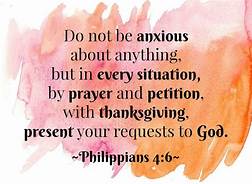
Here is camaraderie, teamwork, and togetherness at work. And, the togetherness, the sense of interconnectedness and belonging of the Christian life is what Paul recommends to us in verses 2 and 3. All of Paul’s commands dovetail into his urging to pray—with gratitude and thanksgiving. “Do not be anxious about anything, but in every situation, by prayer and petition, with thanksgiving, present your requests to God.”   

All too often, our prayers are just a ‘shopping list’ we bring to God, without thanksgiving and seasoned with anxiety and fear. We are urged to be grateful, to count our blessings.

            I encourage all of us – and I am preaching to myself as much as to anyone else – to strive to make it a habit. A way of living, to be thankful and grateful. Not just for this week, for Thanksgiving, but for the rest of the year, too. For always. Let us encourage each other to tap into this praiseworthy sense of interconnectedness and belonging! And celebrate the community that we are and the community that we are becoming!

Be like Paul. Don’t be filled with worry, but instead, be filled with gratitude and thanksgiving! Not just on Thanksgiving, but every day!

@chaplaineliza

(Suggestion: visit me at my other blogs: matterofprayer: A Year of Everyday Prayers. #PursuePEACE – and  A Year of Being Kind . Thanks!

(I would like to express my great appreciation for the observations and commentary from the web page www,umcdiscipleship.org for their brief series on gratitude. I used several quotes and ideas from their useful resources. Thanks so much!)


[1] http://worshipingwithchildren.blogspot.com/2013/09/year-c-thanksgiving-day-october-14-2013.html

[2] https://www.umcdiscipleship.org/worship-planning/our-hymn-of-grateful-praise/twenty-fifth-sunday-after-pentecost-year-a-lectionary-planning-notes

[3] Hooker, Morna D., The New Interpreter’s Bible Commentary (Vol. 12,The Letter to the Philippians), (Nashville, TN: Abingdon Press, 2000), 547-48.

Unknown's avatar

Attitude of Gratitude!

“Attitude of Gratitude!”

Psalm 100 – November 12, 2023

            Gratitude! Be grateful! Have an attitude of gratitude! But, how on earth do we do that? Great question!

With November, all of us here in the United States enter a time of thanksgiving, a season of gratitude. We can think of the Thanksgiving story, that thankful meal shared several centuries ago in New England. This was a means of showing gratitude for the harvest gathered in, and for the blessings of the bounty of nature God bestows upon those who farm the land.

I’ve lived in the Chicago area all my life. I’ve never lived in a small town, or a farming community, or had anything to do with gathering in crops. The most I’ve ever done is go to an apple orchard in the fall to pick apples – and that was just twice in my life. I know that whole communities rely on the harvest! Except – I have never been a direct part of that process.   

            What we all share, both city folks and country folks, is gratitude. Yes, we all can be thankful and grateful. Yes, we all can lift our hearts to the Holy One to say “thank you” for the bounty of nature, and we can come to God in praise for the interconnectedness of life.  

Autumn is, indeed, a thankful time of the year. But, how can each of us generate an attitude of gratitude? What does a life of gratitude look like? Or perhaps more importantly, what does a life of gratitude feel like?

            I want us to focus on our Scripture reading for today, and take special note of verse 4: “Enter God’s gates with thanksgiving and his courts with praise; give thanks to him and praise his name.” Psalm 100 is a praise psalm or song, the last in a small collection of special psalms of praise and worship. Do these verses get you in the mood of worship? Of praise? Could we see ourselves marching to our particular house of worship looking forward to meeting with God? To serve and praise and bless and be thankful to God? That is exactly what this Psalm is encouraging—no, even more strongly—is commanding us to do.

            The ancient superscription – or introduction – to this psalm simply says “a psalm of thanksgiving.” “On the one hand, there is the idea that thankfulness covers all of life; it is our way of approaching the world and the attitudes with which we choose to live. On the other hand, there is a clear indication that we are making a commitment to God in our choice to live a grateful life.” [1]

A number of verbs, or action words in this short psalm, are clear commands. In the first three verses, “Raise a shout!” “Serve!” “Come!” and “Know!” Verse four has “Enter!” “Be thankful!” and “Bless!” All of these verbs—and they are many of the chief action words in this Psalm—are instantly recognizable as an imperative, a command to anyone who spoke Hebrew!

This grateful commitment to God is quite serious if we follow these commands found in this psalm of praise. The grateful, thankful life shown to each of us in this short psalm is more than just a possibility. It becomes a blessed reality, if we follow through on the commands and promises highlighted by these few verses!

            We look to verse 4 again. We are commanded to “Enter the gates with thanksgiving!” “But what does that mean? Do we come to church with grateful hearts? Well, of course, we do. But more than that, we pass through every door with gratitude in our minds and hearts.” [2] Except, it’s more than that. Yes, we enter every door with thanksgiving and gratitude! And – plus – moreover – we can take the opportunity to incorporate this gratitude into each interaction we have throughout our day. When we enter our homes, we can be grateful for the family of which we are a part. When we go out and about, into the neighborhood or the community, we can be grateful for the abundance we all take for granted far too often. [3]

            And, what about those we encounter in our daily lives? Perhaps we haven’t even thought that far. Could it be that God would be pleased if we are grateful for each person we meet? Each one is a precious child of God, too – even the ones we sometimes struggle to get along with. Perhaps that attitude of gratitude is helpful for bridging the gap, for helping each of us be thankful for every interaction we have, every single day.

            I was so amazed to read about a senior’s daily practice in the preaching notes for this Sunday’s Scripture reading. Listen to this description: “Every morning, Amy Kawahara, ninety-four years old, opens her eyes and thanks God for another day to live. She knows she belongs to God. She reads devotion, prays, and seeks ways to share joy. She sings in the choir to make a joyful noise to the Lord. She leads a prayer group and senior exercise ministry. In every way, she worships the Lord with gladness.” [4]

            Isn’t the attitude of this senior Amy Kawahara a model attitude of gratitude to God?

            What are you thankful for, at this thankful time of year? What is each of us grateful for? There is something behind all this gratitude and thankfulness! We belong! We not only belong to God, but we belong to our church, to our fellowship of believers. “We are a part of something that is infinitely bigger than we can see. Of course, gratitude is the only proper response.” [5]

            This psalm ends with a powerful description: we have a the good God who loves each of us – all of us! Praise-filled, and thankful! May we all come into God’s loving, faithful presence with a joyful noise, giving thanks from the bottom of our hearts. Let us have an attitude of gratitude every day of the year, not only on Thanksgiving Day.    Alleluia, amen.

@chaplaineliza

(Suggestion: visit me at my other blogs: matterofprayer: A Year of Everyday Prayers. #PursuePEACE – and  A Year of Being Kind . Thanks!

(I would like to express my great appreciation for the observations and commentary from the web page www,umcdiscipleship.org for their brief series on gratitude. I used a number of quotes and ideas from their useful resources. Thanks so much!)


[1] https://www.umcdiscipleship.org/worship-planning/our-hymn-of-grateful-praise/twenty-fourth-sunday-after-pentecost-year-a-lectionary-planning-notes/twenty-fourth-sunday-after-pentecost-year-a-preaching-notes

[2] Ibid. 

[3] Ibid.

[4] https://www.umcdiscipleship.org/worship-planning/our-hymn-of-grateful-praise/twenty-fourth-sunday-after-pentecost-year-a-lectionary-planning-notes/twenty-fourth-sunday-after-pentecost-year-a-small-groups

[5] https://www.umcdiscipleship.org/worship-planning/our-hymn-of-grateful-praise/twenty-fourth-sunday-after-pentecost-year-a-lectionary-planning-notes/twenty-fourth-sunday-after-pentecost-year-a-preaching-notes

Unknown's avatar

Wipe Away Every Tear

“Wipe Away Every Tear”

Revelation 7:9-17 (7:17) – November 5, 2023

            Memory is a precious thing. People remember lots of things: birthdays of loved ones, victories of sports teams, anniversaries of weddings or graduations or even the dates of those who have died. Many, many people remember Pearl Harbor, or the day John F. Kennedy was shot, or that terrible day of September 11, 2001.

            Our Scripture reading today comes from the book of Revelation, the last book of the Bible. Revelation has much that is foreshadowing, and much that is cloudy. This book also has passages that are incredibly scary and sad, and some that are hope-filled and even absolutely awe-inspiring.

            This reading today is certainly a joy-filled reading that gives hope and promise to even the saddest and most despondent follower of Christ. The Revelation was written late in the 1st century by the elderly apostle John, in exile. He wanted to give some comfort and encouragement to his fellow believers, it is true! This reading today does exactly that – in the midst of great sadness and tribulation.

            Let us pause, and think about this day. This is a special Sunday, when we remember. That is why I want us to think hard about memory and remembering today, of all days. All Saints Sunday is the day when we not only remember those our church has lost in this past year, but all of our loved ones who are no longer here on this side of the River Jordan. We also remember that great cloud of witnesses, all the saints who are in the presence of the Lord.

In the many-part vision that John saw, he wrote this: “After this I looked, and there before me was a great multitude that no one could count, from every nation, tribe, people and language, standing before the throne and before the Lamb.”

            Many churches practice the tradition of honoring the members of congregations and families who have died during the past year on All Saints Sunday, each year. Many churches also remember all of their loved ones who have passed on throughout many years, that great cloud of witnesses, and truly have a corporate memorial time in the service.

            As the United Methodist minister Rev. Dr. Derek Weber says, “This observance is worth taking the time in worship to give thanks and honor the saints of the church. The founder of the Methodist movement, John Wesley, loved All Saints Day. So, we suggest you take this day and let it stand alone as a celebration of the church that was, the church that is, and the church that will be.[1] In all its diversity, with different looks, languages, cultures, and customs.

            I know from my end-of-life work with families and their loved ones in the hospital, in skilled nursing facilities, and in homes throughout Chicago, that many people grieve even before their loved one has died. So many factors, so many features of life slip away while we are journeying with loved ones. We see a stopping of familiar activities, decrease in mobility, downsized living space, and any one of many other poignant, heart-tugging losses. The person or the family can grieve each loss as it comes, and sometimes several at once.

            At the same time, there can be quiet contentment, sharpening awareness, or gentle expectation wrapped up in this journey alongside, on the prayerful way through aging or end-of-life. You and I can see our families, our loved ones who have passed on as part of this heavenly congregation that the apostle John talks about in Revelation.

            “Yes, there is grief in the recognition of death, but there is also joy in the promise of eternity and the gratitude for the legacy that remains. On this day, we proclaim that we are who we are because of those who have gone before. But we also give thanks for the saints who are still with us.” [2] Today, All Saints Sunday, is not only a memorial time for those in the great cloud of witnesses surrounding us here, but also a celebration of the life and ministry of the church today, here and now. As the apostle Paul tells us, we are all saints! Each one of us is, for real.

            As we reflect on this Scripture reading set in the heavens, the apostle John tells us “he who sits on the throne will shelter [the saints] with his presence. 16 ‘Never again will they hunger; never again will they thirst.” Yes, we might see the “saints” as those dressed in white, in the heavens, gathered into the church triumphant. But since you and I are also called saints, couldn’t we also be considered present, before the Lamb who sits on the throne?

            To all of those who are struggling to find hope or healing, or to find the strength to continue being a caregiver, or to go to that difficult job for one more day: Jesus Christ’s promise to “wipe away every tear” is a word that all of us may appreciate hearing, today! [3]
            I encourage each of us to reflect on an everyday saint, someone you know or who you remember as being an everyday person, yet a special child of God. How was that person special? What did they do or say that makes you think of them as a saint? Today is not only a memorial and remembrance, but also a celebration. What is your favorite memory of that everyday saint? How can you best honor that person?  I encourage all of us to think of those everyday saints, our loved ones, family or friends. Think of how we can honor them best, and then do that.

Remember, the apostle John “is describing a vision: there are countless people from all over the world with different looks, languages, cultures, and customs. And they’re all worshiping God! These are the ones who have gone home to God.” [4]  We know that God was with those saints, every step of the way, just as God is with us – and we are God’s saints, too.  

@chaplaineliza

(Suggestion: visit me at my other blogs: matterofprayer: A Year of Everyday Prayers. #PursuePEACE – and  A Year of Being Kind . Thanks!


[1] https://www.umcdiscipleship.org/worship-planning/from-every-tribe/all-saints-sunday-year-a-lectionary-planning-notes

[2] Ibid.

[3] https://www.davidlose.net/2014/10/all-saints-a/

[4] https://www.umcdiscipleship.org/worship-planning/from-every-tribe/all-saints-sunday-year-a-lectionary-planning-notes/all-saints-sunday-year-a-youth-lessons